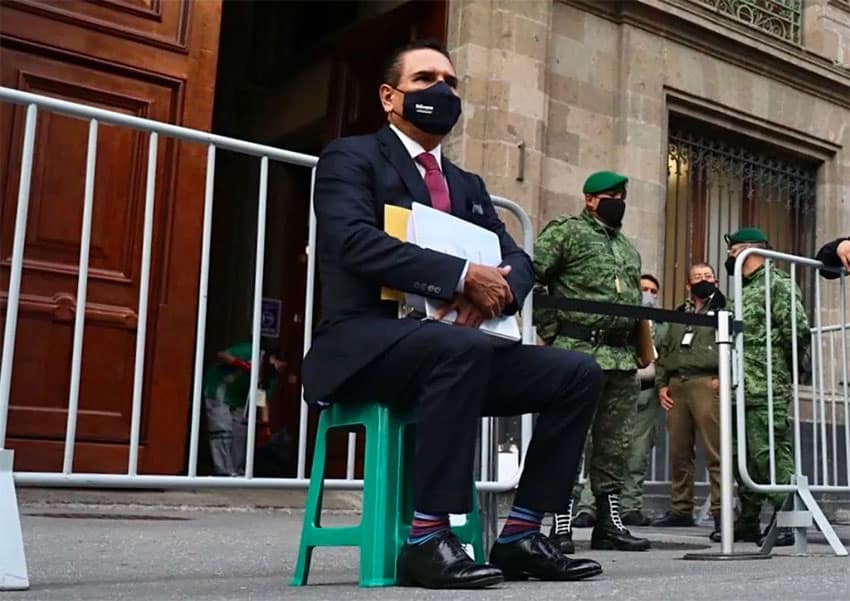
Silvano Aureoles, outgoing governor of the violence-plagued Mexican state of Michoacán, sat on a plastic stool outside the National Palace for hours last month, waiting in vain for an audience with the president.
In his hand, he held a pile of documents he wanted to hand to Andrés Manuel López Obrador that he said supported his claim of links between the president’s Morena party and organized crime. Those ties, he said, were putting Mexico on course to become “a narcostate.”
Critics dismissed the spectacle as a political stunt by a politician whose leftist Democratic Revolution Party lost the western state in June 6 midterm elections. By contrast, Morena won 11 of 15 state elections, taking control of virtually the entire Pacific coast, which includes drug cartel bastions.
Some media commentators and opposition politicians seized on Morena’s Pacific victories, saying they suggested the ruling party had struck a deal with organized crime groups to win power in an election tainted by violence amid rising concerns about the government’s ability to deliver on promises to curb violent crime.
Experts said it was ludicrous to imagine the bosses of the Sinaloa Cartel or Jalisco New Generation Cartel, or CJNG, Mexico’s most powerful crime syndicates, ordering people to vote for Morena down the entire Pacific coast.
But they stressed that does not mean organized criminal groups were absent from the election, in which bargains are traditionally struck between powerful local crime, business and political bosses.
“The tide [among organized crime groups] has shifted in favour of Morena,” said Falko Ernst, a senior analyst at the International Crisis Group, a think tank focused on armed conflict, citing criminal groups in the violent Tierra Caliente area in Michoacán.

“They see them as a better bet for power because popular opinion is still on the side of Morena so for some, Morena is a more pertinent vehicle [to support] … but that doesn’t mean collusion.”
Aureoles was not convinced. “What a coincidence that they won big in … the Pacific corridor. Who let them?” he told the Financial Times a few days after his sit-in.
“It’s terribly dangerous that Morena is becoming a narco party and the president is looking the other way when the most important issue for people is security … Morena has become the instrument of organized crime,” he said.
López Obrador denies such allegations. He refused to meet Aureoles and said the governor should take his claims to the relevant judicial authorities. Aureoles has faced similar charges of links with crime groups, which he denies.
A recent U.S. estimate, which the Mexican president has rejected, suggested that 30-35% of Mexico is controlled by organized crime groups.
There are frequent reminders of the cartels’ continued power. Presumed CJNG members recently paraded their military firepower in Aguililla, a town in Michoacán that has become a major flashpoint.
Other brutal attacks have included one in the northern state of Tamaulipas last month in which 19 people died after gunmen apparently opened fire at random on civilians, turning up the heat on López Obrador’s strategy as the government struggles to make a dent in record homicide levels.
There were 14,243 homicides in the first five months of this year, virtually unchanged from 14,673 in the same period in 2020. Last year was the second-deadliest on record, with 34,554 murders compared with 34,681 in 2019.
The president says he will not back down on his “hugs not bullets” approach — an attempt to help vulnerable young people study and work in order to avoid joining cartels.
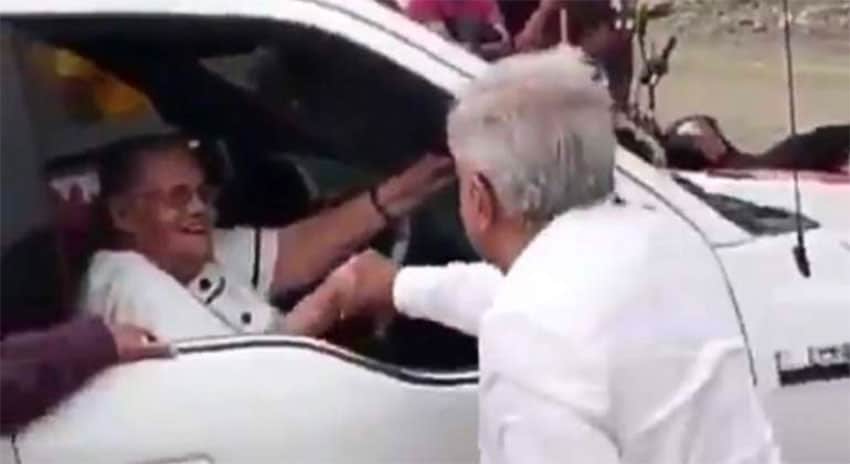
Some of López Obrador’s actions have fueled criticism of a laissez-faire approach to cartels. He released the son of jailed Sinaloa Cartel boss Joaquín “El Chapo” Guzmán; met and shook the hand of Guzmán’s mother; and publicly apologized for using the drug lord’s nickname. The day after the election, he said organized crime groups had “behaved well.”
“Every president tries to negotiate with the narcos … In politics, you’ve got to deal with these people,” said Benjamin Smith, a professor at the U.K.’s Warwick University in Coventry, who has recently published a history of the Mexican drug trade.
Romain Le Cour Grandmaison, co-ordinator of the Mexico and Central America program at Noria Research, a non-profit, said it was “a stretch” to say Morena was in cahoots with criminal groups “because this goes way beyond Morena,” and alliances were constantly shifting.
“If you want to stay in power, or win power, you have to talk to the local strongman — that could be a narco boss, a businessman or the mayor … You have to make deals to win elections, sometimes with the narco, and violence is at the center of the game,” he added.
Successfully dealing with that has, however, so far eluded López Obrador.
“AMLO to his credit recognizes he has got to change course” from hardline past approaches to organized crime, said Stephanie Brewer, Mexico director at the Washington Office on Latin America, using the president’s nickname.
“But where the Mexican federal government does seem to be giving up is on the strategies — building capable, civilian police forces and strengthening criminal investigations. If criminal groups can continue to operate with impunity, that will continue to be a huge driver of violence.”
Ernst of the ICG was less hopeful: “There seems to be an acceptance that this is a non-solvable problem for now.”
© 2021 The Financial Times Ltd. All rights reserved. Please do not copy and paste FT articles and redistribute by email or post to the web.