The Cornish pasty, introduced to Mexico in the 19th century by British miners, has helped a 19-year-old university student from Pachuca, Hidalgo, take another step toward achieving his goal of a career in the space industry.
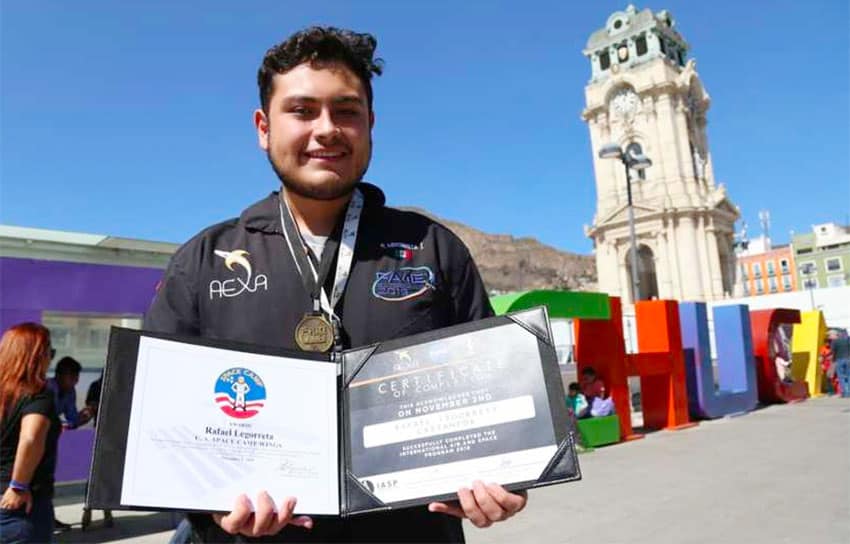
Rafael Legorreta Castañeda, an aeronautical engineering student at the Metropolitan Polytechnic University of Hidalgo (UPMH), sold the snack on campus to raise funds to attend NASA’s International Air and Space Program (IASP) in Huntsville, Alabama, from October 27 to November 2.
In an interview with the newspaper Milenio, Legorreta, or “El Chico Paste” (Pasty Boy) – as he came to be known at his university – said that attending the program at the U.S. Space and Rocket Center was a dream come true.
“When we’re little, everyone’s dream is to be an astronaut and to get to know the National Aeronautics and Space Administration . . . [NASA astronauts] were the first to travel to the moon, so when I was told that I had the opportunity to participate in this program, I was very excited,” he said.
“Six months ago, the call-out to participate was published and the director of my degree program told me to enter so I did and I met the necessary requirements although I needed to cover the costs. That was difficult because I spent about US $4,500 but with the help of my parents and by selling pasties at university . . . I raised the funds to achieve this dream,” Legorreta said.
His attendance at the IASP couldn’t have been more successful: Legorreta, along with another UPMH student, Andrés Romero Badillo, won the program’s first prize for a project they created.
“We won . . . with a strontium hexaferrite project, it’s a highly magnetic material . . . and the purpose we gave to it was that, combined with paint, it can be a UV radiation insulator as well as a treatment against cancer, among other uses. The prize was that our material will go to space for nine months from Cape Canaveral in May 2020; then they’ll return it to us to continue with the research,” he said.

“Beyond the first place that we won, I feel proud to have achieved my goal [of attending the IASP] and to have represented my country, my state, my city Pachuca and my university, in a dignified way,” Legorreta said.
During the six-day program in Alabama, the UPMH student attended conferences and classes at which he learned about topics such as rocket design and the languages used at the International Space Station. Legorreta also had the opportunity to experience life as an astronaut in a space simulator.
“. . . It was really cool, a great experience,” he said, before offering some inspirational words to other young people.
“Sometimes we don’t have the money necessary to achieve our goals but that shouldn’t limit us or stop us from achieving them . . . Fight for what you think is impossible . . .”
Source: Milenio (sp)