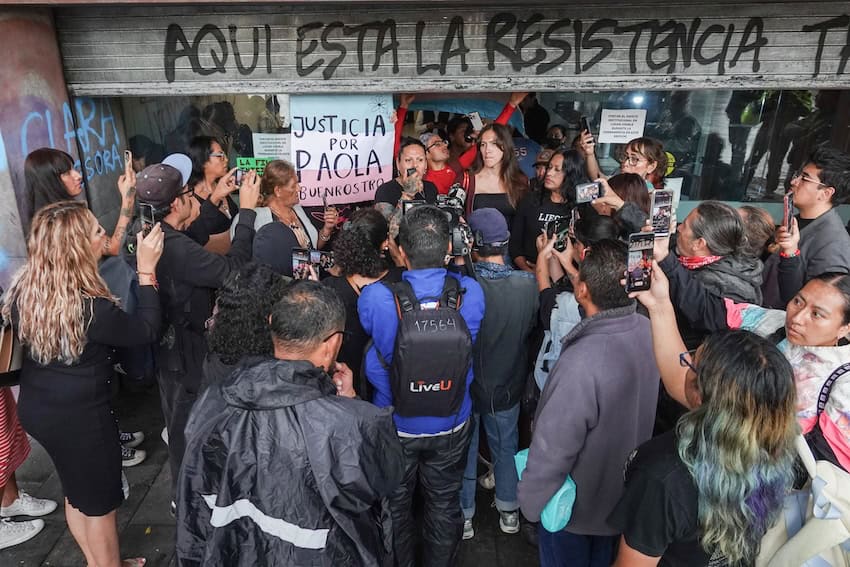
A man accused of murdering a transsexual sex worker in Mexico City almost 10 years ago was arrested in México state on Monday, authorities said.
The case of Paola Buenrostro — who was shot dead in an inner-city Mexico City neighborhood on Sept. 30, 2016 — was the first to be recognized as a transfemicide by the Mexico City Human Rights Commission.

In 2024, the Mexico City Congress passed a law, known as the “Paola Buenrostro Law,” that made transfemicide a crime with a prison sentence of up to 70 years. Buenrostro’s case thus became even more emblematic for members of the trans community in Mexico, many of whom are victims of crimes themselves.
Arturo Felipe Delgadillo Olvera, the man accused of killing Buenrostro after picking her up on a Mexico City avenue known for sex work, was detained in the México state municipality of Nicolás Romero on Monday, the Mexico City Attorney General’s Office (Fiscalía CDMX) said in a statement.
Fiscalía CDMX said that Delgadillo (referred to as Arturo “N” in the statement) was arrested for “his probable involvement in the transfemicide of Paola Buenrostro.”
“According to the investigation, in the early morning hours of September 30, 2016, Paola got into Arturo ‘N’s’ vehicle after he hired her services. Moments later, she called out for help to her colleagues, and immediately after, two gunshots were heard. Her colleagues approached the car, where they found Paola unconscious in the passenger seat and the accused holding a firearm. Paola died as a result of her gunshot wounds,” Fiscalía CDMX said.
Delgadillo was detained the day he allegedly murdered Buenrostro, but was later released due to the arresting officers’ failure to present sufficient evidence against him. He evaded recapture for almost a decade.

Fiscalía CDMX noted that in 2023, it offered a reward of up to 500,000 pesos (US $29,400) for information leading to Delgadillo’s arrest. In efforts to locate the suspect, Mexico City investigative police pursued various lines of inquiry, carried out field work in the capital and in México state and requested “collaboration” with the Baja California Attorney General’s Office, Fiscalía CDMX said.
“These actions made it possible to rule several locations out and to focus the search on the El Tráfico neighborhood in the municipality of Nicolás Romero, … where agents located and apprehended Arturo ‘N,'” the Attorney General’s Office said.
Mexico City Attorney General Bertha Alcalde Luján said on Monday that, “with this arrest, we take a decisive step toward taking Paola’s case to court.”
“We acknowledge the struggle of her family and the trans community, who kept the demand for justice alive,” she said.
“At the Mexico City Attorney General’s Office, we will handle this case with rigor and a gender perspective,” Alcalde said.
Delgadillo accused of homicide, not femicide, in initial court hearing
In a separate statement on Tuesday, Fiscalía CDMX noted that a warrant issued in 2016 for the arrest of Delgadillo was for the crime of homicide rather than femicide. For that reason, the suspect’s first hearing on Tuesday was for homicide, Fiscalía CDMX said.
The Attorney General’s Office noted that “victims and activists” have requested that the murder of Buenrostro be reclassified as femicide. It said that a reclassification in “later stages” of the criminal process remained possible.
Fiscalía CMDX said that in 2016, the grounds for proving femicide were “more restrictive,” while the crime of transfemicide “didn’t yet exist.”
However, it said that “the identity of Paola Buenrostro as a trans woman” is now “fully recognized.”
Witness slams prosecutors
After Tuesday’s initial hearing, trans activists including Kenya Cuevas — a trans woman who was with Buenrostro just before she was allegedly murdered and saw her lifeless friend in Delgadillo’s vehicle — complained that Buenrostro was identified as a man by prosecutors in court.
“They showed up before a judge saying my male name the whole time, the name I had before my change of identity,” Cuevas told reporters.
She said that prosecutors also used Buenrostro’s previous “male name” and the previous male names of other “witnesses” — i.e., other transsexual sex workers who were with Buenrostro on the night she was murdered.
Cuevas said that she and other trans activists weren’t seeking the reclassification of the murder of Buenrostro as “transfemicide,” but they do, “at least,” want the crime to be reclassified as femicide given that that offense “already existed” in the Mexico City criminal code at the time.
According to a report by the EFE news agency, the complaint about prosecutors’ use of previous male names of Buenrostro and other transsexual sex workers “escalated into a protest” at the headquarters of the Mexico City Attorney General’s Office, where activists “denounced institutional transphobia and demanded the reclassification of the crime.”
In its statement on Tuesday, Fiscalía CDMX said that it would “provide the necessary evidence to request that the judge consider reclassifying the crime.”
It also said that it “fully recognizes the right of victims, and the activists who stand with them, to protest and demand justice.”
“We understand the pain and anger that have built up over nearly a decade, and we reiterate our willingness to keep channels of dialogue and support open, even when there are differences regarding the legal aspects of the process,” Fiscalía CDMX said.
“At the same time, the Mexico City Attorney General’s Office is clear: no protest, however legitimate, can justify attacks against public servants or damage to the institution’s facilities,” Fiscalía CDMX said.
“Regarding the allegations about the treatment received during the hearing, the Mexico City Attorney General’s Office takes them seriously. Any error in the manner of addressing the victims does not meet the standards of care that the institution requires of its personnel. However, this does not imply that there is any institutional practice, directive, or intent of a transphobic nature.”
With reports from El Financiero, Animal Político and EFE