
The federal government and the private sector have still not reached agreement on controversial outsourcing legislation after three meetings.
President López Obrador sent a proposal to Congress last month to ban subcontracting or outsourcing of jobs by private companies without prior government authorization.
He said the practice has been used for tax evasion purposes and to avoid paying workers the benefits to which they were entitled.
But the business sector says that the proposal presented by the president discourages job creation and threatens economic growth. The Business Coordinating Council (CCE), an umbrella organization representing 12 business groups, said last month that it was both surprised and concerned about the initiative, and that the government had violated a commitment to consult the private sector.
Government officials including López Obrador have now met with business representatives three times to discuss the proposal, including an almost three-hour-long meeting Thursday night. But they have still not ironed out their differences.
After leaving the National Palace meeting on Thursday, CCE president Carlos Salazar told reporters that while agreement remained elusive progress had been made.
“We’re advancing, the issue is obviously complex and it’s taking more time than we would have liked,” he said.

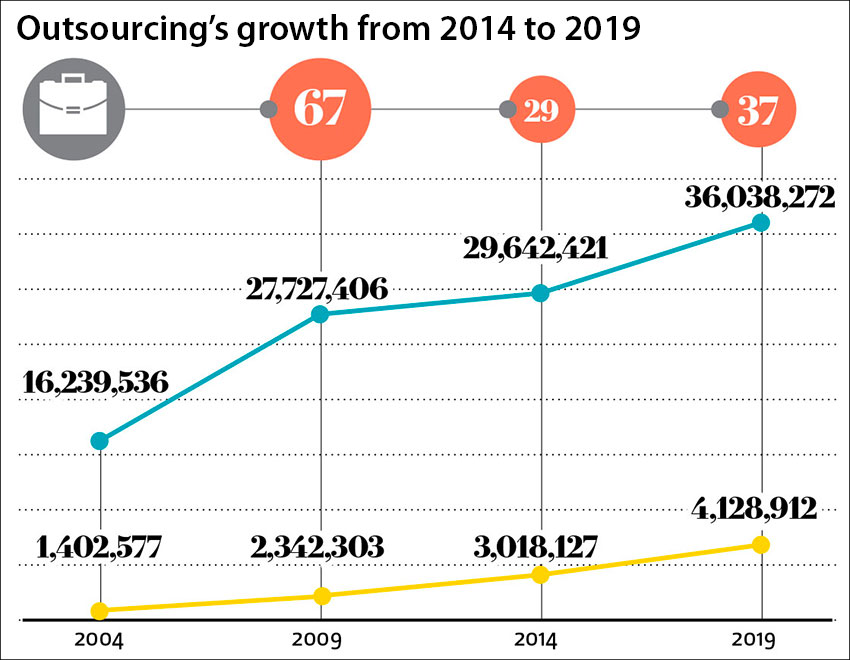
Salazar said that the complexity stemmed from the fact that the government’s proposal would overhaul the labor market in which some 4.1 million workers – 11.5% of the formal sector workforce – were subcontractors or hired as outsourced labor in 2019.
The CCE chief said that business leaders will meet again with the president and other officials next Wednesday.
“The way in which the dialogue has been carried out has been very positive. The understanding of our concerns has been very good,” Salazar said.
However, the business leader used curt language earlier on Thursday to describe what he believes the government is trying to do with the proposed outsourcing ban, telling a press conference that it is aiming to dismantle an entire hiring system just because parts of it have been misused by a small number of companies.
“To remove a rotten apple” the authorities are trying to fell the entire tree, Salazar said. “Don’t fuck around.”
Francisco Cervantes, president of the Confederation of Industrial Chambers, said after Thursday night’s meeting that the private sector and the government were continuing to negotiate over when the proposed outsourcing legislation would take effect.
“We’re asking for six months [to prepare] … so that everything’s ready and productivity isn’t lost,” he said.
Among the government officials in attendance at Thursday’s meeting were Labor Minister Luisa María Alcalde, Economy Minister Graciela Márquez and Mexican Social Security Institute Director Zoé Robledo.
Once the two parties reach an agreement, lawmakers will have the opportunity to make amendments to the proposal before it faces a vote in Congress.
Source: Milenio (sp)