Talks have resumed in Washington today after Mexican officials failed to reach an agreement to stave off tariffs that United States President Donald Trump has threatened to impose on all Mexican goods.
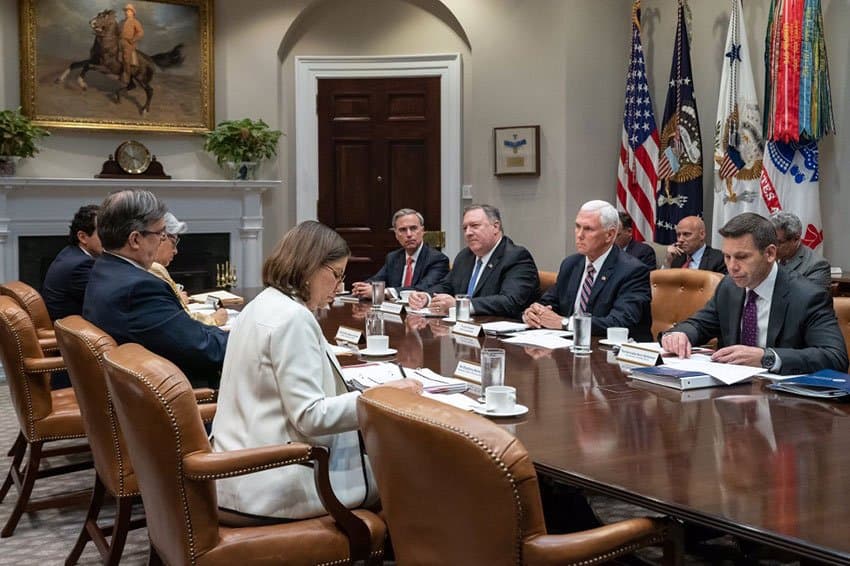
Foreign Secretary Marcelo Ebrard led a delegation that met with U.S. Vice President Mike Pence, Secretary of State Mike Pompeo and acting Homeland Security Secretary Kevin McAleenan at the White House yesterday afternoon.
Tweeting from Ireland, Trump said that “progress is being made but not nearly enough,” adding that “border arrests for May are at 133,000 because of Mexico and the Democrats in Congress refusing to budge on immigration reform.”
He said that if no agreement is reached, “tariffs at the 5% level will begin on Monday, with monthly increases as per schedule.”
The U.S. president announced last week that the blanket tariffs will increase monthly by an additional 5% to a maximum of 25% if Mexico doesn’t take “action to dramatically reduce or eliminate the number of illegal aliens crossing its territory into the United States.”
Trump tweeted yesterday that “the higher the tariffs go, the higher the number of companies that will move back to the USA!”
Earlier Wednesday, he told reporters that he believed Mexico wanted to reach an agreement.

“I think they want to make a deal and they sent their top people to try to do it,” Trump said.
After the White House meeting, Ebrard told a press conference that discussions focused on migration rather than the impending tariffs, adding that he didn’t know how long the negotiations will take.
“We are optimistic because we had a good meeting with respectful positions from both parts,” the foreign secretary said. “We had an opportunity to explain our point of view.”
Ebrard said that while the United States is seeking to implement measures “immediately,” Mexico wants to take longer term steps to stem migration.
The White House has been vague about exactly what measures it wants Mexico to take but trade adviser Peter Navarro yesterday outlined three demands.
He told CNN that Mexico “could commit to taking all the asylum seekers and then applying Mexican laws, which are much stronger than ours.”
If migrants know that will be unable to enter the United States and have to remain in Mexico, migration flows will reduce to a “trickle,” Navarro said.
The official added that there needs to be a “strong commitment from the Mexican government” to better protect its border with Guatemala and that corruption at immigration checkpoints that allow migrants to continue their journey towards the United States border must stop.
“It’s the mordida, the bite, the corruption, the government officials who make money off this human trafficking, that has to stop . . .” Navarro said.
Arrests of undocumented migrants in the United States have risen significantly in recent months.
In May, more than 144,000 were arrested after illegally crossing the border or at ports of entry, according to statistics released yesterday by U.S. Customs and Border Protection (CBP).
It was the highest monthly figure in 13 years, CBP said, and a 32% increase compared to April.
In a Twitter post Sunday, Trump said that Mexico “could solve the border crisis in one day if they so desired” but there is skepticism on both sides of the border that all immigration into the United States via its southern border can be completely stopped.
“It shows a basic misunderstanding about the patterns of migration,” immigration expert Kevin Appleby told the New York Times.
“The Mexican government could take some steps. But there are going to be ways that migrants get to our border regardless of what the Mexicans do.”
The looming threat of universal tariffs on Mexican exports to the United States has already taken a toll on stocks, oil, the peso and economic growth forecasts and ratings agency Fitch yesterday downgraded Mexico’s sovereign rating to one notch above junk status.
There is also speculation that ratification of the new North American trade deal could be placed at risk.
Despite Ebrard’s optimism that a deal to stop the tariffs can be reached, the Mexican government is preparing a list of U.S. products to hit with retaliatory tariffs, officials told Reuters yesterday.
President López Obrador – who is pushing for investment in development projects in Central America to stem migration – said today that he will announce any retaliatory measures at an event in Tijuana Saturday that will celebrate the positive relationship between Mexico and the United States.