Evaluating teachers is not a priority for the federal government, President López Obrador said today as debate over the new education reform continues.
The president pledged that the government will strengthen Mexico’s public teacher training colleges and therefore evaluation won’t be vital, although the government doesn’t intend to do away with it completely.
“. . . Evaluation isn’t essential for us because if the teacher training colleges are strengthened, teachers are going to leave well-prepared to carry out their educational work . . .” López Obrador said.
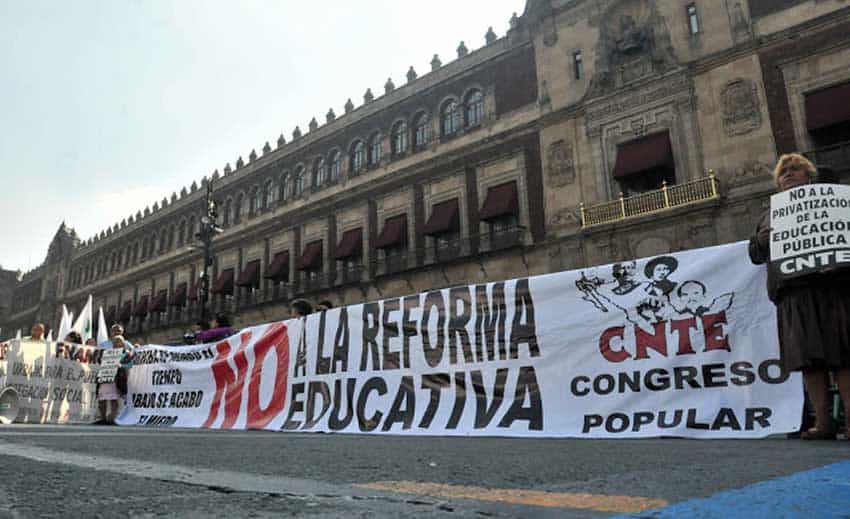
Compulsory evaluations introduced by the previous federal government as part of its 2013 education reform were condemned by the CNTE teachers’ union, which has held countless protests to demonstrate its opposition.
Education Secretary Esteban Moctezuma reiterated today that teacher evaluation as provided for in new legislation will not be used punitively to determine whether a teacher keeps his or her job as was the case under the administration led by former president Enrique Peña Nieto.
The CNTE union nevertheless remains unhappy with the composition of the new education reform and has continued to place pressure on the federal government to change it by blocking access to the lower house of Congress this week.
The blockade was lifted early this morning but union members warned that they would return next week if their demands are not met.

CNTE member Gonzalo Martínez Villagrán told a press conference yesterday that the union wants the complete abrogation of the 2013 education reform, freedom for political prisoners and immediate reinstatement of teachers who were dismissed after failing evaluations.
In the new education legislation prepared by the government, around 80% of the education laws introduced by the Peña Nieto government remain.
Opposition lawmakers said yesterday that they will withdraw their support for the new education reform if López Obrador and the government give in to the demands of the CNTE.
“. . . We will not accept moving backwards just to please a small group that is seeking to pressure and blackmail [the government] in search of privileges,” said René Juárez, leader of the Institutional Revolutionary Party (PRI) in the lower house of Congress.
“The president should talk to the discontented teachers to reach positive agreements, not to give them everything they ask for,” he added.
Democratic Revolutionary Party (PRD) lower house leader Verónica Juárez Piña said “the agreement will be at risk if they make changes to what has already been approved without consulting and without the consensus of all parties.”
Juan Carlos Romero Hicks of the National Action Party (PAN) said “if there are changes in central issues, like evaluation and the control of [teaching] positions, we obviously won’t support the reform.”
The coalition led by López Obrador’s Morena party has a majority in both houses of Congress.
However, as the 2013 education reform required changes to the constitution, the president needs the support of two-thirds of Congress in order to repeal it and pass his government’s plan.
Most of the union opposition to the education reforms comes from the state of Oaxaca, where most of its membership is based. The Section 22 local has a long history of often-violent protest and its quarrels with different governments over the years have been more about political differences than education.
Source: Reforma (sp), El Financiero (sp), Milenio (sp), El Universal (sp)