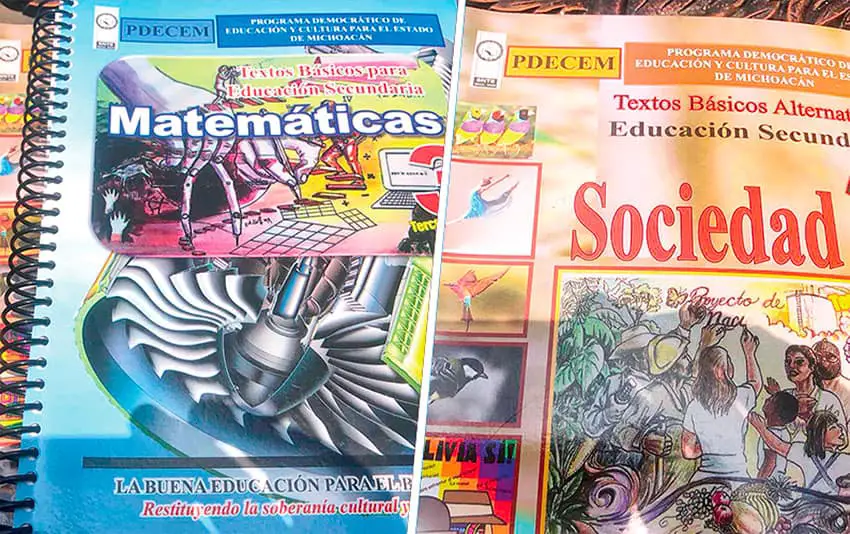
Critiques of the “neoliberal economic model” implemented in Mexico by past governments and biographies of former Cuban president Fidel Castro and revolutionary hero Che Guevara feature in “alternative” textbooks developed and distributed by the CNTE teachers’ union in Michoacán and Oaxaca.
Víctor Manuel Zavala Hurtado, leader of Section 18 of the CNTE, told reporters that the textbooks were designed to offer “complete” educational programs to students studying at preschools, primary schools and secondary schools.
But the ideological bent is clear.
In the preface to primary and secondary school textbooks distributed in Michoacán, the CNTE says that its education program is a response to the “neoliberal economic model, which seeks to put an end to public schools, denying the right to a free education.”
A sixth-grade social studies textbook asserts that former president Carlos Salinas de Gortari sacrificed Mexico’s sovereignty by implementing neoliberal economic policies, and that inequality in the country is the product of the same model.
A fourth-grade language skills textbook features lyrics of a popular revolutionary song that blames poverty on the greed and mistreatment of employers. Other revolutionary and anti-capitalist texts are found in textbooks designed for several different grades.
Horacio Erik Avilés, Michoacán head of the education advocacy organization Mexicanos Primero, said the textbooks are of “questionable academic quality” and reflect a curriculum that is distant from national and international trends.”

He told the newspaper El Financiero that the books’ content was not subjected to the scrutiny of academic experts and charged that their consequence would be the formulation of an “insular” and “isolationist” character in students who attend schools under CNTE control.
Avilés also claimed that the teachers’ union is aiming to raise revenue by asking for voluntary contributions from the parents of students who receive the books, many of which are photocopied rather than originals.
It’s not just the content of the books that is considered deficient. Newspaper reports pointed out that they are also littered with spelling and grammatical mistakes.
But the union’s Zavala said there were no plans to change the textbooks or discontinue the CNTE’s educational program.
“. . . We have more than 6,000 schools working with our program and we’re going to continue it. The goal of Section 18 is to spread the alternative program to all schools,” he said.
In Oaxaca, Section 22 of the CNTE said that official government-issued textbooks can still be used but it is “not a priority” to do so.
“. . .They’re auxiliary materials, Oaxaca has its own [educational] scheme . . .” the union local said.
Source: El Financiero (sp), El Universal (sp)