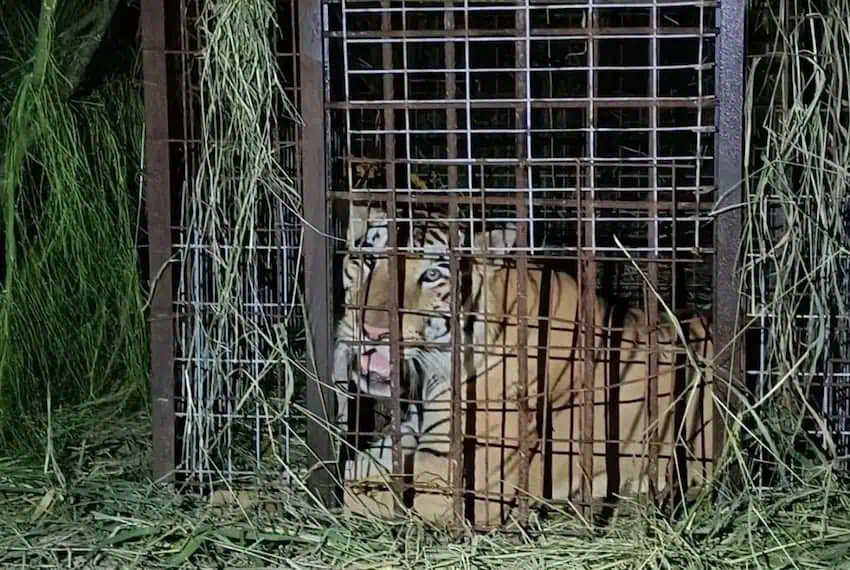
Five days after breaking out of his cage at a zoo in Reynosa, Tamaulipas — and causing high anxiety among the local population — a Bengal tiger has been captured safe and sound, state authorities reported Tuesday.
During his 135 hours on the lam, the tiger reportedly attacked a pig farm, causing injuries to several pigs, and was sighted chasing sheep — but otherwise caused no known damage.
📍#MientrasDormias | Después de una semana lograron capturar al tigre 🐅 que escapó de #quintalafauna en #Reynosa. pic.twitter.com/1j3ctcyxVg
— El Mañana de Reynosa (@elmananarey) September 10, 2024
He was captured Monday night around 11 p.m. in a trap cage baited with chicken that was set up by the state’s Wildlife Department.
Drones, helicopters and motion-detection cameras were also used in the search. On Saturday, the tiger’s footprints and excrement were found.

Officials didn’t provide the exact location of the capture, except to say it was in the vicinity of Los Longoria, a communal agricultural area (ejido) that abuts the United States-Mexico border. Quinta La Fauna, the private zoo from which he escaped, is in that area.
“Tony” — the tiger’s name according to newspaper accounts but no official sources — weighs about 100 kg and is approximately three years old, officials said. In the wild, Bengal tigers generally live 13-14 years, while in captivity they can live up to age 20.
His species (Panthera tigris) is classified as endangered, with an estimated 2,000 to 2,500 left in the wild as of last year, mainly in protected areas of India, Bangladesh, Bhutan and Nepal.
In a press release issued Tuesday, Mexico’s federal Environmental Protection Agency (Profepa) noted, “The Quinta La Fauna Zoo in Reynosa can no longer shelter the specimen that escaped from its facilities, so it will be transferred to the Tamatán Zoo in Ciudad Victoria, Tamaulipas.”
Tamatán “has the facilities and the appropriate personnel to safeguard this type of specimen,” Profepa added. At least initially, the tiger will be under observation and not displayed to the public.
Profepa and personnel from a variety of local, state and national agencies carried out the search to find the feline, aiming every step of the way to avoid risks to the public.
To that end, several trap cages were set up in and around the Los Longoria area of Reynosa, which is just 500 meters from the U.S.-Mexico border.
Additionally, officials in the United States were told to be on the lookout in case the tiger were to seek out the banks of the Rio Grande, which separates the two countries in that region.
Wild Bengal tigers typically live in tropical forests, swamps, grasslands and rocky areas. In addition to their distinctive orange and black-striped fur, they are known for their tremendous strength and agility as predators.
The Quinta La Fauna Zoo reported that its other tigers remained in their cage. Shortly after last week’s escape, the zoo posted on social media that it was closed “until further notice.” As of early Wednesday afternoon, it had not reopened.
With reports from Infobae, Milenio, El Sol de Tampico and El Universal