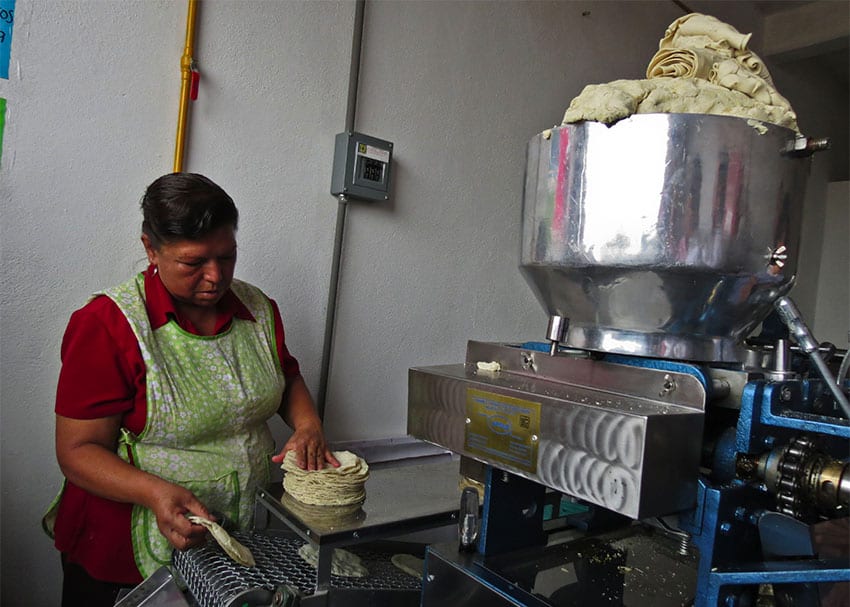
Mexico’s history of making tortillas goes back centuries but in the state of Querétaro today’s tortilla makers are producing the staple food in a thoroughly modern way — using solar power.
According to the Federation of Producers of Corn Flour and Tortillas, a trade association for tortilla shop owners and other related producers in the state, 40% of its 389 tortillerías are currently powered with solar panels, which are not only more environmentally friendly than conventional electricity but ultimately cheaper for the proprietors as well, says association president Arturo Campos Novoa.
The eventual goal, says Campos, is to get 100% of shop owners off the grid.
The initiative, which is financed in part by the organization and in part by the state government, allows tortilla shop owners to take out 40,000-peso, low-interest, no-collateral three-year loans to purchase and install the photovoltaic equipment.
As soon as a participating business gets the panels, it stops paying for conventional electricity. Meanwhile, the loan’s monthly payments end up costing about the same or less than owners are used to shelling out for monthly electric bills.
“Over three years, they have to pay [monthly] for the [solar panels], but after that, it will be a benefit to the business,” said Campos, explaining that after the loan term, the owners make more profit since they have fewer overhead costs.
He estimates that altogether, participants in the program are already saving 20,000 pesos bimonthly against projected electricity costs.

And what’s good for tortillerías is also good for Querétaro citizens, he added, since more profitability means that tortillerías can afford to keep their prices down, even when the cost of ingredients goes up.
The state’s price ceiling on tortillas, an amount regulated by the government, has stayed the same in Querétaro since 2018 at 18 pesos per kilo, and Campos predicts that it will remain the same into next year thanks in part to the program.
Sources: El Universal (sp), Diario de Querétaro (sp)