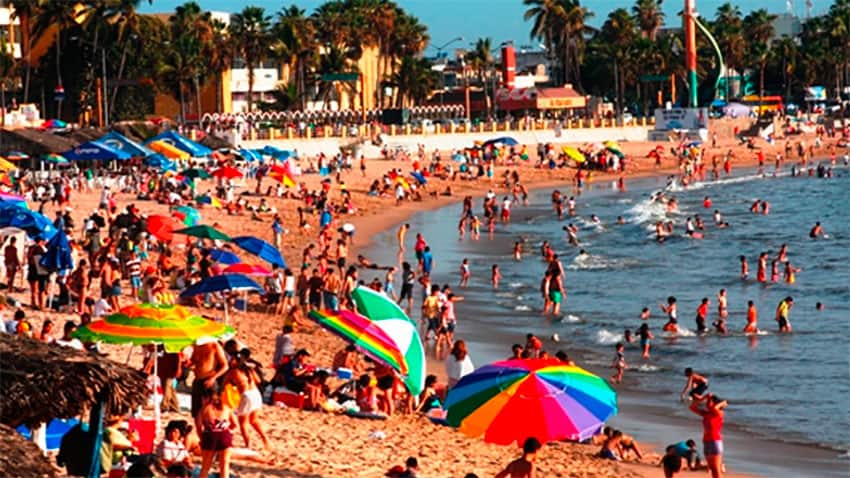
In 2019 Mexico was one of the top 10 most visited countries in the world, drawing some 44.7 million visitors to its beaches, cities and historical sites.
And although due to coronavirus 2020’s outlook looks decidedly grim, Miguel Torruco Marqués, head of Mexico’s Ministry of Tourism, is hoping he can revive this essential industry once the coronavirus epidemic has subsided.
It’s a somewhat daunting endeavor that will take time and patience.
“In these times of health crisis, it is of utmost importance that as a country we send a message of unity and empathy to the world, and from today we focus on being ready for when the recovery phase begins,” Torruco said.
Mexico has, after all, been through tough times in the past, he stated, recalling the H1N1 swine flu in 2009 which decimated the tourism industry and from which it took some 32 months to get back to pre-2019 visitor levels.

To that end, the tourism minister announced a three-phase, 300-million-peso (US $12.68 million) marketing campaign to keep Mexico on the minds of potential visitors.

The first, “immediate” phase revolves around the theme of “see you soon,” including a sweeping YouTube video, the first of several the ministry has planned, promising potential visitors that Mexico will be waiting for visitors when they are ready to come back.
“In times of crisis, Mexican people have proven that working together, federal, state and municipal governments, private sector and citizens are able to overcome any adversity,” wrote Torruco on the ministry’s YouTube channel on March 20. “I invite you to circulate this video among your contacts with the aim of encouraging the spirit and commitment of the Mexican tourism sector. This video is the first of several that will be released through the media as part of a campaign designed to show the strength of our great nation and maintain our leadership in tourism.”
“The journey is within us” is the theme of the second phase, where the marketing message will remain one of subtlety and empathy, as nations are expected to be emerging from the pandemic at different times.
Some markets targeted for the campaign include the United States, Canada, United Kingdom, Italy, France, Germany, Spain, Colombia, Brazil, Argentina, Peru, Chile, Australia, China, Japan and South Korea. The ministry is also looking to attract strategic audiences such as youth, families, couples, businesses, the luxury market, LGBT and Baby Boomers.
National tourism from within Mexico will also be encouraged.
The final, “recovery” phase will be more of a hard sell and a call to action reminding people in those targeted markets that “Mexico needs you.”
“A diverse grid will be created to provide content to people in their homes and so that Mexico continues to be present and on the top of the mind of international travelers,” said Torruco as he tries to salvage what was, in 2018, a US $22.5-billion industry.
Source: Noticaribe (sp)