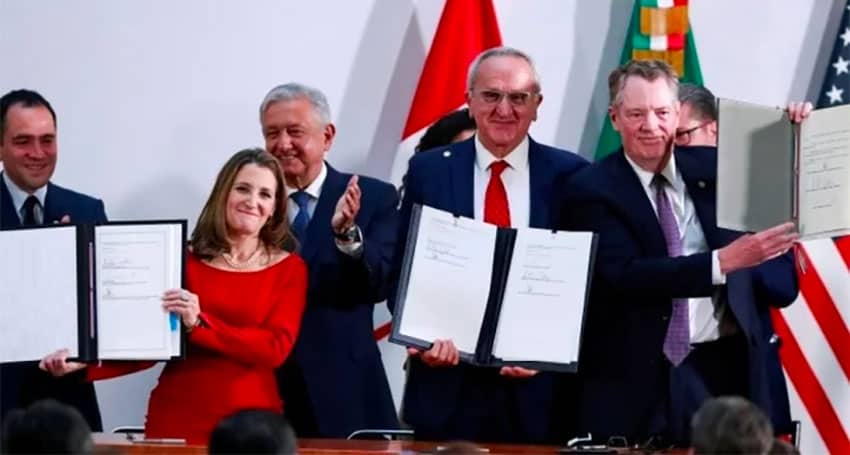
The new North American free trade agreement has hit a snag just days after a revised version of the trilateral pact was signed in Mexico City.
The federal government has objected to legislation sent to the United States Congress that says that up to five U.S. labor attachés will monitor labor conditions in Mexico to ensure their compliance with the terms of the United States-Mexico-Canada Agreement (USMCA).
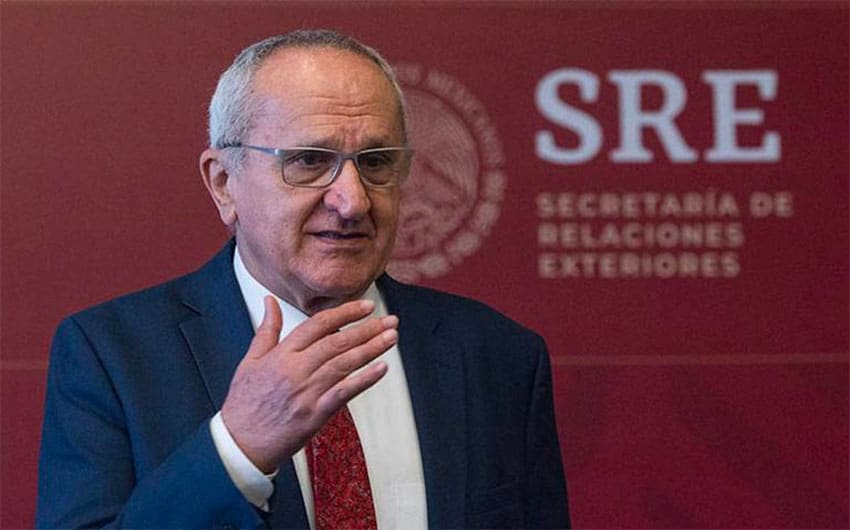
Mexico’s chief USMCA negotiator told a press conference Saturday that the attaché provision was not part of the modified trade deal signed by Mexican, Canadian and U.S. officials last Tuesday and ratified by the Mexican Senate two days later.
“This arrangement, the result of political decisions by the Congress and administration in the United States, was not discussed . . with Mexico and of course, we’re not in agreement,” Jesús Seade said.
“It’s important to emphasize that this proposal . . . is not part of the treaty agreed by the three countries. It’s not the result of the trilateral negotiation . . .”
He stressed that Mexico will never accept foreign labor inspectors “for a simple reason: Mexican law doesn’t allow them.”
Seade told reporters that he had sent a letter to U.S. Trade Representative Robert Lighthizer to express “Mexico’s surprise and concern” about the changes.

“. . . While Mexico respects the United States legislative process . . . we would hope that [the bill’s] content reflects . . . the commitments that were agreed to without additional considerations or mechanisms,” the letter said.
The U.S. legislation also proposes that three inspectors will be sent to Mexico to ensure environmental compliance with the USMCA. Mexico said it wasn’t consulted about that provision either.
Seade flew to Washington D.C. on Sunday to hold urgent talks with Lighthizer and other U.S. officials with a view to resolving the two countries’ differences. But there was no further information forthcoming after he met Monday morning with Lighthizer. A press conference was scheduled to take place at 2:00pm CT.
Some Mexican business leaders also condemned the United States’ plan to send labor inspectors to the country.
“For no reason can we accept them [U.S. attachés] coming to carry out an inspection,” said Francisco Cervantes, president of the Confederation of Industrial Chambers.
The operation of United States inspectors in Mexico is “unacceptable and violates sovereignty,” said Enoch Castellanos, president of the National Chamber for Industrial Transformation. The government “must demand” that the U.S. comply with the terms of the agreement that was reached, he said.
The Secretariat of Foreign Affairs (SRE) said in a communique that Mexico could reject any U.S. diplomats posted to carry out inspections because the accreditation of labor attachés can only proceed with the consent of the host country.
Earlier this month, Mexico rejected the U.S. proposal to allow foreign officials to carry out labor inspections, arguing that it would violate the country’s sovereignty.
Instead, negotiators agreed to the establishment of three-member panels to resolve disputes. In disputes between Mexico and the United States, the panels would include one Mexican and one U.S. expert along with a third from a neutral country.
Mexican officials said that agreement meant that inspections of Mexican workplaces by the United States were no longer a possibility.
However, according to the legislation sent to the U.S. Congress, labor inspections will go ahead, focusing on eight sectors: automotive and auto parts, aerospace, baking, electronics, call centers, mining, steel and aluminum.
Inspectors would monitor compliance with USMCA terms that are reflected by new Mexican labor laws that guarantee the rights of workers to freely elect their union leaders and participate in the negotiation of collective contracts.
According to a report in the newspaper El Universal, a telephone hotline monitored by the United States Department of Labor will also be established with which workers can make complaints if they are not afforded those rights.
Speaking at his morning press conference on Monday, President López Obrador said the United States had acted “in a clandestine manner” by sending legislation to Congress that doesn’t match the deal reached last week.
However, he said it wouldn’t affect the overall implementation of the trade deal, which will replace the almost 26-year-old NAFTA.
“. . . This issue is already being addressed with the same method that we’ve used in our relations with the United States: the method of dialogue,” López Obrador said.
The emergence of the sticking point came a day after the president touted his personal relationship with U.S. President Donald Trump as a key factor in the inking of the revised USMCA deal.
“Everyone was betting that because I’m from this land [Tabasco], because I’m from the tropics, that I was going to fight with Donald Trump. He even said to me: ‘they were betting that we were going to fight but I don’t want to fight with you,’ he told me. Well I don’t want to either,” López Obrador said at a rally in Teapa, Tabasco.
The president said there has been “mutual respect” and understanding between him and Trump and that has resulted in the absence of conflict between them.
But that respect was apparently insufficient to avoid Mexico being deceived by its largest trading partner. Government critics have claimed that Seade was careless or naive in the negotiations with the United States.
“It was a serious error for Seade to have gone alone to the final negotiations on USMCA,” José Antonio Crespo, a political scientist at the Center for Research and Teaching in Economics, wrote on Twitter.
“If he had been advised by Mexican personnel, he wouldn’t have been tricked, or be pretending that he’d been tricked.”
Source: Milenio (sp), The Washington Post (en), El Universal (sp), EFE (sp)