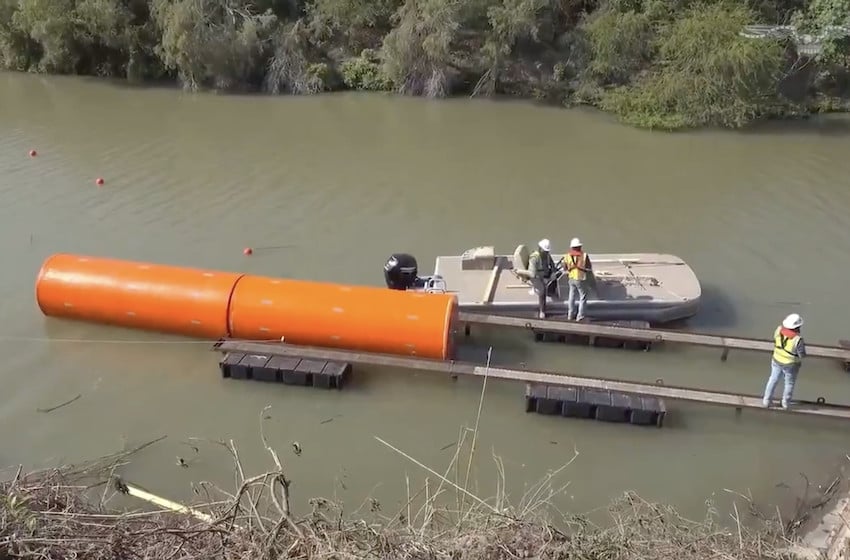
The U.S. Department of Homeland Security is beefing up its border security efforts along the Rio Grande, expanding on a controversial Texas strategy by placing large, floating buoys along more than 500 miles of the river.
U.S. Homeland Security Secretary Kristi Noem announced the deployment of the barriers on Wednesday during a visit to the Rio Grande Valley that included a roundtable discussion with U.S. Customs and Border Protection personnel as well as ranchers whose property is often traversed by migrants moving north after crossing the border.
Standing before one of the buoys — large floating, cylindrical devices that can measure up to 15 feet long and four to five feet in diameter — Noem said 130 miles of the water barrier were already under contract and were beginning to be installed that day.
This water barrier is part of a push by President Donald Trump to build a “Smart Wall” made up of steel barriers, waterborne barriers, patrol roads, lights, cameras and detection technology. The projects are funded by the 2025 tax and spending megabill, which Trump named the One Big Beautiful Bill.
Noem touted the water barrier as a deterrent to people crossing the border illegally as well as drug smugglers and human traffickers.
Homeland Security and the Border Patrol are working with the U.S. International Boundary and Water Commission and the state of Texas to ensure proper installation of the buoys, Noem said.
The state of Texas is already familiar with using buoys to deter border crossings. Governor Greg Abbott ordered the installation of a 1,000-foot water barrier along the Rio Grande near Eagle Pass in 2023 as part of his mission to tighten border security, and an additional 1,000 feet of buoys after Trump took office in January 2025.

Texas launches billboard campaign referencing sexual assault to deter US-bound migrants
“Texas finally has a partner in the White House,” Andrew Mahaleris, press secretary for Abbott, said in a statement Wednesday. “The floating marine barriers deployed by Texas have been a resounding success, and Governor Abbott is proud to work with the Trump Administration and Border Patrol to expand the program. ”
The buoys sparked protests from activists concerned about migrant safety and a complaint from the Mexican government alleging the buoys violated water treaties between the U.S. and Mexico. The U.S. Department of Justice under President Joe Biden sued Texas over the buoys, citing similar concerns. The U.S. Fifth Circuit Court of Appeals has allowed the buoys to remain in place while the merits of the case move forward in a lower court. The state has argued it has the right to defend itself against an “invasion” of drug cartels.
Weeks after the buoy wall was installed in Eagle Pass, Mexican authorities reported the lifeless body of a migrant had been found on one of the floating spheres. On Wednesday, Noem argued that the water barrier would prevent migrant deaths by discouraging them from trying to cross the river.
“They’ll create a safer environment for agents on patrol, and securing our waterways not only protects Americans, it saves the lives of illegal aliens by deterring them from daring to attempt to cross through this treacherous water,” Noem said.
This article was written by Berenice García and first appeared on The Texas Tribune.