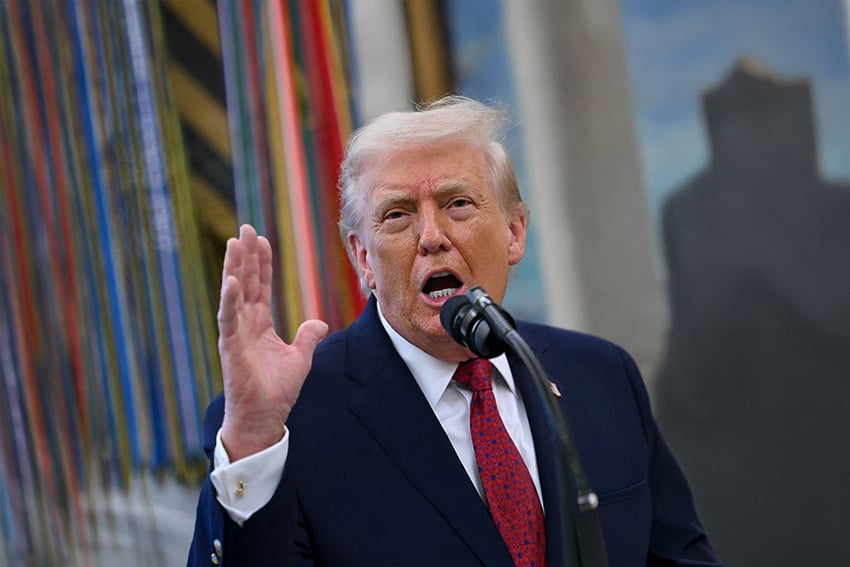
After the Jan. 3 raid on Venezuela that captured that country’s president, analysts and everyday residents worried that Mexico may be the next target. U.S. President Donald Trump has now validated those concerns, stating bluntly that the U.S. military could begin land strikes on drug cartels in Mexico.
“We’ve knocked out 97% of the drugs coming in by water, and we are going to start now hitting land, with regard to the cartels,” Trump told Fox News host Sean Hannity Thursday. “The cartels are running Mexico; it’s very sad to watch and see what’s happened to that country.”
🚨🔥 BREAKING: TRUMP FLOATS LAND STRIKES ON MEXICO AS GLOBAL POWERS QUIETLY MOVE IN 🇺🇸🇲🇽
A political shockwave is spreading after Donald Trump signaled the possibility of U.S. land strikes on Mexico, following a viral clip from his latest Fox News interview now circulating… pic.twitter.com/RrIcKhj57j
— Slavic Networks (@SlavicNetworks) January 9, 2026
Mexican President Claudia Sheinbaum, who had previously condemned the U.S. military actions in Venezuela, responded on Friday by saying that defending national sovereignty is a priority in light of Trump’s statements.

At the same time, she called for stronger coordination with the U.S. on maritime security.
During her daily morning press conference, Sheinbaum highlighted the Mexican Naval Ministry’s surveillance in Mexico’s continental waters, insisting it has provided concrete results in the fight against drug trafficking.
“We are in contact with the U.S. government and the Coast Guard in case a vessel or boat approaches, so that it can be apprehended through coordinated efforts, without the need for force,” she said, adding that the Navy has seized 1.6 tons of cocaine in the past year.
“We want to continue working as necessary to further strengthen coordination within the framework of defending our water sovereignty and the territorial integrity of Mexico,” she said.
The White House has yet to clarify Trump’s remarks, nor has it provided additional information on the timing or scope of the potential land attacks.
Since September, the U.S. has carried out strikes on approximately 30 so-called narcoboats allegedly from Venezuela, resulting in the deaths of more than 100 people. These operations were conducted without a court order or congressional mandate.
Trump also said U.S. forces recently struck a docking facility for such boats in Venezuela and, this week, U.S. forces boarded and seized a Russian-flagged oil tanker in the Atlantic Ocean.
The U.S. has accused the ship of breaking sanctions and shipping Iranian oil, although the BBC reported that it has historically transported Venezuelan crude oil. Reports suggest it is empty at the moment.
Last February, Trump designated six Mexican cartels as foreign terrorist organizations, a move Sheinbaum criticized as threatening Mexico’s sovereignty. In November, NBC News reported that the U.S. military was training for ground operations in Mexico.
Last month, the digital news outlet Código Magenta reported that U.S. operations might even target past and present Mexican politicians with alleged links to drug cartels.
Speculation about U.S. intentions with regard to Mexico has intensified since the Venezuelan operation which prompted mixed reactions — and protests — across Mexico.
There’s an economic threat as well
However, there are other concerns for Sheinbaum.
The Trump administration has announced that it would reincorporate Venezuelan oil into international markets, a move that would reshape the global energy map and economically threaten Mexico, a principal supplier to its northern neighbor.
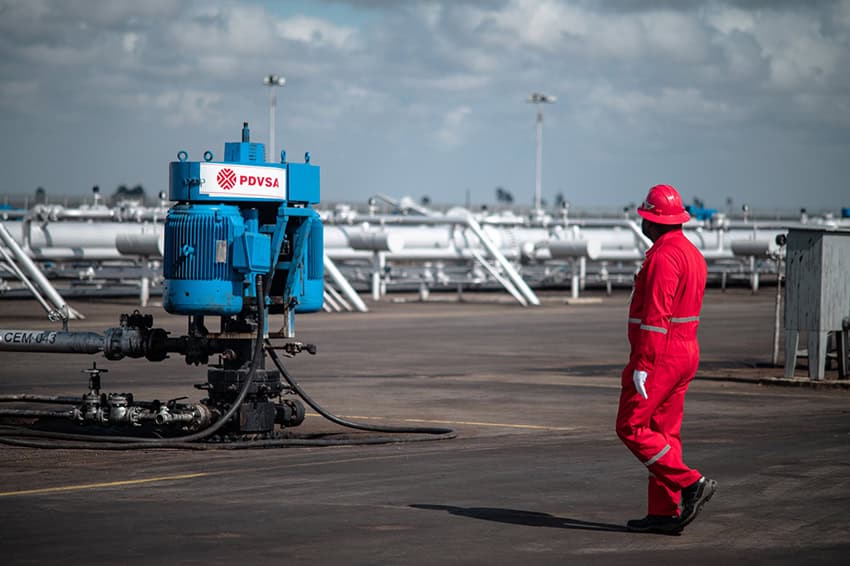
George Baker, an energy sector analyst based in Houston and the editor of the specialized newsletter Mexico Energy Intelligence, told the digital publication Animal Político that Mexico is especially vulnerable.
Baker warned that “Mexico is at risk of losing its second-place position (Canada is the top supplier) as a source of crude oil supply to the United States, due to the likely advance of PDVSA, Venezuela’s national oil company that has been restricted for years due to financial and operational problems.”
U.S. Energy Secretary Chris Wright said on Wednesday that the U.S. is already in talks with major trading firms and banks to immediately move between 30 million and 50 million barrels of Venezuelan oil stored on floating platforms and on land.