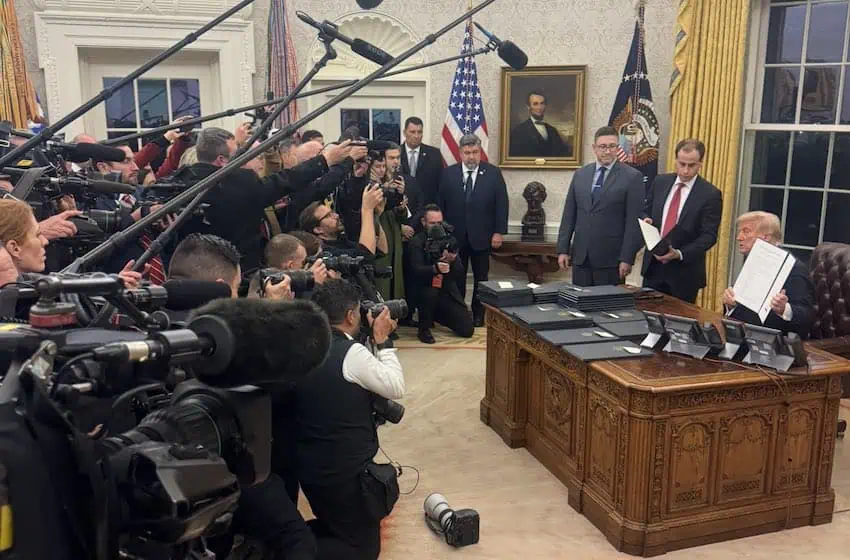
United States President Donald Trump signed an executive order declaring a “national emergency” at the U.S.-Mexico border on Monday night as he sought to swiftly assert his authority and differentiate his administration from that of his predecessor Joe Biden.
From the Oval Office on Monday night, Trump also said that he planned to impose a 25% tariff on all Mexican and Canadian exports to the United States on Feb. 1. He previously pledged to impose the tariff on his first day in office and keep it in place “until such time as Drugs, in particular Fentanyl, and all Illegal Aliens stop this Invasion of our Country!”
After taking the oath, US President #DonaldTrump says, “I will declare a NATIONAL EMERGENCY at our southern border… All illegal entry will be immediately halted and we will begin the process of returning millions and millions of criminal aliens back to the places they came.”… pic.twitter.com/btkF5zDCoh
— NewsMobile (@NewsMobileIndia) January 20, 2025
Trump said in his inauguration speech on Monday that he would promptly “sign a series of historic executive orders” and that “first I will declare a national emergency at our southern border.”
In his inauguration speech, Trump said that “all illegal entry” to the United States would be “immediately halted” with his national emergency declaration.
“And we will begin the process of returning millions and millions of criminal aliens back to the places from which they came,” he said.

“We will reinstate my Remain in Mexico policy. I will end the practice of catch and release. And I will send troops to the southern border to repel the disastrous invasion of our country,” Trump said.
The New York Times reported that in addition to the executive order to send troops to the United States’ southern border, Trump also signed an order requiring the military to “seal” the northern border with Canada, to repel “forms of invasion, including unlawful mass migration, narcotics trafficking, human smuggling and trafficking, and other criminal activities.”
The 47th U.S. president also said that “under the orders I sign today, we will also be designating [drug] cartels as foreign terrorist organizations.”
He signed an executive order making that designation shortly before 7 p.m. He subsequently said that the U.S. military could be used against Mexican cartels. In his inauguration speech, Trump also said that “a short time from now we are going to be changing the name of the Gulf of Mexico to the Gulf of America.”

The New York Times reported that some of Trump’s executive orders “are almost certain to be challenged in court.”
For example, involving the U.S. military in border security tasks “would draw immediate legal challenges because of the strict limits in American law for how the armed forces can be deployed inside the country,” the Times said.
The declaration of a “national emergency” on the Mexico-U.S. border — where the number of migrant arrests have recently fallen — would allow Trump to access funding for border wall construction without approval from Congress.
The successful execution of the U.S. president’s pledge to reinstate the Remain in Mexico policy — which requires asylum seekers to await the outcome of their claims in Mexico — would depend on the cooperation of the Mexican government. However, President Claudia Sheinbaum is opposed to the reactivation of the policy.
Sheinbaum congratulates Trump
In a post to social media on Monday afternoon, Sheinbaum, “on behalf of the government of Mexico,” congratulated Trump on his inauguration as the 47th president of the United States.
“As neighbors and trade partners, dialogue, respect and cooperation will always be the symbol of our relationship,” she wrote.
A nombre del Gobierno de México felicito a Donald Trump @POTUS por su toma de posesión como presidente número 47 de los Estados Unidos de América. Como vecinos y socios comerciales, el diálogo, el respeto y la cooperación siempre serán el símbolo de nuestra relación.
— Claudia Sheinbaum Pardo (@Claudiashein) January 20, 2025
At her morning press conference on Monday, Sheinbaum and other federal officials provided details about the government’s plan to receive Mexicans deported from the United States during the second Trump administration.
The program — part of a strategy called “México te abraza,” or “Mexico embraces you” — includes welfare support for deportees, registration with the Mexican Social Security Institute and transport so that returning migrants “can reach their places of origin,” Sheinbaum said.
*Note* This is a breaking news story and will be updated accordingly.
Mexico News Daily