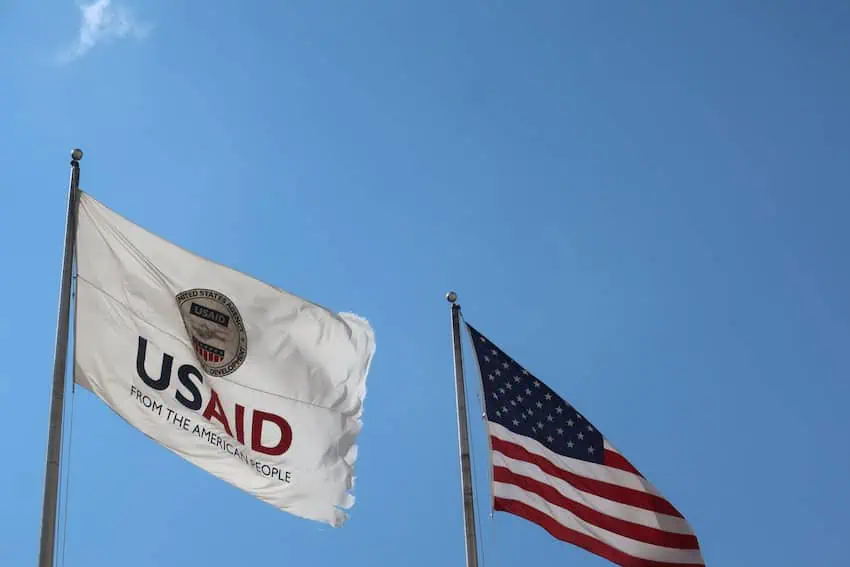
Many organizations in Mexico — including the federal government — have been left in a state of limbo after United States President Trump announced plans to shut down the U.S. Agency for International Development (USAID) on Monday.
In 2023, the U.S. was the largest source of foreign aid in the world, with USAID disbursing roughly $45 billion to international programs. According to the Washington Office on Latin America (WOLA), the State Department and USAID together allocated $2.6 billion to over 2,000 programs across 20 Latin American countries that same year.
🚨 Trump’s decision to freeze foreign aid to Latin America is an “America Last” policy. It weakens democracy, fuels migration, and empowers corruption.
📊 WOLA’s latest analysis breaks down the consequences. Swipe through the carousel & read more here ⬇️ pic.twitter.com/cuScRHm0j6
— WOLA (@WOLA_org) February 4, 2025
On Jan. 20, Trump signed an executive order temporarily suspending all U.S. foreign development assistance programs for 90 days, pending reviews to assess whether they aligned with his policy goals. Then, on Jan. 24, the State Department ordered a sweeping freeze on new funding for most U.S. foreign assistance.
On Monday, it was reported that President Trump and the head of the Department of Government Efficiency (DOGE) Elon Musk “agreed” to close USAID.

“He [Trump] agreed we should shut it down,” Musk said during a live session on X on Monday. “It became apparent that it’s not an apple with a worm in it … What we have is just a ball of worms. You’ve got to basically get rid of the whole thing. It’s beyond repair. We’re shutting it down.”
USAID was formed in 1961 to administer aid to foreign countries to promote social and economic development. Trump and Musk, as well as Republican legislators, have previously criticized the agency for funding progressive causes abroad.
In Mexico, USAID allocated approximately $71 million in 2023, supporting civic initiatives related to human rights, anti-corruption, missing persons and environmental protection, among others.
“This [cut] is causing great uncertainty and alarm among implementing partners: civil society organizations, international organizations and contractors throughout the region,” warned WOLA in a statement on Jan. 31.
Mexican projects affected by a freeze in US foreign assistance
Around 70% of Latin American missions working with migrants, refugees and human rights will reduce their staff, while 77% will see budget cuts, according to a WOLA survey.
“The elimination of these programs would not only harm individuals and groups in Mexico but could undermine the current administration’s approach to migration, weakening efforts to address the root causes of migration, such as crime and insecurity,” said WOLA.
In Mexico, USAID provides funding to the Mexican government for the forensic identification of missing persons. With over 120,000 recorded cases of missing persons nationwide, the cuts threaten to worsen what experts have called Mexico’s “forensic crisis.”
USAID also supports several environmental causes in Mexico, funding conservation and sustainable development projects in the states of Campeche, Chiapas, Oaxaca, Quintana Roo, Tabasco, Veracruz and Yucatán.
In addition, a long list of independent media projects in Mexico receive partial funding from USAID.
President Sheinbaum’s response to the impending closure of USAID
On Tuesday, President Claudia Sheinbaum responded to news of USAID’s impending closure positively, mentioning that the agency had financed the political opposition.
“USAID has so many things that, the truth is, yes, it is better they close it. And that, in any case, if there is going to be aid for different types, they should open other types of channels; that they be transparent, that is the issue, the big issue,” said Sheinbaum in her Tuesday morning press conference.
🇲🇽MEXICO’s PRESIDENT
SHEINBAUM:“There are so many things inside USAID that yes, it is best if they shut it down”
— José Díaz Briseño (@diazbriseno) February 5, 2025
El Salvador’s President Nayib Bukele also accused USAID of financing political opponents.
“While marketed as support for development, democracy, and human rights, the majority of these funds are funneled into opposition groups, NGOs with political agendas, and destabilizing movements,” Bukele wrote on the X media site.
On Tuesday, President Trump announced all USAID employees would be placed on administrative leave starting Friday, Feb. 7.
With reports from Milenio, El Universal, Yahoo News, Devex and The Associated Press