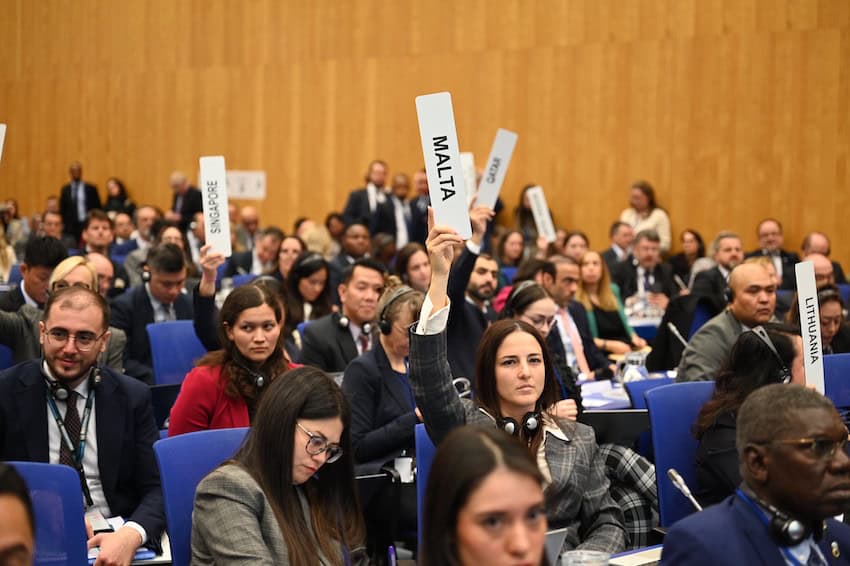
The United Nations Commission on Narcotic Drugs (CND) has just approved a resolution to prevent the use of specialized equipment and controlled materials in the production of synthetic drugs, following a proposal by Mexico.
With the official name of “the Resolution on Article 13 of the 1998 United Nations Convention against Illicit Traffic in Narcotic Drugs and Psychotropic Substances,” it was adopted as part of the 69th session of the CND in Vienna on March 13. It specifically targets tableting and encapsulating machines, which are normally used for legitimate purposes in the medical field, but according to Mexico’s Foreign Relations Ministry (SRE), “are being used for the production of synthetic drugs.”
The international community came together this week at #CND69 to discuss and decide on global responses to the world drug problem.
Watch the CND Chair, Ambassador Andranik Hovhannisyan @ARMEmbVienna share the highlights of this year’s session. pic.twitter.com/8VRmUELdHn
— UN Office on Drugs & Crime (@UNODC) March 13, 2026
“This Mexican initiative seeks to equip all countries with tools to address the exponential growth in the consumption of synthetic drugs — including those resulting from abuse or misuse of medications — and the consequent adaptations occurring in the production, manufacture, trafficking and sale of these drugs and their precursors,” the SRE said in a statement.
The resolution on Article 13 of the 1988 Convention indicates that these machines, however, must still remain accessible for legitimate medical, scientific and industrial purposes, as its primary goal is to prevent these devices from being diverted into illicit activities, rather than imposing a complete ban on the technology itself.

Furthermore, it urges countries to “adopt legislative measures to prevent the diversion of tableting and encapsulating machines to the illicit market,” while also ensuring that their legal trade continues without hindrance.
The resolution is part of a broader CND agenda on the threat of synthetic drugs, which also includes resolutions on supply chain integrity, early warning mechanisms and evidence-based public health responses.
It also follows former Foreign Affairs Minister Alicia Bárcena’s intervention at the UN in 2024, when she called on member states to combat drug trafficking on the further grounds that it fuels illicit economies, violence and phenomena that can be linked to extremism and terrorism.
The resolution on Article 13 of the 1998 Convention is a concrete tool for the type of cooperation that Bárcena demanded then, strengthening the control of equipment and materials used to manufacture synthetic drugs.
Mexico’s strategy to combat drug trafficking also saw current Foreign Affairs Minister Juan Ramón de la Fuente hold a meeting with the head of the U.S. Office of National Drug Control Policy, Sara Carter, aimed at strengthening cooperation between both countries in the areas of public health and drug use prevention.
With reports from El Sol de México