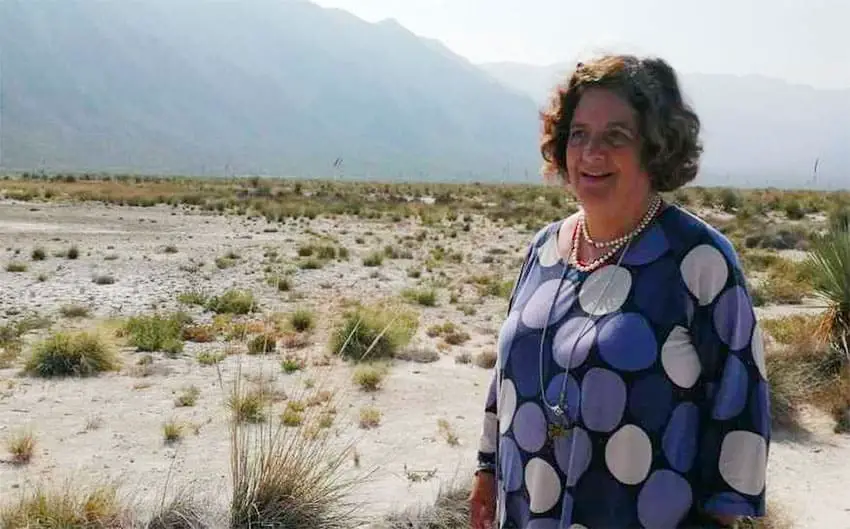
A scientist at the National Autonomous University (UNAM) has become the fourth Mexican citizen to be inducted into the prestigious American Academy of Arts and Sciences (AAAS).
Valeria Souza Saldívar, a researcher at the university’s Institute of Ecology, signed her name into the organization’s register on Saturday to become an honorary international member. She joined the ranks of legendary scientists such as Charles Darwin, Albert Einstein and Barbara McClintock.
The AAAS was established by George Washington, Benjamin Franklin, Thomas Jefferson and other U.S. founding fathers in 1780 “to cultivate every art and science which may tend to advance the interest, honor, dignity and happiness of a free, independent and virtuous people,” according to its charter.
Souza called her induction a great honor but she also said she hopes it will draw public attention to Cuatro Ciénegas, an oasis and biosphere reserve in Coahuila.
Chosen by the academy for her work in biological sciences, Souza has been dedicated to saving a “lost world” that holds some of the oldest evolutionary material on the planet, researching molecular evolution in the azure springs of Cuatro Ciénegas.
The springs are home to direct descendants of the organisms that transformed the earth from a place with orange seas and no oxygen to the planet of today.
The springs have the world’s highest levels of diversity of cyanobacteria, creating stomatolites, fossilized mounds that serve as records of ancient life on Earth. They are also home to over 80 endemic fish, reptile and amphibian species.

Souza’s work over the last 20 years has shown the gradual drying of the springs due to irrigation for alfalfa cultivation, for which she petitioned the National Water Commission (Conagua) to close an irrigation canal.
In operation since 1900, it is the principal extractor of water from the springs. However, due to evaporation and inefficiency of the infrastructure, only 10% of the water extracted by the canal is ultimately used.
Source: Milenio (sp)