An art collection owned by the SNTE teachers’ union and worth as much 3 billion pesos (US $150.6 million) is now on display in Mexico City.
It is made up of eight works by Mexican muralist Diego Rivera, six by Spanish painter Pelegrí Clavé and one each by Mexican artists Francisco Toledo, Pedro Coronel and Gabriel Orozco.
The works are on permanent display at the Contemporary Mexico Cultural Center, located on Leandro Valle street in Mexico City’s historic center.
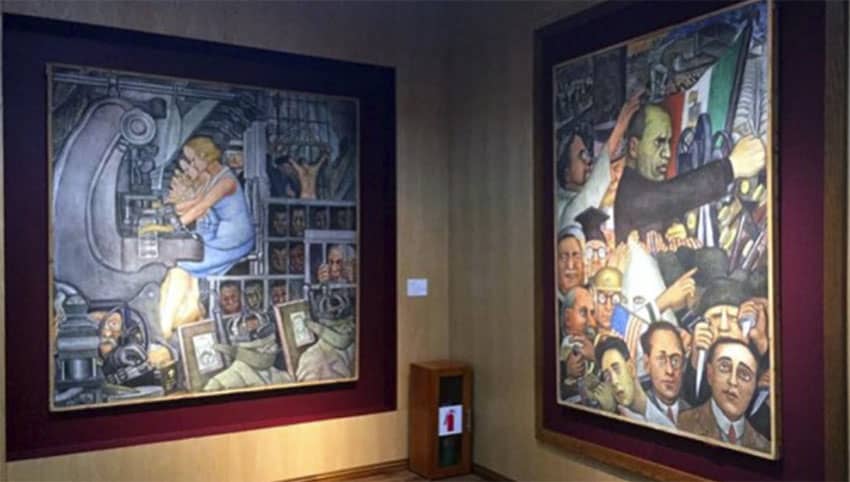
Most prominent among the works are five of 21 mural panels painted in 1933 by Rivera for the New York Workers School, which was an ideological training center of the United States Communist Party.
The five panels, which were part of the Portrait of America mural, are called World War; The New Freedom; Modern Industry; Mussolini; and Defense of the Workers’ Land.
Former SNTE union boss Elba Esther Gordillo is believed to have bought the panels from former president Luis Echeverría although how much she paid for them is unknown.
The panels and other artworks were seized by the federal Attorney General’s Office after Gordillo’s arrest in 2013 on charges of embezzlement and organized crime.

The SNTE union recovered the art – which Gordillo purchased using dues collected from teachers – in June 2018.
“They are works with an incalculable value,” said Paul Achar Zavala, the SNTE-designated custodian of the artworks.
“I don’t know how much they could cost but they have a great historical value and it is great news that Mexicans can now admire them,” he said.
SNTE secretary general Alfonso Cepeda Salas, who last year estimated that the value of the 17 works of art could be as high as 3 billion pesos, said it was a “privilege” for the union to possess such a collection and to put it on public display.
“Apart from being very important assets for the teachers of Mexico and for education workers in general, the art is also [part of] Mexican heritage . . . it makes all of us proud . . .” he said.
Source: El Economista (sp)