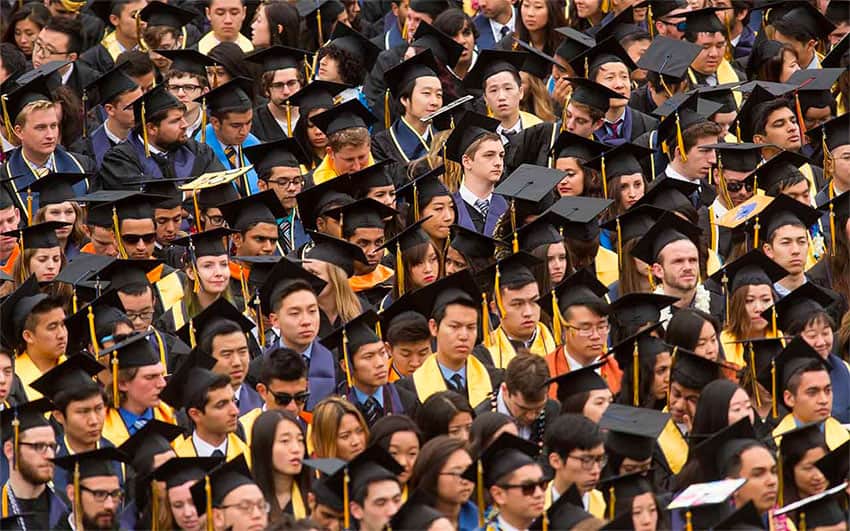
Graduates of public and private universities earn an average of around 10,400 pesos (US $490) a month, a study by the Universidad del Valle de México (UVM) has found, with women earning 22% less than men.
UVM’s National Survey of Graduates 2020 interviewed 10,036 students about their professional trajectory after graduating from college.
The study is intended to help authorities formulate public policies to align higher education with the economic and social needs of the country and help universities design an updated educational offering based on market needs.
This in turn is to help students choose their field of study based on updated information on demand for skills, employability and income.
And as in previous years, the disparity between male and female graduates continues to be noticeable as men are still better paid, have better benefits and are more employable than women in Mexico. In their first job after graduation, 27% of men were paid more than 8,000 pesos (US $376) a month, compared to just 18% of women.
Salaries across the board were not what many students hoped for: 54% of those surveyed said they were not earning what they had expected.
Only 17% of all graduates earned more than 15,000 pesos per month, and 5% said they earned less than 1,500 pesos, the survey found.

Private university graduates say mechanical engineering and metallurgy careers are the best paid with an average salary of 16,394 pesos per month.
Of those who attended a public university, chemistry majors were the best paid at 13,465 pesos per month.
Graduates are also finding it increasingly difficult to find work. In 2005, the study found that 40% of those interviewed found it difficult or very difficult to find a job after leaving school. In 2019 that number jumped to 56.5%.
One-third of study participants said they pursued a college education to improve their standard of living, while 27% said they went to college because they enjoyed their field of study.
Students tend to stay in the same state in which they studied, with only 17% moving elsewhere after graduation, and four out of 10 surveyed said they worked while going to school
Social sciences, administration and law (35%) and engineering, manufacturing and construction (25%) were the areas of study with the highest number of graduates, followed by health-related degrees at 12%, natural and computer sciences with 10%, and education or the arts and humanities 6%.
Not surprisingly, only 24% of arts and humanities graduates found work in their fields, whereas 74% of those who studied a health-related field were able to find related work.
Source: El Financiero (sp)