There are currently just under 100,000 missing persons in Mexico, according to information presented by Interior Minister Luisa María Alcalde on Monday.
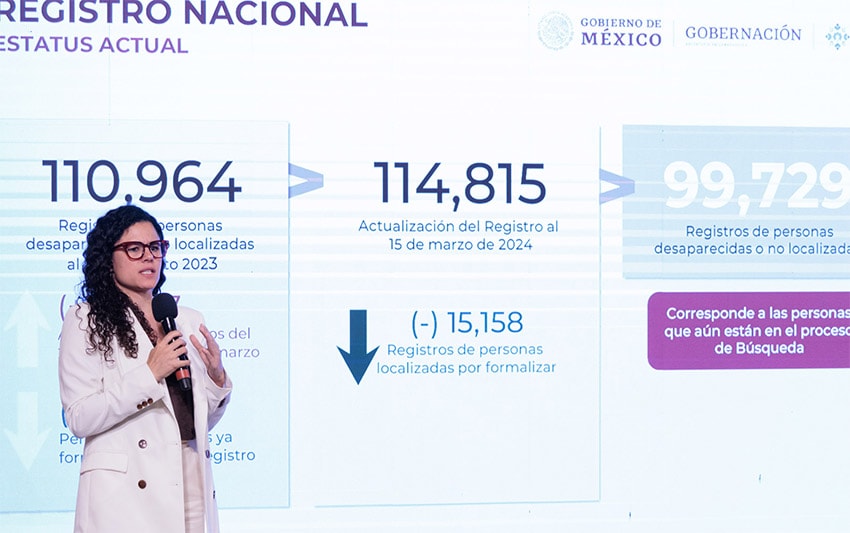
Speaking at President Andrés Manuel López Obrador’s morning press conference, Alcalde said that a total of 99,729 people were missing as of last Friday.
She acknowledged that Mexico’s national missing persons register shows that almost 115,000 people reported as missing since 1962 have still not been found.
However, Alcalde told reporters that more than 15,000 of that number have now been located or their deaths have been confirmed and they will therefore be removed from the register.
The interior minister reported late last year the results of a “massive” nationwide search for missing persons that was carried out as part of the government’s “National Generalized Search Strategy for Missing Persons.”
More than 16,000 people were located in their homes, in prisons or in other places, or were confirmed to have died, during search efforts in the second half of 2023. The search efforts have collectively been referred to as a missing persons “census.”
In the first three months of this year, an additional 3,512 people were located or confirmed as deceased, Alcalde said.

Data she presented on Monday showed that there are more than 10,000 missing persons in three of Mexico’s 32 federal entities.
Jalisco has the highest number of missing people with 12,389, followed by Tamaulipas with 12,219 and México state with 10,619. Campeche has the lowest number of missing people with just 88.
Alcalde said that 86% of people reported as missing but subsequently located were not victims of crime. Their disappearances were instead classified as “voluntary absences.”
Alcalde said that 4% of those located were victims of forced disappearances, or kidnappings, while 10% were victims of “some other kind of crime, mainly domestic violence.
“There … [was] a crime and the absence … [was] for that reason,” she said.
Many of the people who disappear in Mexico as the result of kidnapping are never found, while it is rare for the perpetrators of such crimes to be held to account. The United Nations Committee on Enforced Disappearances said in a 2022 report that impunity in missing person cases in Mexico is “almost absolute.”
Alcalde indicated on Monday that the government is hopeful it will locate more missing persons in the near future as it has obtained more than 31,000 “new addresses” and over 7,000 telephone numbers associated with people on the missing persons register.
On March 7, the government began a sixth “generalized search” campaign during which it will visit all those addresses and call all the numbers, she said.
Before the government began its “generalized search strategy” last year, López Obrador asserted that Mexico’s missing persons register wasn’t accurate, and advocated a new count.
He said last August that Karla Quintana’s resignation as head of Mexico’s National Search Commission (CNB) may have been “because of the [new missing persons] census,” which has been conducted by so-called “servants of the nation” — government officials who have mainly aided the implementation of social programs — and others.
Quintana, who became CNB chief shortly after López Obrador took office in late 2018, claimed in November that the aim of the missing persons census was to reduce the number of people listed as such across Mexico, and especially in states governed by the ruling Morena party.
Non-governmental organizations, search collectives and academics have also been critical of the census, warning that the government could be seeking to reduce the number of people officially listed as missing for electoral purposes.
López Obrador and other government officials including Alcalde have denied that is the case.
As of last June, more than 40,000 disappearances had been recorded during López Obrador’s presidency, a figure higher than the numbers recorded during the entire administrations of both Enrique Peña Nieto (2012-18) and Felipe Calderón (2000-06).
Mexico News Daily