The United States government is seeking talks with Mexico due to concerns that it may be violating North American trade pact environmental commitments by not adequately protecting the near-extinct vaquita marina porpoise.
The Office of the United States Trade Representative (USTR) announced Thursday that it was requesting environmental consultations with the Mexican government in accordance with provisions in the environment chapter of the United States-Mexico-Canada Agreement (USMCA).
“These consultations concern Mexico’s USMCA environment chapter obligations relating to the protection of the critically endangered vaquita porpoise, the prevention of illegal fishing and trafficking of totoaba fish,” the USTR said in a statement.
The federal government faced criticism last year after abandoning a policy of maintaining a fishing-free zone in the upper Gulf of California, the only area in which the vaquita lives.
Trade Representative Katherine Tai said the USTR was requesting the discussions to “ensure Mexico lives up to its USMCA environment commitments.”
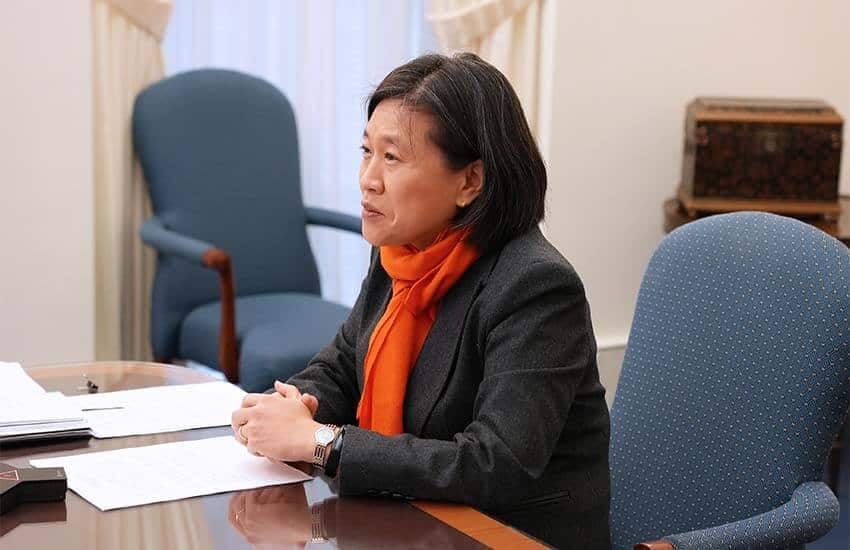
“We look forward to working with Mexico to address these issues,” she said.
It is the first time that environmental consultations have been requested under the agreement.

The USTR noted that the most recent data indicate that at least six but likely fewer than 19 vaquita remain.
The species is threatened by illegal totoaba fishing, as well as shrimp fishing, because vaquitas are vulnerable to becoming entangled in gillnets and dying.
The swim bladder of the totoaba, a large member of the drum family, is highly sought after in parts of Asia, especially China, where it sells for thousands of dollars per kilogram. The opportunity for fat profits has attracted Mexican drug cartels, whose members conspire with Chinese traffickers.
“… While Mexico has adopted environmental laws designed to prevent illegal fishing in the Upper Gulf of California, to prevent trafficking of protected species such as the totoaba and to protect and conserve the vaquita, available evidence raises concerns that Mexico may not be meeting a number of its USMCA environment commitments,” the USTR said.
The Mexican Economy Ministry (SE) acknowledged the United States’ request in a statement.
It said it would “coordinate the work between the different Mexican and United States authorities with the objective of opportunely presenting the efforts and measures adopted to protect marine species in national waters.”
“The government of Mexico reaffirms its commitment to the correct implementation of the USMCA,” the SE said.
If the U.S. and Mexico fail to reach a resolution during consultations, an expert panel could be tasked with ruling whether the latter is breaching its USMCA commitments. If it decides that is the case, the United States could impose trade sanctions on Mexico.
The two countries also have issues to address in the Gulf of Mexico.
A United States government ban on Mexican fishboats entering U.S. ports took effect Monday due to illegal fishing in U.S. waters. According to the U.S. government, Mexico hasn’t done enough to stop Mexican boats fishing red snapper in U.S. territorial waters.
With reports from El Universal