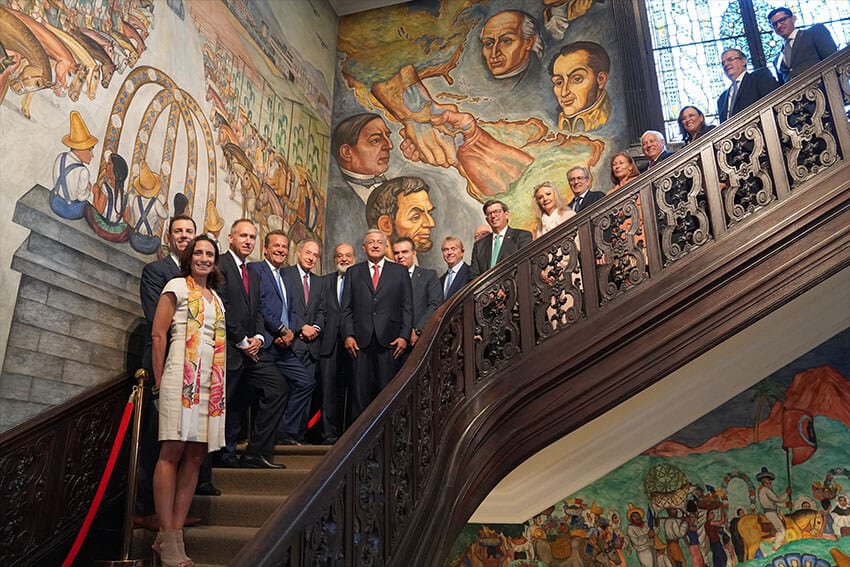
United States companies will invest US $40 billion in Mexico over the next two years, Foreign Affairs Minister Marcelo Ebrard said Wednesday after he, President López Obrador and other officials attended a meeting in Washington with U.S. and Mexican business executives.
Ebrard wrote on Twitter that López Obrador told the U.S.-Mexico CEO Dialogue that U.S. companies have committed to invest $40 billion between now and 2024. “Good news for Mexico,” he added.
López Obrador noted on his social media accounts that he had met with Mexican and United States business leaders at the Mexican Cultural Institute in Washington. “We spoke about economic cooperation, investment, sovereignty and progress with justice,” he wrote.
López Obrador announced last month that 17 U.S. energy companies had committed to invest in solar and wind projects in Mexico.
The United States Chamber of Commerce, which co-hosted the 12th U.S.-Mexico CEO Dialogue with Mexico’s Business Coordinating Council (CCE), said in a statement that the meeting allowed participants to “take stock” of the United States-Mexico-Canada Agreement (USMCA), the free trade pact that took effect in July 2020.
According to the statement, the CEOs “expressed serious concern over the deteriorating investment climate in Mexico,” where the government has been particularly hostile to energy sector companies as it endeavors to “rescue” the state-owned Federal Electricity Commission and state oil company Pemex.
The U.S. Chamber of Commerce said that business executives called on the Mexican government to uphold its USMCA commitments by:

- Eradicating energy sector policies that unfairly favor state-owned enterprises at the expense of private sector providers.
- Eliminating burdensome “Carta Porte” requirements and associated USMCA Article 7 implementation challenges.
- Addressing systemic delays and denials in permitting and licensing across key sectors such as hydrocarbons and customs.
- Ceasing closures of installations such as energy terminals, mines and quarries in actions often devoid of due process.
- Accelerating significantly the pace of approval processes for biopharmaceutical, agricultural biotech, medical device and food products.
CCE president Francisco Cervantes said López Obrador “listened very carefully” to both the U.S. and Mexican CEOs and was “very receptive.”
Economy Minister Tatiana Clouthier, who also attended the meeting, reported on Twitter that the president remarked that he had come to listen to energy companies. Pemex CEO Octavio Romero acknowledged that concerns were raised about Mexico’s energy policies and said that the government “offered to resolve them.”
Speaking to reporters after leaving the meeting, the state oil company chief said the concerns were expressed in “very good terms” and agreed that “we have to speed up a lot of things in order to make [bureaucratic] procedures quicker.”
One major concern of U.S. companies was allayed in April when a proposed electricity reform that would have guaranteed CFE over half the market failed to pass the lower house of Congress.
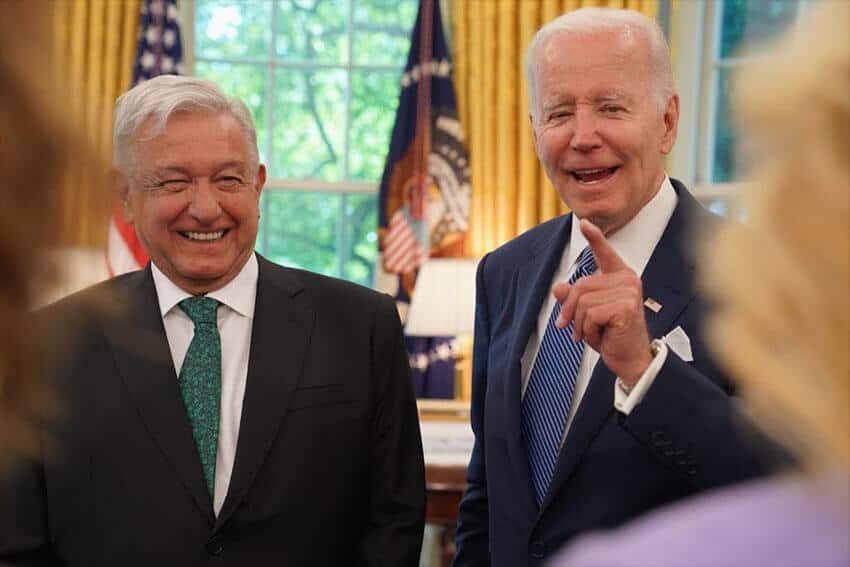
Wednesday’s business breakfast in the United States capital – which U.S. Secretary of Commerce Gina Raimondo and Secretary of Agriculture Tom Vilsack also attended – came a day after López Obrador met with U.S. President Joe Biden at the White House. The two leaders subsequently issued a joint statement that announced that Mexico would invest US $1.5 billion on border infrastructure between 2022 and 2024.
Ebrard said in an interview that the money wouldn’t be designated to stopping irregular crossings into the United States. It will be used to “modernize ports of entry, guarantee [the efficient functioning of] customs, … [and] facilitate trade,” he said. “We need more technology on the border.”