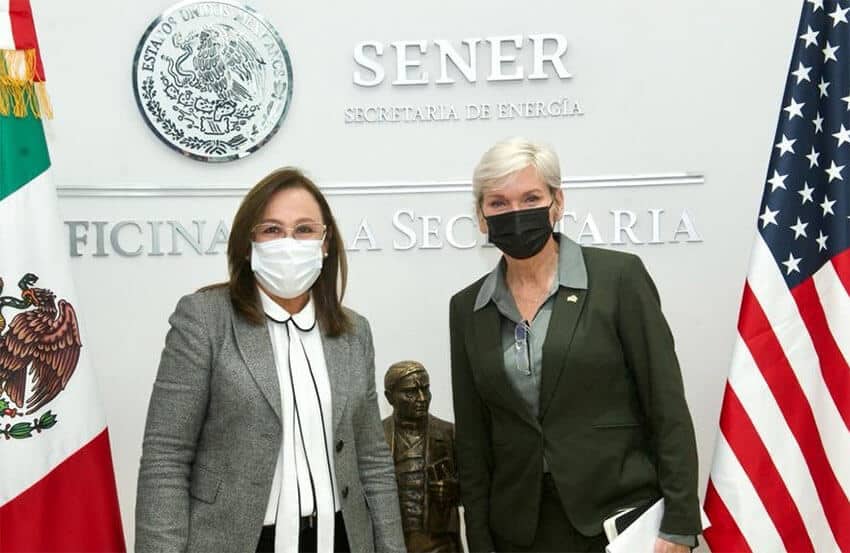
United States Energy Secretary Jennifer Granholm conveyed “real concerns” about Mexico’s proposed electricity reform during her visit to Mexico City late last week, contrary to statements by Mexican officials.
Energy Minister Rocío Nahle said last Thursday that the United States was not concerned about the planned constitutional reform – which would guarantee 54% of the electricity market to the state-owned Federal Electricity Commission, but Granholm countered that claim in a statement issued Friday.
“Throughout my trip, I met with senior Mexican leadership, including President Andrés Manuel López Obrador, as well as industry, legislators, and civil society, for frank and respectful dialogue. In each meeting, we expressly conveyed the Biden-Harris administration’s real concerns with the potential negative impact of Mexico’s proposed energy reforms on U.S. private investment in Mexico,” she said.
“The proposed reform could also hinder U.S.-Mexico joint efforts on clean energy and climate,” Granholm added.
On a more positive note, the energy secretary said she was assured that Mexico is committed to supporting clean energy and resolving current disputes with energy projects within the rule of law.
“Mexico is blessed with an abundance of potential renewable energy, that, if fully realized, could power its own country at least 10 times over, create millions of good-paying jobs, and develop an extraordinary export industry geared for a world in need of clean energy solutions,” the statement continued.
“We have expressed our enthusiasm about working with the Mexican government to advance their climate goals, and grow a competitive and diversified clean energy economy,” Granholm said.

Four United States Democratic Party senators wrote to the energy secretary early last week to urge her to challenge the Mexican government on its decision to “prioritize fossil fuel development over renewable energy.”
They warned of a range of adverse consequences if the proposed electricity reform is approved, including the cancellation of renewable energy permits, contracts, and certificates.
In public remarks during a meeting with Foreign Affairs Minister Marcelo Ebrard last Thursday, Granholm acknowledged that “there may be issues” with regard to the electricity reform but emphasized that the United States and Mexico would continue to be “strong allies” and “strongly supportive of a strong North American economy.”
In a letter sent to Republican Party Representative Buddy Carter the same day, the energy secretary, Secretary of Commerce Gina Raimondo and United States Trade Representative Katherine Tai declared that U.S. agencies remain committed to ensuring fair treatment of U.S. investors in Mexico.
The officials told the lawmaker that the Office of the U.S. Trade Representative was continuing to review Mexico’s energy sector plans to determine their compliance or lack thereof with the USMCA, the North American free trade pact that took effect in July 2020. U.S. lawmakers, including the senators who wrote to Granholm last week, have warned that the electricity reform violates USMCA provisions.
The Congress is expected to vote on the controversial bill – which requires two-thirds support to pass – in April. The ruling Morena party doesn’t have a supermajority in either the Chamber of Deputies or the Senate, meaning it will need the support of some opposition lawmakers to approve the reform.
The Canadian Chamber of Commerce in Mexico, the European Union’s ambassador to Mexico, U.S. Ambassador Ken Salazar and the Mexican Solar Energy Association have also raised concerns about the planned constitutional change, which would partially reverse the 2013 reform that opened up the electricity and oil markets to foreign and private companies.
With reports from El Universal