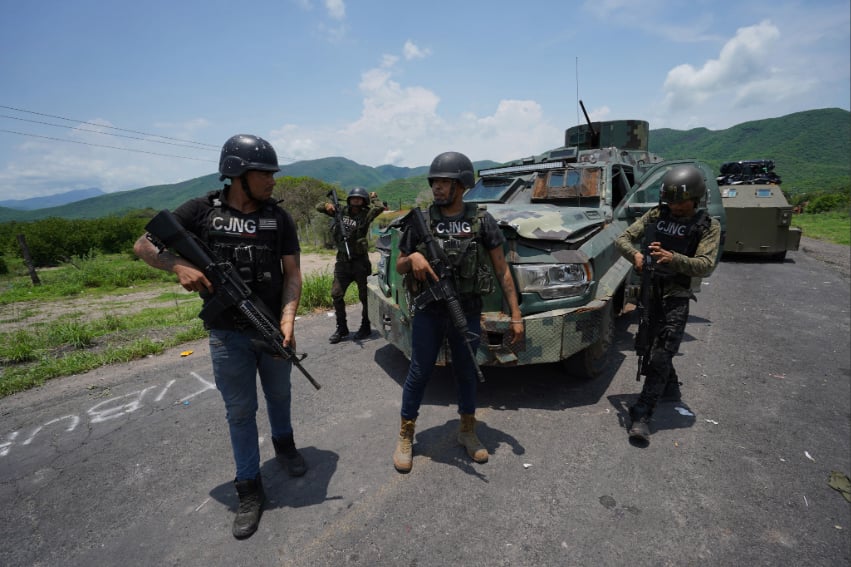
The U.S. Treasury on Thursday imposed sanctions on 39 Mexican individuals and 16 companies it alleges are linked to the Jalisco New Generation Cartel (CJNG), calling it “the largest action ever taken” against the notorious crime gang.
The measure targets the leadership of the cartel — designated by President Donald Trump as a foreign terrorist organization — and its illicit financing networks across Mexico.
The Treasury Department said in a statement that the goal of the sanctions is to limit the CJNG’s ability to traffic fentanyl and other drugs into the United States.
Shortly thereafter, Mexico’s Financial Intelligence Unit (UIF) reported it had identified “indicators related to possible operations with resources of illicit origin, including cash transactions, acquisition of high-end vehicles, jewelry and real estate,” as well as “international transfers, intensive use of credit and debit cards and transactions using virtual assets.”
As a result of this review, Mexico blocked the accounts of the same 55 individuals and companies sanctioned by the U.S. Treasury Department.
“The coordinated actions between Mexican and U.S. authorities strengthen mechanisms of international cooperation to prevent abuse of the financial system, combat money laundering and weaken the economic structures of organized crime,” the UIF said.
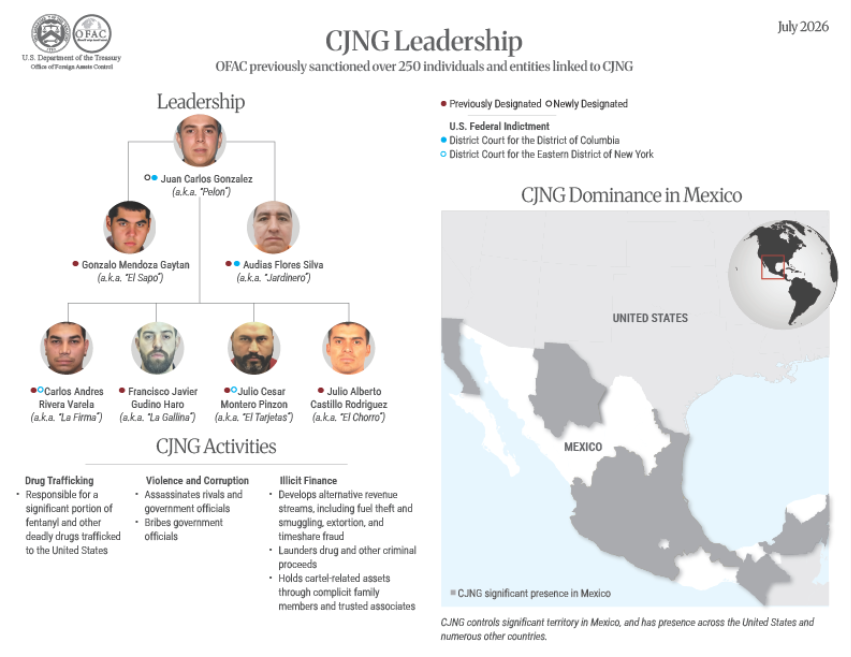
Among those sanctioned is Juan Carlos González, aka “El Pelón,” identified by U.S. authorities as the new leader of the CJNG following the February death of his stepfather, cartel founder, Rubén Oseguera Cervantes, who was killed in a federal operation.

The U.S. State Department has offered a reward of US $5 million for the capture of González, who holds both Mexican and U.S. citizenship.
Also sanctioned was the network of associates and subordinates linked to Audias Flores Silva, aka El Jardinero, who was arrested by Mexican authorities in April.
The UIF review found “inconsistencies” in tax records involving the accused, saying “they present characteristics of shell companies or with corporate structures of limited or no apparent economic activity.”
A complaint was filed with the Federal Attorney General’s Office (FGR) and the 39 individuals — as well as eight others accused of being part of the same CJNG network — were added to the UIF’s Blocked Persons List (BPL).
The BPL is a public report identifying individuals and legal entities involved in money laundering or terrorist financing. All Mexican individuals and companies are required to immediately suspend any and all acts, operations or services with people or entities on the BPL.
With reports from EFE, Infobae, El Economista and La Jornada