The formal review of the U.S.-Mexico-Canada (USMCA) free trade agreement that has been looming over almost all recent trade issues in the region has officially begun.
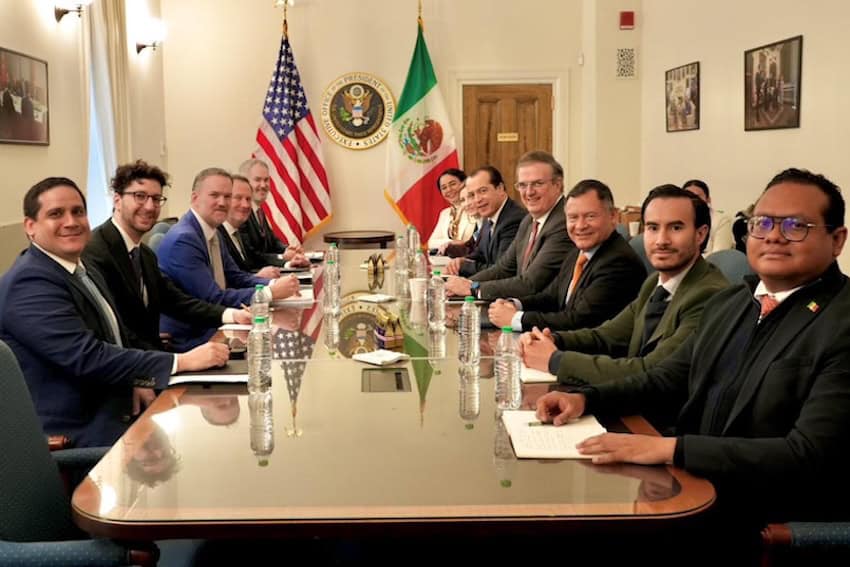
Mexico’s Economy Minister Marcelo Ebrard and U.S. Trade Representative Jamieson Greer sat down with their respective teams in Washington Wednesday to start in-person negotiations.
As had been the case with recent preliminary and informal USMCA review meetings, only two of the three nations participated. Canada is expected to join the talks in May.
Ebrard posted a photo of the two teams at the office of the U.S. Trade Representative (USTR) and explained that the purpose of this first meeting was to discuss the countries’ expectations for the future of the USMCA.
“We held talks with Ambassador Jamieson Greer, head of the USTR, and his team to begin discussions regarding the review of the USMCA,” he wrote. “The technical teams will be working today and tomorrow throughout the day.”
Wednesday’s meeting followed a virtual meeting on Tuesday between representatives of the Mexican Economy Ministry and the USTR to finalize the details and outline each country’s expectations for the review.
Ebrard has indicated that Mexico’s interests lie in resolving issues such as trade asymmetries and the tariffs that the Trump Administration has imposed on trading partners in the last year on products such as steel and aluminum, and on the automotive sector.

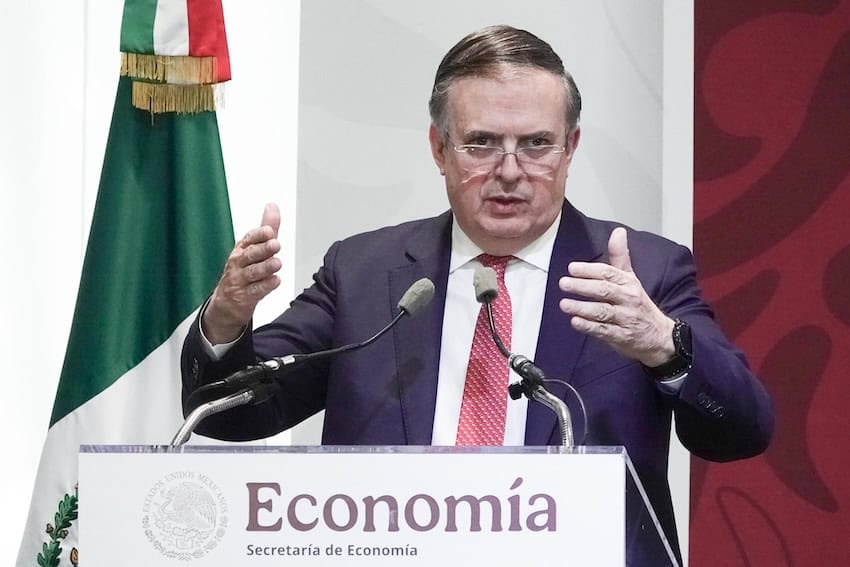
Upon arriving at Wednesday’s meeting, Ebrard told a Mexican TV network that Mexico’s vision is “to reduce our dependence on other regions, to work as a team and to see what we each want to do regarding rules of origin and how we can secure the supply chain.”
As the Los Angeles Times noted, more than US $4 billion worth of goods cross the U.S. borders with Canada and Mexico every day.
After this week’s talks, working groups will begin addressing specific aspects of the treaty’s 34 chapters.
We’re going to present a lot of data; we’re well-prepared,” said Ebrard, who has long held that Mexico’s objective is to guarantee the permanence of the USMCA, based on a strategy of “cool heads and firmness.”
The USMCA under review is the successor to the original 1994 North American Free Trade Agreement. Its future is uncertain, however, given U.S. President Donald Trump’s many lukewarm statements about it, and his demonstrated willingness to impose tariffs on his two neighbors, whom he accuses of facilitating fentanyl trafficking to the United States.
Trump has even suggested the possibility of letting the USMCA expire and seeking separate bilateral agreements with Mexico and Canada.
With reports from EFE, El País and the Los Angeles Times