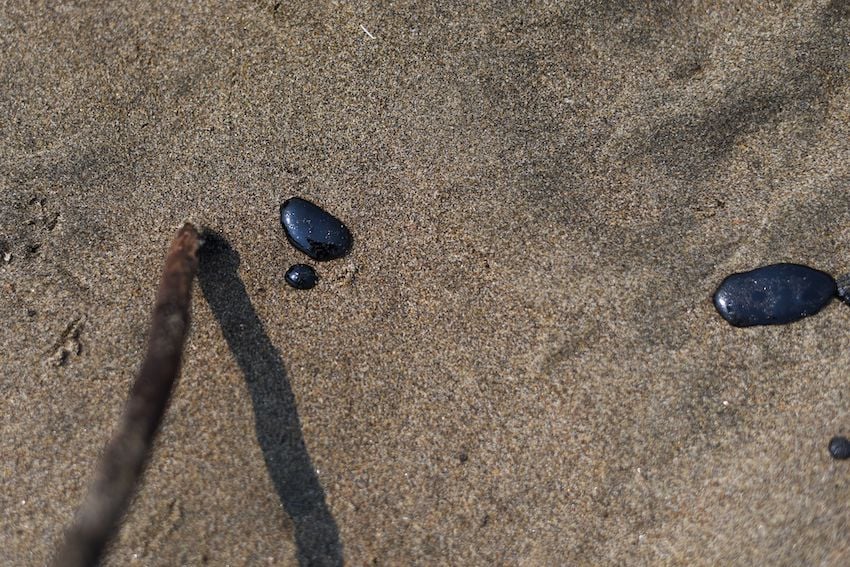
Oil that has contaminated the southern coast of the state of Veracruz may have come from a natural oil seep, Governor Rocío Nahle said Tuesday.
In early March, what appeared to be an oil spill was detected off the coast of Pajapan, a municipality in southern Veracruz that borders Coatzacoalcos. The contamination also affected the Gulf of Mexico coastline in other nearby municipalities. The mayor of Pajapan said last week that fishermen, restaurant owners and tourism were all affected.
The state oil company Pemex promptly denied that it was to blame, saying in a statement that “no leaks or spills” had been detected and that its infrastructure in the region was “operating normally.”
On Tuesday, Nahle said that there were no reports of an oil spill from a petroleum tanker or oil platform.
There is a “theory,” the Veracruz governor said, that the oil that has contaminated the coastline of Veracruz and Tabasco is the result of a “natural” oil seep.

According to the U.S. government’s National Ocean Service, an oil seep is a “natural leak of crude oil and gas that migrates up through the seafloor and ocean depths.”
Naturally occurring oil seeps “account for nearly half of the oil released into the ocean environment every year,” the National Ocean Service says on its website.
Nahle said that federal and state authorities are working together to clean up the oil that has reportedly contaminated beaches as far north as Alvarado, a city about 70 kilometers south of the port city of Veracruz.
Oil contamination extends north and south
Bernardo Hernández Guzmán, leader of the Federation of Fishermen of the Port of Veracruz, said Tuesday that a small oil slick had been sighted in waters off the coast of the city. He also said that “almost imperceptible” quantities of oil had been detected off the coast of Boca del Río, located just south of Veracruz.
Hernández said that local fishermen have stopped fishing because the oil damages their equipment, especially their nets. Fishermen in other parts of the state have stopped work for the same reason, a situation that is economically unsustainable.
In addition to spreading north, the oil contamination has also extended south to affect the coastline of Cardenas and Paraíso, municipalities in Tabasco near that state’s border with Veracruz.
Citing environmental organizations and local residents, the news outlet Infobae reported on Tuesday that the oil contamination was affecting approximately 230 kilometers of coastline in Veracruz and Tabasco. Among the affected areas is the Laguna del Ostión (Oyster Lagoon), a large lagoon located between Pajapan and Coatzacoalcos. Infobae reported that at least nine fishing communities depend on the lagoon.
The coastlines of the Veracruz municipalities of Tatahuicapan, Mecayapan and Catemaco have also been affected by the oil contamination. Infobae reported that locals and members of environmental collectives have detected the presence of oil in coastal areas of the Los Tuxtlas Biosphere Reserve in Veracruz, which, according to UNESCO, “hosts significant ecosystem diversity and nine types of primary vegetation.”
In the northern part of the reserve — which is home to and visited by a wide array of wildlife — residents found a turtle covered in oil, Infobae reported.
Unhappy with the official response to the contamination, residents of many affected communities, including fishermen and tourism sector workers, have reportedly undertaken cleanup efforts themselves, despite potential health risks due to exposure to the oil.
Greenpeace México said in a statement on Monday that “Indigenous and fishing communities are facing an emergency situation, as they have been unable to carry out their main economic activities, such as fishing and tourism, for a week, which has led to significant losses.”
“In addition, they have had to mobilize to respond to the environmental emergency. This situation increases the vulnerability of families who depend on daily income for their subsistence,” the organization added.
Greenpeace also said that “affected communities and cooperatives” haven’t received any compensation for the economic losses they have incurred.
“The situation has caused distress, frustration, sadness, and anger among the communities, who say they are paying the consequences of an industry [i.e. oil] to which they have not given their consent, which does not share benefits, and which, until now, has not taken responsibility for the damage caused,” the organization said a day before Nahle said that a natural oil seep may be to blame for the widespread contamination.
With reports from La Jornada and Infobae