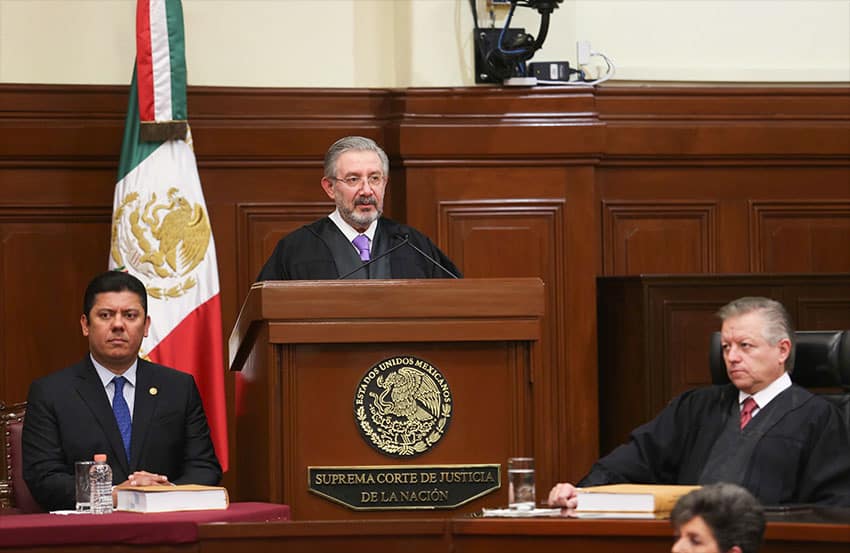
A Supreme Court (SCJN) justice who advocated the abrogation of a constitutional provision that applies mandatory pre-trial detention for suspects accused of certain crimes has withdrawn his proposal.
Justice Luis María Aguilar withdrew his proposal Thursday before it was put to a vote. A majority of the 11 justices expressed opposition to modifying the constitution, meaning that the proposal was doomed to fail had a vote been held.
Aguilar said he would reformulate his proposal in order to present to his SCJN colleagues “a new methodology that allows us to do away with the damaging effects” of mandatory preventive prison, which currently applies to suspects in crimes including homicide, rape, kidnapping, human trafficking, illicit enrichment, fuel theft, burglary and firearm offenses.
He rejected suggestions that his proposal sought to declare an article of the constitution unconstitutional.
“I categorically reject affirming or even insinuating that I propose removing pages from the constitution,” Aguilar said.
Other justices characterized his proposal in that way, and asserted that only the federal Congress has the authority to modify the constitution. The federal government – which argues that mandatory pre-trial detention is fundamental to ensure that suspects don’t evade justice and continue committing offenses – also contended that the SCJN doesn’t have the power to invalidate sections of the constitution.
Although Aguilar withdrew his proposal, he continued to argue for the elimination of mandatory preventive detention, saying that use of the measure violates human rights as it doesn’t respect the presumption of innocence principle.

It “punishes the most vulnerable people,” he added, citing data that shows that 65% of people in preventive custody have low levels of education and over 50% are younger than 35.
“This statistical data allows us to see a cruel reality: over half the people detained in preventive custody are young people with incomplete studies,” Aguilar said.
“Almost half the people in preventive prison earn [just] 5,000 pesos [US$250] a month, almost 20% … are indigenous people and Afro-Mexicans and many of them don’t even speak Spanish.”
With reports from Milenio