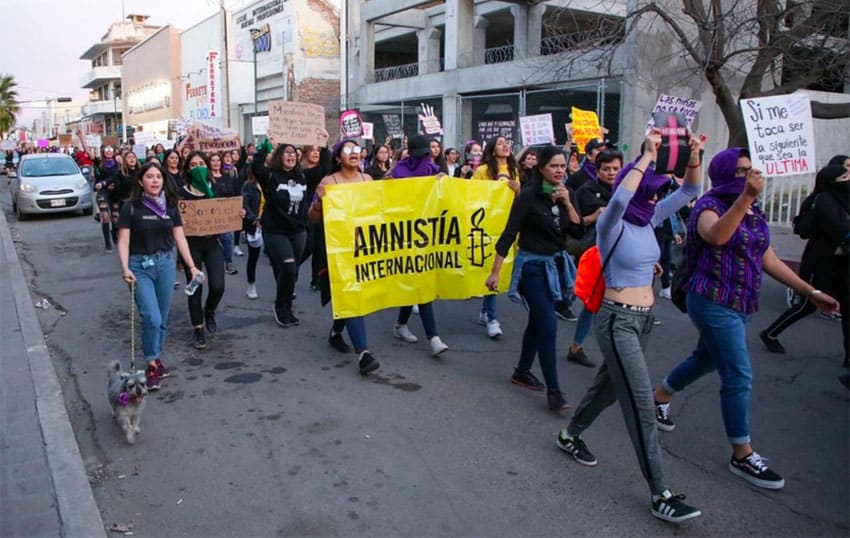
Hundreds of women marched in Hermosillo, Sonora, on Sunday to demand justice for the victims of femicide in the state and to make gender violence more visible.
The protest resulted in the vandalism of the state Supreme Court and other buildings in the city’s Historic Center.
Heeding a call by a youth collective called “Feminists of the Desert,” women of all ages showed up to march, carrying signs and wearing the purple-and-green scarves that have become emblematic of the movement.
The group met at 5:30 p.m. outside the museum and library of the University of Sonora, where they announced that the movement is “separatist” and asked any men in attendance to leave.
They marched toward the downtown business district and historic center, demanding that authorities take action to stop gender-motivated murders.
They accused President López Obrador of minimizing the problem and said that Sonora Governor Claudia Pavlovich has refused to activate the gender violence alert, despite an increase in femicides in the state.
The crime of femicide increased by more than 28% in Sonora in 2019 from the previous year, according to data published by the National Public Security System. There were seven femicides in Hermosillo alone last year.

The protesters painted graffiti on the walls of businesses, the Government Palace and Congress buildings. When they arrived outside the state Supreme Court they read aloud a poem and a list of the names of femicide victims in Sonora.
When authorities turned the lights off outside the courthouse, the protesters demanded they be turned back on. Upon receiving no response, they pulled on the security bars to the court entrance until they succeeded in yanking them loose.
The angry marchers entered the courthouse and broke windows and flower pots, broke into the offices of court officials and removed furniture, destroyed documents and lit a fire in the central courtyard.
State police arrived to control the situation, but they did not make any arrests.
State Public Security Minister David Anaya Cooley said in a statement after the protest that the government was forced to act due to the protesters’ use of violence.
“We obviously have respect for the protests; however, it was turning into a violent demonstration in an institution that is important to Mexican and Sonoran society, so we obviously must take the necessary care to preserve it,” he said.
Source: Milenio (sp)