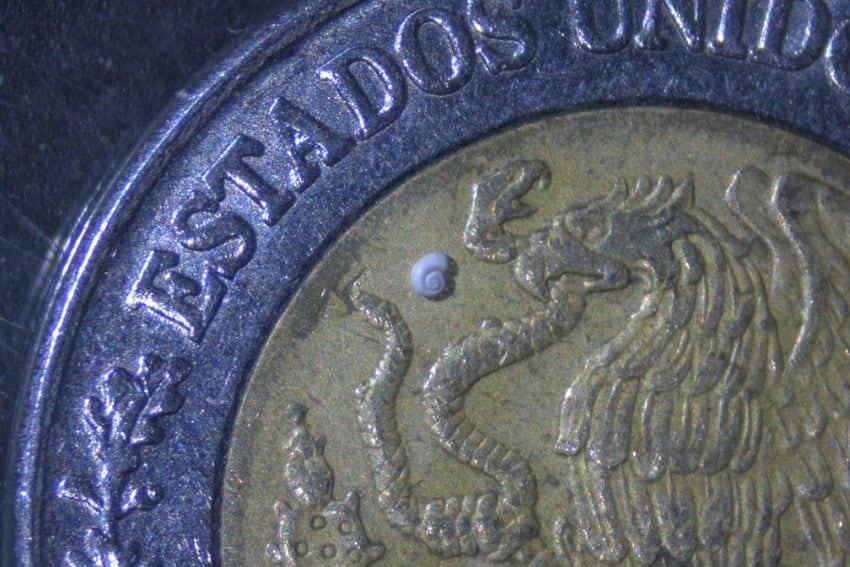
Mexican scientists have discovered the world’s smallest freshwater snail, a transparent mollusk measuring just 0.7 millimeters — about the width of a pinhead — in an underground spring in the northern state of Coahuila.
The new species, named Microphreatus saltillensis, represents not only an entirely new species but also a new genus, according to researchers at the Juárez University of the State of Durango (UJED). Their findings were published in July in the international scientific journal Zootaxa.
#Ciencias | El #caracol más pequeño del mundo fue descubierto en #Coahuila, dentro de una cueva ubicada a 10 kilómetros de Saltillo. Se trata de “Microphreatus saltillensis”, una nueva especie —y también nuevo género— hallada en el manantial de #LosChorros, cuya concha mide… pic.twitter.com/jq2ni0tmsW
— La Jornada (@lajornadaonline) August 7, 2025
The species was named “micro” for its tiny size, “phreatus” for the water tables in which it lives and “santillensis” in homage to the nearby city of Saltillo — which, unrelated to the discovery, happens to be one of Mexico’s best places to live and work.
“When we observed these shells in the samples, we noticed they were even smaller than those of the subterranean snails we commonly study,” said Alexander Czaja, a UJED professor who specializes in malacology, the branch of biology dedicated to the study of mollusks.
Czaja led the team that discovered the tiny creature via a sediment collection between late 2024 and January 2025.

“After a thorough review of the international literature lasting several weeks, we confirmed that this is the smallest freshwater snail described in the world to date,” Czaja added in a recent UJED press release.
The discovery was made in El Chorro, a groundwater-fed spring about 17 kilometers from Saltillo. The snail is considered endemic to this area, though scientists believe more undiscovered species may be living in similar subterranean waters.
More than 80 specimens were collected, revealing striking evolutionary adaptations that allow the snails to live underground in total darkness, among grains of water-saturated sand and sediment.
“These snails have evolved to survive in very specific and hostile conditions,” Czaja said. “Their small size is a necessary adaptation for living among sand particles. They are incredibly specialized organisms for surviving under these conditions.”
The snail’s size is about equal to the thickness of a credit card. The team stressed that underground invertebrates, though often overlooked, serve key roles in nature.
“Every organism plays a role in its ecosystem, even a snail less than a millimeter in size,” Czaja said, adding, “but we’re still in our infancy when it comes to studying them. We still need to understand how they interact, how they survive and what role they play in ecological balance.”
In Mexico, some snails — though not this one — have traditionally been used to make dyes for textiles and clothing. In some cases, this has created environmental concerns due to dwindling snail populations.
This recent tiny discovery in Coahuila isn’t the first time the state has made animal news this year — and at opposite ends of the size spectrum. In March, the focus was on a much, much larger animal, as “mystery giraffes” were seen roaming the countryside.
With reports from Milenio and La Jornada