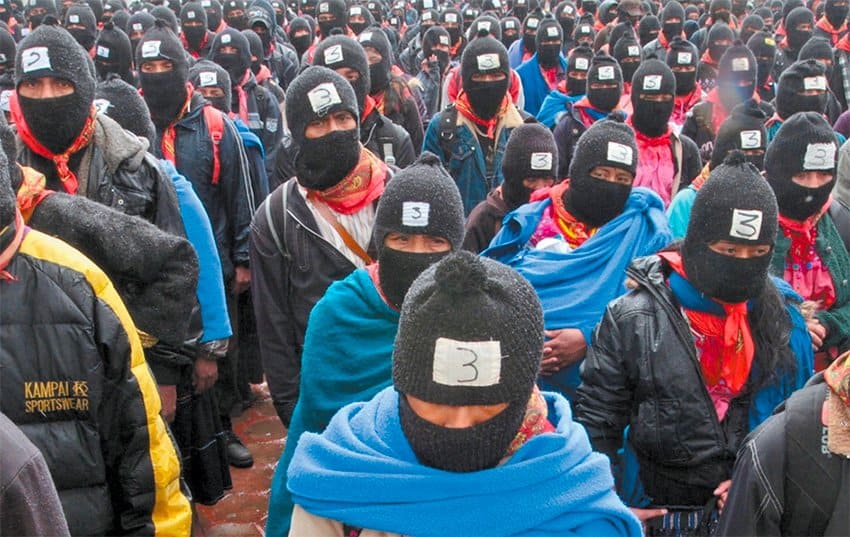
January 1 will mark 24 years since the Zapatista Army of National Liberation (EZLN) emerged from the rainforests of Chiapas to declare war on the Mexican government.
Now they plan to mount another protest movement, this time against President Andrés Manuel López Obrador and his Maya Train project.
The former army is now a political movement and is preparing to raise its voice against the train and other development projects on the first day of the new year, according to a report by the newspaper Milenio.
The organization and two indigenous groups met in October and drafted a text that claimed the new federal government represented a threat to indigenous communities with the Cancún-Palenque train, its trans-Isthmus projects and expansion of the economic zones.
In response, they said, they would create the Networks of Resistance and Rebellion to fight the federal government’s plans.
They also expressed opposition to López Obrador’s plan to plant a million hectares with fruit and other trees in the south of the country, a project intended to promote economic development, the government’s support for mining, its plans to incorporate 50,000 youths into the armed forces and its approval of the new trade agreement that replaces NAFTA.
Pedro Faro Navarro, director of the Frayba Human Rights Center explained that the networks would not only try to bring together indigenous peoples, as it has in the past, but anyone who opposes the country’s system of government.

He said the Maya Train project is only “the tip of the iceberg” for the EZLN and its allies because bringing such a project into Chiapas represents “the dispossession of the indigenous peoples’ lands” and will translate into “confrontations between the government of the ‘Fourth Transformation’ and the native peoples of southern Mexico.”
Large-scale public works projects like the Maya Train provoke the exclusion of the autonomous organized peoples who outright oppose the project, the activist said.
López Obrador has won support for his plans from some indigenous communities and was even honored by indigenous representatives at his official inauguration as president.
But not all see the new president and his Morena party as their political home.
Source: El Sol de México (sp), Milenio (sp)