Uncertainty is rising, tariffs are everywhere, and the USMCA’s 16-year extension failed. You’d be forgiven for expecting Mexican trade to be in shackles. Yet, it isn’t; it’s booming.
Mexican exports to the United States reached an all-time high of $545 billion in 2025 — a 5.8% increase over 2024. And 2026 has kept the momentum: in the first quarter alone, Mexico’s exports to the U.S. hit a record $138 billion, with Mexico accounting for 16.9% of all U.S. goods imports — ahead of Canada at 11.2% and China at 7.4%. During the first semester of 2026, exports grew 25% compared to the same period of 2025 and imports increased 22%.
Let that sink in. Now, buckle up, because multiple things are happening simultaneously.
The USMCA compliance flip
At the start of 2025, roughly 45% of Mexican exports to the United States entered under the USMCA. The alternative — the WTO’s Most Favored Nation (MFN) mechanism — came with a modest 3% tariff (more or less), so many companies simply didn’t bother qualifying. Then Trump’s tariff regime changed the math completely.
When the U.S. slapped 25% tariffs on non-USMCA Mexican goods, USMCA utilization rates jumped from 45% to 89% between January and November 2025. The opportunity cost of doing otherwise is now 10x higher.
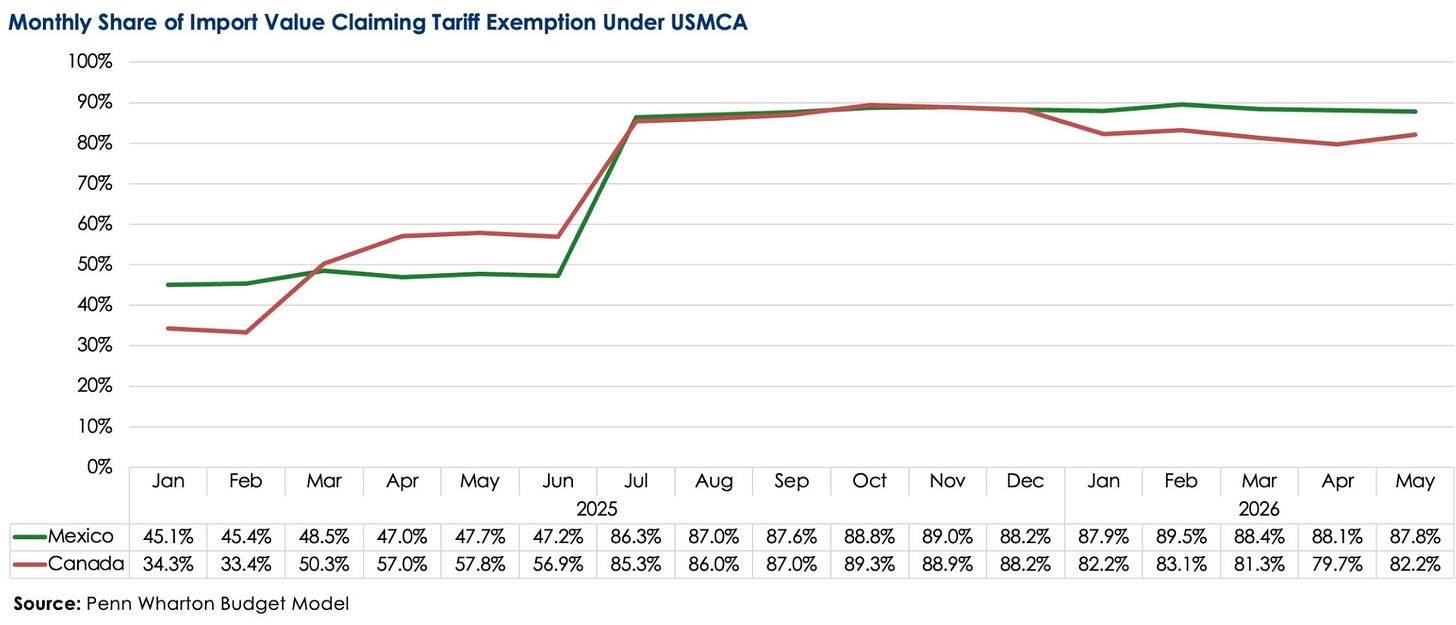
The result: for USMCA-compliant exporters, the effective tariff rate on goods shipped to the U.S. is now near zero; 3.74%, to be precise. Compare that to the 23.4% effective rate on China, or the 7.19% global average. Mexico, paradoxically, ended up in a more competitive position after the tariff shock than before it. Remember: the absolute value of tariffs is not as important as their relative value compared to your competitors.
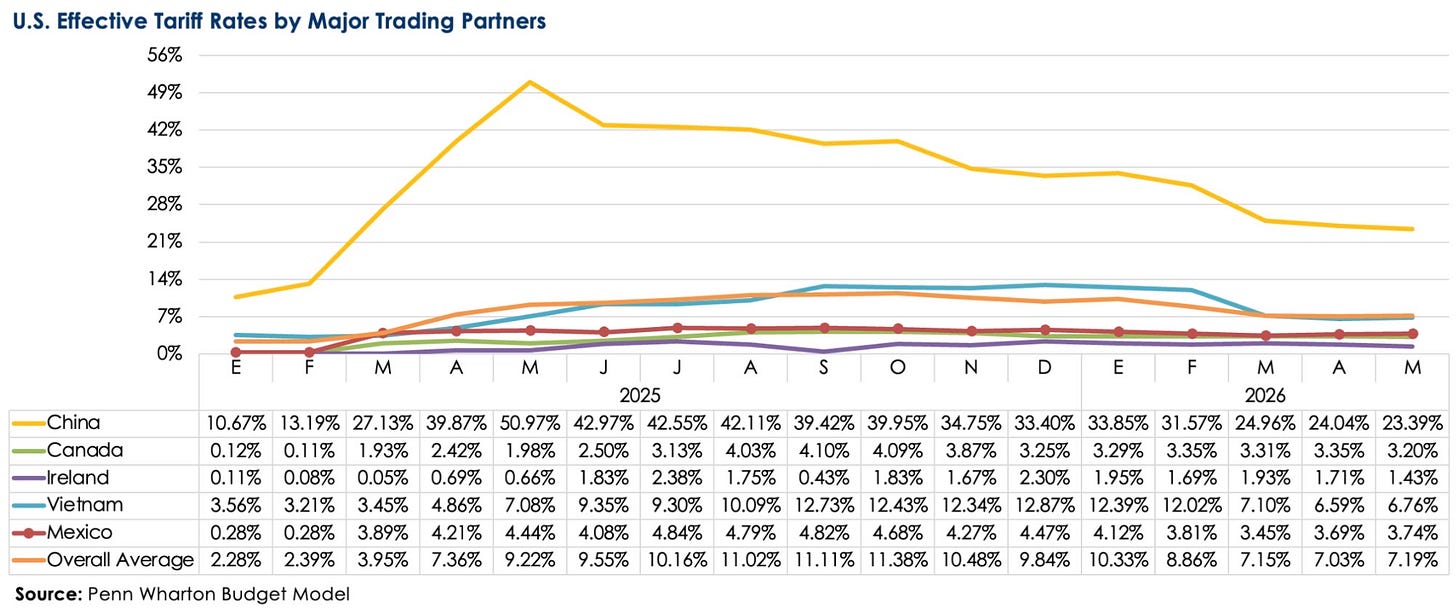
So, yes, exports and imports are increasing, but is it just more of the same or has something changed?

The king is dead. Long live the data center
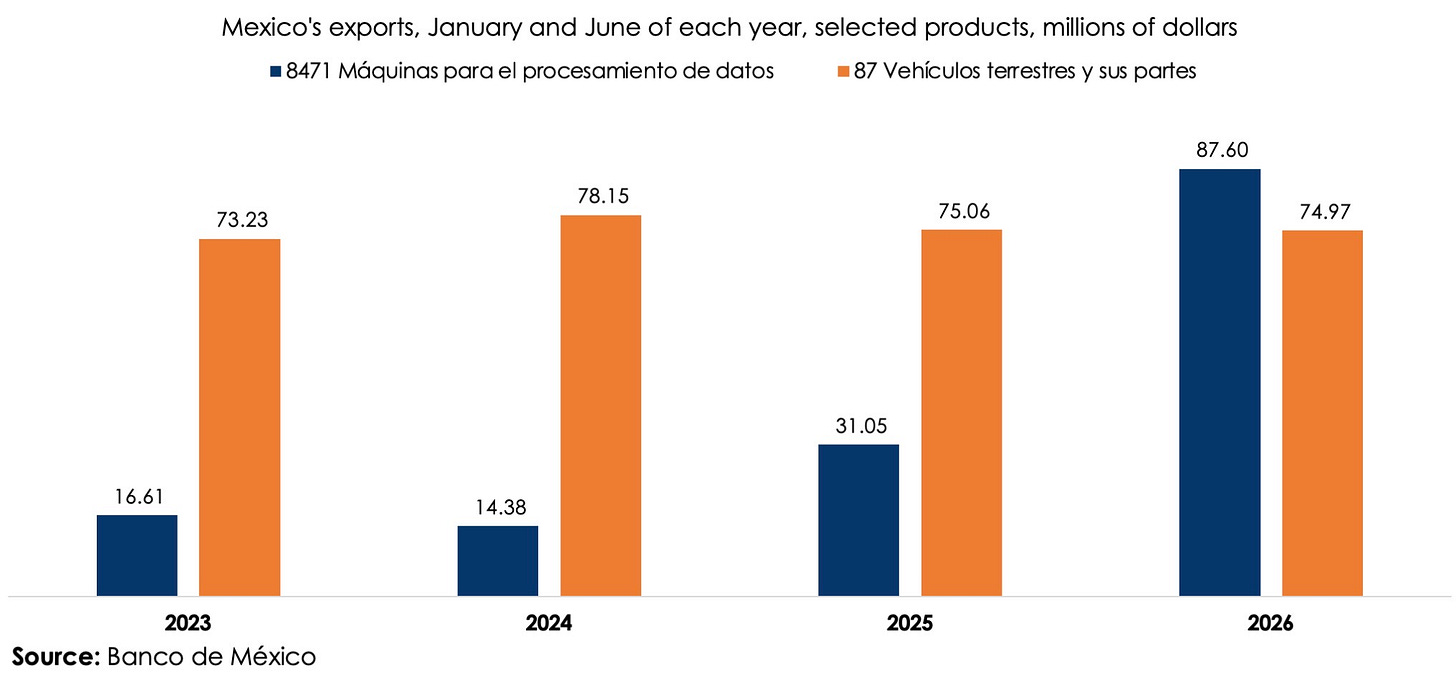
For 30 years, one product category ruled Mexican exports without interruption: automobiles and auto parts. That era just ended.
In the first half of 2026, computer-related exports from Mexico reached $87 billion — a 280% increase from the same period a year earlier. That places computing equipment ahead of automobiles and auto parts, which generated $74.9 billion over the same six months.
For the first time in three decades, the king was dethroned — not by another car, but by a server rack.
The AI revolution is not only the usage and high dependency on Claude, ChatGPT and its friends. It’s the physical machines that make it possible. Mexico is now building them, or at least assembling them… Wait, who’s that guy over there? Taiwan?
Who invited Taiwan to the party?
How did Mexico pivot from autoparts to data processing machines in a year? The answer has two parts, and one of them is uncomfortable.
The first part is legitimate: Mexico has the installed manufacturing capacity — the plants, the workers, the logistics — to pivot from manufacturing one type of electronic component to another. Tijuana is increasingly positioned as a semiconductor ecosystem hub, serving U.S. technology and electronics manufacturing. Ciudad Juárez, Guadalajara and Tijuana are the capitals of Mexico’s electronics industry. Adaptability and resilience at their core.
The second part is where it gets complicated. In the first five months of 2026, Mexican exports of AI-related electronic inputs climbed 313% compared to the same period the previous year. But a significant share of the inputs behind that growth is not North American — it’s Taiwanese. Mexico’s imports from Taiwan surged 256% last year, and the intensity of it is climbing this year. U.S. imports from Taiwan increased in a similar proportion. The only difference is that the U.S. imports 200 billion; Mexico 1.7 billion (118x less).
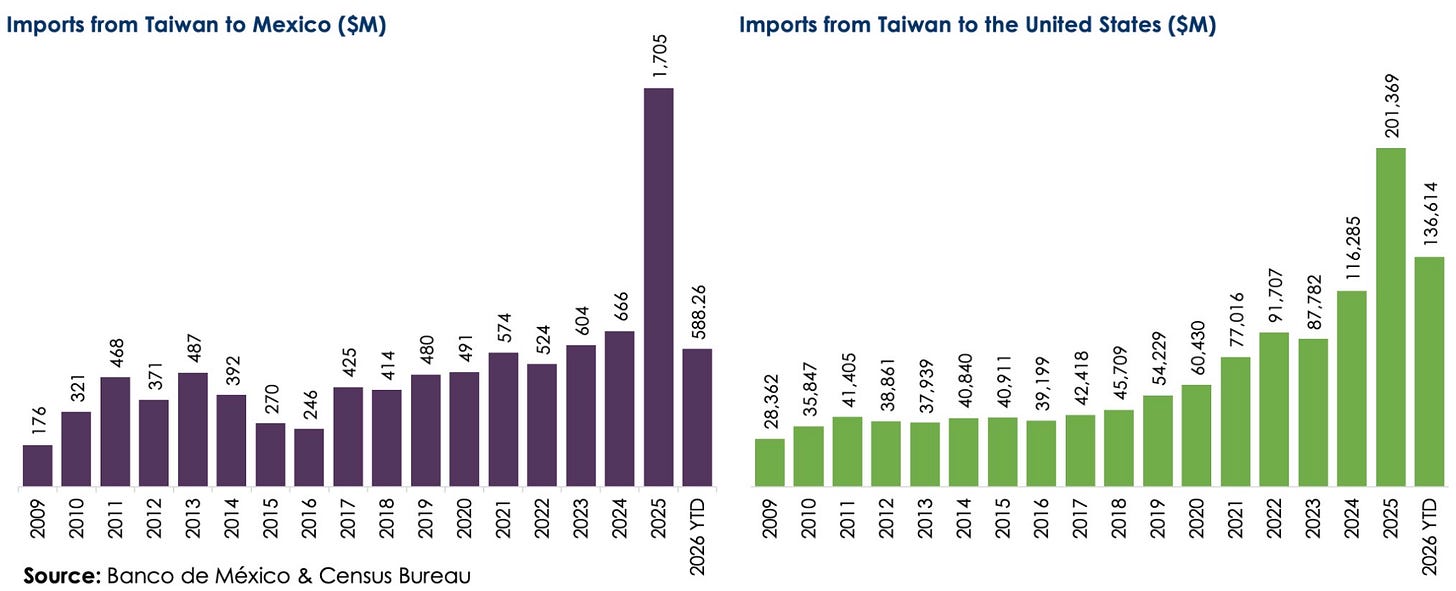
Mexico is, in many instances, assembling and integrating components that arrive from Asia, then shipping the finished product north. That’s not nothing — assembly creates jobs and keeps supply chains on this side of the Pacific. But it’s not the same as manufacturing a vertical regional integrated supply chain. And it’s exactly the distinction that the USMCA review negotiations will eventually force us to confront, through stricter rules of origin and regional value content requirements.
So what comes next?
The shift from automotive to electronics is probably unstoppable at this point. But it brings real complications that nobody is talking about enough.
Automotive is labor-intensive. Electronics, much less so. The car industry has been the poster child of North American regional integration — entire communities built around plants, supplier networks spanning three countries, millions of jobs at every skill level. The electronics and data center supply chain doesn’t replicate that model. It employs fewer people, requires different skills and, for now, depends heavily on inputs from the other side of the world.
AI data centers are also strongly dependent on energy and water. If North America is serious about building this supply chain regionally, we need to invest heavily in energy capacity. This isn’t a nice-to-have. Computers and related electronic equipment already account for much of the increase in AI-related trade, becoming a key driver of U.S.-Mexico commerce. The infrastructure demands will only grow from here.
North America must also work on reducing its dependence on Taiwan — without getting into why, the geopolitical logic is self-evident. The goal has to be a regional co-production platform that genuinely aggregates value in the electronics supply chain and creates high-quality jobs across the three countries, not just assembly operations dependent on Asian inputs.
Lavoisier was right: matter is never created or destroyed, only transformed. North American supply chains are transforming at a speed that few predicted and even fewer have fully processed. The question is not whether the transformation happens. The question is whether we get ahead to make the most of it, or we end up being just spectators.
Special thanks to Arturo Martinez who worked on the graphs and gave me valuable insights.
Pedro Casas Alatriste is the Executive Vice President and CEO of the American Chamber of Commerce of Mexico (AmCham). Previously, he has been the Director of Research and Public Policy at the US-Mexico Foundation in Washington, D.C. and the Coordinator of International Affairs at the Business Coordinating Council (CCE). He has also served as a consultant to the Inter-American Development Bank.