There is a genre of political video you have probably seen before, even if you didn’t have a name for it. A leader boards a commercial flight. They greet the crew warmly. They open a laptop. The camera catches it all at just the right angle. It goes viral. We call it transparency.
It isn’t.
What we are watching — when President Claudia Sheinbaum flies economy to Barcelona, or to Rio, or to Ottawa — is not a candid moment. It is a produced one. Her team filmed it, edited it and released it. That single fact should change everything about how we read it. Your own communications office does not film a spontaneous gesture. What they film is a choreography.
I want to be precise here, because this argument is often misread: I am not saying Sheinbaum is a bad president. I am not saying the video is a lie. I am saying it is a genre — one with a long history and a very specific purpose — and that we should know the difference between the genre and the thing it is designed to represent.
The oldest trick in the modern playbook
Edward Bernays, Sigmund Freud’s nephew and the man who invented public relations as a discipline, understood something about human psychology that politicians have exploited ever since: people do not respond to arguments as much as they respond to images. A well-chosen image doesn’t just inform. It feels like proof.
Bernays called it the “conscious and intelligent manipulation of organized habits and opinions.” He was not being cynical. He genuinely believed that democracy and businesses required this kind of management, that the masses needed to be guided by the right emotional signals. Whether or not you agree, his mechanics were correct: a striking image can rearrange a person’s fears and desires faster than any speech or statistic.
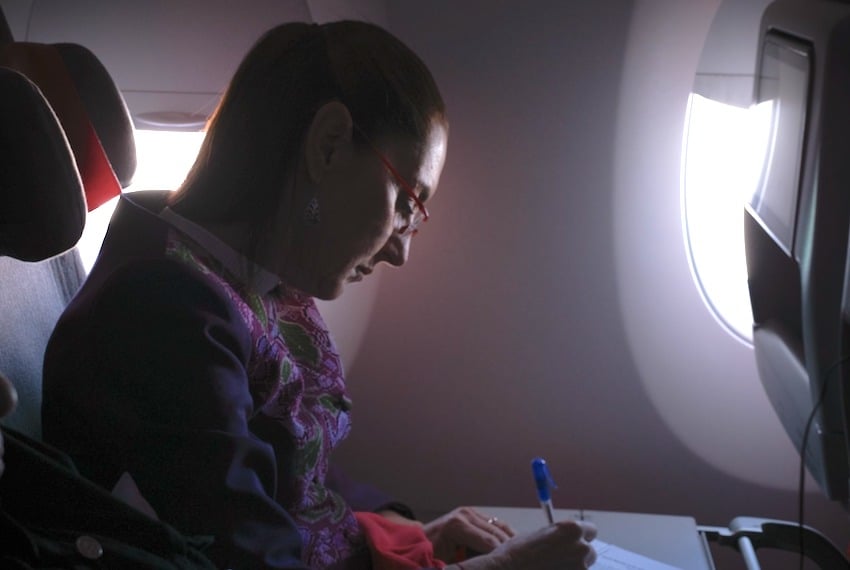
The boarding a commercial plane video is a Bernays masterclass. Its message is not spoken — it doesn’t need to be. The image says everything: here is a president who is one of you, who lines up and works mid-flight as you do, who does not believe she is better than you.

It is good storytelling. The problem is that good storytelling and good governance are not the same thing, and confusing the two has costs.
Barcelona as a case study
Let’s use the Barcelona trip itself as the test. Strip away the images and ask what the trip was actually for, and what it accomplished.
The official purpose was the In Defense of Democracy summit — a gathering that, by its very name, carried serious weight. In practice, it operated as two parallel events: a broader forum for progressive political movements from around the world, and a separate meeting of the heads of state of Brazil, Colombia, Uruguay, Spain and the president of the European Union. When a reporter at Sheinbaum’s April 16 press conference called it an “anti-Trump meeting,” Sheinbaum immediately corrected the label. “It’s not an anti-Trump meeting at all,” she said. “I consider it a meeting for peace.”
That rebranding happened before the president even boarded the plane — and it is worth pausing on. The same trip was simultaneously framed as a bold gesture of diplomatic normalization with Spain. Each audience received the version most useful to them. That is not communication. That is product placement.
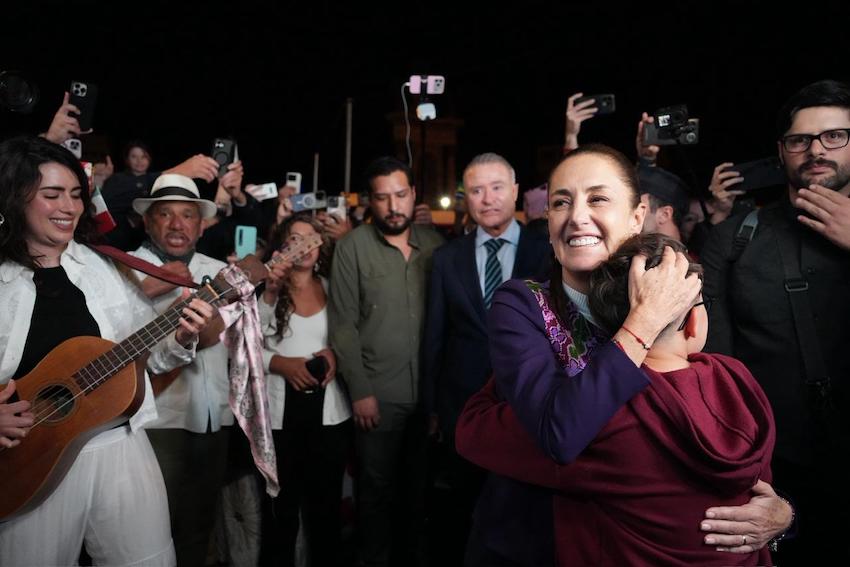
What remained were the images: Sheinbaum in economy class, Sheinbaum greeted by Mexicans waving flags, Sheinbaum hugging a musician from San Miguel de Allende. A gathering ostensibly convened to defend democracy and discuss global peace had been converted, in the public conversation, into a display of presidential warmth and accessibility. The policy content evaporated. The optics survived.
If we ask what the trip accomplished diplomatically, the picture becomes even thinner. This was not a state visit to Spain. There was no meeting with the Spanish royal family — the direct target of AMLO’s original letter demanding a formal apology for the crimes of the Conquest, and therefore the symbolic party with whom any genuine institutional rupture existed. Embracing Pedro Sánchez is ideologically coherent, but it is not the same as repairing Mexico’s relationship with Spain as a country. Isabel Díaz Ayuso, president of the Community of Madrid, dismissed the entire event as a “narco-state summit” — a signal that whatever symbolic repair occurred was felt by some Spaniards and not others.
Now zoom out further and the foreign policy picture becomes harder to read. Sheinbaum declined an invitation to Davos, sending representatives in her place — forfeiting a stage where leaders shape their countries’ economic narratives directly.
She has not made a high-visibility visit to Washington, D.C., nor to the Mexican communities in Los Angeles, Chicago or Houston, where millions of her compatriots — many undocumented, many living under the threat of deportation — would have the most to gain from that symbolic and political embrace. Barcelona’s Mexicans got the hug, the flags, the musicians. The Mexicans in the United States, who are navigating one of the most hostile political climates in recent memory, are still waiting.
This set of choices reveals her priorities. Barcelona offered a friendly crowd, ideological alignment and a controlled environment. Washington would offer tension, risk and the kind of visibility that cannot be fully managed. One of these trips is better PR. The other would be harder, more meaningful diplomacy.
What the coach seat doesn’t tell you
A boarding pass tells you nothing about the judicial reform that many legal experts warn will weaken Mexico’s justice system. It tells you nothing about energy policy, about PEMEX, about what happens in classrooms across the country. It tells you nothing about whether the person in that seat will make decisions that improve your daily life or complicate it.
This is not a trivial distinction. Every minute we spend discussing the president’s seat assignment is a minute we are not spending on any of those questions. And that displacement — of the substantive by the symbolic — is not accidental. It is the point. The boarding pass video does not just generate goodwill; it consumes oxygen. It fills the conversation so efficiently that there is less room left for everything else.
Reunión en el consulado de Barcelona con mexicanas y mexicanos residentes en España. pic.twitter.com/FdzLRoBVn9
— Claudia Sheinbaum Pardo (@Claudiashein) April 18, 2026
Travis Bembenek asked in his column this week what it would take for Sheinbaum’s critics to approve of her leadership. It’s a fair question, but it may be the wrong one — not because Sheinbaum doesn’t deserve evaluation, but because a president’s “approval” is not actually the job of a citizen.
We were never supposed to be fans
Somewhere in the last two decades of political branding, we confused two very different relationships: the relationship between a consumer and a product, and the relationship between a citizen and a government.
Consumers approve or disapprove. They rate, they recommend, they return. Politicians — and the communications teams that serve them — have learned to exploit this instinct brilliantly. They run permanent campaigns not because elections never end, but because approval ratings are easier to manage than policy outcomes. An image of a president in economy class is measurable, shareable and emotionally immediate. A structural reform of the energy sector is none of those things.
The result is that we have learned to evaluate governments the way we evaluate restaurants: based on how the experience felt, not on whether the food was actually nutritious. And a president who understands this — who is skilled at managing the emotional register of her image — has a significant advantage over citizens who haven’t noticed the mechanism.
Approval, in a democracy, was never supposed to be the goal. Accountability was. Those are not the same thing, and one of them requires us to look past the boarding pass.
What I’m actually asking for
I am asking that we, as citizens and as readers, learn to notice when we are being shown a symbol in place of a substance, and resist the substitution. Symbols, after all, are most powerful when they point toward something real. This one points toward a seat.
The president of Mexico does not need our approval to govern. She needs our attention — the sustained, critical, unglamorous kind that does not fit in a 40-second vertical video. The kind that asks what the judicial reform will mean for ordinary people five years from now. The kind that notices which questions get answered at the morning press conference and which ones don’t. The kind that looks at a trip to Barcelona and asks not how it felt, but what it changed.
That is not cynicism. It is citizenship. And it is the one thing no communications team, however talented, can produce for us.
I will add one last thing: A president is not a private citizen — the office itself transforms whoever holds it.
The political, economic and social consequences of anything happening to her mid-flight are immense, and no amount of good optics is worth that risk. Austerity is admirable until it becomes reckless, and a head of state boarding a commercial aircraft with strangers is, by any security standard, closer to the latter than the former.
Maria Meléndez writes for Mexico News Daily in Mexico City.