Home Blog Page 1036

Journalists’ group condemns government’s ‘inaction’ after another reporter killed

0
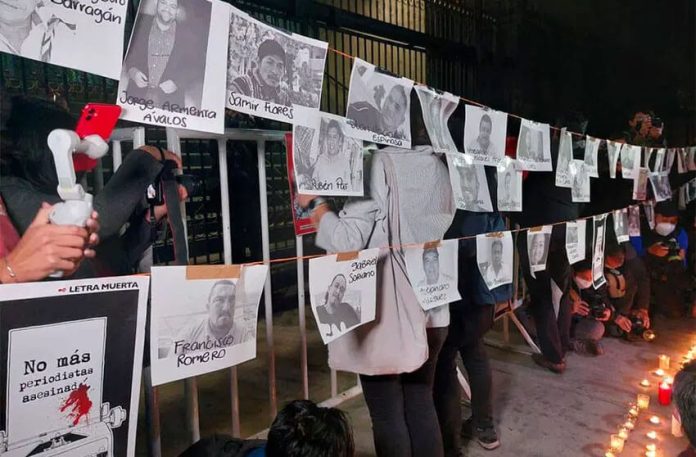
Protesters hang photos of murdered journalists at a January demonstration in Mexico City.
Protesters hang photos of murdered journalists at a January demonstration in Mexico City. Archive

The Committee to Protect Journalists (CPJ) has condemned the federal government’s “inaction” after the murder of yet another journalist last week.

The body of Juan Carlos Muñiz was found with multiple gunshot wounds in a taxi in Fresnillo, Zacatecas, last Friday. Muñiz was a reporter for Fresnillo news website Testigo Minero and other outlets, as well as a taxi driver.

He is the eighth media worker to be killed this year, at least six of whom were practicing journalists.

The CPJ, a New York-based non government organization, said Wednesday that authorities must immediately and thoroughly investigate Muñiz’s murder and determine whether he was killed because of his journalism. Federal government communications coordinator Jesús Ramírez has already said that a through investigation will be carried out and that the crime will not go unpunished.

CPJ Mexico representative Jan-Albert Hootsen said that the “brutal slaying” of Muñiz extended Mexico’s “staggering streak of journalist killings in 2022.”

The murder is “a stark example of the extreme risk that local reporters covering politics and crime face on a daily basis,” he said.

“The Mexican government’s inaction allows the impunity that fuels these attacks to fester and cement its abysmal status as the hemisphere’s deadliest country for journalists.”

President López Obrador has also been accused of fomenting hostility toward journalists and the media more broadly via his repeated verbal attacks on critical press at his morning news conferences.

On Wednesday he took aim at television and radio presenter Azucena Uresti, criticizing her for describing Mexico City as a “walled city” due to the barricades installed around the National Palace, Metropolitan Cathedral and other buildings and monuments to protect them during Tuesday’s International Women’s Day march.

López Obrador said it was clear that Uresti “doesn’t like us” and will use anything she can against the government. He mocked her for broadcasting from the “walled” headquarters of the Milenio media group and compared her to other journalists he frequently derides, including Carlos Loret de Mola, as well as foreign newspapers he regards as mouthpieces of conservatism and private companies.

“They defend vested interest groups and they’re against governments that seek to combat corruption and help the poor. They’re media outlets of the oligarchy, to say it clearly – those here and those there [in the United States and other foreign countries],” López Obrador said.

Azucena Uresti tweeted a response to the president’s Wednesday criticisms.

“If you look at The New York Times, The Washington Post, The Wall Street Journal, Financial Times, El País from Spain, they’re all the same,” he said.

Uresti responded to the president on Twitter, asserting that she doesn’t take orders and isn’t in favor of any vested interests.

“I ask you, in the most respectful way, to show proof of your statements,” she wrote.

With reports from El Universal 

Passion for astrobiology leads student to NASA program

0
Ivana Naomi Millán Flores in the laboratory.
Ivana Naomi Millán Flores in the laboratory. Tec de Monterrey

A university student in México state has been selected to participate in an astrobiology program at NASA.

Ivana Naomi Millán Flores, 22, spent hours staring through her telescope at the night sky as a child. Now in her eighth semester in biotechnological engineering at the Monterrey Institute of Technology and Higher Education (Tec de Monterrey) México state campus, she has been chosen to join the International Air and Space Program to spend a week at NASA.

Millán was selected due to her investigation into the effects of the absence of gravity on cancer cells.

She is raising money through a crowdfunding campaign to be able to make this trip to NASA in the fall, as she still doesn’t have the funds to cover transport and accommodation.

Millán said that inspiring women to study engineering is one of her main motivations.

Millán has launched a crowdfunding campaign to fund her participation in the NASA program.

“My priority is to return to Mexico to share the knowledge with those who want to be part of these projects. I think a big problem with women studying engineering is the lack of representation and exposure in the media,” she said. “… On social media I’ve received a lot of messages from girls who say they want to go to NASA when they grow up. It touches my heart to be able to be that example that I would have liked to have as a child.”

“I’m not going to NASA alone. I’ll take with me all the Latin American and Mexican women who want to make a change in their community,” she said.

Millán added that her openness to new experiences had been of benefit to her.

“I think a lot of people are insecure about doing new things … It’s a very important learning experience. Here you can train like any astronaut, from diving to flying a plane. I want to learn a lot more about the field of aerospace engineering and meet people from all over the world who are passionate about the same thing as me,” she said.

The student also gave credit to her university for helping to shape her character.

“Thanks to Tec I know what it is to be an entrepreneur, to be a leader. I know values like honesty and love … The Tec has given me the tools to be humble and understand that everything we have is to be shared … to put our knowledge at the service and disposal of everyone … to be an agent of change … this wouldn’t have been achieved if I hadn’t studied here,” she said.

Mexico News Daily

War in Ukraine could help drive inflation to 10%, economist warns

0
Annual inflation rose to 7.28% in February, INEGI reported.

Inflation could increase to close to 10% by the end of the year if inflationary pressures – some of which are related to the war in Ukraine – persist throughout 2022, according to the chief economist at Banco Base.

Annual inflation rose to 7.28% in February from 7.07% in January, according to data published Wednesday by the national statistics agency INEGI.

Russia’s full-scale invasion of Ukraine, which began on February 24, is causing prices for some raw materials to rise, which could lead to higher inflation in Mexico.

Bank of America Securities (BofA Securities) has warned that fuel prices in Mexico will increase as a result of the invasion, and has adjusted its end-of-year inflation forecast to 6% from 5%. Banco Base upped its end of 2022 outlook to 5.5% on Wednesday.

That bank’s chief economist, Gabriela Siller, warned that price increases could exceed that forecast, noting that two weeks after the war in Ukraine began, there is a high level of uncertainty with respect to inflation.

“The inflation forecast for the end of the year could be revised toward … 8% if similar inflationary pressures to those seen during January and February are seen between March and June,” she said.

Higher global demand for goods during pandemic-related supply chain disruptions have already fueled inflation, which is currently more than double the Bank of México’s target rate of 3%, give or take a percentage point.

“If the inflationary pressures persist until the end of the fourth quarter, the risk rises that … annual general inflation will approach 10%,” Siller said.

Mexican bank CIBanco also warned of the possibility that higher inflation will be seen due to the higher costs of raw materials including oil.

“In the short term (the end of the second quarter or start of the third) it cannot be ruled out that … [inflation] could approach 8% annually,” it said, noting that such a rate would be the highest since 2000. The bank said that it didn’t expect to see inflation within the central bank’s target range until 2023.

Bank of México board member Jonathan Heath said on Twitter Wednesday that data indicated that core inflation hadn’t peaked in February and will therefore continue to rise. He also said that the conflict in Ukraine will clearly place upward pressure on inflation.

Higher costs of raw materials, including oil, could drive inflation at the pumps and elsewhere.

“High inflation will be more persistent than we had anticipated, both in Mexico and at the global level,” Heath wrote.

The latest inflation data raises expectations that the central bank will continue to increase its benchmark interest rate, which is currently 6%.

“We expect that the Bank of México will lift [rates] 50 basis points in March, May, June, August and September and then return to 25 basis point increases in the last two meetings of the year in November and December,” BofA Securities said.

That would leave the central bank’s benchmark rate at 9% at the end of the year.

BofA Securities is forecasting growth of just 1.5% for the Mexican economy this year, and acknowledged that there are downside risks to that prediction.

It said that higher oil prices – Mexican crude reached its highest price since 2008 on Tuesday – will result in higher revenues for Pemex and other producers, but warned that consumers and the government will spend more on gasoline, the latter due to greater spending on subsidies to limit the price increases at the pump. Motorists would thus be left with less money to spend on other consumer products, which would adversely affect overall growth.

With reports from El Universal and Milenio
Toluca’s stunning Sun Man masterpiece remains little known elsewhere

0
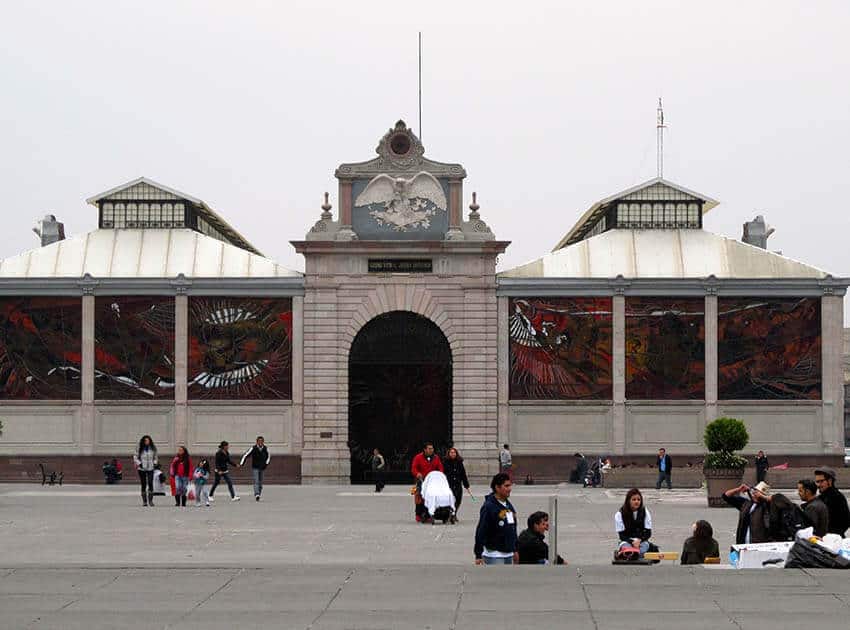
Known as The Sun Man, this is only one part of Lepoldo Flores' massive 71-stained-glass-panel mural, finished in 1980, but it's the most popular with visitors. Gustavo Von

Long gone are the days in Mexico when the equinox had spiritual significance — or are they?

Many of the country’s archeological sites, such as Teotihuacán and Chichén Itzá, bring thousands of people to see the sun rise in these places in March. But in the unassuming industrial city of Toluca, México state, just west of Mexico City, there is a modern “temple” to the cult of the sun.

This building is the site of the former 16 de Septiembre mercado, Toluca’s main market in the early 20th century. Covering about half a hectare, it was built, in art nouveau style, before the Mexican Revolution.

By the end of the 20th century, even this impressive building became too small for its purpose as growing industries swelled the city’s population. The market’s enclosed design meant there was no way to expand it, so it was abandoned for a newer facility in the city.

The government looked to repurpose the building, which was too beautiful and centrally located to let decay. Today, its original large windows allow for a botanical garden here with over 400 species of plants, covering about 3,200 square meters. It is dedicated to Japanese scientist Eizi Matuda, who classified over 6,000 species of plants in this region.

Botanical Garden in Toluca, mexico state
Overview of the botanical garden looking towards the sun panel on the east end. JC Castaneda

But the building’s main attraction is the massive artwork done by local artist Leopoldo Flores.

Flores (1934–2016) is arguably one of the most important Mexican artists to come out of Toluca, creating other monumental works, mostly in the city and the surrounding area. Toluca has created a museum in his honor associated with the state university to safeguard and promote research into many of his works.

His concept for this particular artwork was novel for Mexico, a mural done in multiple panels and using stained glass to take advantage of the window spaces that surround the upper parts of the building and its eastern and western ends.

Flores worked with 60 artisans from 1978 to 1980 to get the sections assembled and installed. It took him a year to work out the artwork’s concept and basic engineering issues. They replaced the market’s old, clear windows with 71 stained glass panels — half a million 15- to 45-centimeter pieces of imported blown glass in 28 different colors.

It all weighs 75 tons: 45 tons of glass, 25 tons of lead and 5 tons of metal supports. It’s so massive that cleaning it — a 15-month process using only water (chemicals could damage the glass), a fine wire brush and rags — involves several people who finish, only to start again.

The piece tells a story of Man and his relationship to the universe, hence its name: Cosmovitral (glass cosmos). According to the artwork’s website, the work represents “… the dualities and antagonism of cosmic forces like day and night, life and death, creation and destruction…” On the north side of the building, blue hues dominate, with brighter colors on the south side. An image of the sun is placed on the east side.

Main entrance to the Cosmovitral building, Toluca
Main entrance to the Cosmovitral building from the plaza. Octavio Alonso Maya

All its panels receive attention from the public, but the most important and popular by far is the Sun Man, a Leonardo da Vinci-like depiction of a male superimposed onto a solar motif, placed not on the east but on the western side of the building on ground level.

It is not only the most impressive and most accessible of Flores’s panels year-round it’s also the site of an impressive effect during the equinox: in the few days before and afterward, the setting sun aligns itself with the torso of the artwork’s male figure, appearing to set the whole work ablaze.

Interestingly enough, Flores did not emphasize this fact when he created the mural, so it is not known whether he was aware of this effect. It was only noticed in 1993 — 13 years after it was installed — by the botanical garden’s director Oliverio Jiménez in 1993.

The best of the spectacle lasts only 20 minutes. These days, a classical music concert worked out specifically for it accompanies the phenomenon. Limited seating inside the building makes the event highly anticipated and difficult to see in person. The spring equinox is far more popular than the one in the fall.

It has become an important tourist attraction for a city with few of them, as well as an important symbol for México state, which lives in the shadow of Mexico’s massive nearby capital city. The image is used heavily in the city and the state’s promotional materials.

However, most of the Cosmovitral’s visitors are from México state and the surrounding region. Very few foreigners are aware of it or its twice-annual spectacle. The site is worth a visit when passing through the area, even if it’s not the equinox. It is the largest secular stained-glass work in the world, and tour guides can explain the meanings of its different panels (in Spanish).

Cosmovitral is also a popular venue for weddings and portrait photos. It is part of a tapestry of other important locations in the city center, including the cathedral, various museums  and the surrounding shops and restaurants.

When I lived in Toluca (2003–2008), a massive semipermanent street market that took over a central plaza made visiting difficult. This site has since been moved to another part of town, allowing for better views.

What has not changed is the city’s chilly climate during most of the year, so a sweater or jacket is definitely recommended, especially at night.

Leigh Thelmadatter arrived in Mexico 18 years ago and fell in love with the land and the culture in particular its handcrafts and art. She is the author of Mexican Cartonería: Paper, Paste and Fiesta (Schiffer 2019). Her culture column appears regularly on Mexico News Daily.

Glyphs deciphered on frieze at Oaxaca archaeological site

0
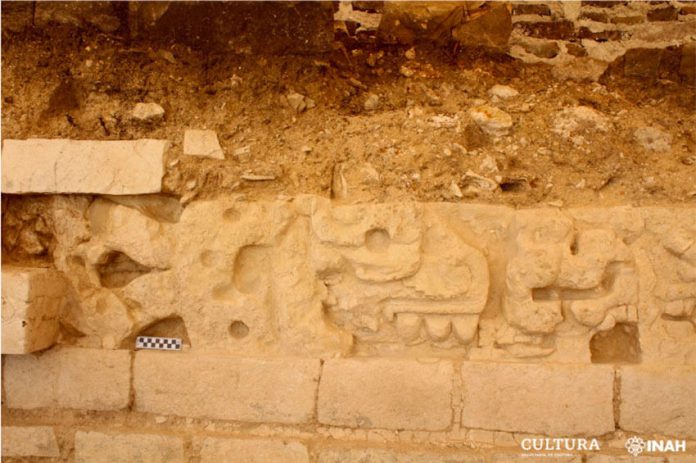
Some of the glyphs that have been interpreted
Some of the glyphs that have been interpreted at Atzompa.

Researchers with the National Institute of Anthropology and History (INAH) have announced their interpretation of a large stucco and limestone frieze discovered three years ago at the Atzompa archaeological site, located near the Monte Albán complex just outside Oaxaca city.

INAH said in a statement that the political, economic and social power that the Atzompa residential area had within the Zapotec capital of Monte Albán between A.D. 600 and 900 and the important relations its inhabitants established with the Mixteca region are some of the details revealed through the iconographic interpretation.

The frieze – which contains a series of Zapotec and Mixtec glyphs depicting the Mixtec year of the lizard, numerals, personages and a quetzal, among other things – has a well conserved section measuring 15 meters. The glyphs carved onto it constitute the longest Zapotec text of its kind known to exist in the Oaxaca Valley, according to Nelly Robles García, who heads up an archaeological project at Atzompa.

“Glyphs in general are allusions to power in the city, supernatural protection and a timeless time,” she said.

“Due to the location we know that it’s a message or discourse of power, associated with the use/function of the space of this residence, a message that could be seen when walking … between the main ball court and Ceremonial Plaza A,” Robles said.

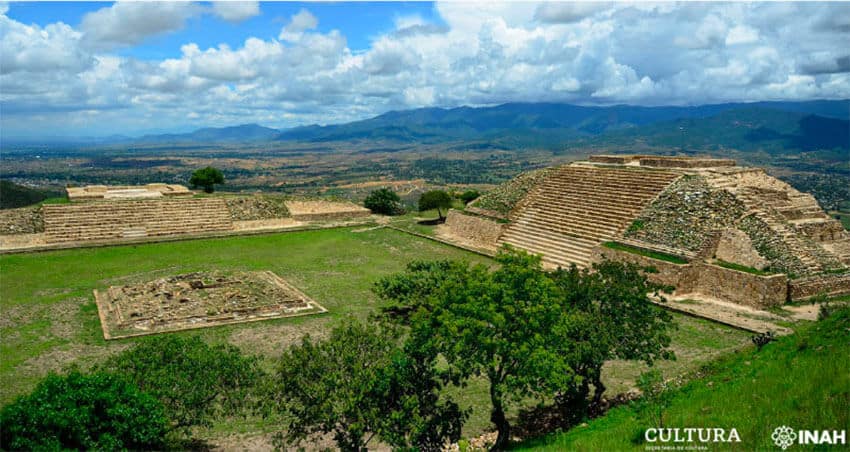
The Atzompa site, near Monte Albán in Oaxaca.

She said the care and additional restoration of the frieze are conservation priorities for INAH. It was partially destroyed by the Zapotec inhabitants when they vacated Atzompa at the end of the ninth century, INAH said.

The researcher also noted that there are fragments of a series of carvings on the facade of the Casa del Sur, on which the frieze is located, that are associated with it. They include figurines of monkeys and jaguars and the representation of a quincunx, which INAH described as “a symbol that alludes to the four directions and the center of the universe.”

The carvings are “manifestations of the cosmic world to which the construction of a house like that obeyed,” INAH said.

The Atzompa archaeological zone is situated on a hill north of the UNESCO-protected Monte Albán site. It is open to visitors only on Saturdays and Sundays between 9:00 p.m. and 3:00 p.m., according to INAH.

Mexico News Daily 

9 dead in multiple homicide in Atlixco, Puebla

0
Scene of mass homicide in Atlixco, Puebla
Authorities outside an Atlixco, Puebla, house where nine people were shot dead and another man was gravely injured.

At least nine people were killed and one gravely injured at a shooting in Puebla in the early morning on Wednesday.

Six men and three women were gunned down inside a house in the Francisco I. Madero neighborhood of Atlixco, 35 kilometers southwest of Puebla city. Another man was shot three times and taken to hospital.

An argument could be heard in the house before the shootings started, the newspaper Reforma reported.

Governor Miguel Barbosa said the mass homicide was caused by a dispute between people involved with selling drugs.

“Evidently, from the data we have, the place where these people were killed was a place for the distribution and sale of drugs … So far, the information does not reveal the identity of those executed. Apparently, they are not from Atlixco nor are they from Puebla … It was an execution between gangs, people who came to Atlixco to commit crimes of drug dealing,” he said.

Barbosa added that the killings were a cause for concern. “Worried? Yes, it does worry us, but … we are composed, with very well-defined convictions about the role that the authorities should play in these events.”

The governor added that agents from the National Kidnapping Commission would travel to Atlixco to investigate the killings.

Meanwhile, five people were killed last Thursday in Chalchicomula de Sesma, near the Veracruz border. About that incident, Barbosa said the four men and one woman killed had all been engaged in criminal activity.

With reports from Reforma

Through music, women’s orchestra takes on gender inequality

0
The Philharmonic Band began playing 11 years ago
The Viento Florido Philharmonic Band began playing 11 years ago but not without opposition.

Forty indigenous Mixe women in Oaxaca are battling gender inequality in an orchestra that has been running for 11 years.

The Viento Florido Philharmonic Band is based in Santa María Tlahuitoltepec, 115 kilometers east of Oaxaca city, in the Mixe Sierra. Women in the region battled with men for decades to form the band, the newspaper Milenio reported.

The band recently performed the song Canción Sin Miedo (Song Without Fear), a 2020 ballad which has become an unofficial hymn of the feminist movement in Mexico.

In one part of their version of the song, performed in the Mixe language, Viento Florido sing the names of Mixe victims of femicide.

The band’s founder, Leticia Gallardo, said the region’s most recent victim had died too young. “The most recent case is Fany, which was a death that everyone really lamented because she had her whole life in front of her, she was very young. She is just another statistic and that’s really regrettable,” she said.

[wpgmza id=”354″]

Gallardo added that violence was a constant threat to women in the region. “As a woman I identify a lot with the song, because any of us could be subjected to violence. There is also violence in communities which often isn’t talked about and isn’t seen,” she said.

Another band member called Karen said Canción Sin Miedo was a fitting song for the group. “Canción Sin Miedo has a very powerful message. It’s a call for justice from women, and that they have to stop killing our sisters,” she said.

Karen added that it was a struggle to start the group. “The music wasn’t well regarded. But despite that, I was the first woman in my town to play a wind instrument … the journey to arrive here in Santa María is about 10 hours, but I made the journey because I wanted to see my band mates and spend time with them,” she said.

With reports from Milenio

Soccer legend Tomás Boy considered one of Mexico’s top players

0
Tomás Boy spent 13 years with the UANL Tigers.

A former soccer star considered one of Mexico’s best ever players died in Mexico City Tuesday after being hospitalized for a pulmonary embolism.

Tomás Boy, a midfielder who represented Mexico on more than 50 occasions and captained his country to the quarter finals at the 1986 World Cup, fell ill while in Acapulco, Guerrero, and was transported to the capital for medical treatment.

The acclaimed futbolista, described as a “legend of soccer in Mexico” in a tribute posted to the Liga MX Twitter account, also coached more than 10 professional Mexican teams as well as the California-based San José Earthquakes.

The national team acknowledged the 70-year-old’s passing in a message on its official Twitter account.

“We will always remember you as the great jefe [boss] you were in Mexican football,” the message said, referring to Boy by his nickname. “Rest in peace, Tomás Boy.”

A video tribute to Tomás Boy by his longtime club the Tigers.


Born in Mexico City in June 1951, Boy was the oldest of eight siblings and a sports lover from a young age.

He started his professional career for Mexico City-based club Atlético Español in the early 1970s but will be best remembered for his more than 400 appearances for the Nuevo León Autonomous University Tigres, or Tigers, with whom he won two league titles and the Copa México.

Boy scored over 100 goals for the club before leaving in 1988 to take up his first coaching position with the Earthquakes.

Among the Mexican league clubs he coached were Querétaro, Monterrey, Atlas and Mazatlán, which he led during the 2020-21 season.

Despite managing clubs for over 30 years, he never won a title as a coach, but will be remembered for his exuberant celebrations when one of his players managed to get a shot past the opposition’s goalkeeper.

Boy is survived by his wife and children, who were at his side in his final hours. “Today a jefe arrives to heaven and from here we send a hug to him and his family,” his beloved, long-term club, the Tigres, said on Twitter.

With reports from Uno TV, Medio Tiempo and Milenio

Attorney general claims criminal extortion by media in case of brother’s death

0
alejandro gertz
Gertz say it's an attempt to lynch him.

Attorney General Alejandro Gertz Manero has claimed that the media is guilty of criminal extortion after leaked recordings suggested that he has improperly intervened in a court case related to the 2015 death of his brother.

Recordings of conversations between Gertz and a colleague were leaked late last week and reported widely in the Mexican media.

Gertz and Juan Ramos López, head of the federal crimes unit of the federal Attorney General’s Office (FGR), speak about a case in which the wife of the the attorney general’s brother and her daughter are accused of “homicide by omission” for failing to provide adequate medical care to him before his death at the age of 82.

The Supreme Court (SCJN) will consider the case next week. The leaked recordings suggest that Gertz had an agreement with the SCJN that would ensure that the two women are not acquitted.

However, the attorney general and Ramos claimed that the court intended to break the agreement and free Alejandra Cuevas Morán, the 69-year-old daughter who has been imprisoned for over a year on homicide charges. Gertz apparently received an advanced copy of the proposed SCJN ruling, which Cuevas’ son described as a serious crime.

In a radio interview on Wednesday, Gertz confirmed that the recordings are authentic but denied any wrongdoing.

“We’re facing a true criminal media extortion, let me repeat it – criminal media extortion in order to lynch the attorney general,” he said.

“… [It’s claimed that] two officials are pressuring a [Supreme Court] justice and [I’m] using my position to gain an advantage … in a personal situation. This is absolutely false,” Gertz said.

He backed up that claim by asserting that his dealings with the SCJN are part of his personal defense of his brother, rejecting the suggestion he has acted in his official capacity as attorney general. Nothing has gone through the Attorney General’s Office because the case “doesn’t concern the FGR,” Gertz said. “It has nothing to do with [the FGR], it concerns Mexico City,” he said.

He claimed that people are trying to “bring me down emotionally” and discredit him in order to strip him of the moral authority he needs to do his job. Asked whether he knew who recorded his conversations with Ramos, Gertz said the FGR is investigating and he can’t comment further because he is the victim.

Opposition politicians have called on Gertz to resign, but the attorney general ruled out that possibility, while indicating that he is willing to appear before the Senate to explain his actions and remarks.

“It doesn’t cross my mind to quit the position,” he said. “… One has to leave the position [if there are] reasons that are sufficiently important, that’s what the constitution and the law say. [Resigning] has to be for some reason, but not because they’re extorting me,” he said.

With reports from El Universal and Reforma 

Sinaloa Congress decriminalizes abortion

0
supporter of decriminalizing abortion in Mexico
The successful vote to decriminalize abortion in Sinaloa was taken by legislators on Tuesday, International Women's Day.

The Sinaloa Congress decriminalized abortion Tuesday in accordance with a Supreme Court ruling in September.

With 28 votes in favor, two against and nine abstentions, Sinaloa is the seventh state to decriminalize abortion for up to 13 weeks of pregnancy. It did so to the dismay of pro-life protesters who had gathered outside the Congress.

The Pacific state joins Mexico City, Oaxaca, Veracruz, Hidalgo, Baja California and Colima, leaving 25 states where the practice remains illegal. It is still allowed in those states in cases of rape, in some cases where there is a risk to the woman’s health, when the fetus is in poor health and in some cases of extreme poverty.

Morena Deputy Nela Rosiely Sánchez has called the criminalization of abortion “a type of gender violence.”

Senate President Olga Sánchez Cordero celebrated the decision. “No longer will women go to prison for taking the decision to abort. The green tide has progressed to Sinaloa,” she said, using the name for the pro-abortion movement in Latin America.

Legal abortion supporters outside the Sinaloa Congress react joyfully to the news.


Sánchez said in a recent debate that there were 1,500 clandestine abortions in Sinaloa every year.

Institutional Revolutionary Party (PRI) Deputy Luis Javier de la Rocha spoke against the bill. He said that while he wasn’t against decriminalizing abortion in principle, lawmakers should understand their responsibility to women when granting the new freedom. He also complained that lawmakers weren’t informed enough to vote, having only received the text of the bill 12 hours earlier.

The Supreme Court effectively decriminalized abortion in Mexico in September, ruling it unconstitutional in response to a challenge to abortion restrictions in Coahuila.

With reports from El País and El Sol de México