Home Blog Page 1052

Court revokes mining concessions for failing to consult indigenous community

0
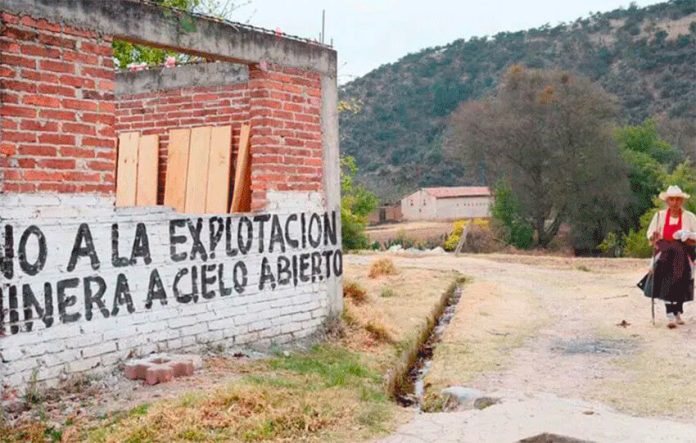
Anti Almaden Minerals graffiti in Puebla
Graffiti protesting the mine project planned by Almaden Minerals in Puebla. The message says, 'No to open-pit mining.'

In an unprecedented ruling, the Supreme Court (SCJN) on Wednesday revoked two mining concessions in Puebla because the federal government failed to consult with the local indigenous community before granting them.

The Economy Ministry (SE) granted concessions in 2003 and 2009 to a Mexican subsidiary of the Canadian company Almaden Minerals.

The concessions allowed the company to mine for gold and silver in Tecoltemi, a community in the Sierra Norte municipality of Ixtacamaxtitlán, although actual mining has not started.

In 2015, a group of Nahua residents concerned about contamination and overexploitation of local water sources filed a challenge against the concessions. Their lawsuit passed through lower-level courts before reaching the Supreme Court.

It is the first time that the nation’s highest court has invalidated mining permits for neglecting to consult with indigenous residents, according to lawyers and legal experts who spoke with the newspaper El País.
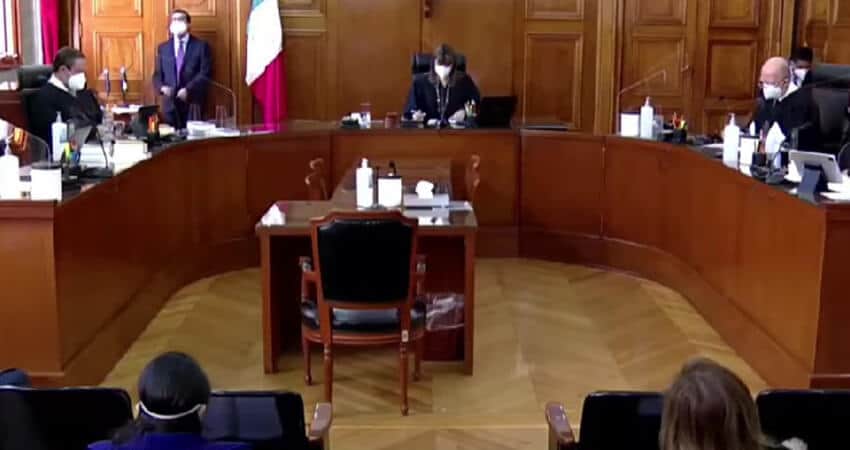
Mexican Supreme Court
The court found in favor of the Tecoltemi, Puebla, residents but didn’t rule four articles of Mexico’s mining law unconstitutional as plaintiffs had hoped.

However, the SCJN didn’t rule that four articles of the federal mining law are unconstitutional, as the plaintiffs had hoped it would. One article the Tecoltemi residents wanted the court to rule against says that mining takes precedence over all other kinds of land use.

However, the SCJN did declare that, in accordance with the constitution and Convention 169 of the International Labour Organization’s Indigenous and Tribal Peoples Convention, which Mexico ratified on September 5, 1990, the government should have consulted with indigenous residents of Tecoltemi before granting the concessions.

The court rejected the defense put forward by the federal government and Almaden that consultation should take place after rather than before the granting of concessions. However, its ruling, which could aid other communities in their fight against mining interests, may not definitively shut down mining in Tecoltemi because the concessions are likely to be reissued.

Almaden acknowledged that likelihood in a statement released Thursday.

“Almaden has reviewed a draft of yesterday’s SCJN decision. As it stands, the draft decision determines that the Mexican mineral title law is constitutional but that before issuing Almaden’s mineral titles, the Ministry of the Economy should have provided for a consultation procedure with relevant indigenous communities,” it said.

“The draft orders the Ministry of the Economy to declare Almaden’s mineral titles ineffective and to reissue them following the ministry’s compliance with its obligation to carry out the necessary procedures to consult with indigenous communities,” the Vancouver-based company said.
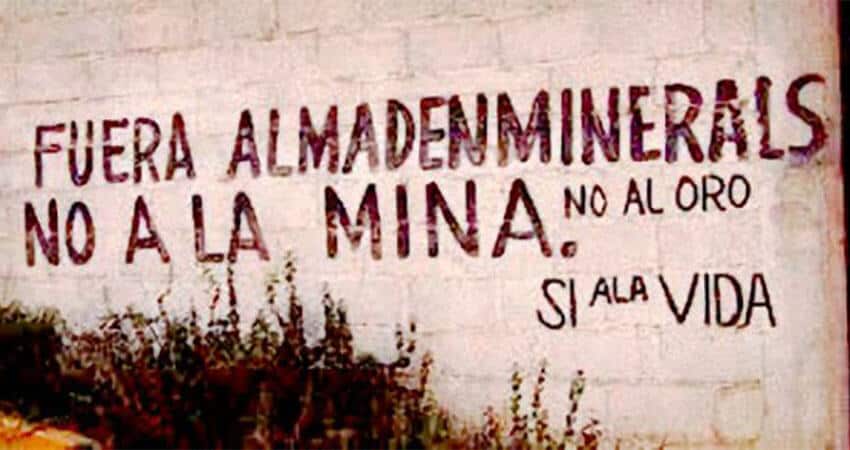
Anti Almaden Minerals graffiti in Puebla
‘Get out, Almaden Minerals, no to the mine,’ reads the message. ‘No to gold, yes to life.’

Almaden, which has invested millions of dollars in its Puebla project, acknowledged that the court’s final decision could be different from the draft version it saw.

“The decision will take effect at the time of official notification of the decision to the company, which is expected within the next two months,” it said.

“Almaden intends to review the final decision when it is available and interact with Mexican government officials and local community officials in order to fully understand the impact of this decision on the company’s mineral claims prior to determining its next step.”

Itzel Silva, a lawyer with the Fundar Center for Analysis and Research who represented the Tecoltemi residents, said that the SCJN had missed a historic opportunity to deem the mining law unconstitutional.

“What the law does … is make the delivery of land to [mining] companies possible. It’s the origin of the violations,” she said.

Nevertheless, its revocation of the concessions sets a “precedent that consolidates … the right to consultation … and it has constitutional standing,” said National Autonomous University legal academic Rodrigo Gutiérrez.

“Fifteen years ago, courts didn’t even recognize the rights of indigenous people nor that Convention 169 was part of the constitution,” he said.

With reports from El País

4 dead, 5 abducted in night of violence in Caborca, Sonora

0
Security footage and cell phone videos showed masked assailants with high caliber weapons entering Caborca.
Security footage and cell phone videos showed masked assailants with high caliber weapons entering Caborca. Screenshots

Four people have been reported murdered and at least five others were abducted during a criminal group’s incursion into Caborca, Sonora, on Tuesday night.

An armed wing of the Sinaloa Cartel is believed responsible for the violence, reported the news website Infobae, although authorities have not publicly identified the perpetrators.

Citing local media, the newspaper El Universal reported that four people were killed and at least nine people were kidnapped in the city of Caborca, located 150 kilometers south of the border crossing between Sonoyta and Lukeville, Arizona.

However, the Sonora Attorney General’s Office (FGJE) said on Twitter Thursday morning that only five abductions were reported and two of the victims had been released.

“Sebastián Manríquez Verdugo, son of the announcer and journalist of the same name, was found safe and sound in Caborca. The 23-year-old man was reported as a victim of kidnapping after violent events in this city,” the FGJE said.

“Five reports of kidnapping were received in total; two have been released, the search for three people, all men, is continuing,” it said.

In a statement posted to the Caborca municipal government website on Wednesday, Mayor Abraham Mier Nogales acknowledged that lives had been lost and young men had been abducted in the early hours of Wednesday morning but didn't reveal the number of victims.

“We know that among these [victims] are good people who have nothing to do with organized crime,” he said.

“I acknowledge that the events ... in the early hours of the morning exceeded the level of response of police authorities, given that we weren't capable of preventing these regrettable events,” Mier said. “... I'm in direct contact with state and federal authorities to implement mechanisms that will allow us to recover peace in our municipality.”

The army, the National Guard, state police and municipal police collaborated on an operation Wednesday and made three arrests. Weapons and vehicles were also seized, El Universal reported.

The mayor said in an interview that the violence began at approximately 11:00 p.m. Tuesday when an “outside group” entered the municipality, home to about 90,000 people.

“We had five or six months of peace and now this group has come in,” Mier said, explaining that he didn't know who they were targeting.

The violence came after a spate of armed confrontations in Caborca and the neighboring municipalities of Pitiquito and Altar in early September.

According to Infobae, alleged Sinaloa Cartel gunmen entered Caborca in 19 pickup trucks on Tuesday night and proceeded to break into and shoot up homes. The attacks lasted more than six hours, affecting at least 40 neighborhoods and sowing terror among residents.

In a video posted online that showed a lifeless man lying on the ground, a clearly distressed woman said she witnessed a shootout at close quarters and was physically assaulted.

“They kicked down the doors, they broke into my cousin's car, they shoved us, they broke all the windows of the apartments,” she said.

Another woman made a plea for the return of her husband. “To the people who took my husband last night, please, I ask you, I beg you, to hand him over to me. He's innocent, he's a working person, a construction worker and I work in the hospital,” she said, adding that their daughter is sick.

In light of the violence and fearing further attacks, Mier ordered businesses to shut by 10:00 p.m. Wednesday and suspended all sporting events. However, there were no reports of additional violence on Wednesday night.

On a per capita basis, Caborca was the 21st most violent municipality in Mexico last year with a total of 102 homicides, according to data compiled by crime monitoring website elcri.men. Sonora was the country's seventh most violent state for total murders with over 1,900.

With reports from El Universal and Infobae 

Mexican chef in London wins a Michelin star

0
The Kol restaurant team
The Kol restaurant team celebrates the Michelin win.

Years of hard work paid off for Mexican chef Santiago Lastra after his new restaurant in London, England, received its first Michelin star on Wednesday.

The restaurant, called Kol, is located in the heart of London and markets itself with the tagline, “Mexican soul, British ingredients,” which, according to the Michelin guide review, “proves a unique and exhilarating combination.” The guide also lauds the talent and creativity of the kitchen team, which uses high-quality British ingredients and Mexican techniques for dishes such as stream trout tostadas and family-style octopus.

Lastra started his career in a Cuernavaca Italian restaurant before moving to Europe at age 18 to work in high-end restaurants, including the Denmark restaurant Noma, which has been named best restaurant in the world multiple times.

Kol was originally scheduled to open in early 2020, but the start of the pandemic threw a wrench in the plan. The restaurant eventually opened at the end of 2020, but had to temporarily close several times due to Britain’s strict pandemic health protocols.

After Kol received the prestigious Michelin star, Lastra shared the news on Instagram, crediting his team and homeland for the recognition.

“I cannot express with words how proud I am of our team! This is for you,” he said. “This is also for my country, Mexico, that deserves to be a bit more recognized, and I hope this can help to shine a light on the indigenous people, traditional cooks, and family that are my constant inspiration.”

With reports from Reforma

A small-town mayor’s big hope: mining its Maya history for future prosperity

0
Pich, Campeche, Mayor Manuel Jesus Castillo
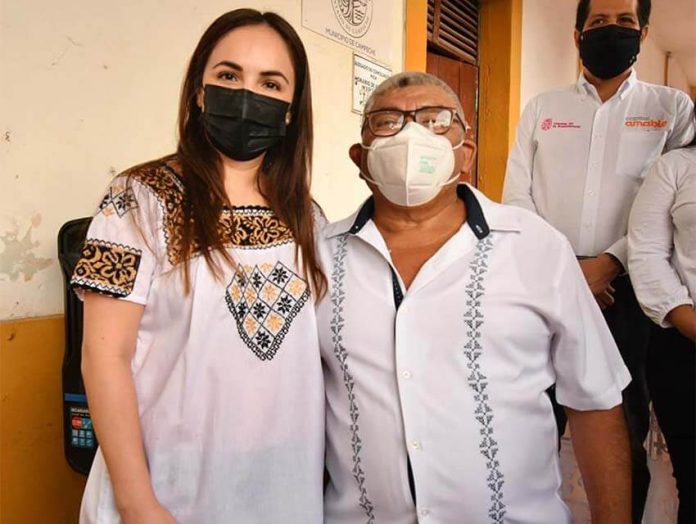
Pich, Campeche, Mayor Manuel Jesús Castillo Tec on his inauguration day in October with Campeche city Mayor Biby Rabelo. Biby Rabelo Facebook

When the Black Pox hit the Yucatán Peninsula at the dawn of the 20th century, entire communities were all but obliterated. One exception was Pich, a small Mayan town in the heart of Campeche where the inhabitants found themselves bereft of neighboring communities but with almost all of its population still intact.

This is a story that they tell their children here today: how they come from a lineage of survivors and how they are survivors too.

On a brisk winter morning (by southern Mexican standards), Manuel Jesús Castillo Tec pulls up on an Italika FT125 scooter in an undone olive guayabera shirt over a white vest. He is the mayor of Pich’s community of stalwarts, and his open shirt speaks to his affable and easygoing demeanor, though his thick-rimmed glasses suggest an underlying reflectiveness that must surely have aided him in his time as the town’s commissioner before he took office as Pich’s mayor in October.

“I know everybody here,” he says of the town’s 3,000 inhabitants, “and I know their parents, their grandparents. We have always existed as a unit of people who survive together, so we hand down our tales and our traditions. I’ve been lucky enough that all of this has added up to trust in me as mayor.”

Indeed, as he rides at low speed around the town, pointing out various landmarks and curiosities, he frequently stops to speak to other residents and his hat seems to bob incessantly as he acknowledges the people he passes. The vibe emanating from Castillo Tec is all over Pich: there is something ineffable in the colors of the buildings that seems to inspire good feeling, and when he pulls up outside the gates to the town’s aguada, it seems like a scene from a tranquil postcard.

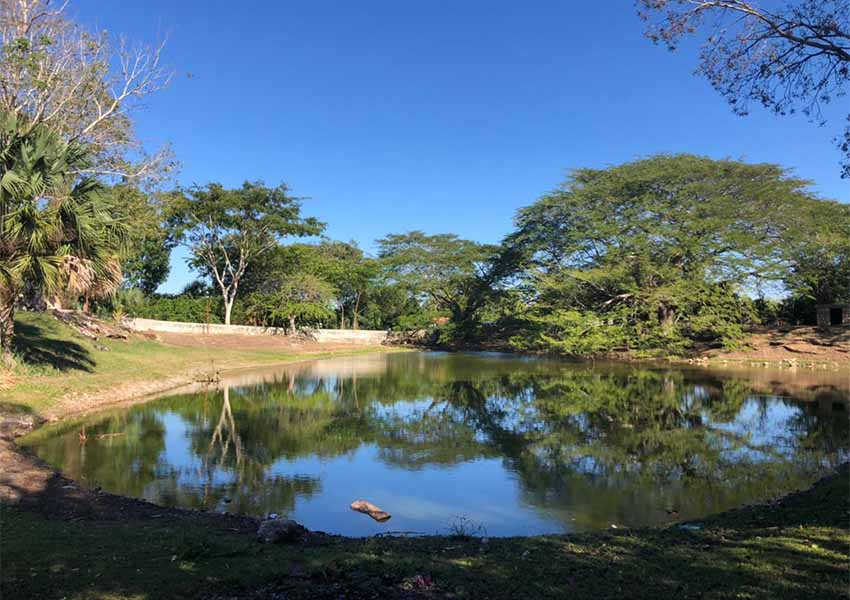
aguada in Pich, Campeche
The town’s aguada waterway is a remnant of the town’s old pre-Hispanic water management techniques.

The aguada, he explains, is a remnant of the old Mayan pre-Hispanic water management techniques that run underneath the town. Today, schoolchildren with clipboards buzz around a large tree.

“It is wonderful to see the children outside learning about the aguada,” Castillo Tec says, “because as well as teaching them their ancestry, it fosters a sense of stewardship for their local environs, which seems to be [becoming] lost. We watch children flee to bigger cities — Campeche, for example — in search of opportunities, when the reality is that we have them right here; we just need to show people.”

Castillo Tec is positive about the future of the town. He is looking to build on his experience as the previous administration’s commissioner by putting the town back on the map.

Towns all over Mexico are embracing the past in order to look to the future, but under Castillo Tec’s guidance, it is very likely that the obscure Maya community of Pich will rediscover its place in the modern world within a few short years.

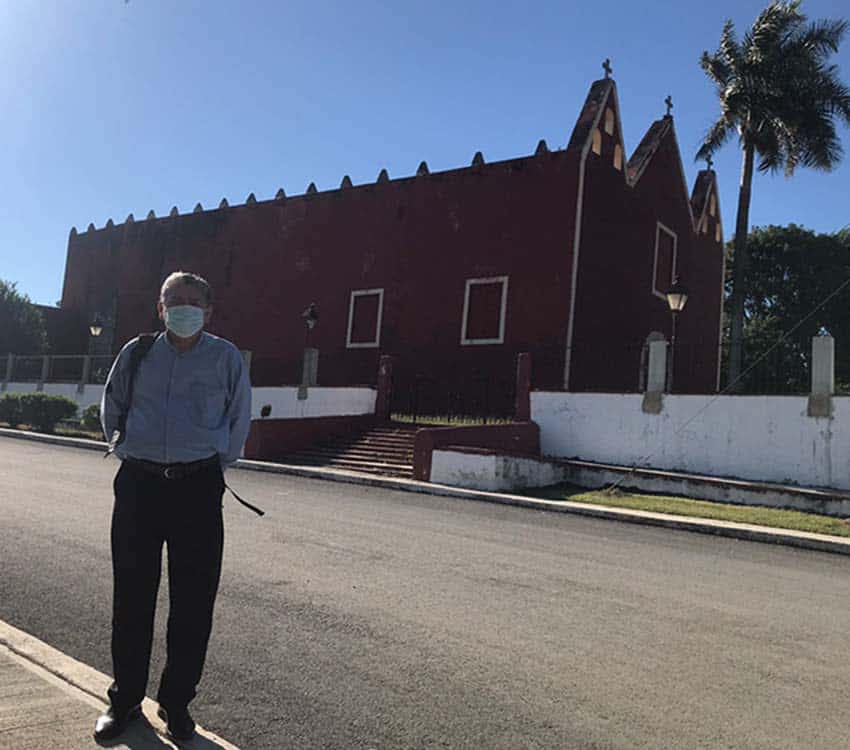
He is leaning on the help of a local historian — Pich’s promoter of culture — José María Cabrera Contreras. Cabrera is helping to curate the history of Pich; his encyclopedic knowledge of the monuments in the town begins to spill out the instant he sets foot inside the town’s centerpiece: La Iglesia de Las Tres Cruces, or The Church of the Three Crosses.

Cabrera explains that the church is a former 18th-century Franciscan convent — itself constructed on the site of an old pre-Hispanic building. The National Institute of Anthropology and History (INAH) restored it in the late 20th century.

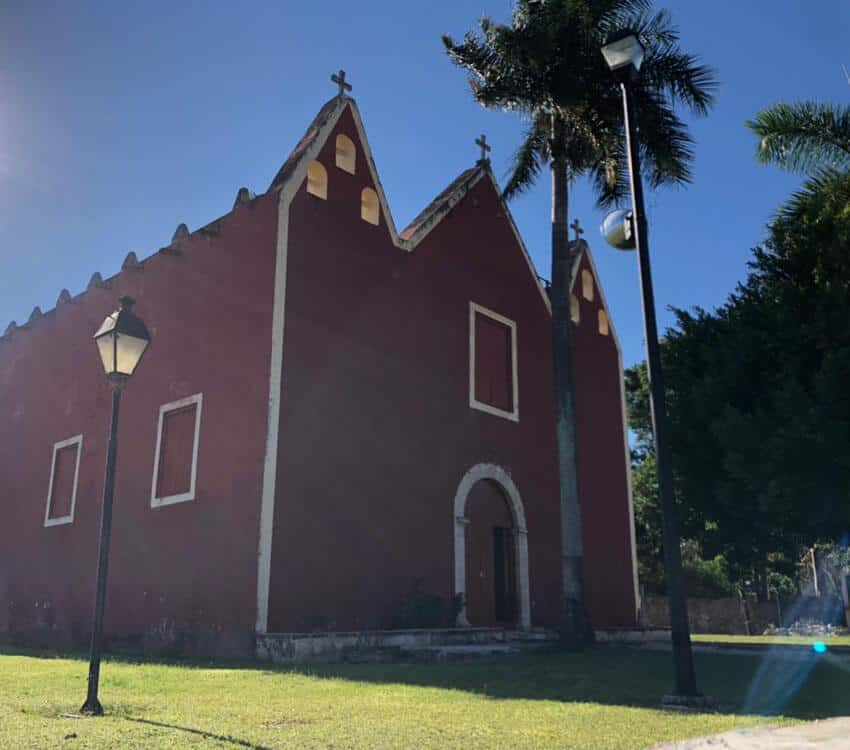
Church of the Three Crosses, PIch, Campeche
The Church of the Three Crosses was one of 27 Franciscan convents in the Yucatán Peninsula.

The church is built in the same style as the majority found in this region: a large, monochrome building in bright red that dominates the central square, boasting lofty ceilings and a larger-than-life-size statue of Christ looking penitently at the floor across from the main entrance.

“This place has fulfilled, at more than one point, the role of integrating a number of different identities into the mesh that we call pichuleño,” Cabrera explains, using the word by which people from Pich refer to themselves.

Beneath the statue of Christ, Cabrera points to three green crosses on the altar: “a symbol of our identity,” he states matter of factly.

The crosses, he explains, represent the Caste War (1847–1901), a rebellion of the indigenous inhabitants of the southern and eastern parts of the Yucatán Peninsula against the wealthy non-indigenous Mexicans. It’s another patch in the quilted fabric of Pich’s history that left thousands dead on the peninsula.

The Maya groups who worked in Campeche’s henequén agave haciendas used the crosses as a banner to protest the imposition of Christian religious beliefs.

“Now,” Cabrera muses, “the crosses represent what gives Pich its character: the population is a mix of Mayan men and women who cohabit with settlers from the central and northern regions of the country and Guatemalan refugees.”

Pich local historian Jose María Cabrera.
Local historian and promoter of Pich’s culture José María Cabrera.

Castillo Tec and Cabrera are using the spaces and identities that already exist in Pich to showcase what gives the town its incommunicable sense of beguilement. Both men are hoping that the qualities which have historically contributed to the obscuration of the vivid histories of rural Mexican towns such as Pich will be the very things that present unique opportunities for change.

Shannon Collins is an environment correspondent at Ninth Wave Global, an environmental organization and think tank. She writes from Campeche.

Veracruz carnival will go ahead but at a later date

0
The Veracruz carnival
The Veracruz carnival makes a return this year.

The Veracruz carnival will be delayed but will return as an in-person event this year, its chief organizer confirmed on Wednesday.

José Antonio Pérez Fraga said the festival, which normally takes place before Lent at the end of February in Veracruz city, would be rescheduled for July 1-5.

The organizing committee decided to move the dates due to a high incidence of COVID-19 cases in the city.

Pérez said this year’s event would be worth the wait. “The idea is to rescue the ancient traditions of the state which highlight the beauty of our ancient Veracruz. We seek to rescue all our pride and tradition organizing a very traditional carnival … one of the best carnivals in history,” he said.

The carnival was held online in 2021 due to the pandemic, its first cancellation in 96 years. The authorities estimated a loss of 250-300 million pesos (US $12.3-14.8 million) in earnings as a result.

The roots of Veracruz carnival extend back to colonial times and it was first held in 1866, according to the site Carnivaland.

Meanwhile, Mazatlán’s annual carnival is likely to go ahead at the end of February even if Sinaloa remains yellow on the coronavirus stoplight map. A decision is to be made Friday.

With reports from Milenio

Newspaper urges US president to condemn AMLO’s attacks against journalists

0
López Obrador and Loret de Mola.

The Washington Post has called on the United States government to condemn physical and verbal attacks on Mexican journalists.

In an editorial published Tuesday, the Post noted that Mexico is going through one of its deadliest periods ever for journalists, five of whom have been killed this year.

“But instead of addressing these dangers, President Andrés Manuel López Obrador devoted much of his regular news conference on Friday to attacking one of the country’s most prominent media figures, Carlos Loret de Mola,” the editorial said.

At his regular news conference, López Obrador claimed that the radio, television and print journalist – a contributor to the Post’s Spanish language opinion section – has a gross income of 35.2 million pesos (US $1.7 million) a year, which he said was 15 times more than his salary.

“… We have to see if he pays taxes, I’m going to ask for all this in a report,” the president said during remarks that triggered a large virtual protest on Friday night.

“Do you think … [his salary is so high] because he’s a high-flying, very intelligent journalist? A good writer? No, it’s because he’s a bully,” he said.

The Post charged that López Obrador had made “a brazen attempt to discredit and intimidate an independent voice” by presenting a slide purporting to show Loret de Mola’s 2021 income.

The journalist, who recently contributed to a report about the luxurious living arrangements of AMLO’s eldest son,  subsequently said the salary information presented was “wrong” and “inflated.”

Still, “the public sharing of a citizen’s confidential financial information is an unprecedented abuse of power,” the Post said.

“… Mr. López Obrador renewed the attacks Monday, calling those who publish critical articles ‘thugs, mercenaries [and] sellouts.’ The episode marks a new low in his fraught relationship with the media,” the newspaper contended.

“… His most recent tirade only emboldens those who attack journalists amid a surge of violence against reporters and whistleblowers — most of whom are not as well known as Mr. Loret de Mola.”

The editorial noted that the Mexican government has expanded its press protection program, but added that “rights groups and journalists say criminals can still commit acts of violence with impunity.”

“The escalating violence is a stain on Mexico’s democratic record,” the Post said before noting that the Biden administration committed last year to “protecting and promoting free, independent, and diverse media around the world.”

The U.S. government “should condemn the attacks on Mexican journalists and call for our democratic allies to support a free press,” it said.

“If they don’t, rogue regimes and bad actors will continue to act as though they have a free hand in their escalating efforts to silence independent voices.”

López Obrador responded to the editorial at his Wednesday morning news conference.

“I was reading that The Washington Post is asking President Biden to call me out for the harassment of journalists. What? Doesn’t The Washington Post know how the mafia of power works in Mexico?” he said.

“… Don’t they know that corruption reigned [when previous governments were in power], that a group [of people] felt they were the owners of Mexico, that inequality, poverty [and] the violence that was unleashed in the country were caused by corruption? Doesn’t The Washington Post know that?” he asked.

During his two-hour presser, López Obrador made a broader attack on several Mexican and foreign newspapers and news outlets, accusing them of bias toward his opponents or demonizing them for not supporting him.

“We’ll have to see who the owners of The New York Times, The Washington Post [and] The Financial Times are,” he said at one point, before declaring later that journalist Carmen Aristegui, who has a news website, and news magazine Proceso “never contributed to the change” he is bringing to Mexico.

Mexico News Daily 

Transport ministry steps in and halts planned highway toll increase

0
A toll plaza in Quintana Roo.
A toll plaza in Quintana Roo. deposit photos

The Transport Ministry intervened Wednesday to stop a hike in toll-highway tariffs, which was set to go into force the same day.

The federal highways agency Capufe released a last minute statement on Wednesday to call off the hikes. “Capufe informs that the tariff adjustment to begin today will be suspended until further notice. This change follows instructions issued by the transportation ministry.”

Capufe, which is part of the ministry, announced a 7.36% average increase in toll prices on Tuesday, in a statement which has now been removed from its website. In the statement, it said the hike was a decision taken by the national infrastructure fund Fonadin and the state development bank Banobras.

The agency said at the time that the hike was in response to high inflation rates, which soared over 7% in 2021. It added that the funds raised from the increase would be directed to improving highways and bridges around the country.

The Cuernavaca-Acapulco highway from Morelos to Guerrero was set to increase more than 13% to 596 pesos (almost US $30) and the Circuito Exterior Mexiquense (México state Outer Loop Road) would have risen 9%.

There are 42 highways and 32 bridges — 12 of which cross borders — under the operation of Capufe. That means the agency is responsible for 44% of the national network of toll highways and 65% of the bridges.

With reports from Milenio and Infobae

First two contracts awarded in project to recover bodies of 63 miners in Coahuila

0
A memorial to the lost miners.
A memorial to the lost miners. organización familia pasta de conchos

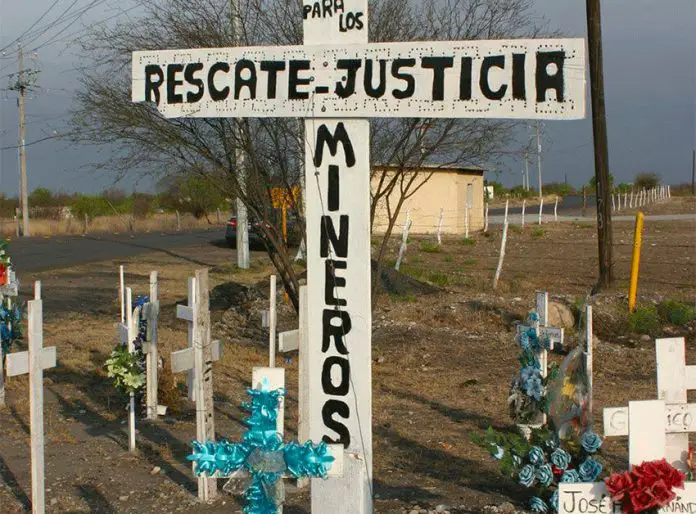
Preparations for an operation to recover the bodies of 63 of 65 miners who died in an explosion in a Coahuila mine in 2006 are set to begin, but it will be some time before the remains of the deceased men are brought above ground.

The Federal Electricity Commission (CFE) announced Tuesday that construction of some of the infrastructure required for the recovery mission at the Pasta de Conchos mine would begin soon.

Only two bodies were recovered after the methane explosion at the Grupo México-owned coal mine in San Juan de Sabinas. Tunnels will be built for the operation with the intention of recovering the other 63.

The companies Desarrollo de Terracerías and Proacon México have been awarded a 308.9-million-peso (US $15.2 million) contract to build shafts into the mine, the CFE said in a statement. Construction is expected to begin this month and is slated for completion by April 2023.

Another contract is likely to be awarded next month for the construction of additional infrastructure including access ramps and tunnels. It’s anticipated that that work will be completed over a period of 20 months.

A third phase of the project will involve more preparations for the recovery of the bodies, including degassing of the mine and its stabilization, as well as the actual search for and retrieval of the miners’ remains. No time period has been set for the completion of that stage, but it’s scheduled to begin in May 2023.

At a meeting on Tuesday at which the recovery plan was outlined, Labor Minister Luisa María Alcalde thanked CFE director Manuel Bartlett for his commitment to the families of the victims, for whom the tragedy has had no end.

She previously spoke about the federal government’s plan to return the miners’ remains to their families two years ago.

President López Obrador announced in May 2019 that he had ordered a recovery operation.

“… We cannot turn our backs on the pain of humanity. This is a humanist government. So we are going to carry out this action,” he said at the time.

At Tuesday’s meeting in Nueva Rosita, the municipal seat of San Juan de Sabinas, a CFE engineering chief working on the rescue project noted the president’s commitment to recovering the bodies. Vicente Arévalo Mendoza also gave an update on the information provided to the victims’ families at meetings the government has held with them.

Thirty-four family members have been employed by the CFE to work on the project, 18 of whom remain in paid positions.

The Pasta de Conchos tragedy is one of numerous coal mine disasters in Mexico that have claimed lives. The deadliest was the Rosita Vieja mine disaster in 1908, in which 200 miners, most of whom were Japanese immigrant laborers, were killed.

Mexico News Daily 

Police force disarmed in Veracruz is 29th in the state in 3 years

0
Decomissioning of police in San Juan Evangelista Veracruz
State police assumed responsibility for security in San Juan Evangelista.

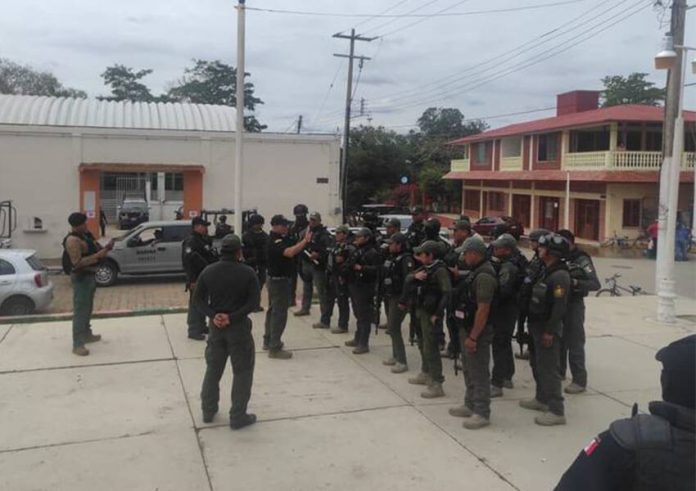
Security forces disarmed a municipal police force in Veracruz on Tuesday, making it the 29th such force to be put out of operation in the eastern state in three years.

Officers in San Juan Evangelista, 340 kilometers southeast of Xalapa, were stood down by state police officers, state Fuerza Civil agents, the army and the navy.

The Fuerza Civil assumed responsibility for security in the municipality.

The officers were sent to the Veracruz police academy (CEIS) for evaluation and to ensure they are licensed to carry firearms.

San Juan Evangelista is state’s 29th municipality to be disarmed since Governor Cuitláhuac García took office in December 2018.

The municipalities of Papantla and Zongolica had their police forces disarmed in June, as did Playa Vicente in May and Orizaba in February 2021. In some of the cases, municipal police officers were suspected of collaborating with criminal organizations.

With reports from e-Veracruz

10 migrants sew their lips closed in protest against Immigration

0
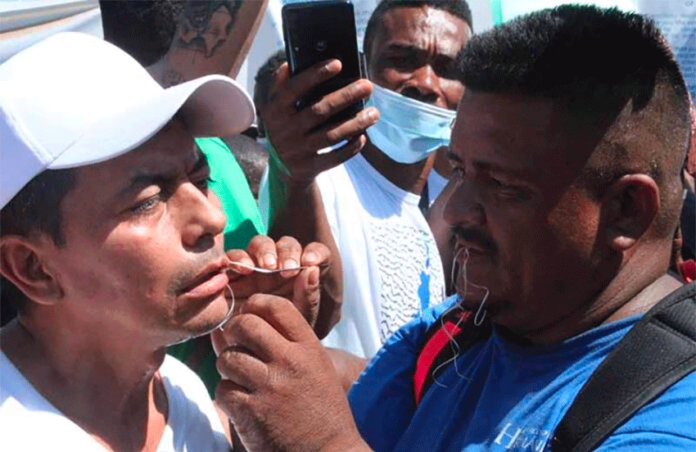
Migrants performed the lip-sewing operation on each other
Migrants performed the lip-sewing operation on each other during Tuesday's protest.

Ten Central American migrants in Chiapas took a two-week protest against immigration authorities to a new extreme on Tuesday: they sewed their lips together while demonstrating in Tapachula.

Some 400 undocumented migrants are demanding humanitarian visas which would legalize their status in Mexico.

Tuesday’s drastic action came after demonstrations by hundreds of migrants over 14 days. Some complained immigration authorities had mocked and deceived them, the newspaper El Orbe reported.

Rafael Hernández, a migrant from Venezuela, said they left their countries for a better future in the United States but they’re forced to wait three to four months for a first interview with immigration authorities.

Hernández hopes to reach Monterrey, Nuevo León, and requested the National Immigration Institute (INM) provide visas to allow him to travel within Mexico.

Illegal migrants crossing the southern border are generally arrested and sent to prison-like migrant detention centers for an indeterminate period, or are told to go to Tapachula’s Olympic Stadium, a refugee camp where they are provided no humanitarian services and there are no immigration officials.

The legal status of migrants in Tapachula is increasingly clouded: they have been banned from leaving while they await the outcome of their applications to the refugee agency COMAR and the INM. However, both agencies have collapsed under the pressure of migrant influxes, leaving undocumented migrants waiting for responses to applications without any reliable time frame.

Many opt to join migrant caravans, in defiance of the authorities. It can be their best bet: some who left in a caravan on October 18 are in the United States with asylum applications pending.

With reports from El Orbe