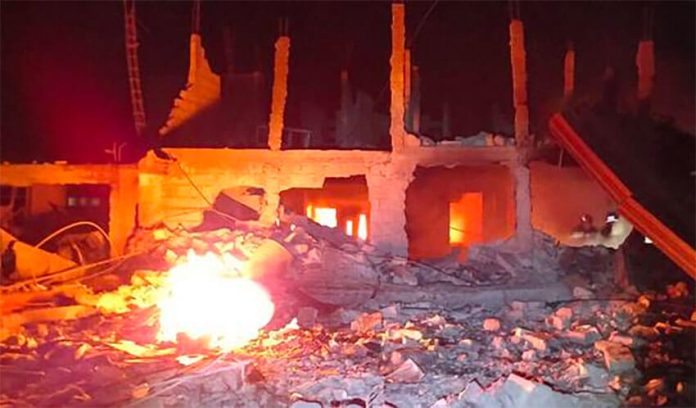
Damage from Monday night's blast at an illegal fireworks maker.
An explosion at a home-based, illegal fireworks factory killed six people and injured nine Monday night in Puebla.
It was the second such incident in two days. One person was killed and six people were injured under similar circumstances on Sunday when gunpowder exploded at an illegal fireworks operation in Juan C. Bonilla.
Monday’s blast took place in the community of Santiago Tenango in Felipe Ángeles. Two of the dead were children aged 13 and 15. Only two of those who were injured required hospitalization but one, a 13-year-old girl, was reported in grave condition Tuesday morning with second-degree burns.
At least six homes were also severely damaged in the blast, which took place about 7:30 p.m.
Puebla Governor Miguel Barbosa confirmed that the incident took place in an unlicensed fireworks factory and ordered officials to carry out inspections of fireworks makers throughout the state to identify those that are operating without permits from the Ministry of National Defense.
Fireworks is a big business in some parts of Mexico and this is a busy time of year for manufacturers. And explosions are not uncommon.
What was probably the worst incident killed 46 people in Tultepec, México state, in 2016 when several explosions ripped through and destroyed Mexico’s biggest fireworks market.
The market itself was legal but regulations controlling the distance between individual vendors’ stands had been relaxed. Officials concluded at the time that the damage would have been less severe had the regulations been enforced.
People aged 60 and over will be given AstraZeneca COVID-19 booster shots regardless of the vaccine with which they were first inoculated, Deputy Health Minister Hugo López-Gatell said Tuesday.
Speaking at President López Obrador’s regular news conference, the coronavirus czar said that seniors must have been vaccinated before June to be eligible for a booster shot. The vast majority of seniors were vaccinated before the start of that month, he said.
People aged 60 or over who were vaccinated more recently will have to wait for six months after their second dose before they can receive an additional shot, López-Gatell said.
The rollout of booster shots begins Tuesday in Mexico City, Jalisco, Chiapas, Oaxaca, Sinaloa and Yucatán. In the capital, seniors who live in the southern borough of Tlalpan will be the first to get a third shot.
López Obrador, who had COVID in January, and other federal officials aged 60 and over received their boosters at the president’s news conference, held in Zapopan, Jalisco.
Seniors are not required to register for a third shot, as was the case with their initial vaccination. They simply have to go to a vaccination center and show official identification to prove their age, López-Gatell said.
Authorities will announce the location of the vaccination centers and the dates on which they will be offering booster shots on a state by state basis.
Teachers, who were among the first Mexicans to be vaccinated, will also be offered booster shots after they have been made available to seniors. Most teachers were vaccinated with the single-shot CanSino vaccine.
Meanwhile, Mexico’s accumulated coronavirus case tally currently stands at just over 3.9 million after 752 new infections were reported Monday. The country’s first case of the highly mutated omicron variant was detected last Friday but no additional cases have been reported.
The Health Ministry reported 110 additional COVID-19 fatalities on Monday, lifting the official death toll to 295,313.
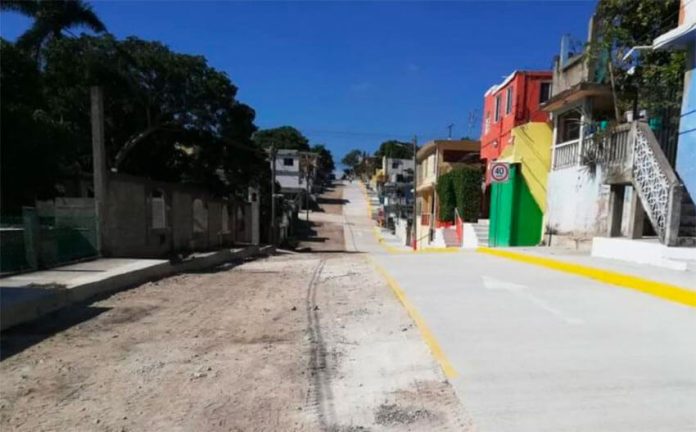
Calle Morelos clearly marks the boundary between two municipalities.
The urban area formed by the municipalities of Tampico and Ciudad Madero in Tamaulipas has a unique new boundary marker: a half-paved road.
While residents on the Ciudad Madero side of Calle Morelos have a newly paved lane, their neighbors in Tampico are still driving on unpaved dirt, a situation that has been mocked and criticized on social media.
Luis Carlos Leal Contreras, director of public works in Ciudad Madero, said the paving project began cooperatively, but when Tampico ran out of resources, Ciudad Madero decided to go ahead and finish its half of the street as planned.
But the Tampico director of public works, Pedro Pablo Rangel, tells a slightly different tale.
“When it became known that Ciudad Madero was going to pave Calle Morelos, I approached Luis Carlos Leal Contreras and I invited them to work together, half and half, but they didn’t want to … what they did is absurd, they are doing things badly,” Rangel said, adding that paving only half the street will cause future problems with uneven compaction.
A Tampico councilor who sits on the public works commission has called for a meeting to review the project status.
“It is not Madero’s responsibility anymore if it is affecting neighbors on our side,” Mayra Ojeda said.
Ciudad Madero Mayor Adrián Oseguera later explained that his city had no choice but to go ahead with the paving project because the funds had already been approved by the municipal council.
Oseguera said he has a good working relationship with the mayor of Tampico, and the Tampico side of the project will be completed in 2022.
“There is excellent coordination between my friend [Tampico Mayor Jesús Nader] and me and the public works directors,” Oseguera said.
He urged Calle Morelos residents not to lose hope, and assured them that the project would indeed be completed.
“What happened is that we had already approved it and the neighbors insisted we do it, but there is good communication and it is not the only street we will [pave] with Tampico,” Oseguera said.
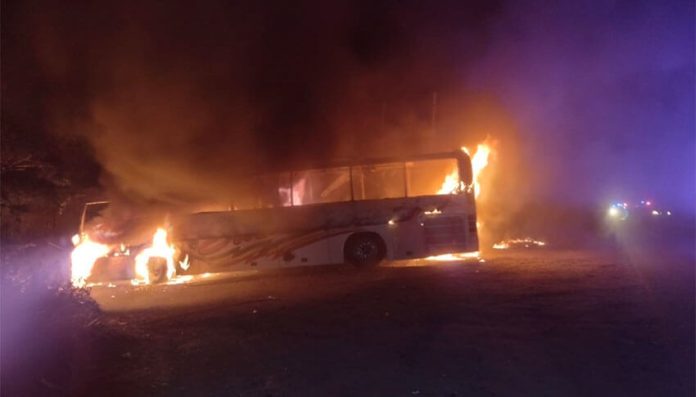
A bus burns in Veracruz after thieves ordered the passengers off and took their belongings.
A gang of thieves intercepted, robbed and then burned a bus Monday night on federal highway 180 between Coatzacoalcos and Jáltipan in southern Veracruz.
About 10 armed civilians in pickup trucks forced a Sotavento line bus filled with passengers to stop. They took the passengers’ money and cell phones then forced them off the bus at the stop known as El Porvenir.
The thieves proceeded to douse the bus with gasoline and set it on fire. Neighbors alerted the authorities and helped the passengers. No injuries were reported.
The newspaper La Jornada reported that the owner of the bus had previously received extortion calls demanding payment.
The robbery comes less than a week after another incident involving the Sotavento bus line in the same area. On December 1, a 71-year-old Sotavento employee was driving in his own vehicle on the highway between Jáltipan and Oteapan when an armed gang forced him to stop and kidnapped him. He was freed after family and coworkers paid a ransom.
Previous efforts to ban bullfights in the capital have failed.
The Mexico City Congress will vote on a bill that would ban bullfighting after the proposed law was approved by the legislature’s animal welfare committee.
Four members of the committee voted on Monday in favor of modifying Mexico City’s Animal Protection Law in order to prohibit bullfighting while a fifth member abstained.
Jesús Sesma, a Green Party deputy and president of the animal welfare committee, announced the committee’s approval of the initiative on Twitter.
“We’ll continue fighting to achieve its approval in the whole Congress vote. #It’sNotCultureIt’sTorture,” he wrote.
Speaking after the committee vote, Sesma noted that there has long been a push for bullfighting to be banned in the capital but efforts by former lawmakers to prohibit the bloodsport failed.
Bullfighting in Mexico City is currently exempt from a ban on activities that involve cruelty against and mistreatment of animals. The bill would prohibit public spectacles in which “bulls, steers and calves are mistreated, tortured or killed.”
If it becomes law, anyone who stages a bullfight could face fines of 4.9 million pesos (US $231,000).
Lawmakers are expected to vote on the initiative in the coming days. The Morena party is the dominant force in the Mexico City Congress, holding 32 of the 66 seats. Only one of the Morena members of the animal welfare committee attended Monday’s virtual meeting at which the vote was held and she abstained.
The absence of the other Morena members led lawmakers from other parties to question Morena’s support for the proposal. If most Morena lawmakers don’t support the initiative in the Congress vote, it would appear doomed to fail.
The four members of the animal welfare committee who voted in favor of the bill noted that the Mexico City constitution recognizes animals as sentient beings worthy of decent treatment. However, bulls in bullfights suffer mortal wounds inflicted by banderillas, they said.
Bullfighting association Tauromaquia Mexicana rejected the bill, characterizing it as an attack on a “cultural and popular activity established in our society for almost 500 years.”
More than 4 million people from “all strata of our society” attend bullfighting events every year, it said in a statement. The association also said that a ban on bullfighting in Mexico City would undermine an industry that contributed 6.9 billion pesos (US $326.1 million) to the economy in 2019, generates more than 80,000 direct jobs and pays annual taxes of more than 800 million pesos.
Bullfighting has already been prohibited in four states: Sonora, Guerrero, Coahuila and Quintana Roo. In contrast, the states of Aguascalientes, Tlaxcala, Hidalgo, Querétaro, Zacatecas, Michoacán and Guanajuato consider bullfighting intangible cultural heritage
The World Cup champion team, Ek ‘Balam of Belize with coach Menalio Novelo holding the trophy. Courtesy of Menalio Novelo
Just outside of the historic center of Merida, Yucatán, an ancient Mayan ball game — pok-ta-pok — saw its fourth World Cup final won by Belizean team Ek’ Balam. But in terms of the teams’ unified ultimate goal — to revive this sport played by the ancient Maya — they were all winners.
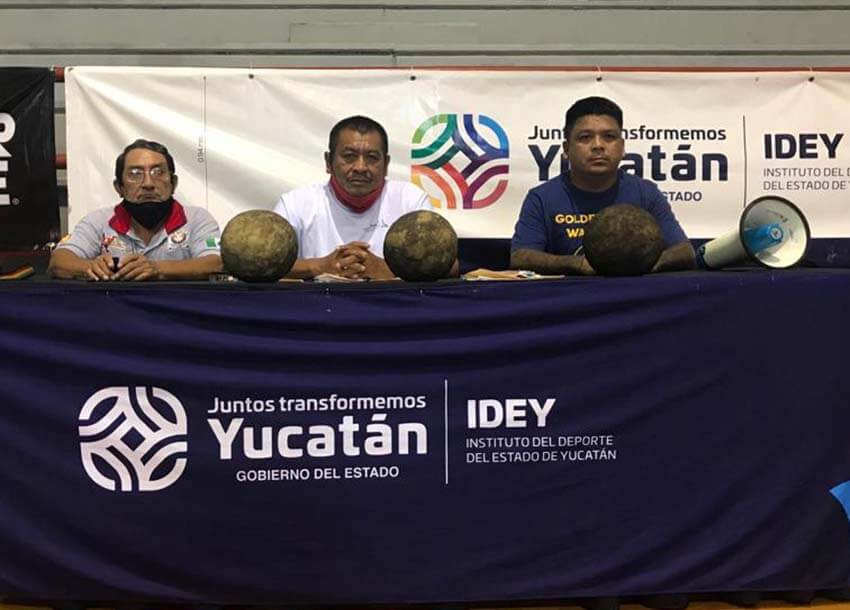
Seven teams competed on December 2 and 3 to be the world pok-ta-pok (also known as pelota Maya) champions. The tournament, held at the Yucatán State Institute for Sports, brought teams together from countries across Mesoamerica, including Mexico, Guatemala, Honduras and Panama.
Three of these championships have already been played since the modern-day version of the sport began to be played in Maya communities — in Guatemala in 2017 and in El Salvador in 2019 and the inaugural one in 2015 here in Mexico at the Chichén Itzá ruins in Yucatán. Organizers have revived the game as an engaging way for Maya all over Mesoamerica — but especially youth — to connect with pride in their heritage and to bond with members of their community.
The game rules are relatively straightforward: for every time that a team gets the ball over their opponents’ end zone, five points are awarded. Points are also deducted for foul play.
In the court’s center hangs a hoop that, if players can achieve the impressive feat of passing the ball through it, usually affords 10 points. For the finals, however, if the ball passes through the hoop, the game is won regardless of the points scored by the opposing side.
The panel of judges assigning teams their points for goals and deductions for foul play.
Spectators, however, should take heed: the game commands the full attention of its spectators with its blink-and-you’ll-miss-it pace.
The drums beat loud and fast as the games commence. There are no timers; no scoreboards to help keep track of proceedings. Instead, points are designated by a panel of judges courtside, and the winner is announced at the game’s end.
As the game gathers momentum, it becomes clear that there is a veritable artfulness in the way the players throw themselves on the floor; freeze the gameplay and the players would look as if they were reclining with one hand to the floor and one leg extended perpendicular to the action.
Even the floor maneuvers, however, do not quite parallel the grace of the aerial leaps these players take. Seemingly suspended in the air, they thrust their hips, straighten their legs and send the ball in a curving parabola back toward the other team.
As he watches, Menalio Novelo, manager and coach of Ek ‘Balam, possesses a calm reserve: his celebrations when his team scores points are composed, and he coaches the team with a practiced hand. Off the pitch, he is all smiles and enthusiasm, speaking keenly about the fifth pok-ta-pok international cup, which Belize will host in the city of Orange Walk in 2023.
Asked how the sport was initially received in Belize, Novelo recalls that, despite the prominence of Mayan culture in the traditions of the region, the game was not at first received with enthusiasm.
Felicita Cantun, at back, fourth from right, founded the Belizean team from youths trained in the game only two months before their first championship match. File photo
“It has been a challenge to encourage participation,” he says, “because the population of Belize is very small — only 400,000 people. Initially, we did not get much support from the government, though lately, we’ve seen an improvement in that area.”
Such challenges are ongoing in the sport, even as it gains traction across Mesoamerica. There is a clear need for a recognition of the sport as part of national and international heritage and a need for dedicated spaces in which to play. It is a question of reviving a sport that had seemed lost — as well as supporting indigenous culture.
Indeed, Felicita Cantun, founder of the Belizean team, derives her love for the sport from a history that runs blood-deep in the people who play pok-ta-pok. “I have my culture in my DNA,” she says. “It is in my veins.”
She explains that when she was young, she used to read about the ancient Mayan culture, including pok-ta-pok, though she did not watch it played until 2003. “After that, I had a vision of bringing this game to life — we have proof that it was played in Belize, so it is our heritage.”
And her role in the growth of pok-ta-pok in Belize?
“I am the founder of the team; I recruited these boys,” she says with a grin. “When I first spoke to my family about finding players in Yo Creek, they said, ‘Tu estás loca! [You’re crazy!],’ but now they see that my dream has been realized.”
The Belize and Guatemalan teams shake hands prior to their World Cup match. Underhemp Balloo
Novelo and Cantun’s hard work is evident in their team’s impressive track record: it came in third in 2015 after a mere two months of training and took the title of champions in both 2017 and 2019.
“Having the youth on board is essential for the future of pok-ta-pok,” says Cantun. “I think our ancestors would be proud that we are helping to grow this game in Belize once again.”
And proud they certainly would be: at the day’s end, the Ek’ Balam team had won the final game of the tournament against Mexico, 34 to 10, to become the pok-ta-pok world champions.
After the game ended, the opposing sides lined up to shake hands. Despite competing against one another, they were united in their efforts to breathe new life into the sport — and to pass on their cultural heritage to the young people of the Mayan world.
Indeed, before the tournament game commenced, three boys were playing on the court with a smaller version of the pok-ta-pok ball — youths who could be future cup finalists playing Mesoamerica’s oldest ball game beneath the ouroboros (a snake eating its own tail that is part of several ancient cultures, including Mayan). It is an emblem for eternal cyclical renewal.
An apt symbol for a game that has survived millennia of change and is fighting to drag itself out of obscurity through Mesoamerica’s youth.
Shannon Collins is an environment correspondent at Ninth Wave Global, an environmental organization and think tank. She writes from Campeche.
President López Obrador speaks at his Monday morning press conference.
The Americas director of Human Rights Watch (HRW) has excoriated President López Obrador in an op-ed published Saturday in The Los Angeles Times.
“Since his election in 2018, López Obrador has not only failed to improve the country’s disastrous human rights record, he has worked to undo many of the hard-fought gains in transparency and the rule of law that rights groups, activists and campaigners have achieved since the end of one-party rule in Mexico in 2000,” José Miguel Vivanco and HRW researcher Tyler Mattiace wrote.
Published under the headline “The U.S. shouldn’t ignore Mexico’s ongoing human rights catastrophe,” the op-ed asserts that the United States has been “noticeably silent” on AMLO’s “accelerating attacks on democracy.”
“President Biden has instead chosen to focus on enlisting López Obrador to prevent migrants from reaching the U.S. border,” Vivanco and Mattiace wrote.
They said the Mexican president inherited a “human rights catastrophe,” noting that there were “horrific abuses” during the military-led war on drugs waged by his two predecessors.
“Homicides hit staggering numbers. Thousands of people disappeared every year. But he has not addressed these problems. Soldiers continue to kill civilians. Homicides remain at historically high rates. And according to the government’s figures, more than 25,000 people have gone missing on his watch,” they wrote.
Noting that López Obrador remains a highly popular leader three years after he took office, Vivanco and Mattiace contended that the president “appears to believe that his continued popular support gives him the moral authority to concentrate as much power as possible in his own hands and to attempt to control every part of the state to bring about his promised transformation.”
They charged he uses his frequent attacks on neoliberals and conservatives as a distraction that helps him to avoid scrutiny.
Such attacks allow him to “avoid responding to genuine concerns raised by journalists who question him, women’s rights campaigners upset at his lack of action on gender-based violence, indigenous communities who oppose his mega-projects, environmentalists who disagree with his coal and oil-focused energy policy, and press freedom campaigners concerned about his government’s harassment of journalists, among others,” they wrote.
Among them: the independent energy and telecommunications regulators, the National Institute for Transparency and Access to Information and the National Electoral Institute.
“He recently decreed that his government’s construction and infrastructure projects would be automatically granted permits without any review and that as matters of ‘national security’ would be exempted from transparency rules,” Vivanco and Mattiace added.
They also said that AMLO has “gone after the judicial system,” asserting that “his efforts to intimidate the judiciary have grown brazen.”
“López Obrador has publicly singled out those whose rulings he dislikes and called for a judge who ruled against him to be investigated,” they wrote.
Vivanco and Mattiace charged that the United States’ “policy of ignoring” AMLO’s attacks on the rule of law “came into stark relief” when Vice President Kamala Harris failed to raise the issue with the president during a trip to Mexico in June.
“… López Obrador will be in office for another three years. His coalition still controls both houses of Congress and he has made it clear that he is willing to amend the constitution if necessary to remove obstacles to achieving his goals,” they wrote.
“Unless the circumstances change, there are no signs he intends to alter his course.”
An angry crowd turned violent after a soccer game was suspended for a homophobic chant in Morelia, Michoacán, on Saturday.
An Expansion League quarter-finals game between C.A. Morelia and Tampico Madero F.C. was interrupted when fans began to chant, “Eh, puto!” a homophobic slur and soccer fan tradition that the Mexico Soccer Federation (FMF) has been trying to end.
As per federation rules, the referee halted the game and sent the players back to their locker rooms after fans repeatedly yelled the chant. But fans were not having it: the crowd turned violent and began to throw objects onto the field.
After a failed attempt to restart the game, it was suspended. Tampico Madero F.C. won 2-0 and C.A. Morelia was eliminated from the quarter-finals in the semi-professional soccer league.
After stadium security guards were unable to calm the mob, Michoacán state police were called in. Home team fans wearing Morelia F.C. jerseys tried to enter the field, but were stopped by police.
The league said the matter will be reviewed by the FMF disciplinary commission.
“The homophobic chant is unacceptable in our soccer [games] and the rules and sanctions will be applied in full,” the league announced.
Federal forces deployed to Zacatecas in late November after a wave of violence in the state.
The federal government’s security strategy has come under fire at a virtual forum organized by four organized crime research organizations.
Among the issues that drew criticism were continuation of the militarized security strategy of the two previous governments and a failure to address policing at the local level.
Romain Le Cour Grandmaison, the cofounder of Noria Research, an organization that studies international affairs and conflict, criticized the government of President López Obrador for its perpetuation of the controversial military strategy.
Le Cour, also program director for public security and violence reduction at the think tank México Evalúa, told the forum – The Politics of Violence in Mexico and Central America – that federal security forces are reacting to violence rather than being proactive and preventing it from occurring in the first place.
Le Cour said the violence problem is complex and requires a strategy beyond deploying the military in a reactive way.
However, it is not the goal of anyone in Mexico – including public, private, criminal and state actors – to end violence, he said.
“No one, unfortunately, in those areas today is fundamentally interested in making violence disappear because violence is a very central political resource,” Le Cour said.
“So when violence is such a political resource and when violence is so functional in the political system, how can you actually make it disappear?”
Sandra Ley, a politics professor at Mexico City’s Center for Research and Teaching in Economics, criticized the federal government for not building the capacity of security forces at a municipal level. There is too much focus on solving the violence problem with a top-down approach, she said.
The forum, part of a 24-hour conference on global organized crime held last week, was hosted by the Netherlands’ Center for Information and Research on Organized Crime, the International Association for the Study of Organized Crime, the Standing Group on Organized Crime and the Global Initiative Against Transnational Organized Crime.
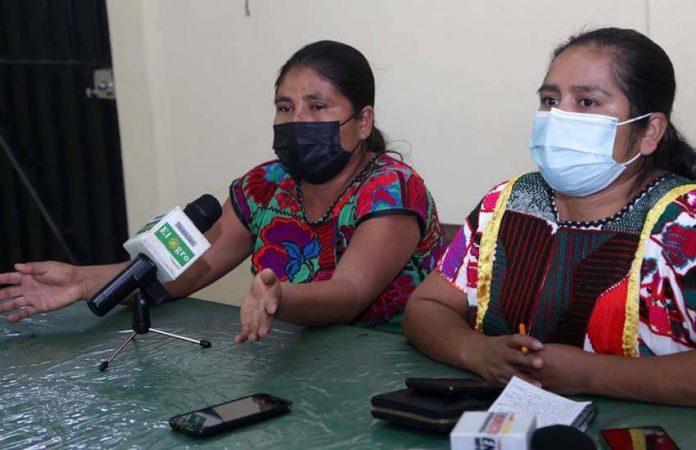
Members of Defensoras de Niñas at a press conference in Chilpancingo.
Indigenous women from the Montaña region of Guerrero have accused authorities at all three levels of government of abandoning them and claim they were better off when former president Enrique Peña Nieto was in office.
Mixtec women from Cochoapa el Grande, a municipality where the practice of selling young girls into marriage is common, traveled to the state capital Chilpancingo to denounce the lack of support from authorities, particularly in the areas of health and children’s welfare.
Members of the Defensoras de Niñas (Defenders of Girls) collective also said that their communities have been stigmatized by the media and authorities because girls continue to be married off for cash. The authorities haven’t taken the necessary steps to eradicate the problem at its root, they said.
Elvira García Rodríguez, a spokeswoman and interpreter for the collective, told a press conference that brigades of health workers traveled to communities in Cochoapa el Grande at least once a month during the 2012–18 government of Peña Nieto.
That allowed local people to obtain medical treatment, she said, explaining that residents don’t have the money to travel to hospitals and clinics outside the municipality.
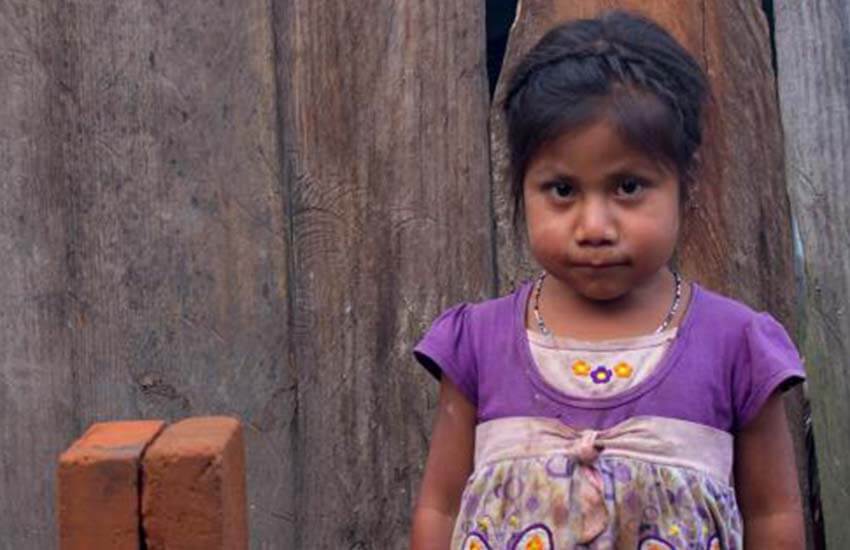
García said that authorities also haven’t taken necessary steps to eradicate the selling of child brides in the region. Yoquieroyopuedo.org.mx
“Now we’re completely abandoned,” García said. There is a lack of both doctors and medications in Cochoapa el Grande, she also said.
“… People die from a scorpion sting because there’s no way to treat them,” she said.
Since the current federal government took office, she said, “There’s no medical brigade that visits the towns to provide care to pregnant women, children and sick people. There’s nothing [in the way of medical care] in the communities, and people are very annoyed.”
García also said that the current government has made welfare payments to mothers contingent on their children being enrolled in school. “But in the majority of indigenous towns, there are no schools, so unfortunately that support doesn’t arrive,” she said.
“The benefits reach a few communities where there are schools nearby, but they don’t get to everyone who needs them,” García said.
In addition to calling for the resumption of visits by medical brigades, the Mixtec women urged federal and state authorities to dispatch officials to help seniors enroll in welfare programs.
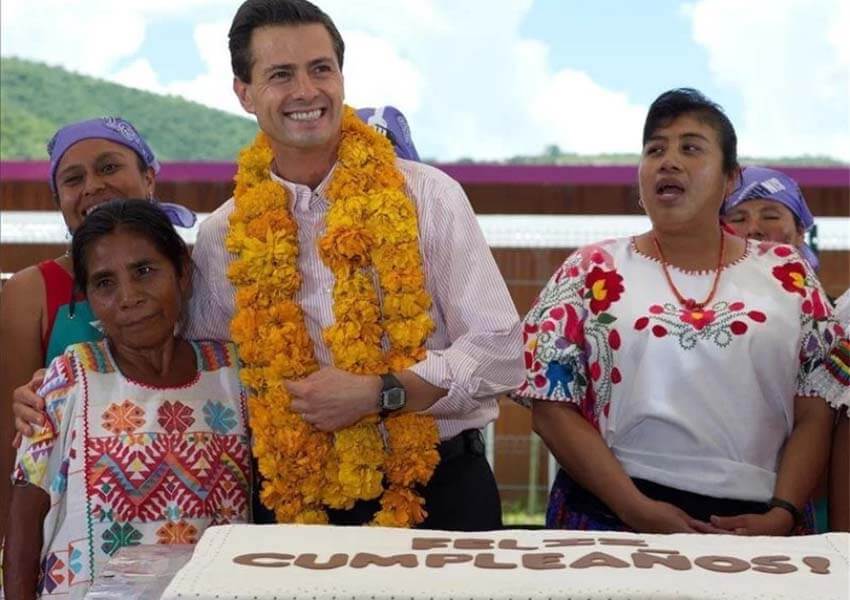
Former president Enrique Peña Nieto at the opening of a Guerrero women’s health and welfare center in 2015. President’s Office
“People don’t know how to fill out the forms or where to get some of the things they need. There’s nobody to guide them; that’s the case with seniors,” García said.
“We want the members of [President López Obrador’s] cabinet … to set foot on that land [Cochoapa el Grande]. We want people to translate so that the officials know how to deal with them because there are a lot of people who don’t speak Spanish,” she said.
Turning to the issue of child marriage, García and the other women said the practice of selling girls can be combatted through education and programs that ensure families have enough to eat. Child marriage in Mexico is most common in poor southern states such as Guerrero, Oaxaca and Chiapas, where parents might see the sale of their daughter as a means to alleviate poverty.
García expressed doubt that a recently-announced federal, state and municipal strategy to prevent violence against women and girls in the Montaña and Costa Chica regions of Guerrero and put an end to forced and arranged marriages will succeed in the short term. In Cochoapa el Grande, nothing is known about the strategy, she said before calling for its details to be disseminated.
García also urged Guerrero Governor Evelyn Salgado to visit the region and observe the conditions in which people live.
In Cochoapa el Grande, the women said, hundreds of families live in extreme poverty without food security and education that would allow them to find work opportunities outside the municipality.
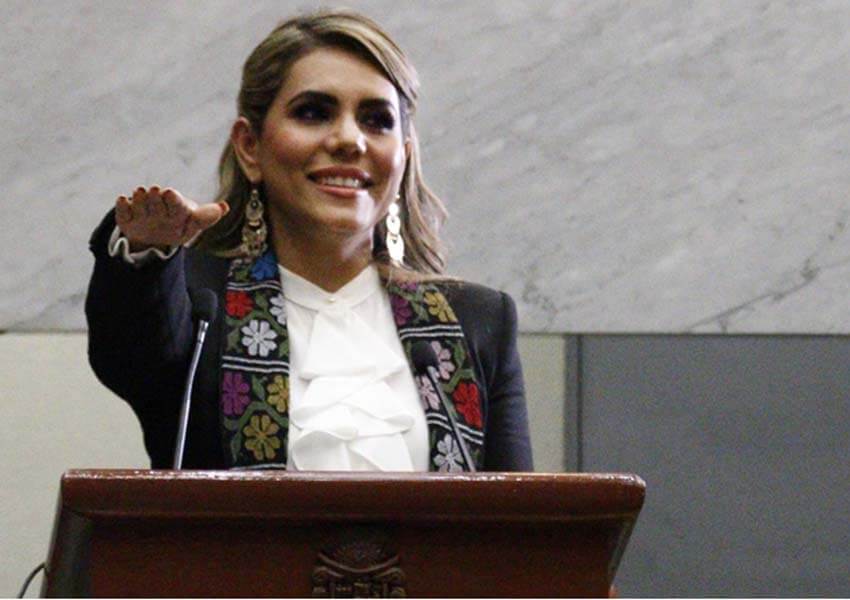
The Montaña activists urged Governor Evelyn Salgado, who took office in October, to visit the state’s Montaña region. Guerrero Congress
The director of the Montaña Tlachinollan Human Rights Center said agreements have been reached for at least four marriages involving minors to occur since the November 10 announcement of the anti-violence strategy. It was not clear whether, to date, those four marriages have proceeded.
“They’re adrift; it’s not known if they’ll be able to return to their towns or whether they’ll be directed into a program … [to help them] rebuild their lives,” he said, adding that both girls are currently displaced.