Home Blog Page 1212

Megadrought at the border strains Mexico-US water relations

0
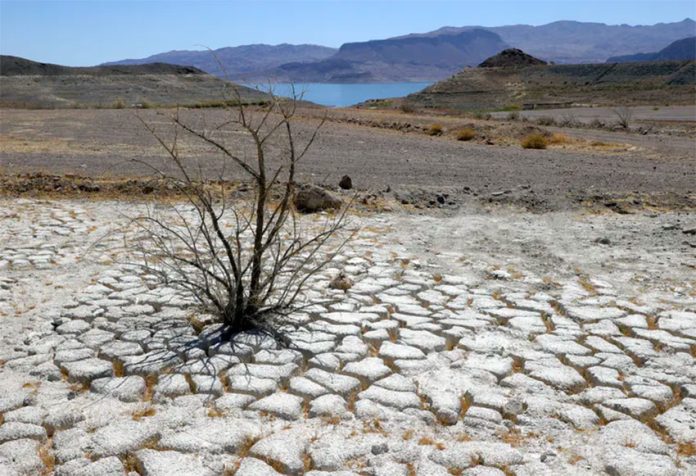
Lake Mead, which serves seven U.S. states and three in Mexico, is drying up
Lake Mead, which serves seven U.S. states and three in Mexico, is drying up. Ethan Miller/Getty Images

The United States and Mexico are tussling over their dwindling shared water supplies after years of unprecedented heat and insufficient rainfall.

Sustained drought on the middle-lower Rio Grande since the mid-1990s means less Mexican water flows to the U.S. The Colorado River Basin, which supplies seven U.S. states and two Mexican states, is also at record low levels.

A 1944 treaty between the U.S. and Mexico governs water relations between the two neighbors. The International Boundary and Water Commission it established to manage the 450,000-square-mile Colorado and Rio Grande basins has done so adroitly, according to our research.

That able management kept U.S.-Mexico water relations mostly conflict-free. But it masked some well-known underlying stresses: a population boom on both sides of the U.S.-Mexico border, climate change and aging waterworks.

The mostly semiarid U.S.-Mexico border region receives less than 18 inches of annual rainfall, with large areas getting under 12 inches. That’s less than half the average annual rainfall in the U.S., which is mainly temperate.
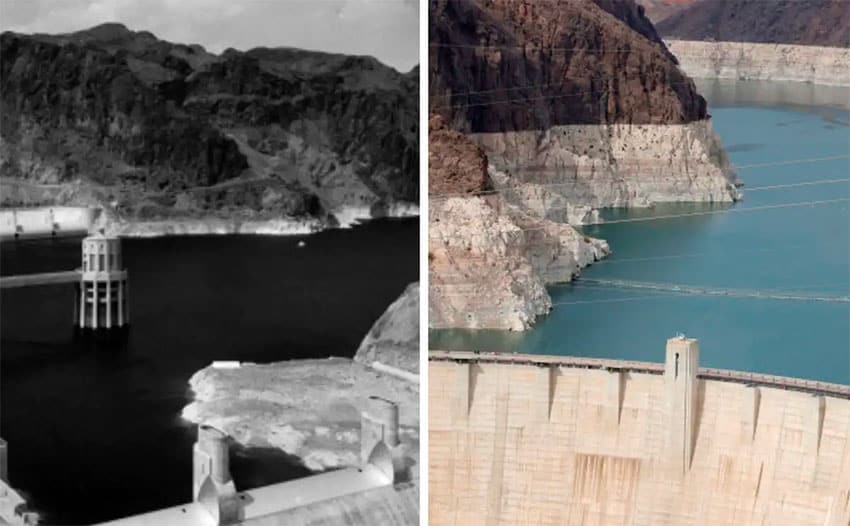
Lake Mead circa 1950, left, and Lake Mead in June 2021
Lake Mead circa 1950, left, and Lake Mead in June 2021. The surrounding cliffs show the substantial drop in water level. William M. Graham/Archive Photos/Getty Images and Ethan Miller/Getty Images

The 1940s, however, were a time of unusual water abundance on the treaty rivers. When American and Mexican engineers drafted the 1944 water treaty, they did not foresee today’s prolonged megadrought.

Nor did they anticipate the region’s rapid growth. Since 1940 the population of the 10 largest pairs of cities that straddle the U.S.-Mexico border has mushroomed nearly twentyfold, from 560,000 people to some 10 million today.

This growth is powered by a booming, water-dependent manufacturing industry in Mexico that exports products to U.S. markets. Irrigated agriculture, ranching and mining compete with growing cities and expanding industry for scarce water.

Today, there’s simply not enough of it to meet demand in the border areas governed by the 1944 treaty.

Three times since 1992 Mexico has fallen short of its five-year commitment to send 1.75 million acre-feet of water across the border to the U.S. Each acre-foot can supply a U.S. family of four for one year.

In the fall of 2020, crisis erupted in the Rio Grande Valley after years of rising tensions and sustained drought that endanger crops and livestock in both the U.S. and Mexico.

In September 2020, Texas Gov. Greg Abbott declared that “Mexico owes Texas a year’s worth of Rio Grande water.” The next month, workers in Mexico released water from a dammed portion of Mexico’s Río Conchos destined to flow across the border to partially repay Mexico’s 345,600-acre-foot water debt to the U.S.

Frustrated farmers and protesters in the Mexican state of Chihuahua clashed with Mexican soldiers sent to protect the workers. A 35-year-old farmer’s wife and mother of three was killed.

Mexico also agreed to transfer its stored water at the Amistad Dam to the U.S., fulfilling its obligation just three days before its October 25, 2020, deadline. That decision satisfied its water debt to the U.S. under the 1944 treaty but jeopardized the supply of more than a million Mexicans living downstream of Amistad Dam in the Mexican states of Coahuila and Tamaulipas.

The U.S. and Mexico pledged to revisit the treaty’s Rio Grande water rules in 2023.

The drought dilemma on the Colorado River is similarly dire. The water level at Lake Mead, a major reservoir for communities in the lower Colorado River Basin, has dropped nearly 70% over 20 years, threatening the water supply of Arizona, California and Nevada.

In 2017, the U.S. and Mexico signed a temporary “shortage-sharing solution.” That agreement, forged under the authority of the 1944 treaty, allowed Mexico to store part of its treaty water in U.S. reservoirs upstream.
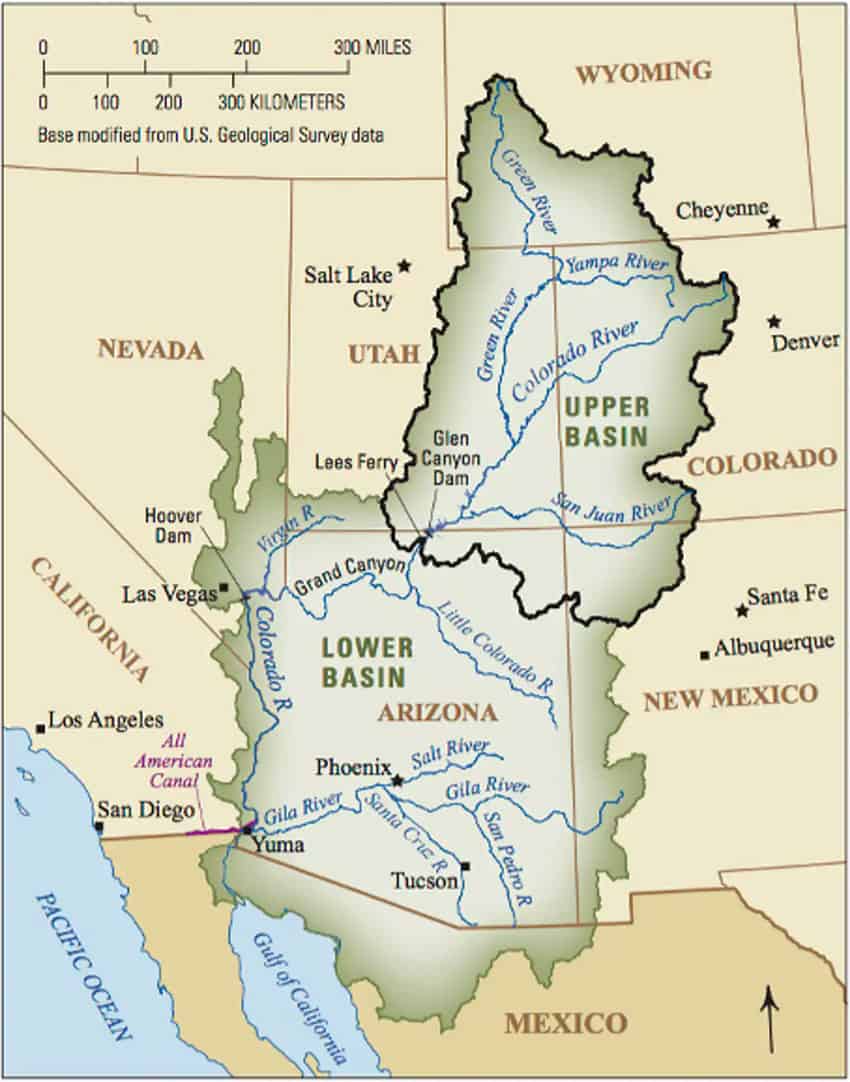
The Colorado River Basin.
The Colorado River Basin. U.S. Geological Survey

Water shortages along the U.S.-Mexico border also threaten the natural environment. As water is channeled to farms and cities, rivers are deprived of the flow necessary to support habitats, fish populations and overall river health.

The 1944 water treaty was silent on conservation. For all its strengths, it simply allocates the water of the Rio Grande and Colorado rivers. It does not contemplate the environmental side of water use.

But the treaty is reasonably elastic, so its members can update it as conditions change. In recent years, conservation organizations and scientists have promoted the environmental and human benefits of restoration. New Colorado River agreements now recognize ecological restoration as part of treaty-based water management.

Environmental projects are underway in the lower Colorado River to help restore the river’s delta, emphasizing native vegetation like willows and cottonwoods. These trees provide habitat for such at-risk birds as the yellow-billed cuckoo and the Yuma clapper rail, and for numerous species that migrate along this desolate stretch of the Pacific Flyway.

Currently, no such environmental improvements are planned for the Rio Grande.

But other lessons learned on the Colorado are now being applied to the Rio Grande. Recently, Mexico and the U.S. created a permanent binational advisory body for the Rio Grande similar to the one established in 2010 to oversee the health and ecology of the Colorado.

Another recent agreement permits each country to monitor the other’s use of Rio Grande water using common diagnostics like Riverware, a dynamic modeling tool for monitoring water storage and flows. Mexico also has agreed to try to use water more efficiently, allowing more of it to flow to the U.S.

Newly created joint teams of experts will study treaty compliance and recommend further changes needed to manage climate-threatened waters along the U.S.-Mexico border sustainably and cooperatively.

Incremental treaty modifications like these could palpably reduce the past year’s tensions and revitalize a landmark U.S.-Mexico treaty that’s buckling under the enormous strain of climate change.

The foregoing was written by Robert Gabriel Varady, research professor of environmental policy at the University of Arizona; Andrea K. Gerlak, professor, School of Geography, Development and Environment, University of Arizona; and Stephen Paul Mumme, professor of political science, Colorado State University.This article is republished from The Conversation under a Creative Commons license.
French family returns 4 pre-Hispanic artifacts to Mexico

0
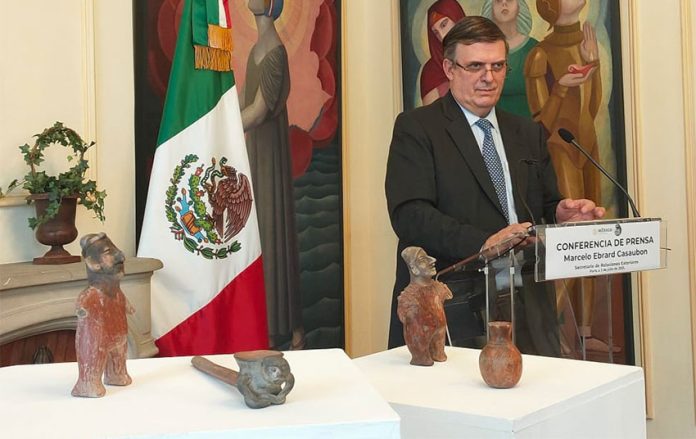
Foreign Minister Ebrard and the four pieces on display at a ceremony Friday in Paris.

A French family returned four pre-Hispanic clay artifacts to Mexico in a ceremony held Friday in the Mexican Embassy in Paris.

Foreign Minister Marcelo Ebrard, who attended the ceremony, said the figurines, vessel and pipe – which are possibly more than 2,000 years old – will be placed in the care of the National Anthropology Museum in Mexico City.

Three of the pieces are believed to be from western Mexico and one likely originates in the country’s Gulf region, according to Íngrid Arriaga of the Cultural Institute of Mexico in France.

The two human-form figurines probably came from shaft tombs that were used in parts of the country where the modern day states of Jalisco and Nayarit are located.

Arriaga told the news agency AFP that the bulbous vessel returned by the family is typical of artifacts from western Mexico, while a pipe in the form of a zoomorphic figure is typical of the Gulf region, home to the Olmecs, widely regarded as creators of the first civilization in Mesoamerica.

“Being able to recover these goods is a great thing for us,” Ebrard told a press conference in the French capital.

“We’re making progress every day in making illegal trafficking more difficult and recovering our historical and cultural wealth,” said the foreign minister, who shared a video of the recovered pieces on his Twitter account.

The family who returned the artifacts requested anonymity. The day before they were given back, Mexican and French officials signed an agreement committing to strengthen bilateral cooperation against the illegal trafficking of cultural artifacts.

Mexico has increased efforts in recent years to recover pre-Hispanic artifacts that left Mexico – some of which were looted from archaeological sites – and found their way to private collections, as well as the auction block in some cases. But it has had difficulty recovering pieces from France due to the laws in that country.

The auction house Christies sold 36 of 39 Mesoamerican and Andean artifacts that went on the block in Paris in February, including 30 Mexican pieces. The auction, which raised more than US $3 million, went ahead despite protests by the Mexican government.

With reports from AFP 

Coronavirus stoplight risk map remains unchanged

0
The new map is identical to the previous one.

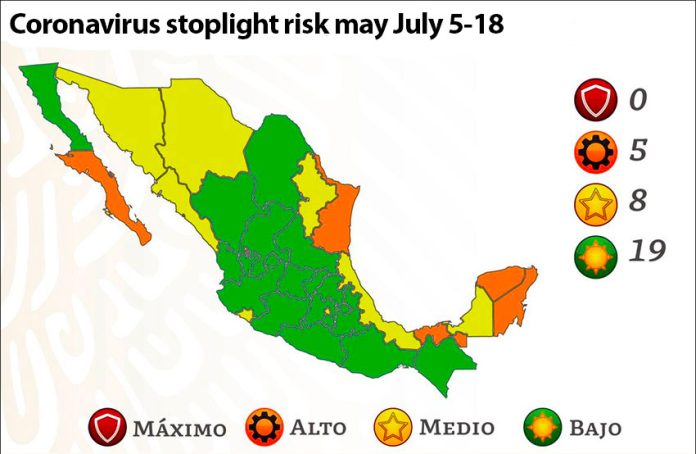
The federal government announced Friday that the coronavirus stoplight map it published on June 18 would remain in effect for an additional two weeks.

Nineteen states will remain low risk green until at least July 18, eight will stay at the yellow light medium risk level and five will maintain their orange light high risk status.

In the green light category are Aguascalientes, Baja California, Chiapas, Coahuila, Durango, México state, Guanajuato, Guerrero, Hidalgo, Jalisco, Michoacán, Morelos, Nayarit, Oaxaca, Puebla, Querétaro, San Luis Potosí, Tlaxcala and Zacatecas.

The yellow light states are Campeche, Chihuahua, Colima, Mexico City, Nuevo León, Sinaloa, Sonora and Veracruz, while the orange light entities are Baja California Sur, Quintana Roo, Tabasco, Tamaulipas and Yucatán.

Although the lights didn’t change, two states recorded new records.

Two of the orange light states – Quintana Roo and Yucatán – recorded new daily records for coronavirus cases this week, with more than 400 confirmed in the former state on Thursday and over 300 in the latter on Friday. The highly infectious Delta strain of the virus is circulating in both Quintana Roo and Yucatán as well as many other Mexico states, according to health authorities.

Nationwide, the federal Health Ministry reported 5,879 new cases on Friday and 177 additional Covid-19 deaths, pushing the accumulated tally to 2.53 million infections and 233,425 fatalities. New case numbers have trended upwards recently, raising fears that Mexico is in or entering a third wave of the pandemic.

Meanwhile, updated Health Ministry excess mortality data shows that more than 447,000 fatalities are attributable to Covid-19, an increase of almost 130,000 compared to data published in March. The figure is almost double the official death toll.

An analysis published in May by the Institute for Health Metrics and Evaluation (IHME) at the University of Washington School of Medicine showed that more than 617,000 people had likely died from Covid in Mexico.

Reported Covid-19 deaths had decreased every month since February after almost 33,000 were recorded in January – the worst month of the pandemic – but spiked 42.3% in June to 9,479 from 6,661 in May.

The increase occurred despite all seniors already having been given the chance to be vaccinated and the vaccine rollout extending to people in their 40s and 30s last Month.

Just under 32 million people have received at least one shot of a vaccine, of whom 19.7 million are fully vaccinated, according to the most recent Health Ministry data. The former figure represents 38% of the adult population but it doesn’t include Mexicans who have traveled to the United States to get vaccinated.

According to The New York Times vaccinations tracker, Mexico ranks 72nd out of 182 countries listed for doses administered per 100 people. Mexico has given 36 shots per 100, the tracker shows, and 25% of the entire population – adults and children – has received at least one dose.

With reports from Milenio

Conditions worsen at informal migrants’ camps at US border

0
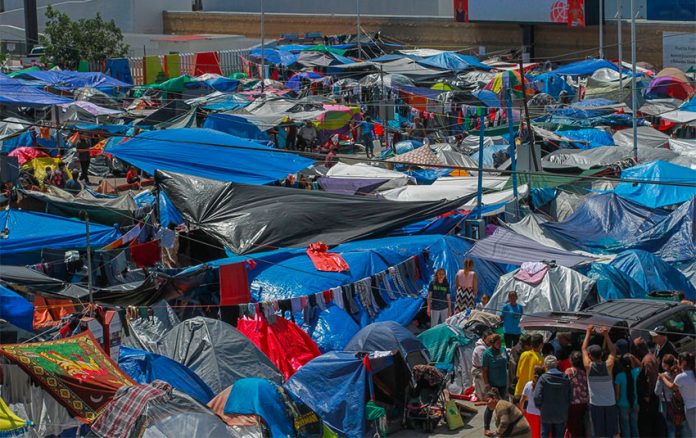
The camp at Chaparral in a photo taken in early May.

Conditions at informal migrant camps on the northern border are worsening, becoming increasingly unsanitary and crowded as more north-bound migrants arrive, according to a report by the Associated Press.

U.S. President Joe Biden has ended former president Trump’s “Remain in Mexico” policy, which forced asylum seekers to wait for their immigration court appointments in Mexico. President Biden also eased, but did not end, pandemic restrictions that prevent migrants from seeking asylum in the United States. But many migrants still have not been able to enter the U.S., and more keep arriving at the border.

One such camp is El Chaparral near the Tijuana-San Diego border crossing. Hundreds of families live under plastic tarps without bathrooms, and vulnerable to the weather and criminal gangs.

“The children are getting sick with diarrhea, they’re getting fevers and infections because there are a lot of flies around,” said Karitina Hernández, 63. “There is no sanitation, there is garbage around, excrement, urine.”

Hernández fled violence in Guerrero after a gang killed one of her sons and threatened her. She and her family have been living for weeks in a tent in El Chaparral. Her neighbors include roughly 2,000 migrants from Mexico, Haiti and Central America.

The Mexican Human Rights Commission issued a warning weeks ago about conditions in the camps and municipal authorities want to shut it down. But migrants fear that if they leave, they could miss their chance to enter the U.S.

A similar camp of asylum seekers in Matamoros, near Brownsville, Texas, was shut down in March. But more migrants keep arriving. Shelters in Tijuana ran out of room and migrants had nowhere to go.

The migrants are vulnerable to kidnapping and extortion by gangs, said Nicole Ramos, an activist with the migrant aid group Al Otro Lado.

“The United States says its laws and programs are there to protect the migrant community from traffickers, but now they are doing even more business,” Ramos said.

Another migrant, Armando Hernández, fled violence in Michoacán with his two sons. He expressed frustration with the admissions process.

“What proof do I need? To come here with my guts shot out?” he asked.

With reports from AP

Puebla celebrates 200 years of chile en nogada

0
chile en nogada
The dish will be celebrated through September 15.

The year was 1821 and Mexican military leader Agustín de Iturbide had just signed the document that gave Mexico its independence from Spain.

As de Iturbide and his army passed through Puebla, the nuns of the convent of Santa Mónica decided to serve him a special meal to celebrate their new country, and chile en nogada was born. Now, 200 years later, Puebla is celebrating the dish with a variety of festivities from now until September 15.

The traditional Puebla dish features the colors of the Mexican flag: green chiles stuffed with meat and fruit in a white nut-based sauce, garnished with red pomegranate seeds. To celebrate the tricolor dish, Puebla has organized master classes with international chefs, food festivals in Calpan and Tehuacán, and the unveiling of a commemorative plaque, among other activities.

There will be a screening of a documentary about chile en nogada and the dish will participate in New York’s international chile festival. The period of festivities will also include the publication of a book on the subject, a traveling exhibition on the origin of the ingredients and to wrap it all up, a concert by the state symphonic orchestra.

And chile en nogada is not just a delicious local specialty. It also bring economic benefits to the region, according to Puebla restaurant association president Olga Mendéz. She said that more than 15,000 restaurants in Puebla serve the dish and that in 2021, the sale of chile en nogada will bring in 800 million pesos (US $40.5 million).

Other states including Querétaro, Oaxaca and México state have expressed interest in promoting the dish among their residents, leading the restaurant association to offer presentations on the Puebla method for preparing chile en nogada, so that more people can enjoy a tasty part of Mexican history.

With reports from Milenio

Pipeline rupture causes balls of flames on surface of Gulf of Mexico

0
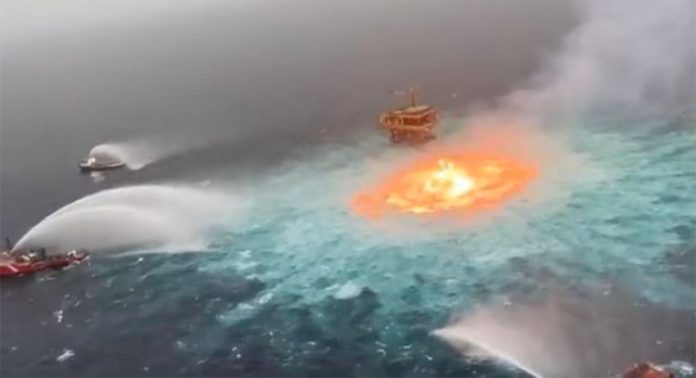
Gas burns on the ocean surface in the Gulf of Mexico on Friday.

The ocean was ablaze in the Gulf of Mexico on Friday after a Pemex underwater gas pipeline ruptured and caught fire.

The fire started around 5:15 a.m. when a 12-inch gas duct sustained a valve failure. The accident occurred 150 meters from the Ku-C drilling platform in the Ku-Maloob-Zaap extraction complex, located on the Bank of Campeche. The Ku-C platform was unoccupied at the time and there were no injuries reported.

Pemex closed the duct and dispatched fire control boats to pump water over the flames that boiled up from the deep. While the accident did not affect the operations of Ku-Maloob-Zaap the extent of environmental damage caused is unclear.

The incident drew widespread criticism from environmental groups.

“The frightening footage of the Gulf of Mexico is showing the world that offshore drilling is dirty and dangerous,” said Miyoko Sakashita, oceans program director for the Center for Biological Diversity. “These horrific accidents will continue to harm the gulf if we don’t end offshore drilling once and for all.”

Reportan incendio en ducto marino en plataforma KMZ de Pemex en Campeche

Greenpeace Mexico called the accident a clear example of how the current fossil-fuels-based mode of energy production is unsustainable and presents grave risks to the environment.

Pemex has experienced several accidents in the course of the past year, including an explosion at the refinery in Salina Cruz, Oaxaca, in January and another at the Cadereyta refinery in Nuevo León in December 2020.

With reports from Excélsior and AP

International human rights body urges Mexico to reconsider ‘media lies’ report

0
Ana Elizabeth García
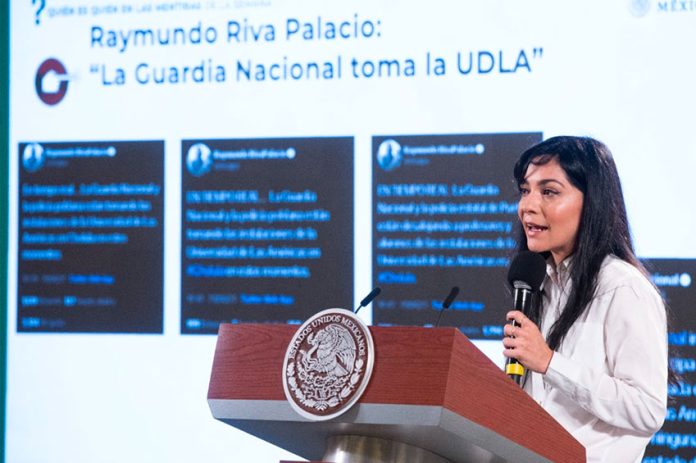
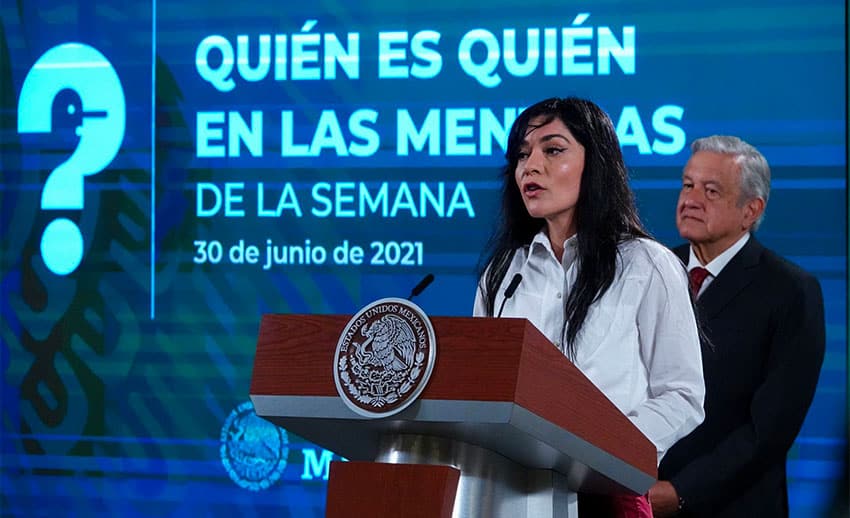
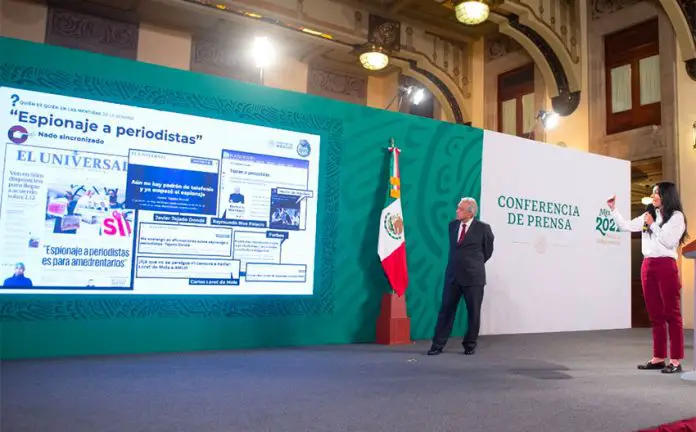
Ana Elizabeth García presents the first weekly exposé of fake news during Wednesday's press conference.

A high-ranking official with the Inter-American Commission on Human Rights (IACHR) has urged the federal government to consider scrapping its fake news exposé sessions, the first of which was held this week.

President López Obrador announced June 23 that debunking fake news would become a regular feature of his morning press conferences.

“… We’re going to have … someone from the government who tells us the lies of the week; a who’s who in the lies of the week in order to combat fake news,” he said.

Ana Elizabeth García Vilchis, a ruling Morena party insider with no prior experience in government, was anointed as the fake news debunker-in-chief and led the first “who’s who of lies” on Wednesday. More on that later.

On Thursday, the IACHR’s special rapporteur for freedom of expression, Pedro Vaca, said the government’s practice of exposing fake news – or what it classifies as such — must be reconsidered because it could affect people’s right to a free and informed debate.

Speaking at a virtual United Nations seminar on the protection of human rights for activists and journalists in Mexico, at which federal government communications coordinator Jesús Ramírez was among the attendees, Vaca said there were doubts about whether the section of the president’s press conference led by García complied with international human rights standards.

“I would like to invite all of you to put yourself in the position of a person who is singled out, with their name and surname, for what he or she has said … like the Pinocchio of the week,” he said.

“… What impact might this have on their future freedom of speech, on the conditions to express oneself on matters of public interest,” the special rapporteur added.

It has been documented that journalists who have challenged López Obrador at his morning press conferences and written critical reports about the government have been ridiculed and threatened on social media. The editor of Reforma, which the president frequently rails against, received death threats in 2019 after López Obrador criticized the Mexico City-based broadsheet. A bomb threat was made against the same newspaper in 2020 after it published negative news about the president’s management of the coronavirus pandemic.

Press freedom advocacy group Article 19 said in 2019 that López Obrador’s “stigmatizing discourse” against the media “has a direct impact in terms of the … risk it can generate for the work of the press because [his remarks] permeate in the discourse of the rest of society and can even generate attacks.”

Jan-Albert Hootsen, Mexico representative of the Committee to Protect Journalists, said last September that government attacks on the media can have serious repercussions for journalists, explaining that reporters who have been criticized by López Obrador at his weekday news conferences have received thousands of adverse and hostile messages on social media and even death threats.

The president looks on as García presents her first Who is Who in the Lies of the Week.

“It’s a situation that all of Mexico knows about, it’s not new … and it’s something that the federal government also knows, although its practices continue to be the same in the morning conferences in the National Palace,” he said.

It would seem logical that the extension of the practice via weekly “who’s who of lies” sessions has the potential to worsen the already hostile environment faced by reporters in Mexico, where more than 40 journalists have been killed since López Obrador took office in late 2018.

Echoing Article 19’s statement, Vaca said that the “stigmatization” of the media by the government could provoke attacks against journalists.

He questioned what action the government would take to correct the record if it accuses a reporter or media outlet of disseminating fake news but its accusation is subsequently shown to be false. Article 19 has already labeled López Obrador’s weekday press conferences “a worrying instrument of misinformation.”

The misinformation continued during Wednesday’s fake news exposé, according to a report by the news website Animal Político.

García said that her section of the president’s presser was “in no way” attempting to “harass or censor” journalists but rather “inform truthfully so that the people of Mexico can exercise their right to access information that allows them to form an opinion with certainty.”

Animal Político, however, said there were “omissions, imprecisions and even false remarks” in her presentation.

The news website challenged claims made by both García and López Obrador about media coverage of the apartment tower collapse in Miami and allegations that the federal government is spying on journalists.

The president questioned why The New York Times, which last month published an extensive investigation into the May 3 Metro disaster in Mexico City, hadn’t published a similar report about the Florida disaster. Animal Político pointed out that the newspaper has in fact reported thoroughly on the tragedy and its suspected cause.

The news website also charged that García made incorrect assertions about news organization Univision, journalists Joaquín López-Dóriga and Raymundo Riva Palacio, Spanish newspaper El País and the Reuters Institute Digital News Report, which was published last month and raised concerns about “frequent attacks from a populist president who accuses the media of unfair coverage and corruption.”

With regard to El País, for example, García accused the newspaper of not seeking an opinion from the government before publishing a story on radioactive waste at a Federal Electricity Commission nuclear power plant in Veracruz.

But the story, Animal Político noted, said the state-owned utility didn’t respond to the request for comment it received from El Páis.

Referring to fake news she claimed to have debunked, García said that “this type of information threatens the democracy for which we’ve fought so much in this country.”

But others saw the “who’s who of lies” as the real threat to democracy.

“The who’s who of lies is a distraction, a circus, intimidation, an abuse of power, an authoritarian practice [and] a sign of intolerance to critical scrutiny,” political scientist and columnist Denise Dresser wrote on Twitter.

“The objective: divert attention from problems that journalism documents and about which the government lies.”

With reports from Proceso and Animal Político 

Tortilla politics and the fake news patrol: the week at the mañaneras

0
Ana Elizabeth García gives her fake news report on Wednesday.

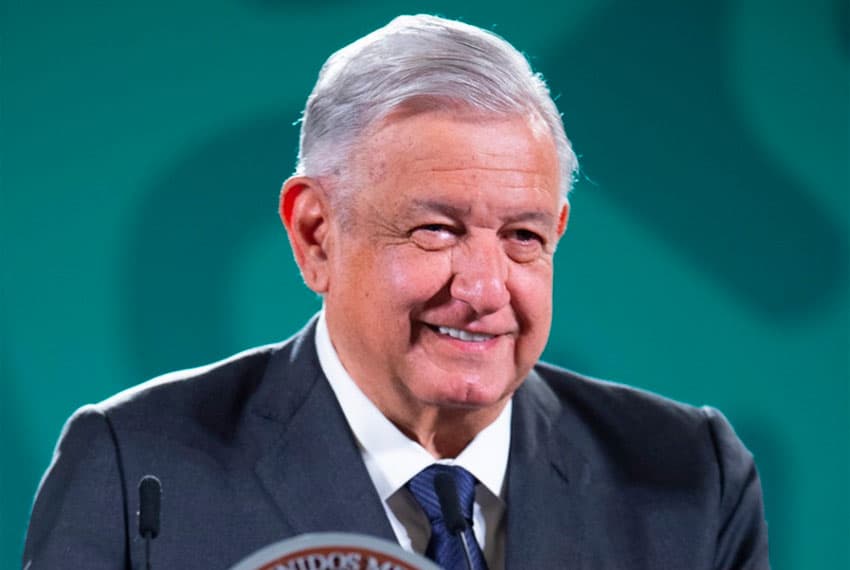
This week marked three years of President López Obrador’s political project, which he terms The Fourth Transformation. Central to the mission is the elimination of corruption from political life, for which transparency is deemed critical. That’s where the morning news conference come in.

Sporadically enlightening and rarely dull, the mañaneras have become spectacle in their own right. Here’s a roundup of the week’s most eye-catching moments.

Monday

The government’s projects reported smooth progress on Monday, including the Maya Train, but trouble was afoot in the media. One newspaper had published two damaging stories early in the day. Safety information for the train’s construction, it claimed, had been withheld in the search for funding, and private companies had said the timeline for completion was unrealistic.

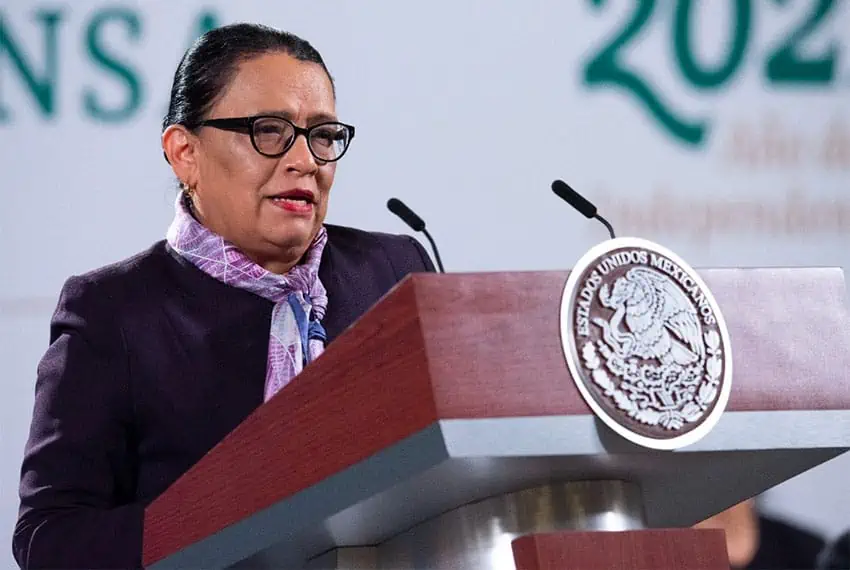
Security Minister Rosa Icela Rodríguez Velázquez entered to give an update on femicides. She didn’t shirk her public duty: femicides had risen 7.1% in annual terms; eight states accounted for 57.4% of investigations.

A cutting question came from the floor about the August 1 public referendum. It will ask if past presidents should be investigated for corruption. The journalist had come prepared: “Article 35 of the Constitution, which establishes the right to consultation, in its eighth section, in paragraph five, establishes that the consultation must be carried out on the same day as the federal elections,” he said. So why hadn’t the question been put to voters on June 6?

“When the initiative was sent for the consultation, it was proposed to be held on the day of the election; however, members of the opposition bloc didn’t accept it,” the president coolly clarified.

Tuesday

The Covid-19 report opened proceedings on Tuesday: case numbers were predicted to be up 15% by the end of the week.

A question regarding the delivery date of cancer medications provoked a rant against media outlets for remaining silent under the old regime, when the suppliers of medications “prospered off the health of the people.”

Speaking of the Spanish newspaper El País, the president said, “It’s a Spanish publishing house dedicated to protecting Spanish companies, which were the ones that dominated in Mexico … It was like the second conquest. The Spanish companies came and seized Mexico as a land of conquest.”

Security Minister Rosa Icela Rodríguez gives her weekly crime report.

He named petrol company Repsol, construction company Obrascón Huarte Lain and electricity company Iberdrola as three offenders. “[Iberdrola] even committed the offense of taking former president Calderón to work as a consultant … A mockery,” he declared.

Then, a pause, for a plea to Sonora. As the clock struck 9:00 a.m. in Mexico City it was only 7:00 a.m. in Sonora, and those tuning in from the northwestern state were implored by the president to get vaccinated. Getting the north of the country vaccinated has become a priority for the government, which hopes to convince U.S. officials that it’s safe to reopen their shared border.

Wednesday

Birthday celebrations kicked off the conference on Wednesday. Still in its infancy, the National Guard had reached two years of age.

Then, something new. In a move that caught journalists off guard, the so called “who’s who of lies,” or the fake news patrol, was given its first airing. Morena party insider Ana Elizabeth García Vilchis had been handed the honor of delivering the weekly reports that aim to round up media misinformation about the administration.

“The Reuters Institute shows that Mexico is at the lowest level of trust toward the media since 2017, going from 55% to 43%,” she said, showing her trust in at least one media outlet.

Claims in the media, some clearly erroneous, were read out and swiftly rebuffed. Last week, a newspaper alleged that journalists were being spied on by the administration. The story was incorrect, García informed, because the president had said so: “Here on June 24, the president of the republic affirmed that it is false that reporters and columnists are being investigated and spied on,” she said.

Later, one media figure was given unusually high praise. Political cartoonist Antonio Helguera, who had died on June 25, received a tribute from the president. “All human beings contribute something, but there are those who are essential … It will be very difficult to replace him because he was a good citizen, a patriot and a person who defended just causes,” the president said.

Thursday

In a highly unusual development, there was no mañanera on Thursday. Instead, a ceremony of sorts to mark three years in power, referred to officially as “the third year of the historic democratic triumph of the people of Mexico.”

In actuality it meant a long speech from the president, and no space for questions from journalists.

The big themes were tackled. In the years of a global pandemic, the government had fared well on the health front, the president said. “Our country is not … at the top for deaths from Covid,” he said. Mexico, for the record, is in the top 1% of countries for mortality from Covid-19.

The president shared historical tortilla prices on Friday.

AMLO, as the president is commonly known, added that the administration’s record stood up on crime too. No new criminal gangs had been formed in his term and throughout the election season there had been no “massacres.” In Guerrero, he said, no electoral candidate had suffered acts of aggression.

By comparison, 152 acts of aggression were recorded in Veracruz.

Friday

The fake news patrol two days earlier had ruffled a few feathers. The UN said the feature was an attack on human rights, according to one journalist.

“Well, that is a very expedient interpretation on the part of those who don’t want there to be any debate of ideas … they just want to have a monopoly of the truth … that is the most undemocratic thing possible,” the president replied.

One issue came up that was of indisputable national importance. Tortilla prices were on the rise with the price per tonne of flour going from 1,500 to 1,600 pesos (about US $76 to US $81).

“Twenty-five years ago, 30 years ago, a minimum wage afforded 50 kilos of tortillas. When we came to the government, a minimum wage was six kilos of tortilla,” the president said.

“Look at what [former presidents] Salinas and Zedillo and Fox, Calderón and Peña did … look how the minimum wage deteriorated,” he added.

Soon after, AMLO called curtains on the final mañanera of the week, and dashed off to pack his bags for a weekend trip to Sonora.

Mexico News Daily

Aguililla residents angry as they suffer from blockades while soldiers unaffected

0
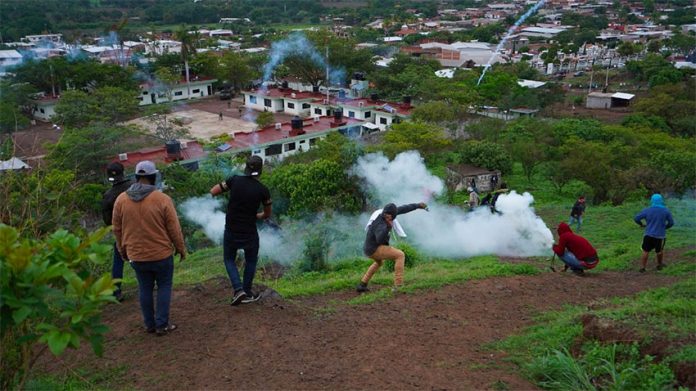
Citizens lob firecrackers and stones at the army's helicopter landing pad in Aguililla.

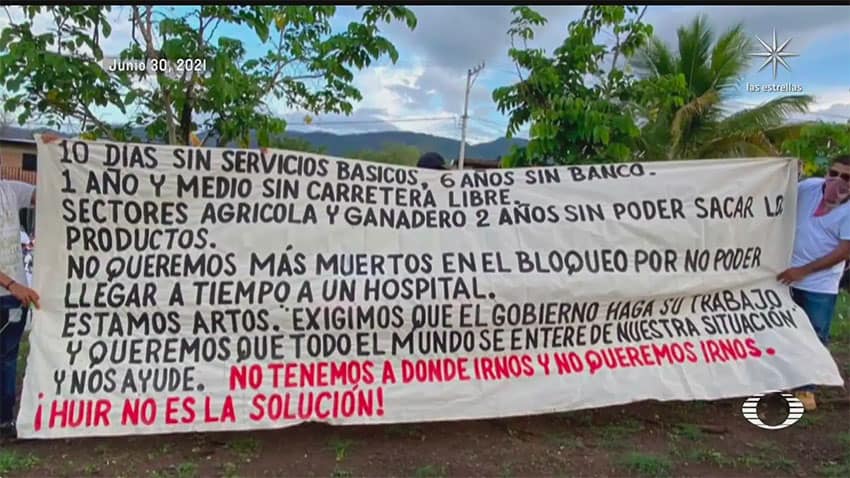
Fed up with being unable to buy basic goods because access to their city has been cut off by criminal organizations, residents of Aguililla, Michoacán, banded together on Wednesday to block supplies for soldiers stationed there.

By launching firecrackers and throwing stones, residents prevented an army helicopter from landing on a hill in Aguililla, where the Jalisco New Generation Cartel and the Cárteles Unidos are engaged in a turf war.

The hill has been used as a heliport for helicopters bringing supplies to soldiers deployed in the town, located in Michoacán’s notoriously violent Tierra Caliente region.

Residents also used used rocks and other items to form large letters across the hill that together sent a clear message to authorities: “FUERA GOBIERNO,” or government (get) out. According to a report by Televisa News, the aim of the message was to get soldiers to leave their comfort zone – their barracks – and confront the criminals.

“… We don’t have food, electricity or telephone service. [The criminal groups] have cut off the roads. [But] the soldiers are well attended to, they get food, they get everything but the [ordinary] people don’t,” one Aguilla resident told the newspaper Milenio.

A banner in Aguililla lists the issues facing residents
A banner in Aguililla lists the issues facing residents: 10 days without basic services, six years without a bank, a year and a half without free transit and two years that farmers have been unable to ship their products.

Residents have also attacked Aguililla military barracks with stones, apparently in an attempt to jolt the soldiers into action.

“We’re not against them having what they need, they’re government workers, but … as we don’t have the means [to get supplies], we’re suffering worse than them,” said Gilberto Guevara, a local priest.

He said the arrival of helicopters with shipments of supplies for soldiers when residents can’t access those same supplies themselves is “almost like an insult.”

Residents also held marches for peace this week in both Aguilla and Morelia. In the state capital, protesters took a petition to the Michoacán Congress that set out a range of demands aimed at bringing peace to Aguilla and some semblance of normality to their lives.

“The most important thing is free transit,” said Karla Velazco, spokesperson for the group Voices of Aguililla.

As roads to Aguilla are constantly blocked by cartels, trucks transporting food, medicine and other essential goods are unable to get to the municipality, she said.

“We’re completely abandoned, we don’t feel like [the authorities] are providing a solution, or the solutions they’ve given us only last hours and that’s not what we’re asking for,” Velazco said, explaining that highway blockades have quickly reappeared after they were dismantled.

Many people have completely given up on Aguililla, choosing to flee and restart their lives in other states or even seek asylum in the United States.

With reports from Televisa and Milenio

‘Hot fudge’ caves in a tiny Jalisco town feature big surprises

0
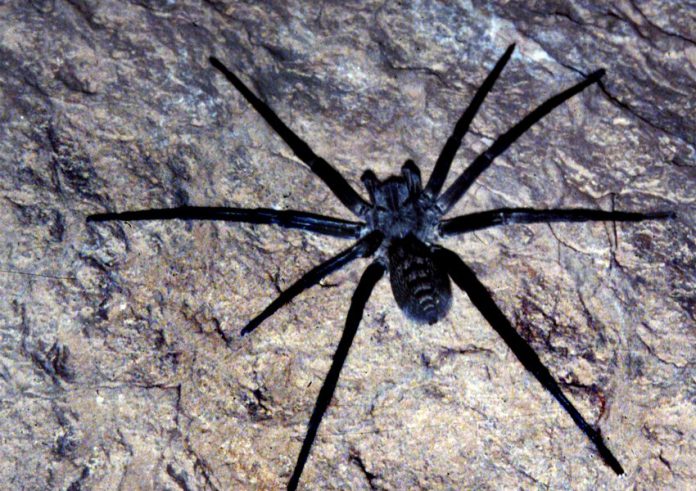
Wolf spider
The wolf spider, an inhabitant of the caves near Pihuamo, Jalisco, has eight eyes and is an excellent hunter.

The town of Pihuamo, Jalisco, is located 150 kilometers south of Guadalajara. “Somewhere near Pihuamo, there’s an iron mine,” we had been told, “and along the road to that iron mine, there is a bottomless pit.”

Well, cavers love bottomless pits, if only for the fun of rappelling down them and a few minutes later shouting, “Hey, I’m at the bottom already. You call this deep?”

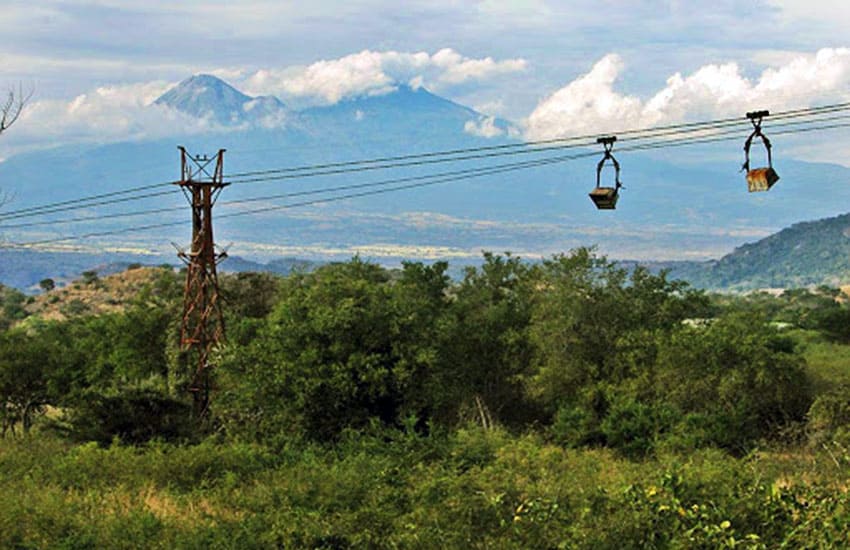
So off we drove to Pihuamo, where we had no problem finding the road to the iron mine because alongside it is a very high and impressive teleferico (aerial tramway) transporting 650 containers brimming with iron ore through the air.

“Do you know el pozo sin fondo [the bottomless pit]?” we queried a local shopkeeper.

His eyes lit up. “Mira no más [look no further]. You have heard about our bottomless pit way up there al otro lado [in the United States]?”

vampire bat
Vampire bats use their razor-sharp teeth to make small incisions and then lap up the flowing blood.

“Of course,” I replied.

“Okay, amigo. Bienvenido and drive up the road toward the mine until you come to a place called Fortín, and there you will find the now internationally famous pozo.”

The pueblito (a town with a population of 10) called Fortín was marked by a little shop selling refrescos (soft drinks). We asked for cold beverages and sat down with the owner, Don Rafael.

El Pozo sin Fondo,” he said, “is back down the road a bit, next to a big pile of garbage.”

Ah, I thought, the local dump! What else would people do with a bottomless pit?

We found the dump without a problem, and my wife Susy walked up to the edge of the hole, which was about four meters in diameter. “I can see the bottom from here!” she complained. “Who are they kidding?”

caves near Pihuamo River, Jalisco
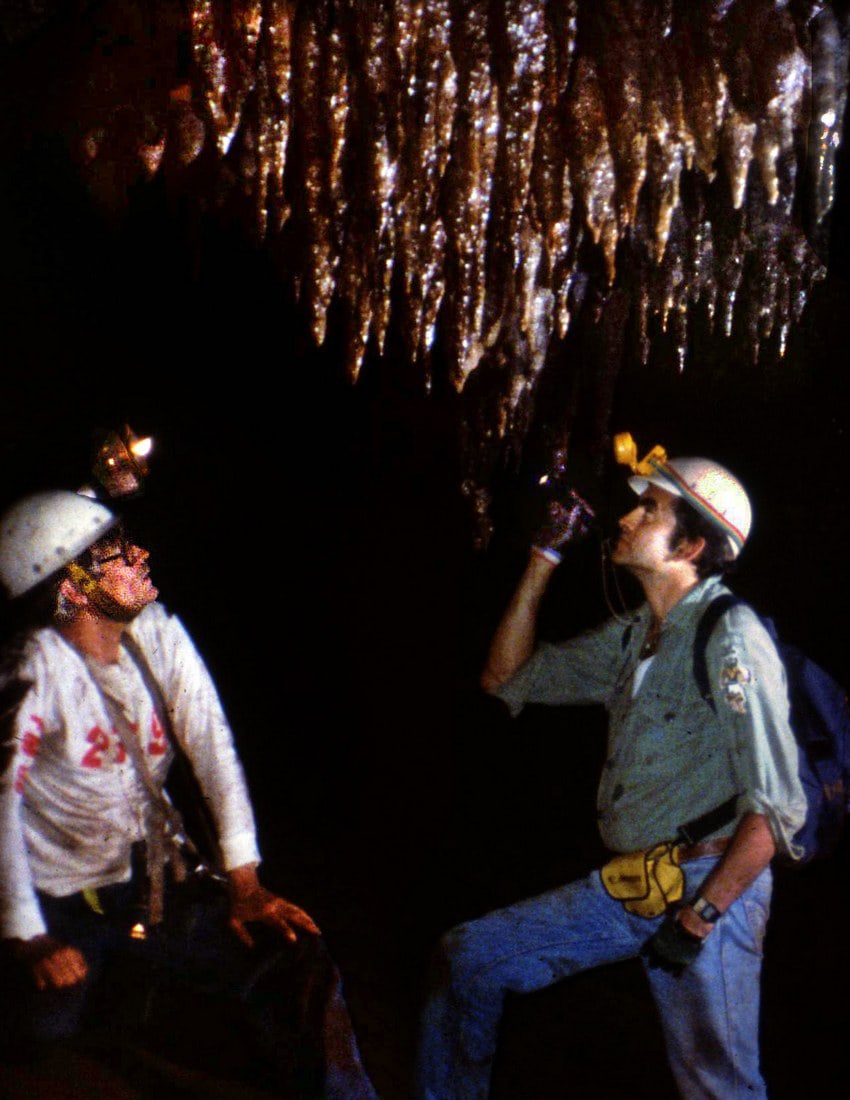
The writer, left, and Luis Rojas explore 360-meter-long Cueva Chocolate.

Hoping to find an extensive cave system down below, we rigged the pit for rappelling.

The supposedly non-existent bottom turned out to be 28 meters below the surface. I was surprised to find not much garbage in it, but this was explained when I proceeded to the lowest part of the room, where I found a vertical passage with smooth, shiny walls.

“Obviously,” I thought, “a lot of water goes down this hole and — I bet — a lot of garbage too. No wonder they thought it was bottomless.”

I slid down the lower passage for 16 meters before the tube got too tight to continue, but continue it did. The surface of this passage was coated with rippling white flowstone, suggesting that below us there must be plenty of karst, the kind of limestone you get where caves abound.

Inspired by what we had seen, we went back and asked Don Rafael if there were any other caves in the area. “¿Cuevas?” he said. “Pos sí [well, yes], there’s a big one down by the river.”

A few weeks later, we were back again. “Don Rafael, remember that cave near a river you told us about? Think we could find it if you give us some directions?”

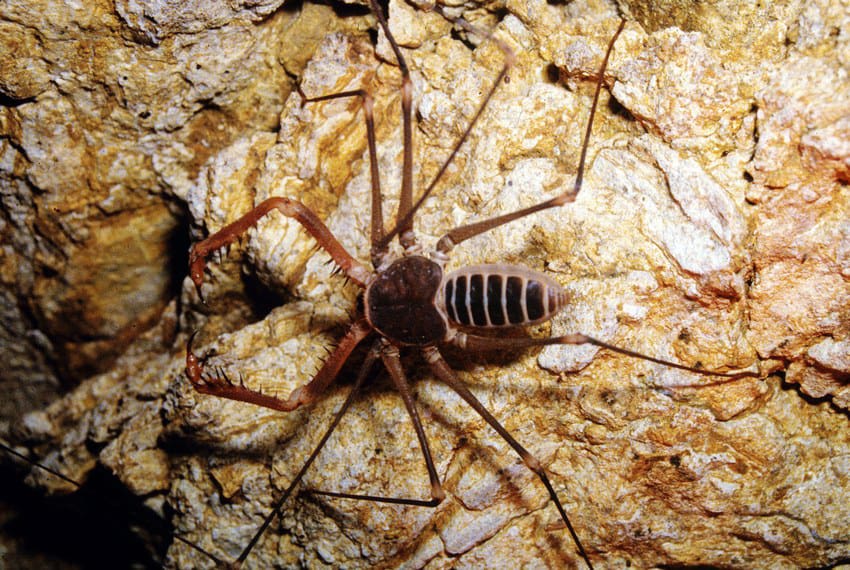
tailless whip scorpion
Although it might look quite ferocious, the tailless whip scorpion is harmless.

“Nope.”

“Er, any chance you could show us where it is?”

“Sure, anytime.”

“Oh … well, er, how about today?”

“Busy today.”

“Tomorrow, then?”

caver in Pihuamo, Jalisco
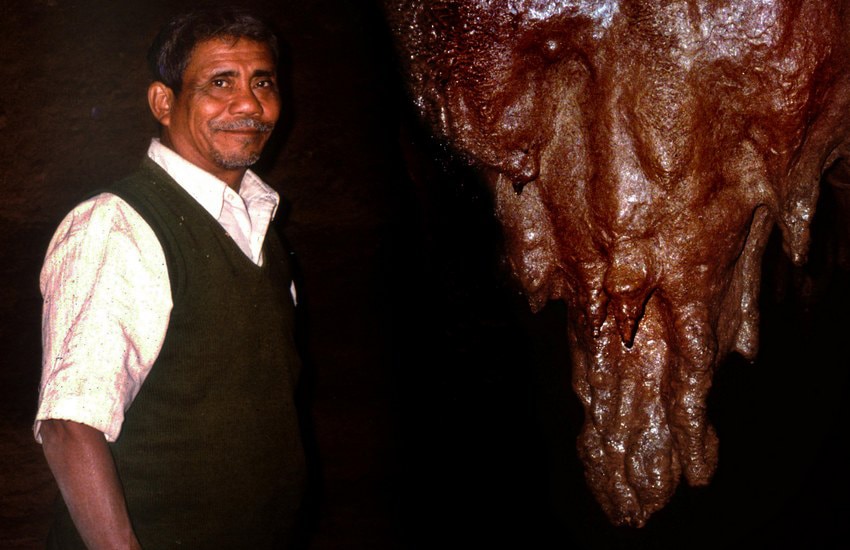
Don Rafael takes an early morning tour of Chocolate Cave.

“Busy tomorrow también.

Since Don Rafael himself had told us that one could easily spend all day wandering inside that cave, none of us were ready to give up so easily. After another hour of chit-chat with a lunch break in between, we finally talked him into “taking us partway.”

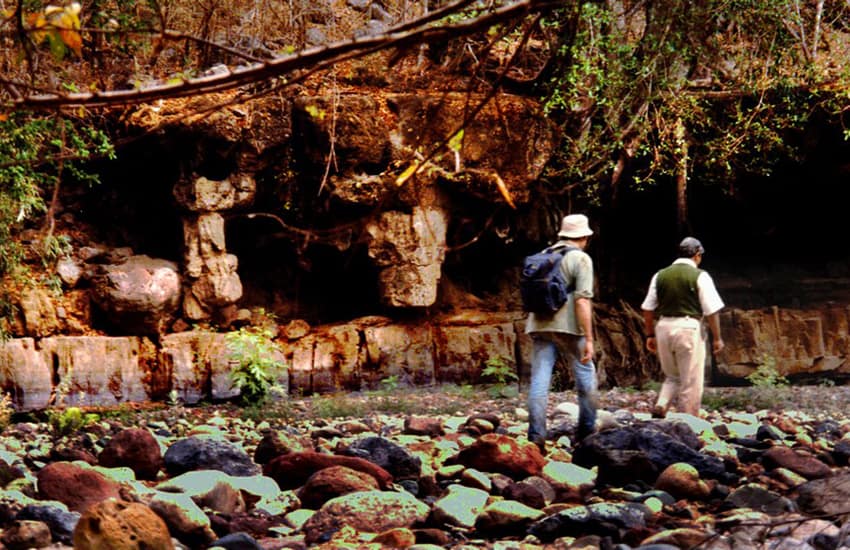
The river in question is the Pihuamo, reachable after a two-hour brisk hike down into a wide, lonely canyon said to be the home of animales de uña: pumas, mountain lions, etc. Shade trees dot the shallow river, which sometimes cuts through beautiful, massive chunks of limestone.

Although the heat was stifling and it felt like our brains were frying, we fairly flew down the hillside and headed upriver. The entrance to Don Rafa’s cave turned out to be small and easy to miss, which was a bit of a letdown until we stepped inside …

It’s been a long time since we’ve seen a cave in Jalisco anything like this: a smooth borehole four to five meters in diameter that reminded us of a train tunnel. Stalactites hung from the ceiling like great drops of hot fudge.

As Don Rafa had no name for this place, we decided to call it La Cueva Chocolate.

Chinche Hocicona insect
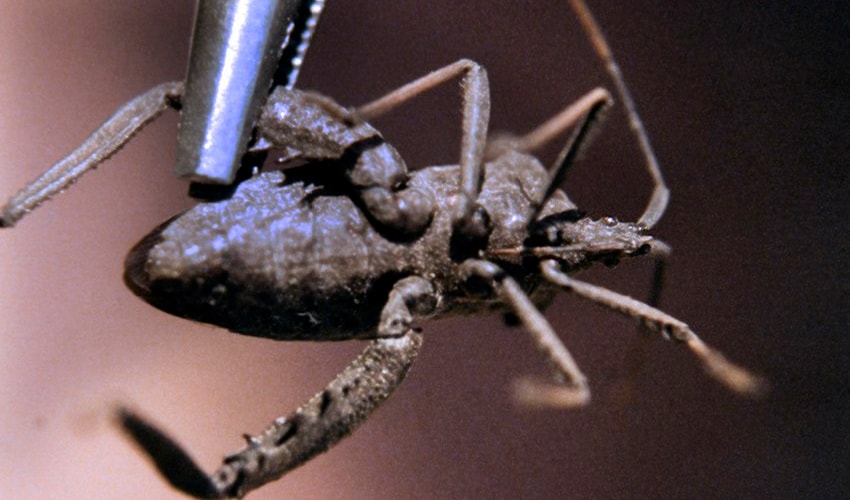
The kissing bug, Triatoma infestans, sucks blood through its needle-like proboscis while its victim sleeps.

Because we had taken our guide away from his work (naturally, he hadn’t stopped at partway), we resisted the temptation to see more of the cave and headed back up the steep hill to tiny Fortín.

The following weekend, Luis Rojas and I were back in the area with the intention of camping near Chocolate Cave. Don Rafa had promised to join us there the following morning for breakfast and a tour of the cave, inside of which he had never dared to venture.

At the riverside, we filled our canteens with fresh spring water and then stored our backpacks inside the cave entrance. Soon we came to a short side passage, where we discovered a chinche hocicona, a two-inch-long, bloodsucking “kissing bug” that can carry the parasitical Chagas disease. Farther on, we found two ferocious-looking arañas lobo (wolf spiders), whose bite is said to cause painful swelling.

Leaving behind this delightful menagerie, we returned to the main passage, which led us to several rooms bristling with countless, shimmering brown stalactites. Many of these were within arm’s reach, and we were amazed not to find any of them broken.

Not far along, we gazed up at a balcony that was obviously home to a good-sized colony of bats. The next rooms we came to were either filled with breakdown or great heaps of sand.

In one place, we found deposits of fine black dust that we proved — with the help of a magnet — to be powdered iron, probably washed into the cave from the aerial tramway.

chocolate colored stalactites in Jalisco cave
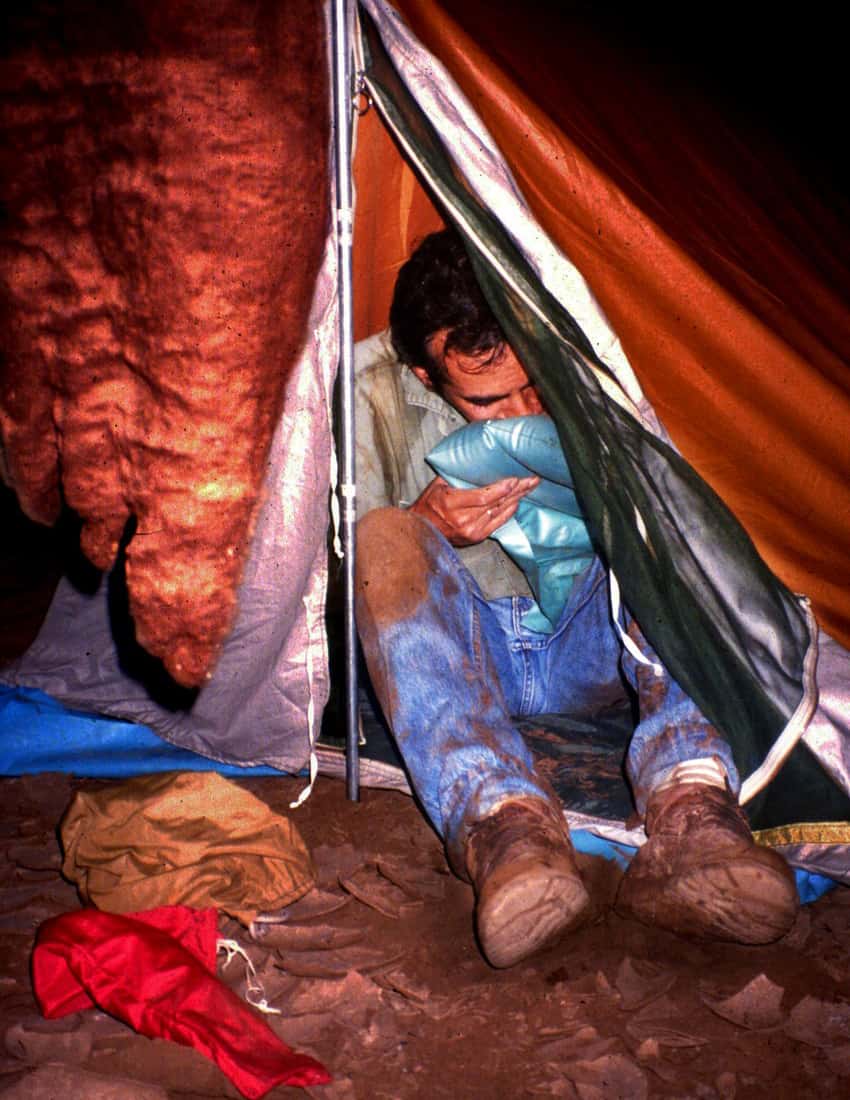
Blowing up an air mattress inside a tent tied to chocolate-colored stalactites.

After 300 meters or so, we stood at the opening to a very large room filled with lots of chunky breakdown. We both stopped and looked at each other: “Do you hear what I hear?”

The sound reaching our ears was so much like the voices of people laughing, shouting and playing in a swimming pool that we really expected to find a balneario (water spa) at the other end of the room.

We actually set out looking for these people, whom we named The Water Sprites, but what we found were two streams of water on both sides of the room, each heading off in the opposite direction, apparently fed by a spring rising up from beneath the breakdown.

Were our “voices” generated by the gurgling stream on the right, or were they real voices floating into the cave above the wider “river” heading off to the left? We still don’t know.

As we hadn’t come prepared for water sports and the hour was late, we headed back to the entrance area, which unlike the terrain outside the cave, was nice and flat. So we decided to pitch our tents here inside by tying them to a couple of conveniently located stalactites on the low ceiling.

Tents inside a cave? With vampire bats fluttering by at regular intervals (not to mention the other critters we had seen), we figured it would be a good idea.

near La Cueva del Salitre, Jalisco
Don Rafael leads us to the picturesque entrance to La Cueva del Salitre.

Luis Rojas, who had been suffering from insomnia for weeks, finally got a good sleep, which was suddenly interrupted in what I thought was the middle of the night …

“ANYBODY IN THERE????” came a loud voice booming through the cave. Who in the world could that be?

We prudently declined to respond and a minute later heard “the voice” again, this time right outside our tents: “Here I am for my tour … let’s go!”

The voice was Don Rafa’s. I reached for my flashlight and looked at my watch. It was 6:30 a.m.!

Nevertheless, here was Don Rafael, smiling at us and opening a big thermos full of hot té de canela (cinnamon tea).

After the tour, as we tromped back up the steep slope, Don Rafa regaled us with tales of other caves in the area: La Cueva del Salitre, where we could see trout swimming about inside, and La Cueva de los Tindarapos, home to tailless whip scorpions (Amblypygi) — huge arachnids with mantis-like claws.

caver in Pihuamo, Jalisco
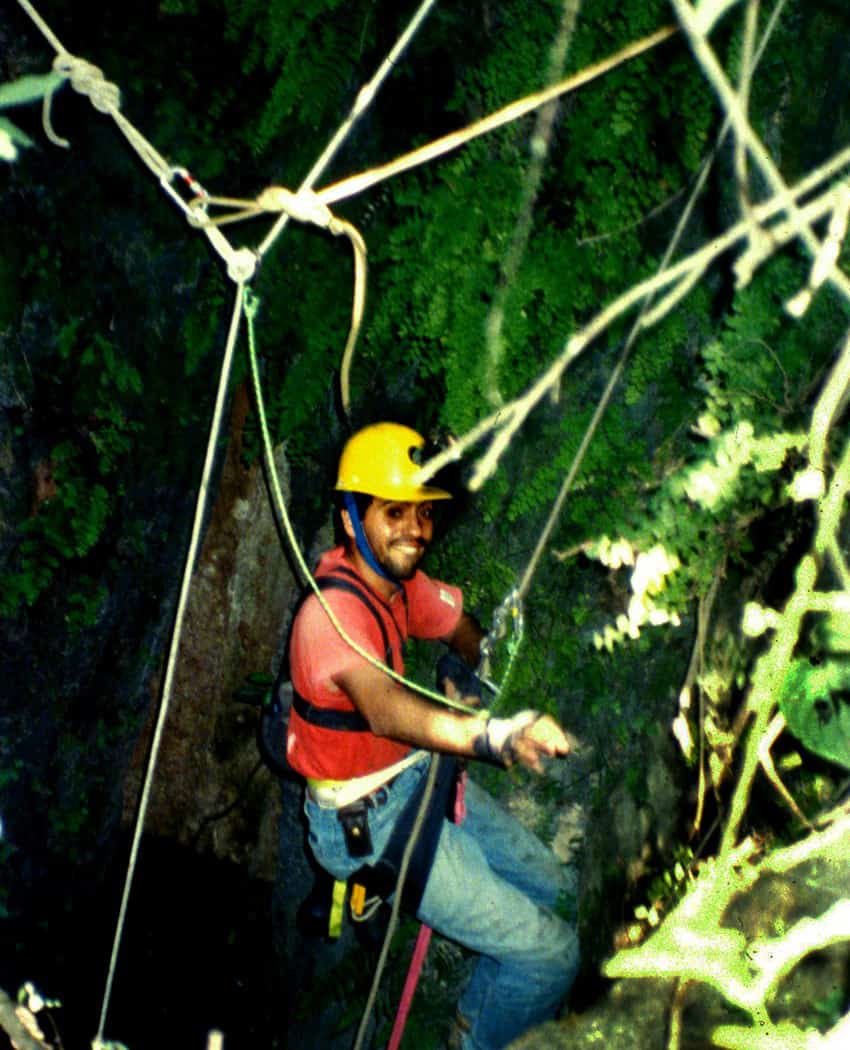
Caver Juan Blake rappelling into ‘The Bottomless Pit.’

We had found it: a caver’s paradise!

The writer has lived near Guadalajara, Jalisco, for 31 years and is the author of A Guide to West Mexico’s Guachimontones and Surrounding Area and co-author of Outdoors in Western Mexico. More of his writing can be found on his website.


Encino Mine aerial tramway, Jalisco
This elegant aerial tramway transports 320 tons of iron ore per hour from Jalisco’s Encino Mine.