A 12-hour power cut in Playa del Carmen, Quintana Roo, Sunday was caused by thieves, the Federal Electricity Commission (CFE) said.
Electricity supply was interrupted early in the morning after power lines were stolen.
The outage left 10,904 users without electricity, affecting about 7% of the population of Solidaridad, the municipality in which Playa del Carmen is located. Power had been completely restored by 4:30 p.m.
The CFE said it would take legal action against those responsible “who had vandalized CFE infrastructure on repeated occasions,” referring to smaller scale power cuts caused by vandalism on Saturday night.
In those outages the neighborhoods affected were Toscana, Colonia Santa Fe, Villas Rivero, Villamar 2 and Bosque Real.
Aside from vandalism, power failures are common on both the Yucatán Peninsula and in Baja California and Baja California Sur due to the vulnerability of their remote electricity generators.
The nurses were hired last year to supplement hospital staff in Zacatecas during the worst days of the Covid-19 crisis.
More than 100 nurses who were hired in Zacatecas last year to treat patients during the first peak of the coronavirus pandemic were unceremoniously dismissed via the WhatsApp messaging service last week.
“Yesterday we were heroes, today we’re unemployed,” said Eladio Sandoval Flores, one of the temporary nurses who was hired in the first half of last year and cared for Covid patients during the first and second waves of the pandemic.
He is one of more than 30 relief nurses at the Zacatecas Women’s Hospital who is now without a job. The other nurses dismissed last week worked at general hospitals in the municipalities of Fresnillo, Jerez, Loreto and Jalpa. All were paid just 180 pesos (about US $9) for each eight-to-12-hour shift and received no benefits.
David Villagrana told the newspaper Milenio that he and other relief nurses at the women’s hospital, located near the state capital, worked during the “ugliest and most intense” periods of the pandemic but their service didn’t even earn them the right to be told about the termination of their employment face to face.
He said that one of his colleagues received a WhatsApp message from her boss last Monday and that she was told to tell all the other relief nurses not to go into work the next day.
Enrique López, a relief nurse at the Loreto General Hospital, recounted a similar story.
“The truth is, it’s very unfair that they dismiss us in this way. … We were on the frontline; we worked during the peak of the pandemic … but we’re discarded from one day to the next; it’s not fair at all,” he told Milenio.
“We know that we’re temporary nurses, but we were also the ones who took up the fight to attend [to patients during] the most critical stage of the pandemic; we put our lives on the line but were notified with a simple WhatsApp message that we’re fired,” Sandoval told the newspaper El Universal during a protest outside the Zacatecas Women’s Hospital.
The dismissed nurses called for health authorities to employ them on a permanent basis even though the pandemic, and the number of hospitalized Covid patients, has declined significantly.
“The only thing we’re asking for is that our work be respected; we’re not asking for anything that we haven’t earned with dedication, effort and love for what we do,” said López.
Frida Esparza, a Democratic Revolution Party federal deputy from Zacatecas, characterized the nurses’ dismissal as a betrayal.
“Yesterday they were considered heroes of the pandemic by President Andrés Manuel López Obrador, but today they’re fired,” she said.
Norma Castorena, secretary-general of Section 39 of the National Health Workers Union, called for the dismissed nurses to keep their cool and not intensify their protest in any way because authorities are looking at the possibility of extending their contracts.
For many, Mexico is becoming a destination rather than a transit country.
Mexico is on track to record its highest ever number of asylum requests as growing numbers of migrants choose to stay in the country rather than seek entry into the United States.
The Mexican Commission for Refugee Assistance (Comar) registered 41,195 applications for asylum in the first five months of the year, 16 more than in all of 2020, when migration fell due to the coronavirus pandemic.
The figure is 68% higher than that recorded in 2019, when Comar received 24,551 requests between January and May. New records for asylum applications were set in March, April and May this year with more than 9,000 requests in each month.
Mexico is becoming a destination rather than a transit country for a growing number of migrants, said Marcos Tamariz, deputy head of mission for Doctors Without Borders in Mexico and Central America.
“We’re seeing statistics that are going to exceed the historic record of 80,000 refugees [in one year],” he said, adding that many of those who are seeking asylum are living in precarious conditions in migrant shelters, detention centers and makeshift camps.
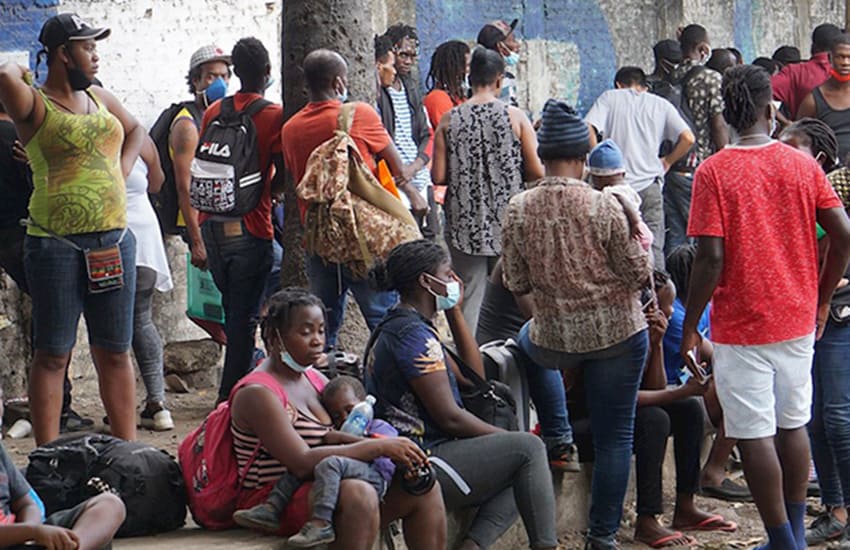
Migrants earlier this year waiting to be processed in Tapachula, Chiapas.
In a new report entitled Global Trends: Forced Displacementin 2020, the United Nations Refugee Agency said that out of 549,200 internationally displaced Salvadorans, Guatemalans and Hondurans, 78,600, or 14%, sought asylum in Mexico.
“While the intended destination of people on the move from these three countries generally remains the United States, some are increasingly settling in Mexico, and a much smaller number go south to Costa Rica and Panama. These countries are also becoming major transit countries for nationals from within the subregion and from outside the region,” the UNHCR said.
Comar says it has received asylum requests from citizens of 78 countries but that just six — El Salvador, Guatemala, Honduras, Venezuela, Cuba and Haiti — typically account for 90% of applications. It has processed just over 13,000 applications this year and ruled in favor of granting asylum in almost three-quarters of the cases.
While it is busy assessing asylum applications, the National Immigration Institute (INM) is equally busy detaining and deporting migrants. The INM reported on June 6 that it had detained 90,850 undocumented migrants this year and deported 42,067 — 46% of the total — to their country of origin.
Some 12,000 INM officials and members of security forces, including the military and National Guard, are deployed to control the flow of migrants, record numbers of whom have arrived in Mexico in recent months on their way to the United States.
Mexico and the United States signed an agreement earlier this month to work together to address the lack of economic opportunities in El Salvador, Guatemala and Honduras, where poverty, violence, climate change and two devastating hurricanes late last year have triggered an exodus of people.
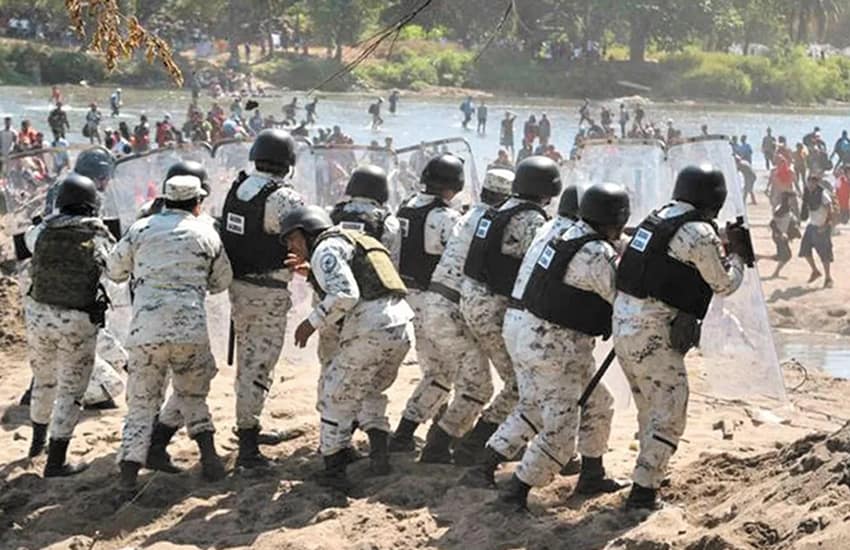
National Guard forces repelling migrants trying to cross the Suchiate River into Mexico from Guatemala. File photo
The federal government deployed large numbers of security force members to stop migrants in 2019 in order to appease former United States president Donald Trump, who threatened to impose blanket tariffs on Mexican goods if Mexico didn’t do more to stem illegal migration.
The United States has scrapped many of Trump’s harshest immigration policies, but Vice President Kamala Harris nevertheless told would-be migrants not to travel to the U.S. during a trip to Guatemala earlier this month. She later softened her message, saying that she was “committed to making sure we provide a safe haven for those seeking asylum, period.”
President López Obrador told Harris in May that his administration agreed with the migration policies the U.S. government was developing and would aid in their implementation. “You can count on us,” he said.
Both Mexico and the U.S. say they are committed to addressing the root causes of migration in Central America, which history shows have been notoriously difficult to combat.
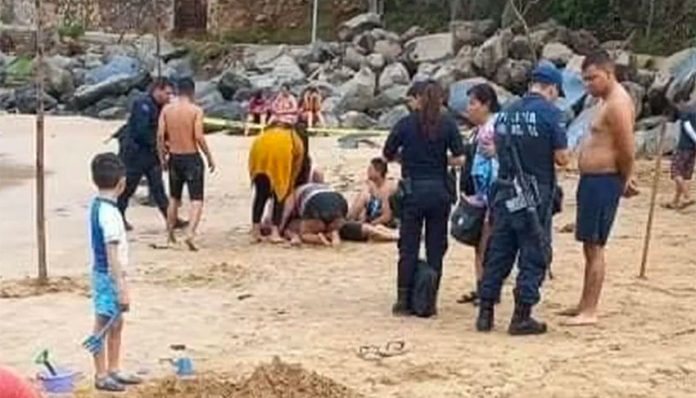
Rescue workers attempt to resuscitate the victim at Chacala beach.
For a Jalisco family on holiday in Nayarit, Sunday will not be a Father’s Day to remember. A father drowned saving his son from strong ocean currents yesterday morning at Chacala beach in Compostela.
The 13-year-old entered the water at around 8:00 a.m. but shouted for help as he was dragged away by the current shortly after.
His father, José Guadalupe Cruz, showed no hesitation and swam out to attempt his rescue, according to Nayarit officials.
However, the strength of the current dragged them both farther out and only after some anxious moments did Cruz manage to get his son onto dry land. But having spent all of his energy in the rescue, he was pulled down by the current.
Several onlookers tried to help Cruz, and rescue workers managed to pull him out of the water. Civil Protection officers attempted cardiopulmonary resuscitation, but he did not respond and was declared dead at the scene.
Officers who interviewed the son confirmed that Cruz’s last words were, “Hang on so we can get out together.”
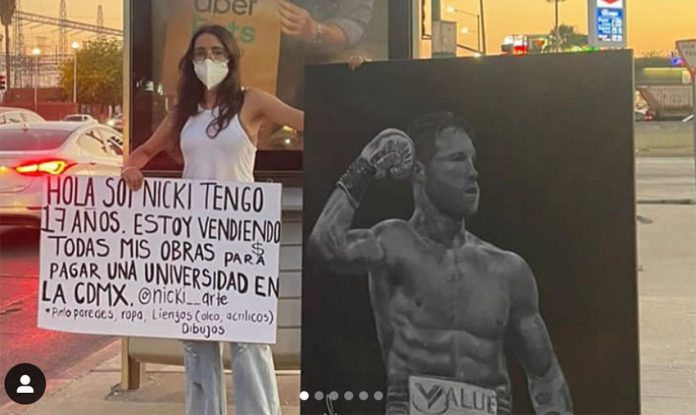
González at the roadside with her painting of Saúl Álvarez.
An appeal from a young artist seeking buyers for her paintings in order to fund her university studies got a positive response from the subject of one of her works, champion Mexican boxer Saúl “Canelo” Álvarez: he bought the piece from the Sonora high school student.
Nicole González, 17, attempted to sell the portrait of Álvarez by displaying it on the side of a busy boulevard in Hermosillo.
“Hi I’m Nicki, I’m 17. I’m selling all my works to pay for university in Mexico City,” read her sign advertising the painting.
Posts on social media helped to publicize the paintings further: “My dream is to study visual arts at a university in Mexico City. After 37 days I’ve finished my painting of @canelo, acrylic on canvas. It is one of my greatest achievements. He [Canelo] has inspired me to follow with my dreams, to try and never stop. This painting means a lot to me,” her post read.
The Hermosillo student’s activity gained traction, and caught the attention of the Jalisco native, who is currently the unified super middleweight world champion.
“Thank you very much to all the people interested in this painting, it is no longer available, it is going to Canelo,” Nicole confirmed. “I hadn’t ever expected so many people to be interested in this painting, I am very grateful,” she added.
Despite her success, Nicole has not received any professional training as an artist. The 17-year-old’s paintings are for sale on her Instagram page: @nicki_arte.
CORRECTION: The artist’s Instagram address was incorrect in the original version of this story. We regret the error.
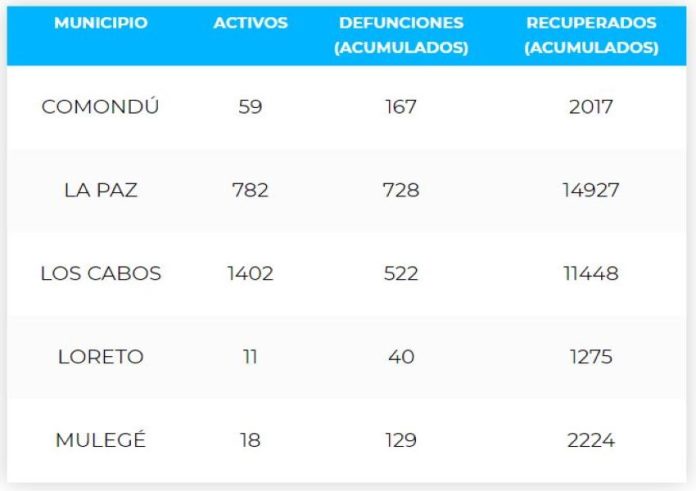
The numbers represent, from left to right, each municipality's active cases, total deaths, and total recoveries from Covid-19. Baja California Sur Ministry of Health
Authorities in Los Cabos, Baja California Sur, are urging residents to stay at home due to an increase in both coronavirus cases and hospital admissions of Covid-19 patients.
The message was broadcast over loudspeakers in the resort city on Sunday, and the Los Cabos council took to social media to advise people to continue to social distance and wear a face mask if they have to go out.
Separately, Mayor Armida Castro Guzmán called on citizens to follow all virus mitigation measures as Los Cabos — one of Mexico’s popular tourism destinations — attempts to get on top of a growing Covid outbreak.
“The Covid numbers … have exceeded the municipality’s hospital capacity,” she said. “We’re very worried, … we have to keep following the [health] measures.”
There are currently 1,402 active coronavirus cases in Los Cabos, according to state government data, a figure that accounts for more than 60% of the total in Baja California Sur. State capital La Paz is also facing a growing outbreak with 782 active cases.
Federal data shows that 97% of general care beds at the IMSS General Hospital in Cabo San Lucas are occupied and 93% of those with ventilators are taken. State data shows that 126 Covid patients are in general care hospital beds in Los Cabos and 44 are on ventilators. A team of 20 health workers from Puebla arrived in the municipality on Friday to support overwhelmed local medical personnel.
Mayor Castro said Sunday that health checkpoints, where citizens are monitored for Covid symptoms such as fever, had been set up across Los Cabos with the assistance of the National Guard. Cemeteries were closed on Sunday – Father’s Day – to avoid crowds and entry to beaches was limited to 40% of normal capacity.
Across Baja California Sur, there are currently 2,272 active cases, according to the state government, the highest figure recorded since the start of the pandemic. New infections increased some 90% during the past two weeks compared to the previous fortnight.
The state has an accumulated case tally of almost 36,000 and has recorded 1,586 Covid-19 deaths. La Paz ranks first for cases and deaths among the five Baja California Sur municipalities while Los Cabos is second in both categories.
The official Covid-19 death toll is 728 in La Paz, 522 in Los Cabos, 167 in Comondú, 129 in Mulegé and 40 in Loreto.
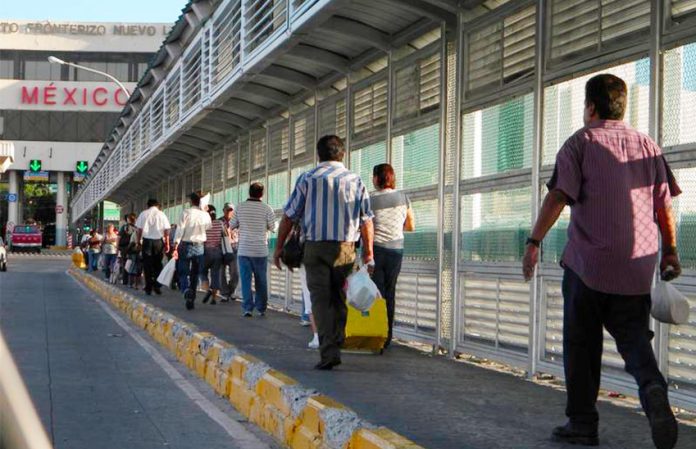
Pedestrians at the Nuevo Laredo border crossing in Tamaulipas.
Border restrictions were extended Sunday by United States authorities for non-essential travel with Mexico and Canada.
The continued measure limits land crossings for a further month, until at least July 21, while allowing for essential work-related travel.
The announcement on the Department of Homeland Security’s (DHS) official Twitter account read: “To reduce the spread of #Covid-19, the United States is extending restrictions on nonessential travel at our land and ferry crossings with Canada and Mexico through July 21, while ensuring access for essential trade and travel.”
Such restrictions have been extended monthly since the beginning of the Covid-19 pandemic.
The U.S. announcement comes days after meeting between Foreign Minister Marcelo Ebrard and the U.S. Homeland Security Secretary Alejandro Mayorkas, in which they agreed to accelerate the rate of vaccination at the border in order to reactivate commerce and tourism.
DHS added it was optimistic about future easing of restrictions. “DHS also notes positive developments in recent weeks and is participating with other U.S. agencies in the White House’s expert working groups with Canada and Mexico to identify the conditions under which restrictions may be eased safely and sustainably,” it said on Twitter.
Canada also extended restrictions on cross border movement with the United States Friday. Prime Minister Justin Trudeau confirmed the aim is to have 75% of the population vaccinated with a first dose before normalizing travel.
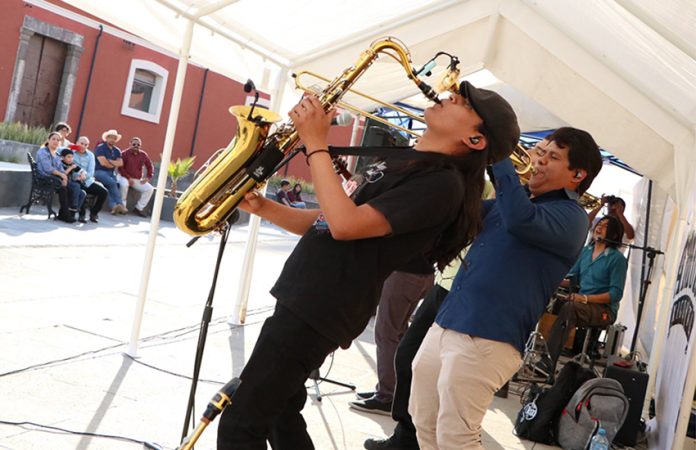
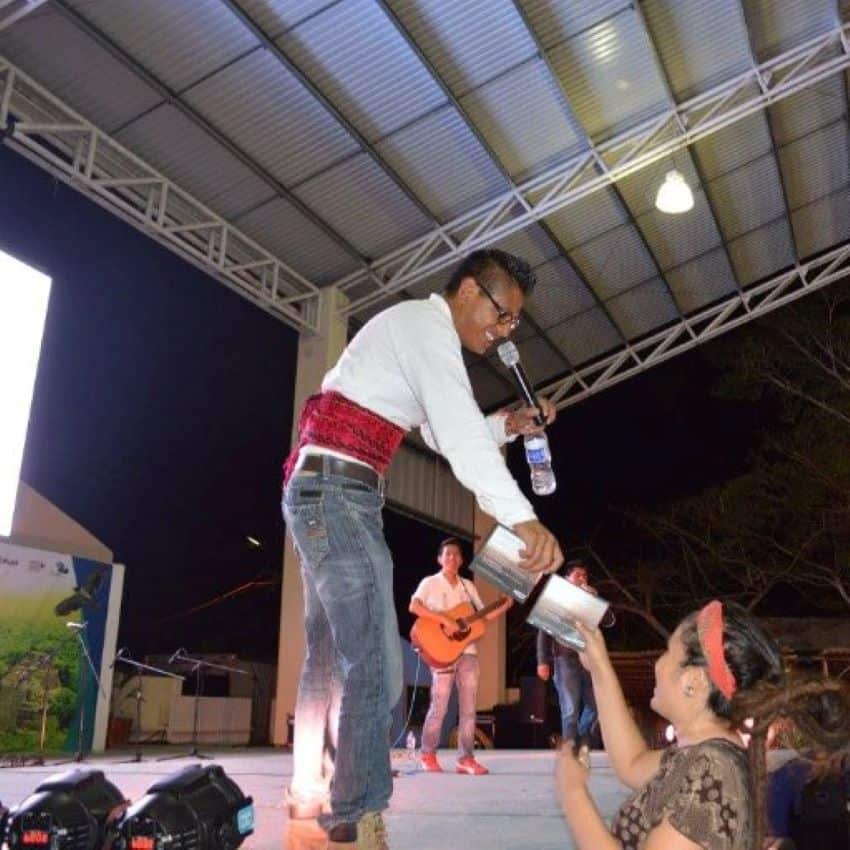
La Murga Xicohtl is a Tlaxcala-based band that performs Carnival, rock and European folklore influenced music in Náhuatl. INPI
It is too easy to think of indigenous communities as never-changing living museums; certainly Mexico’s decades of tourist promotion gives that impression. But the truth is that indigenous cultures change — and wrestle with various conundrums as they do so — just like the rest of the world does.
Those conundrums include generation gaps, as young people are more open to the outside influences that globalization brings to indigenous communities.
But there is some difference. Indigenous cultures were suppressed for centuries after the Conquest.
The Mexican Revolution brought about the notion that Mexican identity was a mix of Spanish and indigenous ones, but even this way of thinking — as radical as it was for the time — did not appreciate the diversity of cultures in Mexico.
Today, many indigenous communities cannot be distinguished readily from others by appearance (dress) nor sound (language), a sign of their absorption into the mainstream.
Los Juchilangos hail from Juchitán, Oaxaca, but live and work in Mexico City. They perform jazz and ballad compositions in Zapotec and Spanish. Facebook
Indigenous youth interested in playing rock, rap, jazz, and other genres have faced pushback from their own communities that feel threatened by it. Even non-indigenous people can feel awkward about the idea, as it challenges the notion that these cultures’ preservation is about a lack of change and the need to be as different from the non-indigenous as possible.
But indigenous cultures have always changed over time. The introduction of European culture after the Conquest irrevocably changed (surviving) indigenous cultures centuries ago, producing many of the traditional music and other cultural expressions that are presented as authentic culture today. That included the introduction of a myriad of instruments such as violins and guitars, along with rhythms, scoring and even the idea of music for secular purposes.
Even as late as the early 20th century, the waltz found its way into some indigenous communities’ repertoire.
But does the adaptation of rock, ska, reggae, rap, hip-hop and even Mexican norteño music threaten indigenous cultures or provide new tools to continue them?
That question can be answered definitely only by the communities in question, but I have to wonder why the idea of a Chontal Maya speaker rapping, for example, seems stranger than the same person creating digital art with iconography from that same culture.
The young people who use outside musical styles do so not to reject their heritage but to preserve it. And their most important efforts are linguistic.
Kjimi Kjuarma, a band that hails from México state, performs rock and rap in the indigenous Mazahua language.
Many of these musicians sing wholly or in part in the language of their communities, something that is vital since of the 63 indigenous languages (and 350 dialects thereof) recognized by the Mexican government, most are in danger of disappearing.
Many young people do not use their indigenous languages outside of their families because of discrimination or because they do not see it as relevant to the modern world. Musicians singing in indigenous languages consider themselves activists striving to keep these languages alive.
In addition, the lyrics they write talk about their communities’ cultures as well as sociopolitical issues. The latter is particularly true for those who perform rap and hip-hop, such as two different Sonorans — Janeidy Molina and Zara Monrroy, both working in the language of the Seri people (also known as the Comcaac).
The popularity of the bands and the types of venues in which they play range from a very local phenomenon to those who play to sizable crowds all over Mexico. Examples of indigenous language bands with a regional and even national following include Isaac Montijo y Los Buayums from Navojoa, Sonora, which mixes various musical styles; Kjimi Kjuarma, from México state, which performs rock and rap; and Los Juchilangos of Oaxaca and Mexico City, which performs jazz and ballads.
These bands have found allies in government, academia and NGOs, mostly through promotion at cultural festivals such as the Festival of Hip-Hop in Indigenous Languages in Mexico City. Another extremely important tool for these groups is social media, particularly YouTube, Facebook and Spotify.
Mexico’s National Institute of Indigenous Peoples (INPI) has long provided selected groups with grants for travel, costumes, equipment and more. They began recording and documenting emerging musical styles in indigenous communities as early as the 1990s.
Chan Santa Roots is a reggae group from Felipe Carrillo Puerto, Quintana Roo, that sings in Mayan, Spanish and English. INPI
INPI’s head archivist, Octavio Murillo, says documenting these bands’ work is important because it “… promotes pride; original peoples can recreate and reevaluate themselves in each performance.”
INPI’s efforts to keep its archives current have included recording an album/book of music by 12 bands entitled Vuelo sonoro: Músicas alternativas de jóvenes indígenas (Resounding Flight: Alternative Music of Indigenous Youth). The album includes Afro-Caribbean, norteño and rock and hip-hop compositions in languages such as Náhuatl, Tepehua, Mayan and Zapotec.
The bands include La Murga Xocohtl (norteño in the Náhuatl language), Nuk Yinik Prehispanica (lyrics in various musical styles in the Tabasco Chontal Maya language) and Tachapunk (punk, hard rock in the Tepehua language).
Murillo states that the project and continuing support for these artists are vital to keep their archives and general knowledge of indigenous communities “up to date.”
• Vuelo Sonoro was not created for sale. Nonprofit agencies or media can request a copy by emailing Murillo.
Leigh Thelmadatter arrived in Mexico 18 years ago and fell in love with the land and the culture in particular its handcrafts and art. She is the author of Mexican Cartonería: Paper, Paste and Fiesta (Schiffer 2019). Her culture column appears regularly on Mexico News Daily.
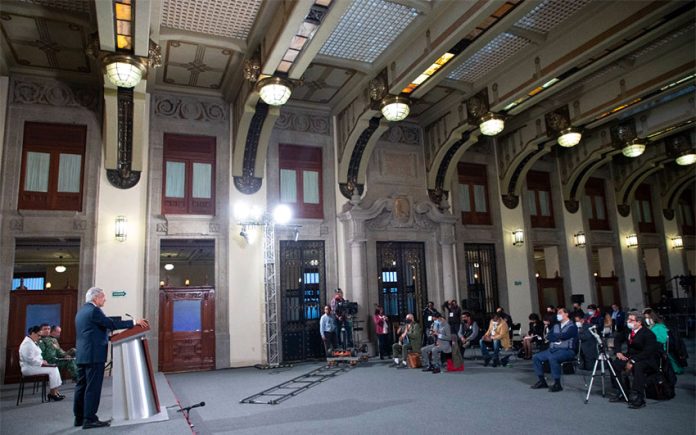
Journalists at work this week in the National Palace.
With election results settled and thoroughly dissected, all topics were on the table at this week’s mañaneras. The opportunity for a wider variety of talking points was embraced by journalists. Nevertheless, media mistreatment of the administration still emerged as one of the president’s most popular themes.
Monday
The New York Times’ investigation into the May 3 Metro collapse was raised early on Monday. Structural faults were to blame, the publication claimed. “Let’s not get ahead of ourselves,” responded AMLO, as the president is commonly known, before diverting the conversation to the “sensationalism” of the “fifí,” or elitist, right-wing press.
“About the fifís. I want to clarify that there are some who feel like fifís and they are not, they want to sneak in, they just think they are fifís,” said the president, hoping to hit his critics where it hurts.
One particular interview, the president said, had overstepped the mark: León Krauze’s conversation with fellow journalist Jorge Ramos.
So the audio was played:
LK: “Would you warn Mexico about the same risks to democracy that you have seen in other places?”
JR: “No, let me absolutely clear. López Obrador is not Nicolás Maduro or Hugo Chávez, Mexico is not Venezuela.”
LK: “… Is López Obrador a democrat?”
JR: “He is the legitimate president of Mexico.”
LK: “… Is López Obrador a democrat, Jorge?”
“He wanted him to say that I was a dictator,” the president concluded.
The president enjoys some interaction with journalists.
Tuesday
Early on Tuesday John S. Creamer, the U.S. Embassy’s business representative, dropped in on video link from the airport to usher in 1 million vaccine doses.
The president then showed a chart of global Covid-19 fatality rates, ostensibly to clear up misinformation: the death rate in Mexico was the 19th best of the 30 countries listed, which on the surface appears decent news. However, if the full list of roughly 222 countries were laid out it would make for sorry reading, putting Mexico in the top 1% of countries for death rate.
Autocratic rule made the Tuesday menu. A journalist raised the case of the union leader of the national telephone company, set to leave the post after 45 years.
“It’s important to recognize that he has done a job — this is my view — to the benefit of the workers,” replied the president, showing support for a long spell in office when the politics are right.
In a big reveal, AMLO named his three desired constitutional reforms, for which he’ll need support from across the house after losing deputies in the midterm elections.
Strengthen the Federal Electricity Commission;
Reform the National Electoral Institute (INE) to make it “truly independent;”
Put the National Guard under the authority of the Ministry of Defense.
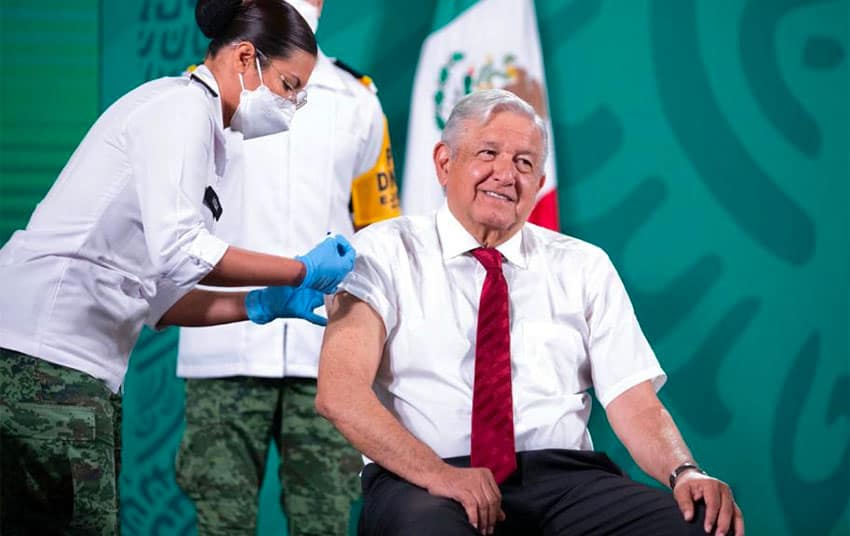
A shot in the arm was the climax to the conference, as the president received his second dose of Covid vaccine.
Wednesday
A whole host of prizes crossed the conveyor belt on Wednesday. For the presidential raffle, 22 prizes with a combined value of 500 million pesos, about US $24 million, were announced, including former narco properties. Tickets, it was confirmed, would cost 250 pesos a piece (US $12).
Meanwhile, it was declared that international hackers who ordered a ransom from the National Lottery on April 27 did not gain any sensitive documents, and received no payout.
Then, a battle of wills. A journalist took on the president for inaction on searching for disappeared people, and the associated 98.5% rate of impunity. “No one should be worried,” the president assured, “injustices will not be permitted.” During the exchange the journalist intervened and interjected more than 20 times.
For the sake of consistency, the president found time to criticize corporate media.
“There is a world crisis in media for a lack of ethics, for a lack of credibility and for a lack of impartiality. They are very close to power and very distant, very far from citizens,” he said.
A discussion of morality ended the conference on Wednesday. “I do believe in the moralization of public life, I believe in the purification of public life. Only by being good can we be happy,” the president said.
Thursday
AMLO proved his austere credentials on Thursday. “When I was mayor of Mexico City I lowered my own wage … I never changed my vehicle, it was always the same one, a [Nissan] Tsuru,” he said.
For a second day running, a journalist was on the president’s case, this time in relation to fires in Chihuahua.
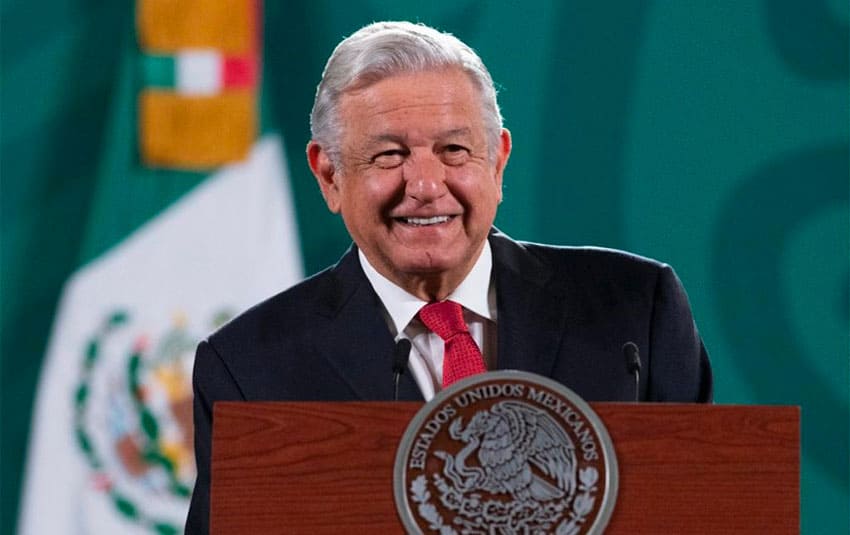
President López Obrador receives his second Covid vaccine shot on Tuesday.
“We are doing everything,” AMLO assured, before starting on a lengthy tangent about the government’s change of tack with social programs and the corruption of the media.
“President, the fires, the National Forest Commission says they have gone up more than 600%” urged the journalist, barely concealing her impatience.
More flak from the floor came late in the conference: one journalist made the accusation that the mañaneras were not impartial, and that some media organizations were being given favorable treatment.
Meanwhile, feeling nostalgic, AMLO reflected on his schooldays. “When we were at school we used to say: ‘Fight, fight, fight, don’t stop fighting for a worker’s government; peasant and working class.’ I’ve never forgotten those things. I haven’t changed,” he said.
Friday
It was three cheers for businessmen on Friday. “I’m really thankful to businessmen. Among other important businessmen, Carlos Slim has acted in a responsible way … there is a really important change, which is to do with the respect of legal authority,” he said, confounding some critics with a qualified endorsement of the business world.
The conference was gently ebbing toward the weekend when one journalist changed the tone: “Who should assume political responsibility for the terrible [Metro] tragedy?” he asked.
“I don’t know, that’s for the attorney general to resolve,” the president replied. “If we go to political responsibility, I could say: who was the president at that time?”
“Felipe Calderón, but who was the head of the city’s government?” the journalist said, referring to now Foreign Minister Marcelo Ebrard.
“Right exactly … if you speak about political responsibility … it’s very abstract,” concluded the president.
Eager to round things up, the commander in chief gave a rundown of his weekend itinerary: first to Veracruz to mediate a local dispute, and then to Zacatecas to celebrate 100 years since the death of poet Ramón López Velarde.
“President, the funds from the presidential plane, what will they be used for?” called out one journalist.
“We’ll speak on Monday,” he replied, striding away to attend to the nation.
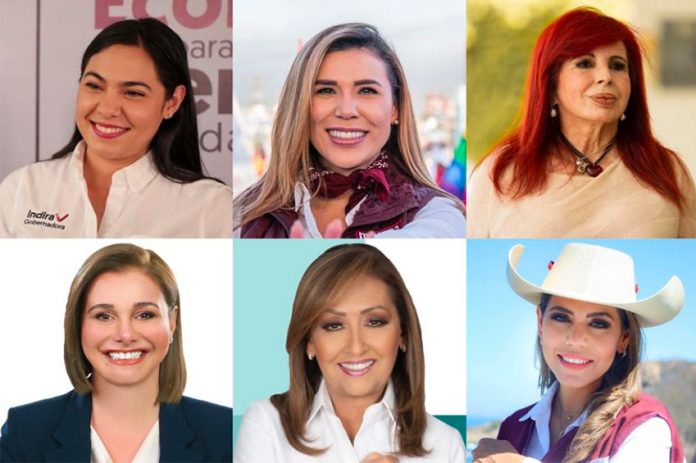
Mexico's six new female governors are, clockwise from top left, Indira Vizcaíno in Colima; Marina del Pilar, Baja California; Layda Sansores, Campeche; Maru Campos, Chihuahua; Lorena Cuéllar, Tlaxcala; and Evelyn Salgado, Guerrero.
Women will be in the majority in 10 of 32 state legislatures as a result of the June 6 elections, while female representation will exceed 40% in the other 22.
Women already hold more than 50% of the seats in the legislatures of Coahuila and Quintana Roo, which didn’t hold state congressional elections on June 6, and they will occupy more than half those in the congresses of Jalisco, Oaxaca, Yucatán, Sinaloa, Michoacán, Baja California, Querétaro and Mexico City thanks to voters’ preferences earlier this month.
Michoacán and Jalisco lead the way with 63% of their state representatives to be women followed by Oaxaca (60%) and Sinaloa (58%).
The San Luis Potosí Congress will have the lowest female representation at 41% followed by Baja California Sur, Hidalgo, Nayarit, Tabasco and Zacatecas, where 43% of seats will be occupied by women.
While women lawmakers will remain in the minority in a majority of states, their representation in politics is on the rise. It will be the first time ever that women will be in the majority in the legislatures of a double-digit number of states.
Tijuana mayor-elect Montserrat Caballero is one of 25 women elected mayor in some of Mexico’s biggest cities.
In the federal Congress, 246 of the 500 seats will be occupied by women for female representation of 49.2%, while women won six of the 15 gubernatorial elections held on June 6. Twenty-five of Mexico’s biggest cities are also set to be governed by female mayors as a result of the elections.
Among those are Mexicali, Tijuana, La Paz, Campeche city, Colima city, Manzanillo, Irapuato, Chilpancingo, Acapulco, Tepic, Chetumal, Cancún, Villahermosa, Veracruz city and León.
A 2019 constitutional reform aimed at increasing female participation in politics and related secondary laws enacted last year have helped to increase both the number of women chosen as candidates by political parties and the number of women elected.
Martha Tagle, a federal deputy with the Citizens Movement party, described the increased female representation as a result of this month’s elections as “a very important advance,” asserting that it goes some way toward compensating for the “historic inequality we have suffered.”
Madeleine Bonnafoux Alcaraz, a federal deputy with the National Action Party and member of the lower house’s gender equality committee, said the long quest for gender parity is finally yielding results.
“The voices of women will begin to be heard more loudly” and state legislatures will begin to modify laws that discriminate against women, she said.
The newspaper El Universal reported that the push to decriminalize abortion across Mexico – Mexico City and Oaxaca are the only states where abortion is legal – and the call for meaningful action to be taken to address the high levels of violence against women could be given a boost by the increased participation of women in politics.
“The next step” toward achieving gender parity in Mexican politics will be for women to take up more leadership roles within legislatures, said Adriana Lecona, a representative of the feminist group Ultravioletas Feministas.
Women should be heading up budget and finance committees and not just the ones they have traditionally led such as children’s rights and social development committees, she said.
An earlier version of this story incorrectly stated that the mayor-elect of Tijuana was Karla Ruiz McFarland.