International flights easily outnumbered domestic ones.
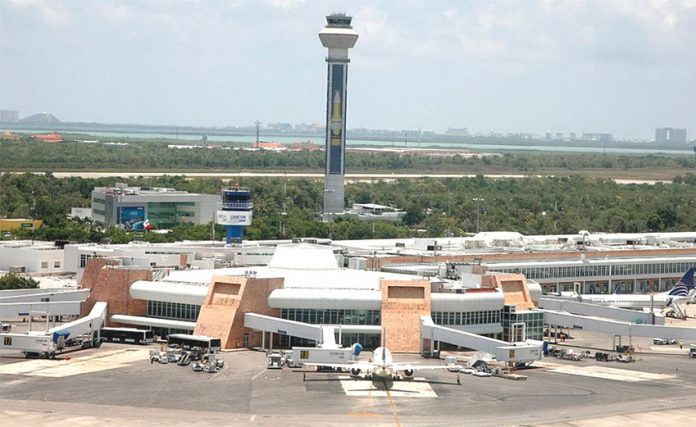
Cancún airport had its second busiest day on record on Saturday in terms of the number of incoming and outgoing flights.
A total of 648 flights touched down at or departed from the resort city’s airport, a figure just 11 fewer than the all-time high of 659 flights on March 31, 2018.
Just under 51% of the operations were arrivals. International operations easily outnumbered domestic ones.
Travelers arriving on international flights are not required to present a negative COVID test result or go into mandatory quarantine.
“Historic Saturday for the #MexicanCaribbean!” tweeted Quintana Roo Governor Carlos Joaquín.
“… We’re on the verge of beating the record of March 2018. … Welcome tourists, have fun and look after your health!”
It was the first time since the start of the pandemic that incoming and outgoing flights exceeded 600 in a single day at Cancún airport, the world’s second busiest airport for international arrivals last year after that in Dubai. The previous pandemic record was 567 flights on Saturday, December 11.
That mark was also surpassed on Sunday with 568 operations. Among the 60 international destinations with direct connections to Cancún are Amsterdam, Atlanta, Bogotá, Buenos Aires, Calgary, Caracas, Dallas, Edmonton, Frankfurt, Guatemala City, Houston, Havana, Istanbul, Lima, Lisbon, London, Los Angeles, Madrid, Miami, Montreal, Moscow, New York, Panama City, Paris, San Francisco, Toronto, Vancouver, Washington D.C. and Zurich.
The Sacred Child of Atocha is expected to be good for religious tourism.
After a year in storage in Mexico City, a huge statue of a young Christ child arrived at a town in Zacatecas on Sunday to take its place behind a revered church.
The installation of the seven-meter, three-tonne Sacred Child of Atocha was delayed due to the death of its sponsor of COVID-19 in 2020. The gas company manager had bought the effigy as an act of religious devotion, but failed to fully pay off its 750,000 peso (almost US $39,000) cost before he died.
The government of Fresnillo stepped in to cover more than half of the outstanding cost and paid for the effigy to be transported, spending more than 500,000 pesos (about $24,000) in the process.
The work was divided into 12 pieces to be moved on two trailers to its place on the Cerro de la Cruz (Cross Hill) in the community of Plateros, near Fresnillo.
A ceremony to bless the effigy is planned for Christmas Day at the church, which is considered the third most important Catholic pilgrimage site in the country after the Basilica of Our Lady of Guadalupe in Mexico City and the Basilica of San Juan de los Lagos in Jalisco.
The statue in place on a hill in Plateros, Zacatecas.
Up to 2.5 million pilgrims used to visit annually to venerate an image of Christ as a child and more than 1,000 faithful are expected for the Christmas ceremony.
Fresnillo Mayor Saúl Monreal said it was worth meeting the cost due to the value of religious tourism to the area. He may be hoping that the young Christ will help tourism be reborn entirely. Violence has had a brutal impact on the industry over the past decade and there’s no sign of it abating: Fresnillo is seen by its residents as the least safe city in the country.
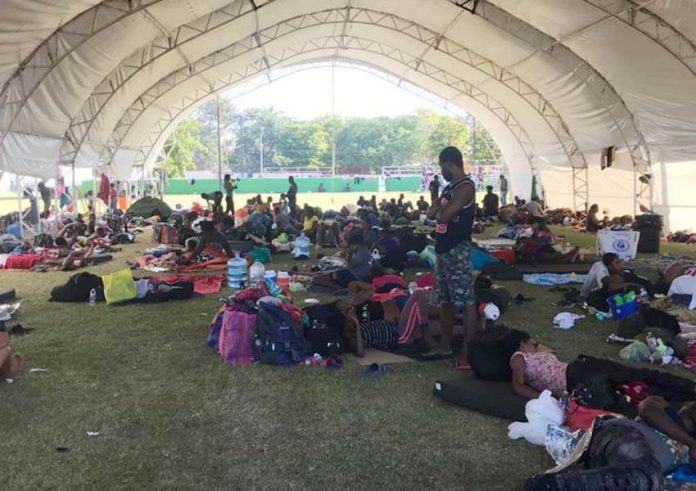
Migrants await attention by immigration staff in the Ciudad Concordia Sports Center in Campeche city. Photos by Underhemp Balloo
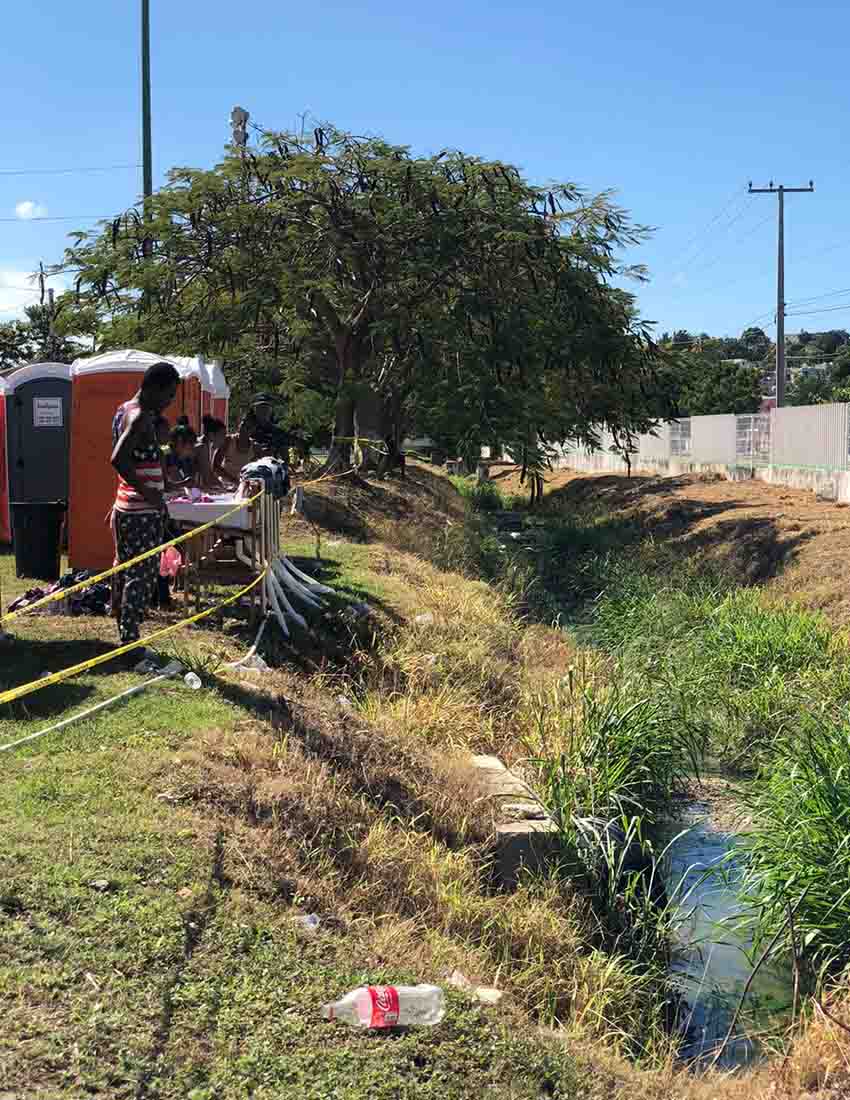
In the Ciudad Concordia Sports Center on the outskirts of Campeche, a domed white tent bustles with people: men, women and children weaving between seated groups. Families are sleeping or sitting on mats laid out close together. Laundry is being done in sinks a few meters from the bustle of the sleeping area. Clothes are slung over fences, poles and almost any other vaguely horizontal surface to bake dry in the sun.
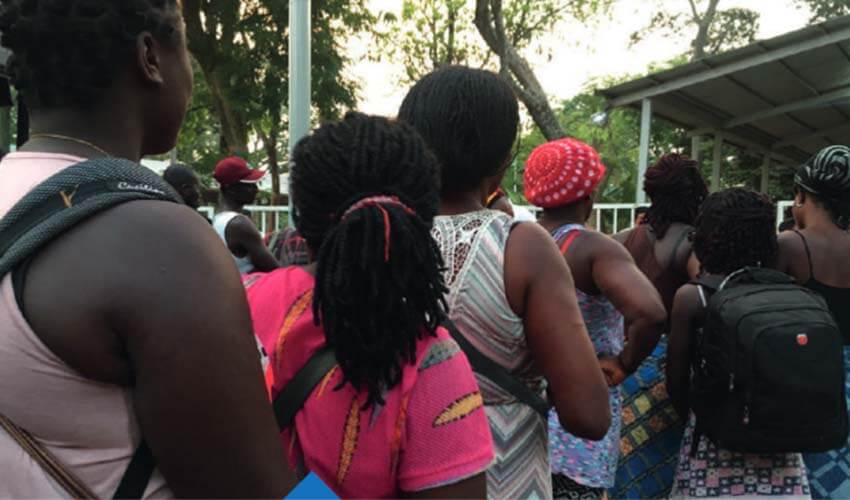
A migrant camp in Campeche is a largely unfamiliar sight for most of the residents of the city, but for the people from various countries who are temporarily housed here, this is not the first they have stayed in. They all hope it will be the last.
The National Immigration Institute transferred these migrants from the border city of Tapachula, Chiapas, earlier this month in an attempt to mitigate pressure on immigration officials there. Campeche is just but one example of cities throughout Mexico where INM officials have been moving migrants awaiting legal immigration status in Tapachula. Officials in that border city have been overwhelmed with trying to process thousands of migrants from Central and South America, the Caribbean and elsewhere who keep arriving there from Guatemala.
Despite the cramped quarters here in the Campeche sports center, there were no complaints about conditions or treatment. Both immigration officials and migrants made clear that the migrants are free to leave once their paperwork is processed.
There were, however, some murmuring protests about the speed of the process, which, when including wait times in Tapachula, has taken weeks for the majority here and is still not complete. Without increased resources to aid INM officials here, however, little is likely to change.
Washing clothes by hand at some outdoor sinks near the sports center’s makeshift sleeping area.
The INM office in Campeche is small and ill-equipped to deal with the sudden influx of people requesting regularization paperwork. Three service booths are hardly sufficient for hundreds of individuals keen to move on from here, even with officials manning the tiny office throughout the night.
Due to its isolated position on the Yucatán Peninsula, the state of Campeche has seen little of the movement of people from southern countries seeking a better life. Now, however, according to Ángel Hernández, the INM subdelegate in Campeche, caravans of migrants in Chiapas are being redistributed across the country in an attempt to ease the pressure on immigration services and the infrastructure in Chiapas, the main point of entry to Mexico for the majority of migrants from Central and South America.
Once relocated to other states, migrants are offered a humanitarian visitor visa, valid for a year. This allows them to move freely through the country and work. After their year-long emergency visa has expired, the pathway is open to applications for permanent residency and citizenship in Mexico. It is a policy that, although noticeably more hospitable towards refugees and asylum seekers than has historically been the case in Mexico, seems designed to fail.
Simply redistributing groups of migrants to cities across the country defers rather than deals with the issues facing migrant families: lack of infrastructure, racism, xenophobia and outright persecution, not to mention a plethora of further issues for those who decide to venture on to the northern border with the United States.
Indeed, most of the migrants in the camp do not intend to stay in Mexico; almost nobody in the camp was intending to stay in Campeche, and a very few were planning to settle wherever they could find work. The majority planned to continue north through the country until they reached the United States, regardless of what Mexico was offering in terms of immigration status.
The situation is born of pressure from the United States to legalize migrants in Mexico, with the hope that legal status here will discourage the flow of people continuing northward who believe that Biden’s electoral campaign policies will manifest themselves as a reality through a restored asylum system.
Over 121,000 migrants have applied for asylum in Mexico this year through November 2021, according to the UN, posing a huge challenge to the nation’s immigration agency. UNHCR
Hernández estimates that there are around 700 migrants currently in Campeche. Of these, around half are originally from Haiti, and the remainder hail from Cuba, Venezuela, Nicaragua and Honduras. The majority of the Haitian migrants currently in the camp have been in “intermediate countries” of Central and South America, living and working on temporary permits in places like Brazil and Chile since 2015 and 2016.
Once the COVID-19 pandemic began, however, work dried up, and people found themselves in desperate situations. Junior, a young man from Haiti, left his home country for Suriname after finishing his degree in agronomy and worked for a year in a beach shop in Suriname.
He speaks about his family in the U.S., whom he is hoping to join once his papers in Mexico are processed. They are sending him remittances to help with the cost of his journey.
“I’m traveling with one other person, and we got stuck in Tapachula for a month, where nothing was happening. All we were told was that we’d be moved eventually because there were too many people in Tapachula,” he said.
“We’ve only been here for two days, and we’re hoping to be able to move on soon, though we’re not exactly sure what the process is,” he added.
Though everyone Junior had spoken to had been in the camp for a few days awaiting their paperwork, he said that there was no sense that people’s needs were being ignored or that they were being made to wait around.
“They’re very patient at [INM],” he said, “and we get meals here, so it isn’t too bad.”
Nevertheless, he is eager to move on. “Once I get my card, I can leave here,” he says with a grin.
Junior’s tale is typical of everyone in the camp willing to discuss their journey: weeks in limbo at the southern border followed by a hasty relocation to Campeche.
Though the situation is far from ideal for any of the involved parties, it is magnitudes more accommodating than the draconian practices of other nations, who continue to treat fleeing migrants with hostility and, in many cases, outright aggression.
Whatever the eventual outcome of each individual’s journey, there is clearly a severe need for increased aid for vulnerable groups of migrants in Mexico, who are being left to figure out their futures in cities they never intended to visit as a way to give governments — here and in the United States — stall time on their immigration policies.
Shannon Collins is an environment correspondent at Ninth Wave Global, an environmental organization and think tank. She writes from Campeche.
The army dismantled 113 synthetic drug laboratories in the first 34 months after President López Obrador took office, a 70% decrease compared to the same period of Enrique Peña Nieto’s presidency.
According to a National Defense Ministry (Sedena) report obtained by the newspaper Milenio via a freedom of information request, the narco-labs were discovered between December 2018 and September 2021 in more than 10 states.
The total number of dismantled labs was 258 fewer than the number destroyed during the first 34 months of Peña Nieto’s 2012-18 government.
Sixty of the meth and fentanyl labs, or 53% of the total, were located in three states where the Sinaloa Cartel dominates. The army detected 46 in Sinaloa including 26 in state capital Culiacán and 15 in neighboring Cosalá, 10 in Durango and four in Sonora.
News of the discoveries comes just days after the United States government announced rewards of up to US $5 million each for information leading to the arrest and/or conviction of four sons of imprisoned drug lord Joaquín “El Chapo” Guzmán Loera.
The State Department said last week that Iván Archivaldo Guzmán Salazar and Jesús Alfredo Guzmán Salazar were operating sophisticated fentanyl laboratories in Culiacán, and that Joaquín Guzmán López and Ovidio Guzmán López were overseeing about 11 methamphetamine labs in Sinaloa.
The Sedena report said that 27 of the dismantled labs were located in Jalisco and Michoacán, where the Jalisco New Generation Cartel is the dominant criminal group.
Among the other states where narco-labs were found were Guerrero, Guanajuato, Querétaro, Colima, Hidalgo, México state, Morelos and Puebla.
Meanwhile, the United States Border and Customs Protection (CBP) reported Friday that drug seizures in that country increased 90% in November.
“CBP officers, Border Patrol agents, and Air and Marine Operations agents continue to interdict the flow of illicit narcotics. Nationwide, drug seizures were up 90% in November over the prior month, as CBP eased travel restrictions for vaccinated travelers,” it said.
The CBP said that seizures of methamphetamine rose 164%, while cocaine confiscations increased 41%. Fentanyl seizures were up 7% while those of heroin fell 12%.
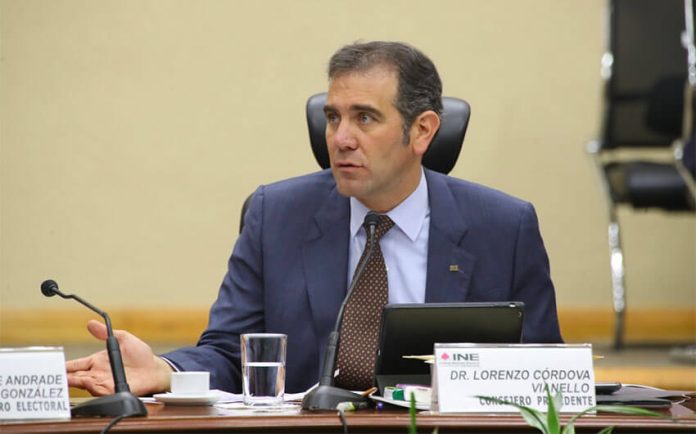
INE president Lorenzo Córdova says the vote is not viable in light of a 5-billion-peso reduction in the agency's funding.
The National Electoral Institute (INE) has indefinitely postponed a referendum on President López Obrador’s leadership on the grounds that it doesn’t have sufficient funds to organize the vote.
A so-called “revocation of mandate” referendum in which citizens would have the opportunity to vote in favor or against the president completing his six-year term was slated to be held on April 10.
But in a 6-5 vote on Friday, INE councilors approved the postponement of the exercise, raising the ire of López Obrador and the ruling Morena party. The INE will, however, continue counting and reviewing signatures of support for the referendum. At least 3% of eligible voters, or more than 2 million Mexicans, must back the vote in order for it to go ahead.
INE president Lorenzo Córdova said that organizing a referendum with 161,000 voting booths was not viable following an almost 5-billion-peso (US $241.2 million) cut to the institute’s funding.
“With the money the INE has today, [a large vote] simply can’t be organized. … We have to be categorical and clear – an exercise such as the revocation of mandate cannot be carried out under the terms established by the federal legislature,” he said.
Córdova, who has previously clashed with the president on electoral issues, said that López Obrador could solve the problem by directing the Finance Ministry to allocate additional funds to the INE. He stressed that the electoral authority was not canceling the planned vote but merely putting it off to a later date.
The vote could still be held in April if Morena successfully challenges the INE decision in court.
“It is not the INE that is today placing the celebration of an eventual revocation of mandate [vote] at risk but rather those who took the political decision to deny the resources needed so that this process can be carried out with all the guarantees of legality and certainty,” Córdova said.
In light of the INE’s decision, Morena national president Mario Delgado called on lower house lawmakers with his party and its allies to initiate misconduct cases against the electoral councilors for violating their constitutional duty.
“The INE is going against the constitution, they [the councilors] don’t have the authority to do what they did,” he told a press conference.
“… The INE councilors have decided to join the conservative bloc,” Delgado said before asserting that it’s clear that they are not the electoral councilors Mexico needs.
Sergio Gutiérrez Luna, a Morena lawmaker and current president of the Chamber of Deputies, subsequently announced that an appeal against the INE’s decision would be filed with the Supreme Court.
Mario Llergo, another Morena deputy and that party’s representative to the INE, accused the institute of seeking to “twist” the law and trying to stop the referendum any way it could.
“In Morena, we’re not going to allow Mexicans’ rights to be trampled on. Call it postponement, suspension or whatever term that want … [but] we think it’s incorrect,” he said.
“If the budget shortage they allege is real, [the INE] should have the will to reduce [the use of] resources where we all know they are not needed,” Llergo said.
The president and Morena lawmakers have been highly critical of INE spending, claiming it has not adopted the austerity measures demanded of federal agencies.
López Obrador called the INE’s decision “very regrettable” and charged that it has a constitutional responsibility to organize the referendum.
“… We used to live in a political system characterized by simulation; democracy was spoken about … but in fact anti-democratic attitudes dominated and this is what is on display [here]. … If they don’t want to comply [with the constitutional obligation to organize the vote] and they use excuses, it’s part of the same old simulation,” he told reporters at his news conference on Monday.
According to Francisco González, a professor of Latin American politics at Johns Hopkins University, López Obrador perceives his power “as being a function of people reiterating their support actively.”
“He wants it officially confirmed to give him that comfort of being the popular leader who is doing the right thing for Mexico,” he told The Los Angeles Times.
Stephanie Brewer, the director for Mexico and migrant rights at the United States-based Washington Office on Latin America, told the Times that victory in the planned referendum on his rule would provide the president with added impetus to execute his agenda.
“What he wants is to come out of the vote, supposing there is one, politically strengthened with this renewed and amplified popular mandate,” she said.
Some critics have warned that López Obrador could use a strong result in the referendum – it requires 40% participation to be binding – as a stepping stone towards extending his presidency beyond the established six-year term.
Opposition politicians have accused the president of using the vote as a promotional tool and many supported the INE’s decision to postpone it.
The government “must admit that nobody is obliged [to do] the impossible,” said National Action Party president Marko Cortés.
“Especially … [when] it was the Morena deputies who took the money for the revocation of mandate from the INE.”
Democratic Revolution Party politician Ángel Ávila accused Morena of wanting to hold a “sham” referendum whose result is preordained, as he claimed occurred with the airport consultation.
“We all remember that … the same people were able to vote once or 20 times … and then there was a magical result [just] as the president wanted,” he said.
Ávila praised the INE for “not lending itself to these kinds of games – [the staging of] sham, simulated consultations so that the tenant of the National Palace can measure his ego and popularity.”
A recently repaired suspension bridge collapsed in Santos Reyes Nopala, Oaxaca, on Sunday leaving as many as 30 people injured, five of them seriously.
The group of mostly women and children were on their way to a Christmas posada when the bridge buckled under their weight in the community of Cañada de Guadalupe, 70 kilometers north of Puerto Escondido.
Some fell into the river below and others onto the rocky riverbank.
The bridge received maintenance in August, which involved laying new wooden planks. The mayor’s office, which was responsible for the work, said at the time that the bridge had been damaged after years of use.
Four children and six adults were taken to a hospital in Puerto Escondido — the five severely injured people among them — and at least seven children and six adults were treated in the town of Nopala.
Work was carried out on the bridge in August.
The mayor organized a shelter for the families near the local hospital, and local hotels also provided accommodation.
This camp is home to 25 families, forced from their homes in Guerrero. ann deslandes
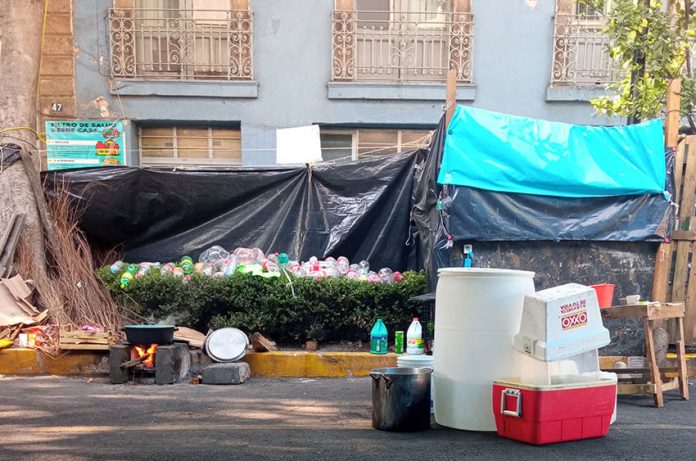
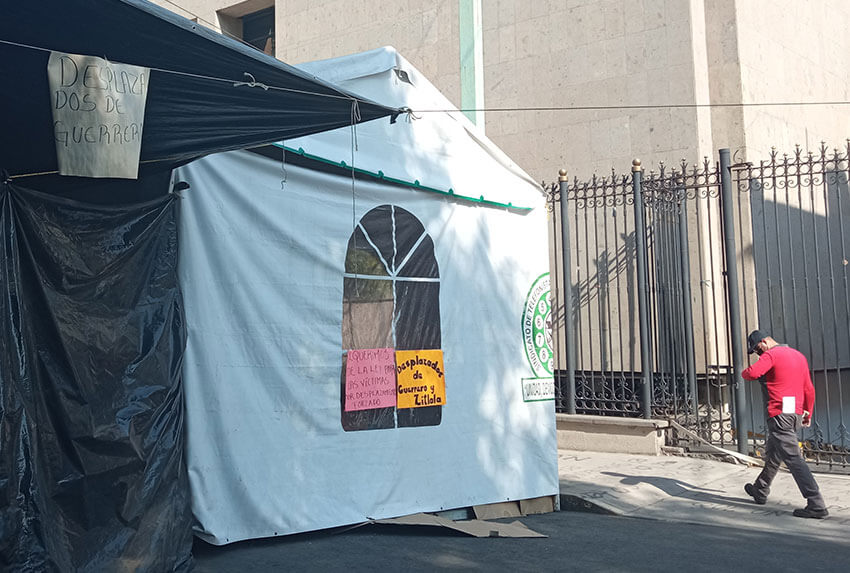
Under tarps pitched outside the federal Ministry of the Interior in the center of Mexico City, some 25 families from the state of Guerrero have been camped out since September 22.
In November 2018 they were forcibly displaced from their homes in the municipalities of Zitlala, Leonardo Bravo and Eduardo Neri, all locations controlled by armed criminal groups who fight over territory to conduct what the international NGO Crisis Group says is a wide portfolio of activities ranging from growing opium poppies to illegal mining.
This is the third time this community of desplazados (displaced people) from Guerrero has spent extended time sleeping on concrete outside government offices in the Mexican capital, daring authorities to remove them and supported by community donations of food and water.
The first time, 350 of them camped in front of the National Palace from February 17 to March 28, 2019, demanding that the then-new López Obrador government dislodge the criminal gangs that had invaded and occupied their towns so they could return to their homes, farms and businesses.
Back then, the government said it would coordinate security for displaced families by posting state and federal security forces in parts of the region where armed groups have infiltrated. Meanwhile, the group was to return to the city of Chichihualco at the base of the La Sierra region of Guerrero, where the government would provide food and health services as well as money for rent and utilities.
Three years later, the funds for housing in Chichihualco have been spottily delivered and there have only been more episodes of forced displacement driven by the armed violence of gangs that operate with impunity if not collusion with the state and transnational mining companies. (Guerrero is home to many lucrative deposits of gold, silver, zinc, copper, and lead.) Many of the original group have fled further afield, going to live with family members in other parts of the country; many have set off for the United States to try their luck seeking asylum or migrating clandestinely. Those who remain live in limbo, unsure where their long term security lies.
“The trauma of displacement is very specific,” Manuel Olivares, a human rights defender who is accompanying the group, told Mexico News Daily. “It’s something you experience individually and at the same time collectively.”
“And it’s not recognized enough. International NGOs won’t come to help in the places people are displaced from because the security situation is so bad.” Then, once people are displaced, the public “don’t see what has been lost — homes, shops, crops.”
To be sure, the latest data from the nongovernmental Mexican Commission for Defense and Promotion of Human Rights found that 9,741 were displaced in 2020, an increase of 12% from the previous year. Government figures have the total number of displaced households between 2016 and 2020 at 281,373.
In reporting on the country, the phenomenon of internal displacement is easily hidden from view, with migration from and through Mexico more likely to make headlines. However, the reasons for migration, asylum seeking and forced displacement throughout Mexico and Central America are becoming more and more similar: conflict and invasion by armed criminal groups that operate with state impunity.
To be sure, in the encampment of people displaced from Guerrero, Mexico News Daily met a young Honduran man who arrived with the caravan of migrants from Central America who are currently in Mexico City. “He asked to stay with us and we’re helping him” after the man’s backpack containing his passport, phone charger and clothing were stolen, said Olivares.
Residents of Zitlala, Leonardo Bravo and Eduardo Neri in Guerrero were forced to flee their homes. ann deslandes
The issue of forced displacement in Mexico has gained increased attention from national and international authorities in recent years. There is a law currently on the table in Congress which if passed would offer formal recognition of and services to displaced people through the Mexican refugee commission, COMAR, as well as prevention measures. Introduced in September 2020, the draft legislation awaits debate in the Senate.
Efforts from displaced communities and their advocates to get the law passed received a boost recently when Guerrero Senator Nestora Salgado hosted a screening of the documentary Cruz for fellow lawmakers. Cruz follows a community of indigenous Rarámuri from the state of Chihuahua who were forcibly displaced by an armed criminal group as they struggle to survive and fight to return to their homelands. As legislators “we have the responsibility” to pass the law to protect displaced people, Salgado said. Still, the legislation remains in a holding pattern, with no date set for debate in the Senate as another year passes.
In the meantime, the displaced of Guerrero are seeking formal recognition as victims of crime from the state, as a pathway to receiving more support. Olivares told Mexico News Daily that only some have been registered as such with the federal Executive Commission for Attention to Victims.
“They only registered some of the heads of families, not every single person” said Olivares.
The law would face the usual problems of high impunity in Mexico, he said, but there is also a significant underlying issue that authorities refuse to touch: the mining companies.
“Mining is the principal cause of displacement in Guerrero,” he said, due to the alignment of mining companies with organized criminal groups that can demand companies comply with their terms in order to do business. According to Crisis Group, the companies provide a source of income for illegal armed groups through protection rackets in Guerrero.
For the time being, the displaced camped outside the federal government offices just want the chance to live safe and prosperous lives. As Joaquina Cantor of Zitlala told a recent press conference, “We want to be recognized as victims and we want the state to provide us with decent housing because we left everything in our communities.”
“No one leaves their homes for fun, but to save their lives and the lives of their children and family.”
Zendaya and Tom Holland in a scene from No Way Home.
The new Spider-Man film has broken box office records in Mexico, raking in an estimated US $32.4 million since its December 15 release.
Spider-Man: No Way Home, the 27th film of the Marvel Cinematic Universe, took in $9 million on its first day, beating Avengers: Endgame, a 2019 release that took a weekend to earn $12.5 million.
The 148-minute smash hit is the second sequel of a Spider-Man series starring U.K. actor Tom Holland. It cost $200million to produce and features Benedict Cumberbatch, Zendaya, Willem Dafoe and Jamie Foxx.
The exceptional commercial success of No Way Home was foreseen by the head of Mexico’s biggest cinema chain, Cinépolis. CEO Alejandro Ramíreztweeted on Wednesday to announce that the Spider-Man film had broken the 50-year-old company’s record for ticket presales.
Its triumph in Mexico has been matched in Latin America more widely: in Argentina and Ecuador, it achieved the biggest opening of all time, and the second biggest in Brazil.
SPIDER-MAN: NO WAY HOME - Official Trailer
After just five days, the Sony release is the third biggest U.S. studio film of the pandemic era, with an estimated global take of $587.2 million, behind only the James Bond film No Time to Die and Fast & Furious 9.
However, some moviegoers struggled to contain their excitement, as demand for tickets led to violence outside a cinema in Cuernavaca, Morelos, on November 29. The video of a confrontation went viral showing two violent scraps between youths with punches and kicks to the head.
“No way, the film is going to be showing all week,” one disapproving person shouted during the melee.
Spider-Man himself also voiced his disapproval when asked about the video. “We are living in a time crazy enough to fight like this,” Holland said.
Spider-Man: No Way Home was produced by Columbia Pictures, Marvel Studios and Pascal Pictures, and distributed by Sony. Audiences have given the blockbuster a 99% approval rating on Rotten Tomatoes, while 94% of critics recommend the film.
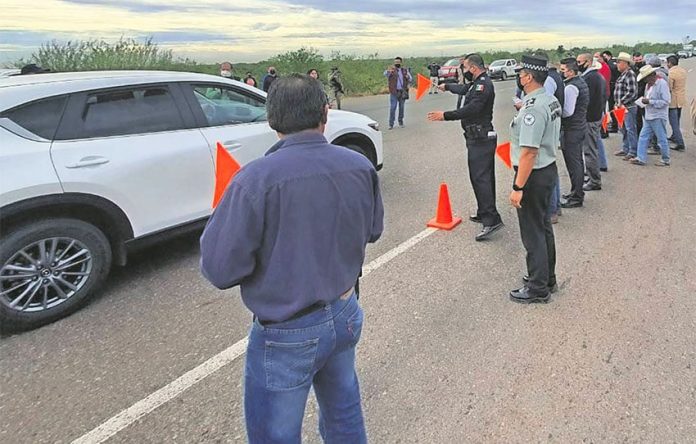
A checkpoint intended to support migrants passing through Sonora.
Mexicans returning home for the end-of-year holiday season are being forced to pay bribes to customs officers, immigration agents, police, members of organized crime gangs and others.
United States-based migrants – frequently referred to as heroes by President López Obrador due to the large quantities of money they send to their families in Mexico – have reported having to hand over as much as US $2,000 in bribes during road trips to their home towns.
Mexicans flying home have also been victims of extortion, the newspaper El Universal reported.
Pedro Muñoz, a 25-year resident of Fresno, California who travels home to Pénjamo, Guanajuato, every year, said returning migrants have been forced to pay bribes to authorities for years, but the number of officials demanding them is higher than ever.
“With or without the Programa Paisano [Compatriot Program], they always extort us,” he said, referring to a government initiative which encourages Mexicans returning home for holidays to travel in convoys escorted by security forces.
“Before it was only customs officers, Federal Police and [state] police but now it’s the National Guard, immigration agents and [organized] crime as well,” Muñoz told El Universal.
“On my way home from Tijuana a week ago I spent more than US $1,000 in bribes. There are checkpoints where you don’t know if they’re police, customs officers or immigration agents,” he said.
Several other U.S.-based migrants recounted similar experiences in social media posts and in interviews with El Universal and Reforma.
“On our way to Torreón [Coahuila] at the start of December we crossed from Laredo, Texas, but when we were going through San Pedro [a municipality in Coahuila] people from [the federal tax agency] SAT stopped us. … The entire road is a shakedown for money; between bribes [handed over to authorities] and two roadblocks with hooded men [we paid] almost US $2,000,” said Leticia Uribe.
“When it’s not … [officials from SAT, which oversees customs], it’s immigration agents or police,” she said.
“They’re asking for a lot of documents in order to allow us to bring vehicles in. It’s a big show,” said Jaime, who was extorted when he entered Mexico at Nuevo Laredo, Tamaulipas, en route to Guerrero from Atlanta, Georgia.
Officially, returning migrants are described as heroes. Unofficially, they are an easy target for corrupt officials.
“We crossed at the Tijuana port of entry. Everything was fine until we reached Ciudad Obregón, [Sonora]. From there on there were roadblocks or police [checkpoints] in every city … and [we had to pay] bribes of 400 to 600 pesos [about US $20 to $30],” said Leonardo Mendoza, a California resident who returned to his home town in Michoacán.
“On the way to Veracruz a transit police officer stopped me. I showed him all the permits and my license and documents. He only asked for a 200-peso bribe. I didn’t argue because the big thieves are in customs,” said Carmelo León.
Santos Ortiz, a California resident, said he returns to Mexico two or three times a year and always brings medical equipment and other items to donate to disabled people and the elderly.
“At the Nogales port of entry I tried to cross with a trailer [filled] with wheelchairs, walkers, diapers and clothes for the elderly. It’s to help fellow citizens in Michoacán and Colima but at customs, despite having everything in order, the police extorted me,” he said.
Ortiz also had to pay hundreds of dollars on two occasions to members of the National Guard, the quasi-militarized security force inaugurated by López Obrador in mid-2019.
Rogelio Ávila, president of a United States-based Mexican migrants association, said the name of the security initiative might have changed – it’s now called the Programa Héroes Paisanos – but the old practice of extorting migrants remains.
“There are still bad agents. They [returning migrants] are reporting to us that they’re being stopped at the 26-kilometer checkpoint [on the Nuevo Laredo-Monterrey highway] and having their [vehicle] permits checked. The National Immigration Institute agents are asking them for money,” he said.
“It’s ridiculous but it’s still necessary to protect fellow citizens from our own authorities,” Ávila said.
Buses transporting U.S.-based migrants to Mexico have also been stopped by customs officers who demand up to $900 from the drivers. Passengers routinely chip in US $20 or $30 each to raise the amount requested to allow the bus to pass without impediment.
Edmundo Ramírez, an immigration expert and former consul general in Seattle, said the commencement of the Programa Paisano invariably gives rise to extortion, the demanding of bribes and other abuses by immigration agents, customs officers, police and the National Guard.
Immigration and customs agents at airports are also demanding payments from returning migrants on the grounds their papers aren’t in order, he said.
El Universal sought comment from the National Immigration Institute and the General Customs Administration about the returning migrants’ reports but received no response from either.
A cave-like, hot-spring-fed pool at El Escondido Place in San Miguel de Allende, Guanajuato. El Escondido Place
Maybe it is not quite swimming weather in the mountains of Mexico, but what about dunking yourself in a volcanic hot spring?
Mexico is constantly reshaped by earthquakes and volcanoes. Logically, it also has an abundance of natural hot springs, which have been valued for medicinal purposes since long before the Spanish came.
Most are located in the Trans-Mexican Volcanic Belt, a strip of land that extends from Jalisco/Colima into northern Veracruz, with others near the faults off the Pacific coast. They become sparser as you move away from these, but one or more can be found in just about all of Mexico’s states.
The more accessible natural hot springs have been developed into what are called in Mexico balnearios, a somewhat vague term. It refers to any location or business that is a water-themed attraction, so it is important to know what your local balneario offers in order to get the kind of experience you are looking for.
Despite being set up around medicinal waters, most of these places are not tailored for adults only but are family oriented with something to keep the kids entertained. The idea is for the kids to run around while the adults hang out.
Water slides are popular in balnearios like El Carrizal in Veracruz, which caters more directly to families. El Carrizal
Such parks will always have pools for kids, but that is just about the only guarantee. However, there are some that cater more exclusively to adults, with a luxurious spa-like feel and some are aimed more at families, with water slides and other activities to keep kids happy.
Most of Mexico’s well-known balnearios are located in the center of the country, particularly in northern Michoacán and the Mezquital Valley of Hidalgo. Michoacán boasts a “health route” (La Ruta de la Salud) that extends from Lake Chapala to the border of México state.
Others balnearios exist in Morelos, Guanajuato, Aguascalientes and elsewhere. This is not only because of the number of hot springs in Mexico, but due to the states’ proximity to Mexico City and Guadalajara. There are many more hot springs but they are undeveloped because they are too remote and/or too hard to get to.
Below are suggestions of balnearios to check out, whether you are looking for a spa-like experience or a place to relax with the kids or grandkids while they visit.
In this state, the expat enclave San Miguel de Allende has a number of very accessible options just outside town, some family-oriented but also many aimed more toward adult luxury. Kids are certainly welcome, and there will be some pools just for them, but most of these are not children’s water parks.
Escondido Place has a beautiful covered pool with thermal waters that mimics being in a cave. They also have some facilities specifically for kids to relax and splash around. The Mayan Baths definitely goes the adult luxury route, with underground thermal pools and one where you can float and watch a starry night sky. There are also fine dining and spa treatments on the premises, making it a perfect place for adults to pamper themselves. Note, though, that although the waters are mineral-rich, they are artificially heated.
Hidalgo
Located in a deep ravine northeast of Ixmiquilpan, Grutas Tolontongo is a communally run resort, taking advantage of a hot-water river that emerges from a cave to fill Jacuzzi-like pools built into the mountain. It has grown quite a bit over the years from just a few pools, campgrounds and a small hotel and now has some attractions for children, but their presence does not overwhelm the overall relaxing experience.
Most other balnearios in Hidalgo are family-oriented. The most unique is El Géiser, and true to its name, it has a small geyser of hot water that shoots out at 95 C to about 100 meters above ground. The artificial pools are cooler than that, of course, with water park rides and spa services. It also has hotel rooms and simpler cabins you can reserve if you want to spend the weekend.
One of the natural pools formed by springs in Cañon de Guadalupe in Baja California. Mexicali Travel
Jalisco
Another destination off the beaten path is the river of heated water in the municipality of Cuquio, in the Los Altos region of Jalisco, where there is a four-meter-deep natural pool. For something with more amenities, El Encanto in the Guadalajara metro area is a hidden treasure even many locals don’t know about. Surrounded by lush trees, it has scattered hammocks around the pools on which to relax, as well as spots for casual dining.
The main hot spring attractions in this region are in Villa Corona, about 40 kilometers from the city. This town has at least nine balnearios, including the family-oriented Agua Caliente and Chimulco, both featuring several pools and water slides. At Lake Chapala, hot springs are the featured attraction at places like Hotel San Antonio San Juan Cosalá, where young families can spend the weekend swimming.
Michoacán
For one of the best-known spa-like experiences in the state, try the balnearios of Los Azufres National Park in the mountains near the México state border. The park has a number of places that take advantage of the area’s lush pine forests as well as its proximity to Mexico City, Querétaro and Guanajuato. They feature hot sulfur-infused waters as well as volcanic mud baths.
Most accommodations are cabins that blend into the environment, even if they are luxurious. Gaudy water park attractions here are relatively rare. For a spa-like experience, try Quinta Los Azufres — featuring overnight cabins with Jacuzzis — and Club Tejamaniles, whose stays include breakfast the next morning.
Puebla
In Chignahuapan, a town also famous for its artisans who make hand-blown glass Christmas ornaments year-round, the main hot spring is in the Tenextla neighborhood. It emerges too hot at 51 C, but larger establishments such as the hotel Aguas Termales de Chignahuapan have communal pools that moderate the temperature. They also channel water to be enjoyed in the privacy of your room, some of which include Jacuzzis.
San Luis Potosí
A similar experience to that in Chignahuapan can be had at the Lourdes Hotel Campestre in the city of San Luis Potosí. This particular spring has been popular for medicinal purposes for centuries, but the hotel dates from the early 20th century. Curiously, the mineral-rich water is also bottled and sold for drinking.
Veracruz
A similar attraction at the far eastern end of the volcanic belt is the El Carrizal water park and hotel in Apazapan, in northern Veracruz. Its volcanically heated river water has been dammed up to form multiple pools, some with water slides, all in a quiet family-friendly oasis surrounded by forest.
Enclosed pools are popular at Quinta Los Azufres in Los Azufres National Park in Michoacán because the climate is chilly in winter. Quinta Los Azufres
This is obviously just a small sampling of what’s available, and if there are balnearios in your area, putting that term into a search on Google should easily find ones close to you. I should also note that because of COVID, most balnearios have put strict limits on the number of people they can accommodate, and a number have eliminated spa services for the interim. It is best to check with any of these before making a reservation.
Leigh Thelmadatter arrived in Mexico 18 years ago and fell in love with the land and the culture in particular its handcrafts and art. She is the author of Mexican Cartonería: Paper, Paste and Fiesta (Schiffer 2019). Her culture column appears regularly on Mexico News Daily.