Home Blog Page 1278

For Mexico City women, trying to report attempted femicide can be a battle

0
gender violence

Surviving an attempt on their lives was just the beginning of the struggles three Mexico City women endured.

The newspaper Reforma spoke with three victims of attempted femicide who went to the Mexico City Attorney General’s Office (FGJ) to report the crimes.

Only one of the women was initially successful in getting prosecutors to classify the crime as attempted femicide, but her aggressor was not convicted.

One of the women who failed to convince the FGJ that an attempt had been made on her life was Diana. When she reported that her partner had attempted to kill her she was told that classifying the crime as attempted femicide wasn’t possible because none of her stab wounds measured more than 15 centimeters.

Diana condemned authorities’ lack of empathy and capacity to do their job.

“The authorities aren’t qualified or trained in gender perspectives and they’re quite indifferent to different situations [women encounter],” she said.

“… A lot is said about victims of femicide, which is [a] terrible [crime], but we also count because we were on the verge of being dead,” she said.

“We’re the ones who can testify; we’re here, we’re present,” said Diana, who was sexually, physically and psychologically abused by her partner.

She said the FGJ treated her as if she was the perpetrator, rather than victim, of a crime, telling Reforma that she felt like she had to explain why she didn’t end the relationship before the attempt on her life occurred.

Diana also said that scheduled interviews with her “key witness” were canceled eight times. Despite the difficulties she faced, Diana persisted in her quest for justice and, with the help of organizations such as the National Femicide Observatory, was able to pressure the FGJ sufficiently to get it to reclassify the crime to attempted femicide.

Another woman, Dafne, had a similar experience. She was the victim of a knife attack perpetrated by her partner but was initially told that her wounds weren’t serious enough for him to be accused of femicide.

Dafne said she was re-victimized by the FGJ and that its prosecutors told her children that she was to blame for the attack she suffered.

Although prosecutors said her wounds weren’t serious it was later proven that the knife reached her vital organs, she said.

After what Reforma described as an “exhausting battle,” Dafne succeeded in getting the FGJ to reclassify the crime as an attempted femicide due to a wound inflicted to the back of her neck. The crime was initially classed as domestic violence and wasn’t reclassified until a year later.

Fabiola, the third woman who spoke with newspaper, survived a strangling attack perpetrated by her partner. “… My partner wanted to take my breath away with his hands,” she said.

The crime was classified as attempted femicide by the FGJ but the attacker evaded justice.

“They let my aggressor free without telling me and knowing that my life was in danger,” Fabiola said, adding that nothing was done to protect her from another attack.

“This person remains free because he’s legally protected. For the authorities we [female victims] don’t exist,” she said.

“They have a certain indifference and it’s as if they don’t want to look at [cases of] attempted femicide,” Fabiola said, adding that the FGJ portrayed the crime of attempted suffocation as something minor from which a person can recover in 15 seconds.

Fabiola said the attack also upended her professional life.

“Now nothing’s left of the life I had built for myself. At almost 40 years old I was a successful architect with my own office and people of whom I was in charge,” she said.

“… I looked for justice and inevitably the people [I worked with] found out what happened. [Then] your employees stop obeying you and your clients don’t ask you to work for them anymore,” Fabiola said.

She also said she has been left with a feeling of guilt, explaining that she was made to feel that she failed in her personal life.

All three women agreed that the authorities have little interest in hearing about violence against women in cases in which the victims didn’t die, and asserted that the government wants to believe that the intention of the aggressors in such cases was not to kill them – despite compelling evidence to the contrary.

With reports from Reforma 
Campeche’s Hormiguero ruins offer feast of Mayan zoomorphic facades

0
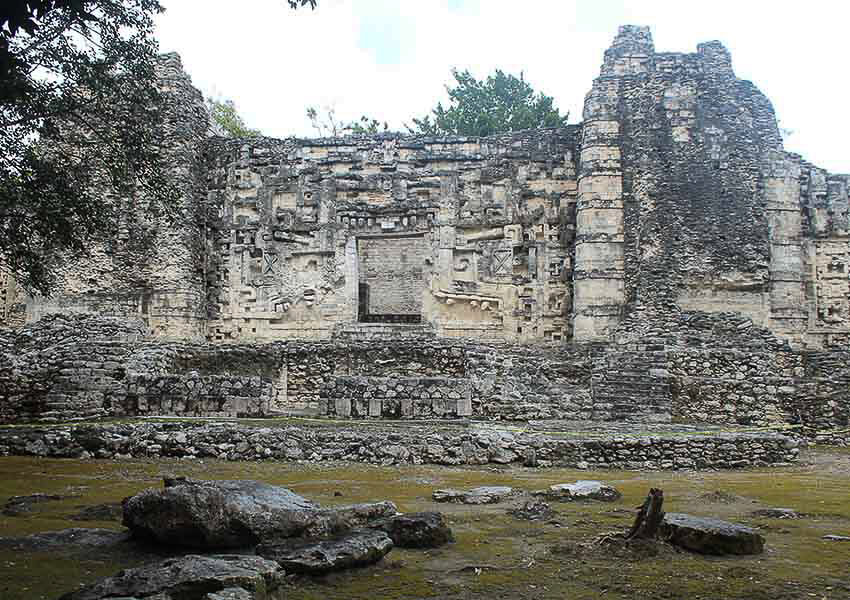
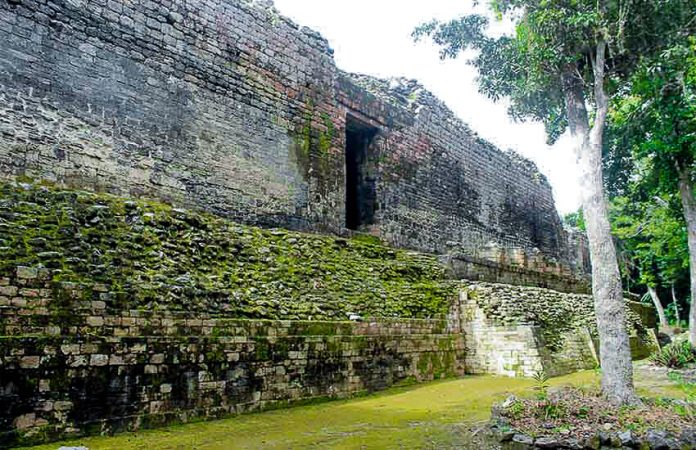
Structure II at Hormiguero Mayan ruins
Structure II is believed to be a palace.

Situated in the Calakmul biosphere reserve in Campeche and around 23 kilometers from Xpujil, the ruins of Hormiguero are a beautiful ancient Maya site hidden in the jungles, ideal for travelers interested in off-the-beaten-path ruins that few know about.

According to the National Institute of Anthropology and History (INAH), Hormiguero was a medium-sized Maya city that was dependent on Becán, which was the principal city of the Río Bec region.

The ancient Maya are thought to have preferred the area due to the availability of water there. It was already occupied by A.D. 300, reaching its peak population between 600 and 800. The city was eventually abandoned around the mid-10th century.

Archaeologists Karl Ruppert and John Dennison, whom the Carnegie Institution for Science sent on an expedition to Campeche, reported the existence of the site in 1933.

According to INAH, Ruppert and Dennison named the site Hormiguero, meaning “anthill,” after the massive number of “ant houses” they discovered. The houses are believed to refer to the actual anthills on the site as well as the appearance of the structures when they were discovered.

Structure II Hormiguero
Hormiguero was eventually abandoned around the mid-10th century.

Archaeological excavations at Hormiguero commenced in the late 1970s, and archaeologists have noted over 80 structures onsite. However, only a small number of them have been excavated thus far, meaning you can easily explore the buildings that are open to the public.

Conveniently, a visit to Hormiguero can be combined with trips to more famous archaeological sites such as Calakmul and Becán, as well as other smaller sites in the region.

Upon entering the site, you will first see the majestic Structure II, believed to have been a palace. It is so far the largest building excavated onsite.

Built on a five-meter platform and measuring around 50 meters in length, it has 11 rooms across two levels. The building’s facade has three sections — a central zoomorphic area and two towers on either side.

The towers have stairways in front and temples on top, which may have been simulations — i.e. intended as decorative and not really functional — and are characteristic of the Río Bec architectural style.

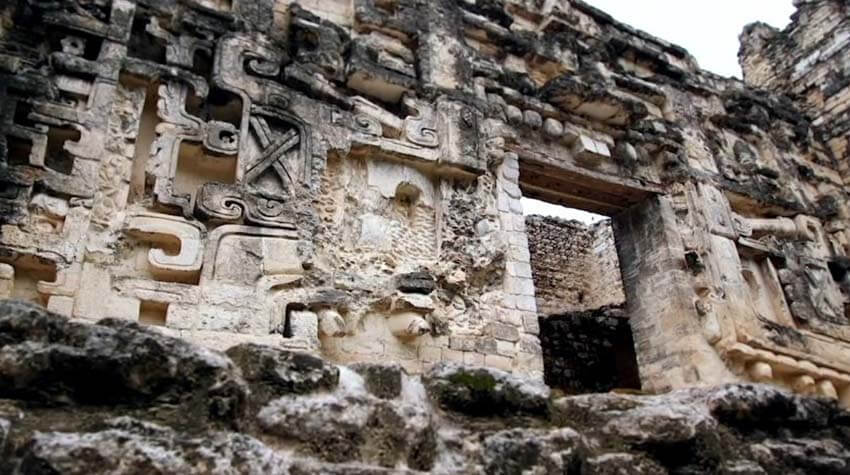
The rooms to the side of the towers also have zoomorphic features – carved animal forms that can also be representations of gods.

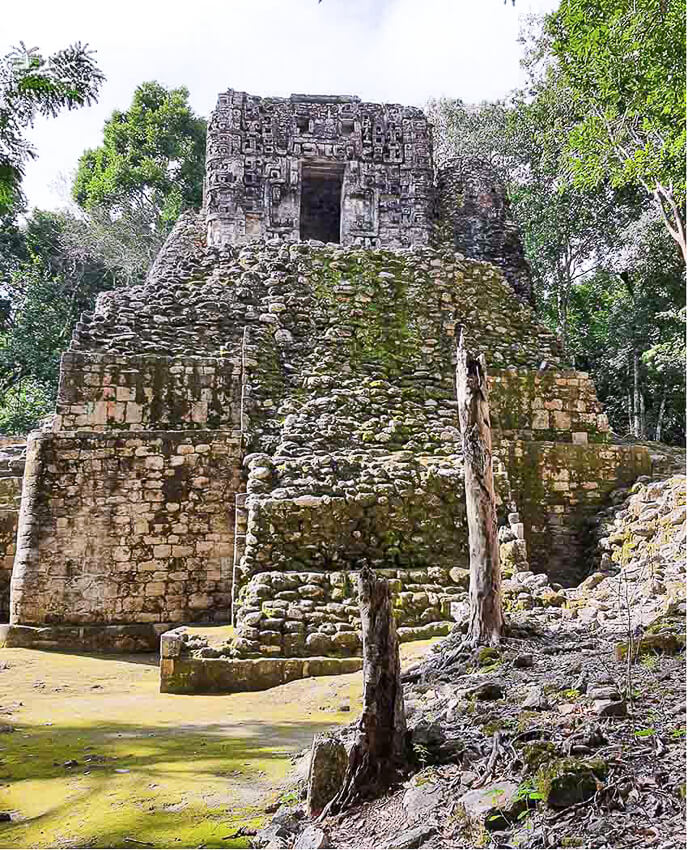
Structure V at Hormiguero Maya ruins
Structure V features a temple at the top, and its corners are decorated with masks believed to be of Chaac, the Mayan rain god.

But perhaps the most notable section of the Structure II facade is the large serpent figure with open jaws that forms the central entrance. The serpent motif is thought to be a depiction of the Maya creator god Itzamná. It has detailed features, including fangs, eyes, a nose and earflaps.

Architecture enthusiasts will not tire of observing the building styles and features of Structure II. The rear of the building is also interesting.

Note that while entering Structure II used to be allowed, when we visited the site during the pandemic it was cordoned off to the public.

North of Structure II is another beautiful building called Structure V, with a pyramid base and a central stairway and temple on top. The temple has a stunning zoomorphic facade, and its corners are decorated with masks probably of the Maya rain god, Chaac.

Also worth seeing is the four-room building attached to the east side of Structure V.

The partially excavated Structure VI has several rooms and two towers with simulated temples. A zoomorphic mask was discovered on the facade’s central entrance.

Hormiguero Maya ruins
A visit to Hormiguero can be combined with trips to more famous archaeological sites such as Calakmul and Becán. INAH

The refreshing forest surroundings of Hormiguero make exploring it a pleasant experience in the usually hot climate of Campeche. Don’t forget to keep an eye out for howler monkeys.

Thilini Wijesinhe, a financial professional turned writer and entrepreneur, moved to Mexico in 2019 from Australia. She writes from Mérida, Yucatán. Her website can be found at https://momentsing.com/

Anti-poverty organization urges 30% hike in minimum wage

0
Increasing the minimum wage by roughly 45 pesos is necessary to fight poverty, one expert says.

The minimum wage should increase by 30% in 2022, says an anti-poverty organization that has been critical of the federal government’s efforts to combat poverty.

Acción Ciudadana Frente a la Pobreza (Citizen Action Against Poverty) submitted a formal proposal to the National Minimum Wage Commission (Conasami) for the daily wage to rise to 185.2 pesos (US $8.60) from its current level of 141.7 pesos.

Members of the Conasami council were due to begin discussing next year’s hike on Thursday. The minimum wage, one of the lowest in the Americas, was raised 15% at the start of this year.

Acción Ciudadana coordinator Rogelio Gómez Hermosillo said an increase of about 45 pesos to the minimum wage is essential to combat poverty, which has increased during the coronavirus pandemic.

He said it’s “proven” that an increase of the size ACFP is proposing won’t have any negative effects on the economy.

“Don’t be fooled or confused, it’s not a generalized salary increase,” Gómez said. “It’s already clear that an adjustment to the minimum wage in Mexico doesn’t have any effect on macroeconomic variables such as inflation but it is significant in terms of reducing working poverty.”

ACFP said in a statement that 61% of people with a fixed salary don’t earn enough to rise above the poverty threshold. The working poor consists of 19.3 million Mexicans, it said.

For work to be “a dignified way out of poverty,” the first step is to increase the minimum wage, ACFP said.

Conasami must announce an increase to the daily minimum wage by December 31. The new rate will take effect January 1.

With reports from Reforma 

Girl, 15, jailed after attempting to escape arranged marriage in Guerrero

0
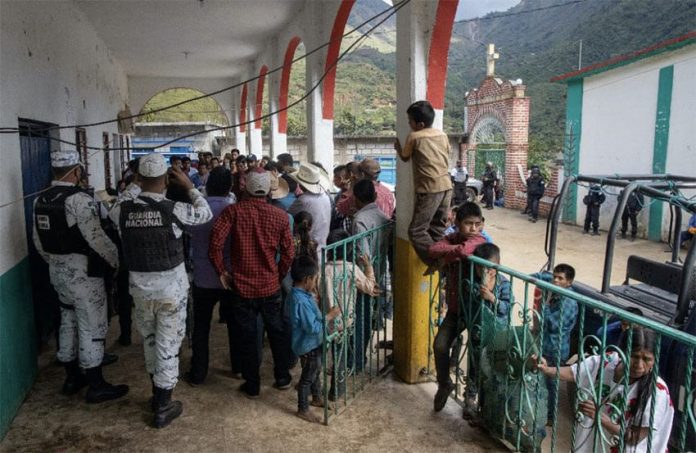
Members of the National Guard, state police and neighbors gathered at the Joya Real police station, where Anayeli was being held, on Tuesday.
Members of the National Guard, state police and neighbors gathered Tuesday at the Joya Real police station, where Anayeli was being held. Tlachinollan Human Rights Center

A teenage Mixtec girl was jailed in the Montaña region of Guerrero this week after fleeing her home to avoid an arranged marriage.

The family of Anayeli, aged 14 or 15 according to differing media reports, had arranged for her to marry a slightly older boy on Monday. The girl’s mother agreed to a payment of 200,000 pesos (US $9,275) from the boy’s family, who hosted a party Sunday to celebrate the imminent nuptials.

A cow was slain and cooked to feed the guests, beer and soft drink flowed and a group of banda musicians provided entertainment. The boy’s parents also provided food and beverages for a gathering at Anayeli’s home last Friday.

Everything was set for a Monday wedding but on the morning of the big day Anayeli slipped out of her home in Joya Real, a community in the municipality of Cochoapa el Grande, and went into hiding at the home of a friend, identified as 15-year-old Alfredo “N.”

Anayeli’s disappearance prompted her family and that of her would-be husband to go to the community police to seek their assistance to locate her. Officers found the girl at Alfredo’s home and took both adolescents into custody, locking them up in police cells.

Joya Real in southeastern Guerrero.

According to the Montaña Tlachinollan Human Rights Center, police told Anayeli she would only be released if she agreed to marry or her family compensated the boy’s family for the 56,000 pesos (US $2,600) it spent on the two pre-marriage events. They said her disappearance on the day of the wedding had “offended” the boy’s family.

Anayeli and Alfredo spent Monday night behind bars but personnel from the human rights center and the Guerrero Attorney General’s Office as well as state police arrived at the Joya Real police station on Tuesday morning and secured their release. The pair were subsequently placed in the custody of the DIF family services agency, the newspaper El Universal reported.

The state is investigating and community police, the local police chief and the parents of Anayeli and her would-be husband could face charges related to the girl’s arrest and intended marriage. The wedding didn’t take place and as a result the boy’s family didn’t make the 200,000-peso payment.

Neil Arias Vitinio, a lawyer with the human rights center, said that arranged – or forced – marriages involving young girls is a normalized practice in the Montaña region and for that reason many people were angered by Anayeli’s disappearance.

“They said, ‘Why did the girl do that if she already knows how things are here?’ [or] ‘She made a mockery of the [boy’s] family’ [or] ‘The girl accepted.’ But how can a girl have the capacity to take the decision to get married?” she asked.

Anayeli’s 14-hour incarceration came less than two months after a 15-year-old girl was held in a police lockup in Cochoapa el Grande for 10 days after fleeing the home of her father-in-law, who allegedly attempted to rape her on repeated occasions. Angélica was sold into marriage at the age of 11 but went to live with her in-laws after her husband emigrated to the United States.

[wpgmza id=”351″]

The federal government’s women’s rights agency launched a strategy earlier this month to prevent violence against women and girls in the Montaña and Costa Chica regions of Guerrero and put an end to forced marriages. But according to Arias Vitinio there is no concrete plan nor sufficient funding to stop the violence and forced marriage problems.

“Signing an agreement isn’t sufficient. It’s necessary to go to the communities and speak with the people, we have to explain to them that marrying off girls and boys has consequences,” the lawyer said.

People below the age of 18 were banned from marrying across Mexico in 2019, but the sale of young girls into marriage continues to take place in some indigenous communities, especially in southern states such as Guerrero and Oaxaca.

During a trip to the Montaña region last month, President López Obrador rejected claims that the practice was widespread, asserting that a media campaign had made the sale of girls for marriage or prostitution appear to be a bigger problem than it really is.

“I’m not here to look at that because it’s not the rule,” he said. “There are a lot of moral, cultural and spiritual values in the communities. It might be the exception, but it’s not the rule.”

The Network for Children’s Rights in Mexico promptly condemned the federal government for downplaying the seriousness of Mexico’s child trafficking problem, including the sale of young girls, saying it is a crime that the Mexican state must investigate and eradicate.

With reports from El Universal and Reforma 

2,500 migrants accept offer of humanitarian visas

0
Migrants blocked a Tapachula highway on Tuesday after the INM cancelled plans to review migrant documents on Monday.
Migrants blocked a Tapachula highway on Tuesday after the INM canceled plans to begin reviewing migrants documents on Monday.

Migrants who left Tapachula, Chiapas, on November 18 have accepted an offer by the National Immigration Institute (INM) to provide them with humanitarian visas.

The fast moving caravan, primarily composed of Haitians and Venezuelans, planned to catch up to a slower caravan in Veracruz which left Tapachula almost a month earlier. However, its members, who number at least 2,500, accepted the INM offer in Mapastepec, 108 kilometers into its journey, through its leader Luis Rey García Villagrán, the INM said in a statement.

“We are going to transfer [the migrants] to 10 states of the country … we have offered them … accommodation in shelters and employment opportunities in addition to the visas,” INM official Héctor Martínez Castuera said. 

The visas are good for one year and include permission to work and the right to move around the country. That will mean only one direction for most of the recipients, who want to earn dollars in the United States.

The migrants are being taken to INM offices in Puebla, Querétaro, Hidalgo, México state, Michoacán, Guerrero, Colima, Jalisco and Guanajuato for their visas to be processed. 

The dissolution of the caravan signals victory for the migrants who decided to storm out of Tapachula, and broke the law by doing so. Many waited for months — some for years — in Tapachula for paperwork from the refugee agency COMAR, which director Andrés Ramírez admitted this week was near total collapse.

The first caravan was offered visas by the INM less than a week after its departure, insisting that they would only be made available to people deemed vulnerable. Initially, most of the convoy were distrustful of the offer, but gradually the majority of the migrants that surrendered themselves to immigration authorities — vulnerable or otherwise — were awarded visas.

The remaining 500 or so migrants arrived in San Juan Evangelista, Veracruz, on Tuesday, 520 kilometers from Mexico City.

With visas in hand, many migrants will head to the U.S. border.

President López Obrador urged Biden to reassess the U.S. position in Washington D.C. on November 18. “Myths and prejudices must be put to one side. For example, stop rejecting migrants, [because] to grow you need a workforce that, in reality, is not sufficiently available in the United States or Canada. Why not study the demand for labor and open the migratory flow in an orderly fashion?” he said.

Meanwhile, thousands of other migrants blocked a highway in Tapachula on Tuesday demanding the INM follow through on its promise of visas.

Mexico News Daily

Additional troop deployment is centerpiece of new security plan for Zacatecas

0
National Defense Minister Luis Cresencio Sandoval announced hundreds of additional troops would be deployed Thursday as part of the security plan.
National Defense Minister Luis Cresencio Sandoval announced hundreds of additional troops would be deployed Thursday as part of the security plan. Presidencia de la República

An additional 460 federal troops will be deployed to Zacatecas to combat high levels of violence, the federal government announced Wednesday at an event attended by President López Obrador and members of his cabinet.

The deployment is the centerpiece of a new security plan for the northern state, Mexico’s most violent on a per capita basis with 96 homicides per 100,000 people in the 12-month period to the end of October.

Presenting the new support plan for Zacatecas, National Defense Minister Luis Cresencio Sandoval announced that 210 additional soldiers and 250 extra members of the National Guard will be deployed Thursday.

The number of soldiers and guardsmen in the state will increase to 1,954 and 1,894, respectively, for a grand total of 3,848 troops. Their public security work will be supported by three military helicopters.

Sandoval said that authorities divided the state into three areas for security purposes and that 1,940 troops will be deployed to the central region, where Zacatecas city and Fresnillo, a notoriously violent city, are located.

He said that 804 troops will go to the state’s north and 1,104 to the south, where nine bodies were left hanging from an overpass last week and a tenth was dumped on the highway below.

National Intelligence Center agents will be deployed to orient the troops’ public security operations.

Sandoval said the military and National Guard deployment will prevent confrontations between criminal groups that are generating violence. The Jalisco New Generation Cartel and the Sinaloa Cartel are among those that operate in the state.

Sandoval also said that military detachments from San Luis Potosí, Guanajuato, Aguascalientes and Jalisco will bolster security on the borders those states share with Zacatecas.

“These military zones will provide personnel, 90 elements each for … a total of 360,” he said, asserting that the troops will curb the movement of criminal gangs between states.

The army chief said the results of the support plan will be evaluated after 30 days. He noted that violence linked to organized crime has increased considerably in the state. There were 560 homicides in 2019, 920 last year and 1,277 to date this year, he said.

President López Obrador and Governor Monreal confer at Wednesday's meeting.
President López Obrador and Governor Monreal confer at Wednesday’s meeting. Twitter

The location of Zacatecas makes control of its territory highly desirable for criminal groups moving narcotics from Pacific coast ports to Mexico’s northeastern border with the United States. The state government said last year that at least five groups were moving fentanyl and other drugs through the state.

Speaking after several of his ministers outlined plans for Zacatecas in a range of areas, López Obrador assured Governor David Monreal that he would have the complete support of the federal government.

“You’re not alone,” the president told the governor, a former federal senator and mayor of Fresnillo.

Monreal, who took office for the ruling Morena party in September, had emphasized that security was the most important issue to address, although he also said the state was facing a “social emergency” and “economic crisis.”

His government inherited a debt of some 10 billion pesos (US $465 million) and is struggling to pay the salaries of bureaucrats and fund policies in sectors such as agriculture.

López Obrador said the federal government would work closely with its state counterpart and continue to support citizens via welfare and employment programs such as the Youths Building the Future apprenticeship scheme, in which an additional 5,000 places will be offered.

Providing opportunities for young people is a priority and reduces the possibility that they will be recruited by criminal groups, the president said.

“We’re going to continue attending to young people, which is very important because violence mustn’t be confronted with violence, evil can’t be confronted with evil, we have to confront violence by doing good, attending to its causes … This wasn’t done before,” López Obrador said.

“We have to remove the breeding ground [for violence], we have to take away [criminal groups’] reserve army of criminals,” the president said, referring to disillusioned young people with scant educational and work opportunities.

“That’s the best way to confront the serious problem of insecurity and violence,” he said before conceding that the plan will take time to work.

With reports from Milenio

Refugee agency admits it’s close to collapsing under flood of asylum requests

0
haitian migrants
Applications for asylum have been made by 45,000 Haitians this year, up from 5,900 in 2020.

Mexico’s refugee agency is near the point of failure due to a surge of asylum applications from Haitian migrants in recent months, the head of the agency said.

Andrés Ramírez spoke plainly on Monday about the scale of the problem. “We’ve almost collapsed at COMAR due to these tremendous numbers of arrivals of Haitians, but our position is: we are registering them all,” he said at the International Congress on Migration at Anáhuac University. 

The number of applications by Haitians has increased by almost eight times this year. In 2020, 5,900 applications were made, compared to 45,000 this year as of November 16. 

When the children of Haitians born in Brazil and Chile are included, the figure grows to 52,000, which is more than the number of applications from all nationalities in 2020.

However, arrivals from the poorest nation in Latin America should come as no surprise: applications from all nationalities decreased in 2020 due to the COVID-19 pandemic, save for Haitians. 

Ramírez said dire living conditions in Haiti made deporting the migrants back to the Caribbean country potentially illegal. “We know perfectly well that the situation in Haiti is terrible. It is a chaotic situation, an absolutely exhausted parliament, a situation in which there has been an earthquake, a hurricane, an assassination. It is the poorest country in Latin America by far … sending or deporting Haitians to Haiti is practically a crime, it is something that we are definitely and absolutely against,” he said.

He added that mass migration of Haitians from places like Chile and Brazil was due to economic strife, social deterioration and in some cases discrimination.

Meanwhile, after a protest on Tuesday by Haitian migrants in Tapachula, Chiapas, the local director of the National Immigration Institute (INM), Héctor Martínez Castuera, was less charitable.

“The problem with some groups of Haitians is that they do not respect order … We told them that the preference was for women, pregnant women and their family nucleus; people in a state of vulnerability and in alphabetical order … so they came and pushed and wanted to go first before anyone else,” he said.

There are around 30,000 Haitian migrants stranded in Tapachula waiting on their refugee applications, the news website Infobae reported. 

With reports from Milenio and Infobae

Whether Mexicans like it or not, Hernán Cortés intrinsic part of history: author

0
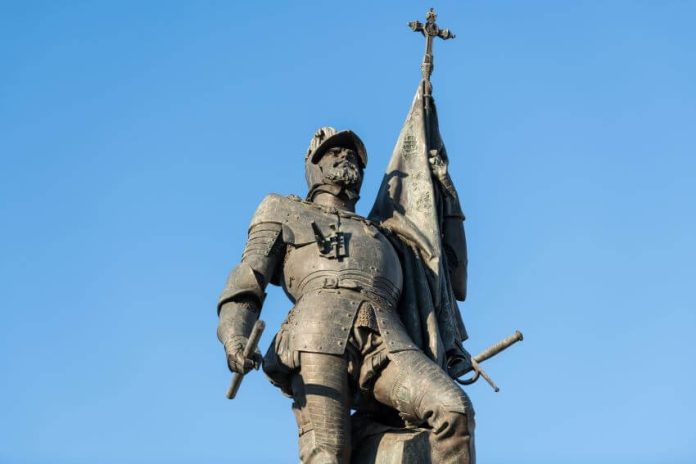
Hernan Cortes statue in Medellin, Spain
A monument to Spanish conquistador Hernán Cortés in Medellín, Spain. (File photo)

Mexicans have not yet overcome the pain of the Spanish conquest and “try to hide” the nation’s history, according to the author of a new biography about conquistador Hernán Cortés.

Spanish historian Esteban Mira Caballos told the newspaper El Universal that when he travels to Mexico he’s surprised that people pretend that the events of the early 16th century — when Cortés led an expedition that defeated the Aztec empire — didn’t happen.

“But for good or for bad, he [Cortés] is an intrinsic part of their history,” Mira said.

“… We can’t make history up, we can’t … [say] now that the Mexicas [Aztecs] defeated Hernán Cortés because that didn’t happen. History was as it was, and we have to accept it as it was,” he said.

Mira, an expert on the Spanish conquistadors that conquered the Americas, also said that Mexicans still speak about Cortés as if he died yesterday.

historian and author Esteban Mira Caballos
Author Esteban Mira says he is surprised at how many Mexicans try to rewrite history concerning Hernán Cortés. Crítica

“The personage died five centuries ago; if people are raped in Mexico, they say, ‘Hernán Cortés brought rape.’ If there is corruption in Mexico, they say, ‘Cortés brought corruption,’ but the historical figure died five centuries ago. … For reasons I’m unaware of, Mexicans haven’t assimilated their history; their past is a process that is ongoing,” he said.

One Mexican who refuses to let bygones be bygones is President López Obrador, who has sought apologies for the 1521 conquest from Spain’s King Felipe VI and from Pope Francis.

Mira described Cortés as a warrior of his times and accepted that he committed atrocities and “acts of barbarism” and made decisions about good and bad and life and death.

However, the conquistador, a deeply religious man, didn’t see the massacres and pillage perpetrated by the Spanish as being incompatible with his faith, he said.

The historian said it’s important to look at historical events from the perspective of those who participated in them and in consideration of the times in which they lived. Mira said that his book, Hernán Cortés Una biografía para el siglo xxi (Hernán Cortés, A Biography for the 21st Century) does just that.

Cortés was guided by values that are not the same as the values of today, he stressed.

Book by Esteban Mira Caballos about Hernan Cortes
Esteban Mira’s book attempts to take a fresh look at the Spanish conquistador, using more recent historical discoveries.

“He wanted a lot more than money — he wanted something else,” Mira said. “He wanted honor for his lineage and even more, he’s the only conquistador of all those I’ve researched that thought about [being remembered by] posterity … and he achieved it.”

“Whether we speak poorly or well of him, five centuries later, he’s still … [being spoken about], which is what he expected,” Mira said.

However, Cortés is not well-known in Spain, the historian conceded.

“Mexicans sometimes think that in Spain we hold him up as a hero … but there are very few people who know who Hernán Cortés is,” Mira said.

“I’m a teacher, and when I talk about the conquest I have to tell my students who Hernán Cortés was because they think he was a pro-[Francisco] Franco general or from the Napoleonic Wars. The majority of the population in Spain doesn’t know who he was,” he said.

With reports from El Universal 

Climbers rescue dog after it spent a month at the top of Pico de Orizaba

0
Canelo the mountain dog
Canelo the mountain dog and his rescuers at the peak of the volcano.

A dog that followed a group of hikers up the Pico de Orizaba volcano and stayed on the peak for almost a month has been rescued.

A group of mountain climbers led by Puebla man Hilario Aguilar scaled Mexico’s highest peak to rescue Canelo, a mixed breed hound.

The dog’s presence on the top of Pico de Orizaba, located in Veracruz, became widely known after a photo of him went viral on social media.

According to a report by the newspaper Milenio, Canelo followed a group of hikers who were giving him food along the way. He remained on the peak for almost a month, surviving freezing temperatures and snow.

Canelo was carried down the volcano by his rescuers. A video posted to social media showed his head poking out of a green and black backpack. One mountain climber noted that the dog was malnourished and that his ribs were visible. He also had an injured paw and very red eyes due to solar radiation, Aguilar said.

“… The ultraviolet rays and reflections of the sun on the snow could have left him blind,” he wrote on social media.

After his rescue, Canelo was handed over to Fátima del Ángel Palacios, a mountain climber and animal lover. She will nurse him back to full health before he is possibly put up for adoption.

In other intrepid dog news, video footage recently posted to social media showed a canine atop the Temple of Kukulcán, the imposing pyramid at the Chichén Itzá archaeological site in Yucatán. Tourists are not permitted to climb the 30-meter-high pyramid, but the rule apparently doesn’t apply to daredevil dogs.

With reports from Milenio

COVID roundup: there are signs of a fourth wave ‘but don’t tell the media’

0
Health Minister Jorge Alcocer
Health Minister Jorge Alcocer: not a fan of the media.

New coronavirus cases and COVID-19 deaths are well below the levels seen in recent months as the third wave of the pandemic extended across Mexico, but there are now signs of a fourth wave, according to the federal health minister.

“Today we were presented signs of a fourth wave but I don’t want this [information] to reach the press,” Jorge Alcocer told a virtual mental health and addiction prevention conference last Friday.

Despite his wish, video footage of the minister making the remarks reached the media this week.

Alcocer described journalists as “distorters of the truth” before warning people to take care due to the (apparently) deteriorating coronavirus situation.

For his part, health policy analyst Xavier Tello told broadcaster CNN that Mexico is likely to face a fourth wave given that European countries such as Germany and Austria are currently experiencing large outbreaks.

He said data shows that previous waves began in Mexico 60 to 85 days after large outbreaks started in Europe.

Tello noted that although 85% of adults are vaccinated only about 50% of the total population is fully vaccinated.

“… We still need to vaccinate minors, we need to vaccinate adolescents and we need to vaccinate children and that’s something that is not in the plan,” he said, although the government announced last week that it would offer shots to youths aged 15 to 17.

Tello said that case numbers were still declining at the moment but predicted they will begin to rise at the end of this year or the start of 2022, largely due to Christmas and New Year’s gatherings and parties.

Pan American Health Organization assistant director Jarbas Barbosa agreed that a 50% population-wide vaccination rate won’t be sufficient to stop a fourth wave.

“Mexico has made a very significant effort to vaccinate its population. It has 50% of its entire population with two doses – it’s significant vaccine coverage but not yet sufficient to guarantee that the country won’t again have … [new] outbreaks,” he said Wednesday.

“Continuing with the vaccination is necessary, [Mexico needs to] reach a higher vaccination coverage, protect everyone with … [two doses],” Barbosa said, adding that other virus mitigation measures such as social distancing, face mask use and hand washing must also be maintained.

“What we’re seeing in Europe is that a lot of countries that have vaccination coverage of 60-75% [are seeing] significant new growth in the number of cases. There is no sign that the pandemic has ended.”

In other COVID-19 news:

• President López Obrador said Tuesday that health authorities will consider the possibility of offering third, booster shots to some sectors of the population.

“The booster vaccine will be analyzed in some cases, especially for the elderly but that still has to be decided by the doctors, the specialists,” he said.

All adults in the United States are now eligible for booster shots if six months have elapsed since they had their second Pfizer or Moderna shot.

• Almost 131.4 million vaccine doses have been administered in Mexico after just under 188,000 shots were given Tuesday.

About 76 million adults have been vaccinated and only 15% of that number are awaiting their second dose, Deputy Health Minister Hugo López-Gatell said Tuesday.

He also said that additional shipments of the Pfizer vaccine will arrive in Mexico this month and next and be used to inoculate youths aged 15 to 17.

• The Health Ministry reported 3,698 new cases and 326 COVID-19 deaths on Tuesday. Mexico’s accumulated tallies are currently 3.86 million cases and 292,850 fatalities.

There are just over 19,000 estimated active cases, including more than 2,800 in Mexico City and over 2,500 in Baja California, the only state in the country that is high risk orange on the federal government’s coronavirus stoplight map.

The other 31 states are all low risk green on the map, which will remain in effect through Sunday. The Health Ministry will publish a new map for the coming two weeks on Friday.

With reports from Milenio, El Universal and Forbes México