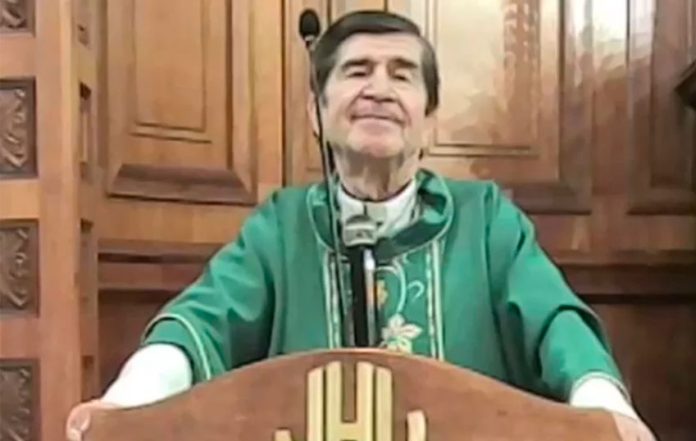
A Catholic bishop in Tamaulipas has asserted that wearing a face mask indicates a lack of faith in God, sparking controversy on social media.
“For me, at a personal level, [using] the famous face mask is to not trust God,” Antonio González Sánchez, bishop of the diocese of Ciudad Victoria, told parishioners during a Mass that was broadcast online on Sunday.
“I understand that maybe tomorrow I’ll be sick because I’m not immune to anything but just as you you see my face now [unmasked] that’s the way I am almost always,” he said. “… I go around like this because I place a lot of trust in God.”
The bishop said that he wasn’t asking others to remove their masks but rather think about how much faith they place in God.
He likened the coronavirus pandemic to leprosy and suggested that people’s prayers could help to end it.
“In these times physical leprosy doesn’t exist but we’re living through another kind of leprosy – the famous pandemic – and I think, obviously I might be wrong, that we lack faith – faith that drives us to ask God for this to end,” González said.
At one stage of his homily, the bishop backtracked somewhat, saying that face masks are “necessary” before reiterating that kneeling and praying to Jesus and God could help defeat the coronavirus.
“If you want to, you can free us of this, and above all let’s ask [God] to free us of fear,” González said. “… Very soon [I hope] to see your full face and very soon [I hope] that these pews can be filled again.”
Hundreds of social media users criticized the bishop for his remarks but but some others expressed support.
“Trusting God is one thing and not using a face mask is another. With all respect, all of us have to wear one in this pandemic, it doesn’t matter what religion we are,” wrote one Twitter user.
“The best commentary from the bishop in Tamaulipas would be silence. We trust God but following the wisdom of science, we wear masks to minimize Covid-19,” said another.
Anais Flores, another social media user, defended González, noting that his remarks expressed his personal opinion and that he didn’t direct anyone not to wear a mask.
In San Luis Potosí, meanwhile, the church is urging the public to use masks “even though the president doesn’t wish to do so.”
Despite the initiation of a vaccination program, said a church spokesman, people must continue to look after themselves and continue following sanitary protocols.
Juan Jesús Priego Rivera said President López Obrador needn’t worry because “he has an army of people, six doctors day and night, looking after him; those of us who are not the president have no one to look after us.”
The president has downplayed the value of face masks since the start of the pandemic and only wears one when traveling by air.
Cream, honey, and peanut butter make up this fondue's base.
Whatever you call them — groundnuts, monkey nuts, goobers — peanuts have been loved the world over for centuries. In Mexico, the word cacahuate originates from tlālcacahuatl (the Náhuatl name), which Spanish conquistadors found in the Tenochtitlán markets in the mid-1500s.
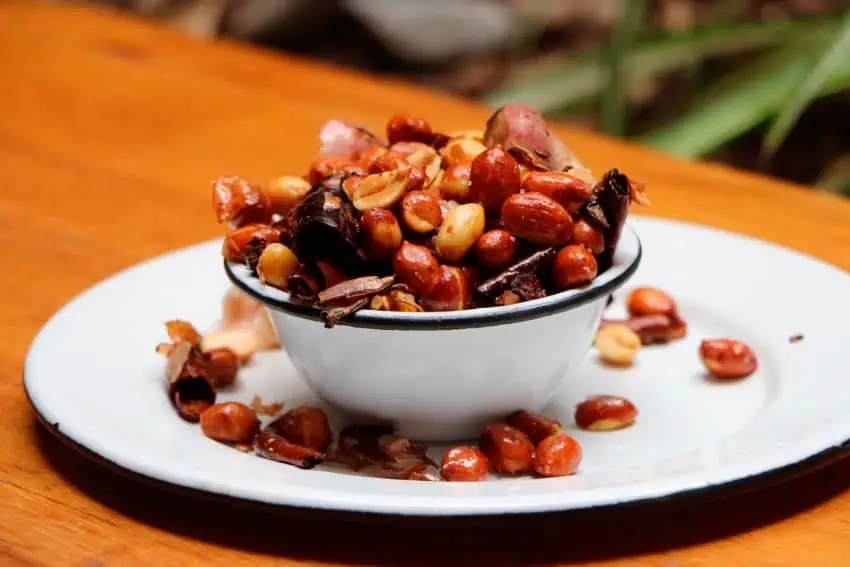
While there are a few traditional Mexican dishes that include peanuts (most notably encacahuatado, chicken in peanut sauce, and some moles), they’re used mostly in snacks, as evidenced by the shelves at any Oxxo or grocery store checkout aisle. One of my favorites and perhaps the most popular of these are cacahuates japonés, which were invented in 1945 by a Japanese immigrant named Yoshigei Nakatani.
Nakatani sold his secret-recipe peanuts with the brand name “Nipon” at La Merced Market in Mexico City until the family expanded in the 1970s and opened their first factory. The rest, as they say, is history, and the crunchy, sweet-and-savory, hard-shelled peanut snack is now found everywhere.
I’ve often wondered why peanut snacks are so popular in Mexico, but peanut butter isn’t. Quién sabe?! But it’s true — peanut butter is hard to find, especially natural peanut butter, and industry statistics say only about 10% of Mexican households contain a jar of it. No worries! You can make it yourself. (Recipe below.)
In the mercado, you’ll see different kinds of peanuts. All are good sources of protein, fiber, B vitamins and healthy fats. Usually, peanuts in the shell are the Virginia variety, with larger nuts and a more attractive shell. The aptly named Spanish peanuts are what’s commonly used in candy, peanut butter, snacks and mixed nuts, and are smaller, with a higher oil content.
These peanuts you get at your local Oxxo are so easy to recreate.
Cacahuates Oaxaqueños con Chile y Ajo (Oaxacan-Style Peanuts w/ Chile & Garlic)
The classic snack, so easy and so delicious!
1 Tbs. olive oil
4-5 chiles de árbol, stemmed
8 garlic cloves
24 oz. toasted Spanish peanuts (skin on)
Coarse salt
Rip chiles into 1-inch pieces, cut garlic cloves in half lengthwise and sauté in oil in 12-inch skillet over medium heat. Cook, stirring, until garlic is softened, about three minutes.
Add peanuts to skillet. Lower temperature to medium-low; cook, stirring, until peanuts are golden and aromatic, about 10 minutes.
Sprinkle with salt.
DIY Peanut Butter
A bit of coconut oil will help keep the peanut oil from separating.
16 oz. roasted unsalted peanuts
1 Tbsp. coconut oil
½ tsp. salt or to taste
Place nuts, oil and salt in food processor or blender. Pulse and process until nuts break down, scraping sides as needed until peanut butter reaches desired smoothness. Peanut butter will firm as it cools.
Store covered in refrigerator.
Quick Thai Peanut Chicken Ramen
If you like, omit the ramen and serve with white rice (cooked separately) instead.
4 cups chicken broth
1 can (14 oz.) coconut milk
¼ cup soy sauce
1 tsp. fish sauce
2 Tbsp. honey
1/3 cup peanut butter
2 Tbsp. red curry paste
¾ lb. boneless, skinless chicken breasts
8 oz. mushrooms, sliced
2 red bell peppers, chopped
1-inch piece fresh ginger, grated
2-4 cloves garlic, minced
1 square ramen noodles
Juice of 1 lime
3 cups fresh baby spinach
1/3 cup fresh basil or cilantro, chopped
Garnish: chopped peanuts, toasted sesame oil
In a large pot, combine broth, coconut milk, soy sauce, fish sauce, honey, peanut butter and curry paste.
Add chicken, mushrooms, red peppers, ginger and garlic. Bring to a simmer over medium heat, reduce to low and cook 15 minutes or until chicken is cooked through.
Remove and shred chicken, return to pot and bring to boil over high heat. Turn off heat, stir in noodles, lime juice, spinach and cilantro.
Let sit 5 minutes or until noodles are soft. Ladle into bowls, top with peanuts and sesame oil.
If you’re craving a more substantial treat, try this Thai recipe.
Peanut Butter Fondue
Not just for kids!
1 cup light cream
1/3 cup honey
¾ cup smooth natural peanut butter
For dipping: bananas, sliced into 1-inch chunks; marshmallows, strawberries, apples, cut into 1-inch cubes
For toppings: mini chocolate chips, crushed honey roasted peanuts, Maria cookie crumbs
In a saucepan, combine cream and honey. Bring to a simmer, stirring constantly. Reduce to low and stir in peanut butter until completely smooth.
Add mixture to a warm fondue pot or serve immediately in a deep bowl and eat quickly!
Dip skewered marshmallows, apple or banana chunks, strawberries or whatever dippable snack you like. Use small bowls of toppings to add crunch. — seriouseats.com
Peanut-Tamarind Dipping Sauce
Use as a dip for satay or spring rolls.
½ cup toasted peanuts
1 Tbsp. grated piloncillo
3 cloves garlic
2 Tbsp. soy sauce
1 Tbsp. red curry paste
1 Tbsp. tamarind concentrate
2 Tbsp. vegetable oil
Dry chile flakes, to taste
Combine sugar and garlic in a mortar and pound into smooth paste.
Add peanuts, continue mixing to make a chunky paste.
Add soy sauce, curry paste and tamarind; stir till combined to a chunky mixture. Mix in oil and chile. Add a little water if needed to adjust consistency.
You probably know atole with corn, but how about with peanuts?
Peanut Atole
The consistency of this traditional Mexican cold-weather drink is a matter of personal taste.
½ cup peanut butter
1 cup milk
½ cup masa harina
3¼ cups water, plus more as needed
3 Tbsp. grated piloncillo or brown sugar
Salt
Using a blender, mix peanut butter and milk until combined. Place masa in saucepan over medium heat. Immediately add water in a slow, thin stream while whisking constantly to avoid lumps. Bring to a simmer; whisk in peanut-milk, brown sugar and pinch of salt.
Return to a simmer, lower heat, then simmer gently, whisking, for 3 minutes. Thin with additional water as needed to create a thick-yet-drinkable hot beverage. Add more sugar or salt if desired.
Janet Blaser has been a writer, editor and storyteller her entire life and feels fortunate to be able to write about great food, amazing places, fascinating people and unique events. Why We Left: An Anthology of American Women Expats, is her first book.
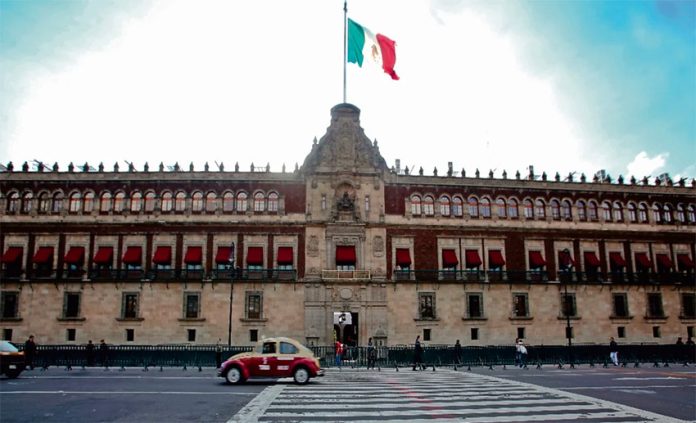
The National Palace: president believes it needs a governor.
President López Obrador has ordered the revival of a largely ceremonial government position that hasn’t existed for over a hundred years, earning a warning that the plan hardly fits with his government’s austerity policies.
López Obrador last week instructed the Finance Ministry to create the position of governor of the National Palace, a role derived from a Spanish royal tradition that was established in writing in 1838 but not held by anyone until the 1860s when former president Benito Júarez was in office.
According to a document the president sent to the National Commission for Regulatory Improvement, the governor of the National Palace – the seat of executive power and López Obrador’s residence – will be responsible for overseeing the upkeep of the building, located in Mexico City’s historic center, and managing the activities held there.
The president will be responsible for appointing a person to the pompous sounding role.
Alfredo Ávila Rueda, a historian at the National Autonomous University, said the reestablishment of the role is in stark contrast with López Obrador’s so-called “republican austerity project.”
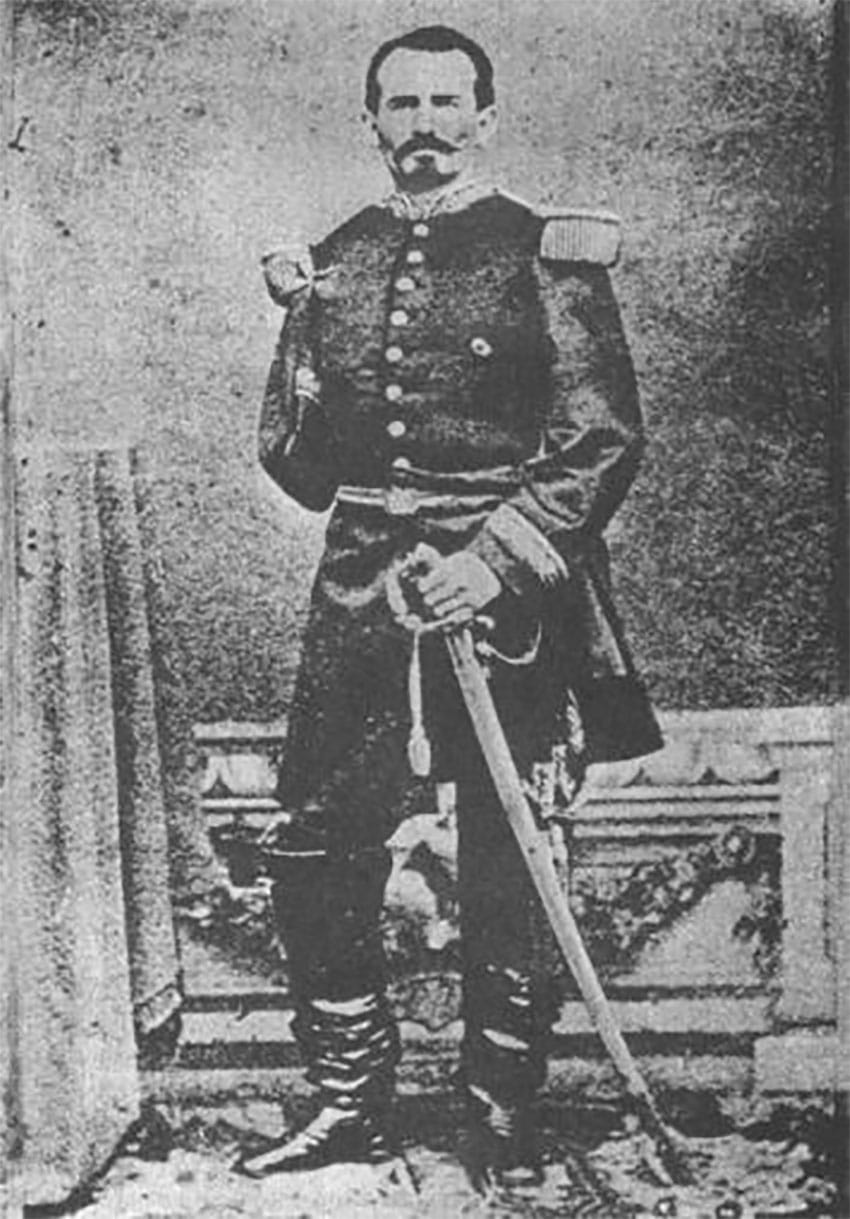
Manuel González, first governor of the National Palace.
In an interview with the newspaper El Universal, the academic said that austerity and such an “honorific” and “regal” role are not compatible, asserting that they clash.
The national president of the Democratic Revolution Party, López Obrador’s erstwhile party, also said that naming a National Palace governor is not congruent with the government’s austerity drive.
The president is living in the past and wants to recreate historical figures from the authoritarian Mexico of old, Jesús Zambrano said.
(Former president Porfirio Díaz, a dictator who held power for about three decades in the late 1800s and early 1900s, had National Palace governors and Emperor Maximilian had an Imperial Palace governor during the Second Mexican Empire in the 1860s. The first National Palace governor was Manuel González, a military general, close associate of Díaz and president of Mexico between 1880 and 1884).
“The position that [López Obrador] proposes reviving dates back to centuries past with authoritarian leaders. The question is who will he install as Palace governor? Who will be his new accomplice?” Zambrano said.
Bolfy Cottom, a researcher with the National Institute of Anthropology and History, said the revival of the position appears to be “within the framework of the law” but suggested that there were more pressing concerns.
“What can be questioned is that amid complete austerity, when resources for cultural institutions are being begged for, a new position is created. … Isn’t there no money? I think it’s immoral, there are no ethics.”
The Conservatorship of the National Palace, an administrative unit of the Finance Ministry, is currently responsible for the protection, conservation and restoration of the building and its contents.
But according to López Obrador, a National Palace governor, whose salary has not been announced, is needed to look after the imposing edifice in a “closer, more punctual and more efficient way.”
When President López Obrador swept to a landslide victory in July 2018, his government pledged to push public and private investment to 25% of GDP in a bid to jolt the country’s economy out of a longstanding rut.
Instead, investment has fallen as a series of investor-unfriendly moves deterred inflows. López Obrador’s step last month to push through a law that would drastically change electricity sector rules is just the latest example, investors have warned.
He has also scrapped a partially built airport and brewery, canceled electricity auctions, rewritten gas pipeline contracts, upset processed food manufacturers with new labeling requirements and pushed plans to ban subcontracting of jobs.
CEESP, a private sector think tank, said the recent decision to prioritize the state electricity company was the 15th initiative by López Obrador, his Morena party or the government to undermine investor confidence in the past 2 1/2 years.
Mexico is battling to haul itself out of its deepest recession since 1932 with only limited help from its government, which has held back from launching the kind of ambitious fiscal support measures undertaken by other major regional economies such as Brazil.
As a result growth is not expected to recover to pre-pandemic levels for another five years according to the IMF.
“They would have struggled to find a worse time to present this bill,” Carlos Salazar, head of Mexico’s biggest business lobby, the CCE, told the Financial Times. “There is no doubt that this will cause more problems. No investors will want to invest.”
López Obrador believes that playing hardball with a private sector he accuses of corruption and unfair competition gets results as part of his self-styled mission to “transform” Mexico by eradicating malpractice.
He frequently brushes off suggestions the economy is in trouble by claiming to have “other data.” He highlights record remittances — US $40.6 billion last year, some 3.8% of GDP — as a key aid to consumer spending.
López Obrador predicts the Mexican economy will grow by 5% this year — more bullish than all economists’ estimates — but even that would not make up for the 8.5% contraction in 2020.
And sustaining growth will be hard. “If anyone tells you that you can grow 5% without 25% [of GDP] total investment, they’re lying,” Carlos Urzúa, López Obrador’s first finance minister, told the FT in 2018.
With millions of jobs lost and businesses shut in Latin America’s second-biggest economy because of the pandemic, and 44% of workers unable to make ends meet on their salaries, economists say the president needs to boost investment to save millions more people from falling into poverty.
“Recovering lost ground is going to take a long time, the investment climate is very strained. The signals are not good,” said Jessica Roldán, chief economist at brokerage Finamex. “In the medium and long term, it’s impossible to grow without investment.”
Yet investment is falling further and further behind. Gross fixed investment — the sum of public and private spending on plants and machinery — was barely above 19% of GDP in the third quarter of last year. It has not fallen to such levels since 2009, during the global financial crisis.
Foreign direct investment has slumped by more than $10 billion during the pandemic and most of that is reinvestment of profits rather than greenfield projects, according to official data.
Private investment now only makes up 16.6% of GDP, down from nearly 20% in 2018, according to the Mexican Institute for Competitiveness (IMCO), a think tank.
And although López Obrador has touted a handful of major infrastructure projects, including a refinery, an airport and a train line, public investment has fallen to 2.5% of GDP — down from 2.9% when he took office, CEESP said.
“It seems like the current federal government is determined to limit investment, and as a result, economic growth,” CEESP said.
Alonso Cervera, managing director in emerging markets research at Credit Suisse, said: “Mexico doesn’t seem to have a clear model for economic growth. It looks like the model of development is to build a couple of landmark projects like the refinery, the train and the airport and hope people will be happy with cash transfers.”
López Obrador prides himself on social spending, including pensions to the elderly and educational grants.
But economists warn the lack of investment will translate into lower growth prospects in future. Mexico has failed to grow much above an average of 2% per annum for decades. Now, Cervera said potential growth was on course to reach just 1.5 to 2%.
“We’re facing a very clear fall in potential growth,” said Roldán.
The electricity bill, which has been fast-tracked and is widely expected to pass, has only deepened the gloomy outlook.
The U.S. Chamber of Commerce called it “the latest in a pattern of troubling decisions taken by the government of Mexico that have undermined the confidence of foreign investors in the country.”
And because of the pandemic, it said, now is “the precise moment enhanced foreign direct investment in Mexico is needed more than ever.”
Members of a search brigade. There are many such groups across Mexico.
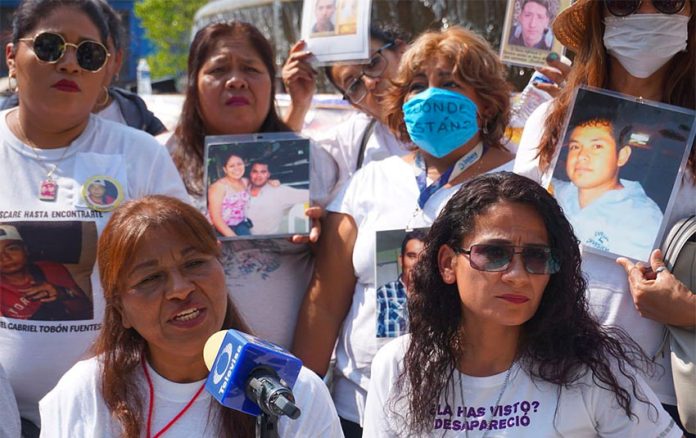
A Jalisco woman whose son was kidnapped in 2018 and never seen again is offering classes on search procedures to family members of other people who have disappeared in the state.
Adriana Méndez Cabrera, a former medical examiner, founded a collective that is now made up of more than 140 members of families who are searching for missing loved ones.
Assisted by former colleagues from the Jalisco Institute of Forensic Sciences, Méndez began sharing her knowledge of search procedures with collective members at an event in Guadalajara on Sunday.
“The little I know, or maybe it’s a lot, I’ll impart to the collective,” she told the newspaper Reforma at the Niños Héroes roundabout, which has been renamed by family members of the missing as the “Roundabout of the Disappeared.”
“[Then] we’ll go out to the field, we’ve already worked in several areas in various municipalities,” Méndez said. “… All the training will be on search techniques,” she added.
She said that ordinary people have to look for their missing loved ones due to the inaction of state authorities.
“My son disappeared two years ago and the [Jalisco] Attorney General’s Office never, never helped me,” Méndez said, adding that the investigators supposedly assigned to the case were changed frequently and no progress was made.
“You go to the state-run morgue and they don’t show you all the bodies, … and sometimes I was ignored,” she said. “Put simply, the Attorney General’s Office doesn’t work.”
Faced with the authorities’ apparent negligence, Méndez founded the Más Uno Igual a Todos collective last August and in the space of just six months it grew from 10 members to more than 140. Similar search brigades operate in several other states of Mexico.
There are more than 11,700 missing people in Jalisco, according to the National Search Commission, and about 80,000 across Mexico.
The official who has allegedly been held hostage since last Wednesday.
The family of a Oaxaca government official taken hostage Wednesday after he tried to negotiate with residents blockading a highway in San Juan Mazatlán Mixe say they fear for his life.
“It’s been six days today, and [the Oaxaca government is] unable to resolve a truly serious problem,” his wife told the newspaper El Universal Sunday. “Six days in which Jorge Toledo Toledo has been without support …”
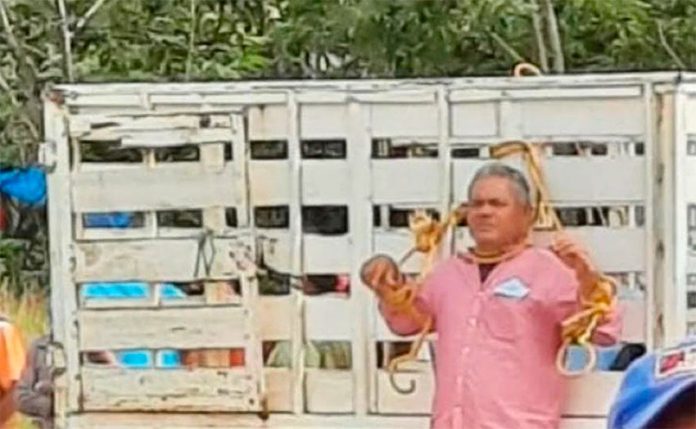
The family’s comments came in light of photos his captors published Sunday, showing Toledo with his neck and wrists tied to a truck, and apparently being forced to collect money from commuters passing through the blockade.
The family said the photos reflected the inhumane treatment he was receiving from his captors.
“It’s outrageous what they’re doing to Jorge,” one family member said. “They are forcing him to ask commuters for money, and the drivers are insulting him, not to mention they’re putting him on display, photographing him, shaming him. They’re violating his human rights.”
They also accused the government of abandoning their own employee, claiming that officials have said that Toledo went of his own accord to the blockade and that he’s basically on his own.
One official told a somewhat different story, explaining that Toledo went of his own accord to negotiate with the group because he is familiar with the town and its issues. He said he has been keeping in touch with Toledo by phone and that he is in good health.
“They’ve known him in the area for several years. Supposedly they tied him up, but that was just for a photo and then they let him go; he’s OK,” he said.
Toledo and two other civil servants were taken hostage after they responded to the demands of residents of the indigenous community located in the Isthmus of Tehuantepec, who are responsible for the blockade, that government personnel appear to negotiate. The two other officials were released Thursday.
Since Tuesday, the residents have blockaded the trans-isthmus highway, which connects Oaxaca and Veracruz, demanding the removal of three-term Mayor Macario Eleuterio Jiménez, whom they accuse of corruption. They claim he has embezzled 5.7 million pesos in federal funds.
While García told El Universal on Sunday that the state government was going to continue negotiating with the residents to reach a peaceful solution, Oaxaca’s human rights protection office has filed requests with the state Attorney General’s Office and the National Guard to intervene in the blockade, saying that the situation is violating Toledo’s rights.
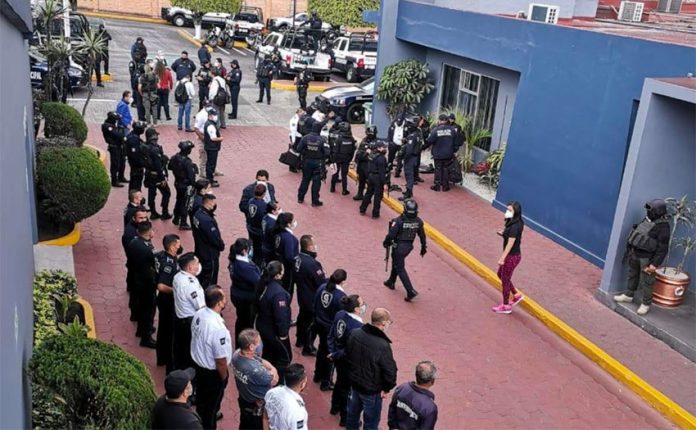
Following a deadly ambush of state police officers last week, security authorities in Veracruz disbanded the Orizaba police department Saturday in a surprise move.
Orizaba Mayor Igor Rojí, who said he had not been informed beforehand, told the newspaper La Jornada that about 120 state police officers have been assigned to Orizaba indefinitely.
Ministry authorities, who took local officers into temporary custody for questioning and inspection at state facilities in Xalapa, said they were investigating whether any had been complicit in the ambush and determine whether any of the officers had links to organized crime.
According to the newspaper Proceso, the Jalisco New Generation Cartel is suspected to have ties to the attack, in which three police were killed.
“We inform Orizaba citizens that their security is guaranteed, now that the Ministry of Security will maintain aerial and land patrols, strengthening the combat against impunity and crime,” the ministry said in a statement.
Three state police officers, including Rita Cecilia Romero Vicon, 24, a newly graduated officer from the El Lencero police academy in Xalapa, died in the attack. An additional officer survived but remains in serious condition.
According to La Jornada, the deaths almost immediately triggered tension in Orizaba over the next three days as state authorities in the area conducted impromptu searches of municipal police officers’ homes and there were clashes between state and municipal officers.
Early Saturday morning, state authorities arrested two municipal officers, one of whom was a commander, and then began the process of disbanding the department, confiscating weapons and patrol cars, as well as detaining 40 local officers.
This set off a reaction by around 60 other officers on the force, who barricaded themselves in the local municipal palace, saying they wanted guarantees of safety before turning themselves over to state authorities. They claimed to know of cases in which officers had been taken into custody by state officials and “had not returned.”
Mayor Rojí eventually convinced the officers to turn themselves in with promise that the local government would take charge of the officers’ transportation to Xalapa and that they would continue to be paid their salaries.
In addition, the officers demanded guarantees of their families’ safety as well as the firing of a local official and a police commander, whose whereabouts, according to Rojí, are currently unknown.
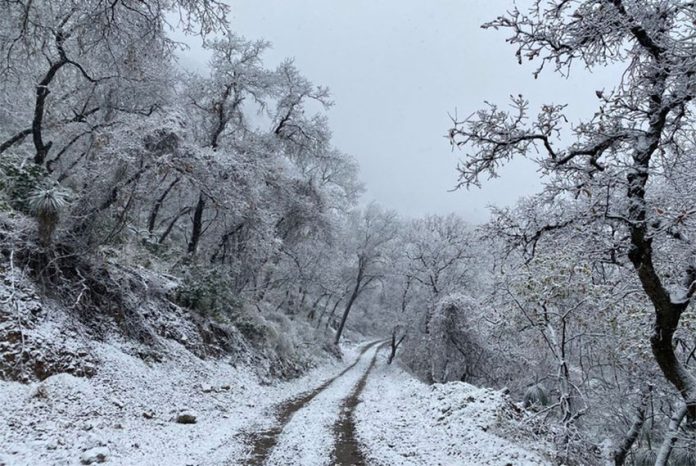
Mexico too is feeling the effects of cold front No. 35.
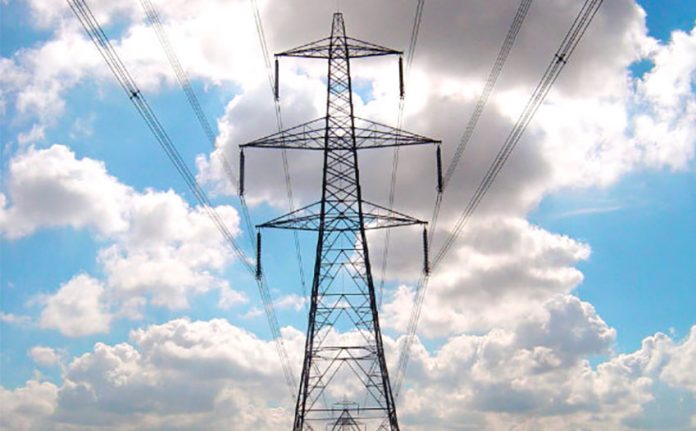
Almost 5 million people in northern Mexico were affected by a major power outage on Monday morning due to an interruption in the natural gas supply caused by cold weather.
President López Obrador said the blackout affected about 400,000 people in parts of Nuevo León, Coahuila, Tamaulipas and Chihuahua, including Saltillo, Reynosa, Matamoros, Nuevo Laredo, Ciudad Juárez, Chihuahua city, Cuauhtémoc and Delicias.
However, Federal Electricity Commission (CFE) distribution director Guillermo Nevárez Elizondo later said 4.7 million people were affected by the outages in the north of the country.
“It’s due to the winter storm, the bad weather; the CFE technicians are already working [to restore power],” López Obrador told reporters at his morning press conference.
“… It won’t last long, [the issue] will be resolved,” López Obrador said.
The National Energy Control Center (Cenace) said in a statement that 58% of affected electricity supply had been restored by noon.
Cenace said the power cut was caused by cold front No. 35, which brought snow to parts of northern Mexico on Sunday, as well as a lack of natural gas. It said that approximately 6,950 megawatts of load were affected.
Cenace called on residents of Chihuahua, Coahuila, Durango, Nuevo León, Sinaloa, Sonora and Tamaulipas to reduce their power use on Monday morning to reduce pressure on electricity infrastructure.
The CFE said in a statement that a cold snap in the United States had caused the supply of natural gas from that country to Mexico to be interrupted.
“In the face of the worsening of extreme temperatures in the United States and particularly Texas, where part of the population doesn’t have electricity today, significant cuts in the supply of gas started today due to the freezing of pipelines,” the state-owned company said.
Gas-fueled power stations in Sinaloa, Sonora, Durango, Chihuahua, Coahuila and Nuevo León were affected by the cuts, the CFE said.
The company also said that U.S. authorities were prioritizing the supply of natural gas for homes and hospitals, meaning that there was less to send to Mexico.
The CFE said it was using its reserves to inject gas into power plants in Chihuahua and Nuevo León to avoid a worsening of the power outage.
“The CFE has made available to Cenace all the energy originating from other sources of generation, and with a team in Mexico and the United states is working on the reestablishment and normalization of natural gas supply from the United States,” it said.
Mexico is heavily dependent on the United States for its natural gas needs, and natural gas shortages have affected industrial production at various times in recent years.
In July 2019, the Confederation of Industrial Chambers and the National Chamber of Industrial Transformation (Canacintra) described the gas shortage as critical, explaining that several companies were only operating at 30% capacity and that states in the north, west and southeast of the country were all affected.
Canacintra said there was “clear ignorance” of the situation on the part of federal authorities.
A year earlier, the then president of the National Hydrocarbons Commission warned that Mexico should produce more of its own natural gas to reduce dependence on imports from the United States.
Mexico relies on U.S. imports for 85% of its gas needs, Juan Carlos Zepeda said in July 2018, a situation he asserted creates not only a geopolitical risk but also an operational risk due to the possibility of a natural disaster interrupting supply.
“One of the first things we have to do . . . is produce more [of our own gas],” Zepeda said, sending a clear message to then president-elect López Obrador.
Mexico’s capacity to store natural gas and López Obrador’s opposition to fracking are also seen as barriers to greater development of gas resources here.
Guillermo García Alcocer, former chief of the Energy Regulatory Commission, predicted Sunday that Mexico would face a gas shortage due to the cold weather in the United States and asserted that greater storage capacity has been needed for years.
“Perfect storm. Freezing weather in Texas with an excess in demand for gas and electricity, together with a reduction in natural gas production … will affect the availability of gas for Mexico. We’ve needed [additional] storage for years,” he wrote on Twitter.
His prediction proved prescient less than 24 hours later.
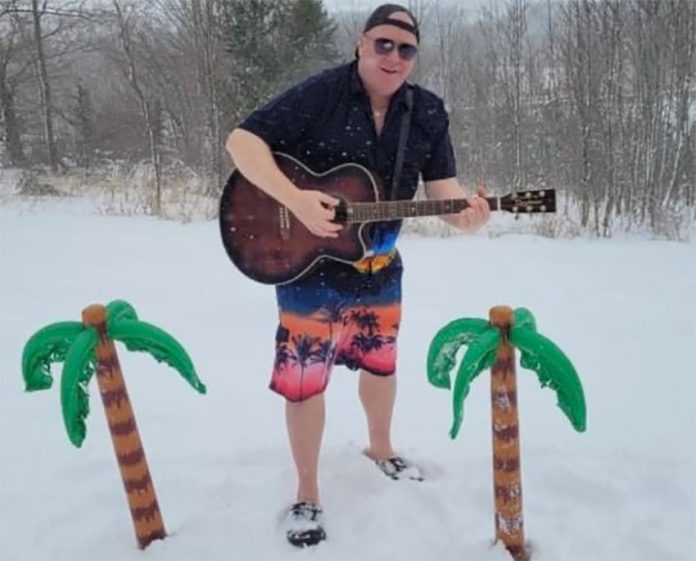
Musician Aiden McGill is a long way from Acapulco.
A Canadian musician who visits Mexico regularly has released a song and video designed to cheer up others who have decided to forgo travel due to the coronavirus.
“Here’s to all the folks who want to vacation but because of Covid-19 they cannot,” wrote Aiden McGill in a message accompanying the country tune and a video on his YouTube channel.
With plastic palm trees on a snowy lawn, Tan In a Can and the heat cranked up to 32 C, Our Own Mexico brings a Mexican beach vacation home to an Ontario winter.
It was written a few years ago by McGill and fellow musicians Tim Taylor and Shawn Christian during a visit to Nashville, and since then tweaked to reflect Covid and the new reality. The song was recorded at McGill’s home studio in Hastings, Ontario.
The video is made up of stills McGill shot during trips to Mexico and others while snowbound in Canada.
OUR OWN MEXICO Aiden McGill
McGill says he travels to Mexico a few times a year.
“I love the food, I love the people and my favorite all-time place to go is Acapulco.”
13-member brigades went to work in 333 municipalities Monday.
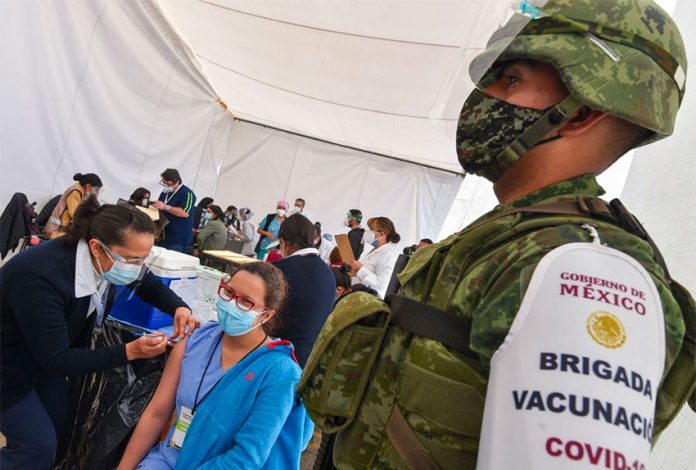
The vaccination of seniors against Covid-19 is underway in marginalized, mostly rural municipalities across Mexico after 870,000 doses of the AstraZeneca/Oxford University shot arrived Sunday from India.
Health Ministry official Ricardo Cortés said Sunday night that the inoculation of seniors would begin 8:00 a.m. Monday in 1,081 vaccination centers in 333 poor municipalities located in all 32 states of the country.
Thirteen-member brigades made up of doctors, nurses, government social program employees, volunteers and members of the military will be responsible for the rollout of the vaccination program to seniors. Some 1,080 brigades were to swing into action on Monday.
The commencement of the seniors’ vaccination program comes after a first shipment of AstraZeneca, two-dose vaccine manufactured at the Serum Institute of India arrived at the Mexico City airport.
An additional 1.16 million doses are expected to arrive from India in March, the Foreign Affairs Ministry said in a statement, while Mexico has an agreement to purchase more than 77 million doses to be manufactured in Argentina and bottled here.
The 870,000 doses, purchased for US $4 each, were taken to facilities of state-owned vaccine company Birmex for inspection prior to distribution across the country via air and land.
Foreign Affairs Minister Marcelo Ebrard, who was at the airport to receive the vaccines, noted that the shipment is the largest Mexico has received to date. Indian Ambassador Manpreet Vohra said the consignment is the first to reach Latin America from India.
President López Obrador announced Sunday that the initial shipment of AstraZeneca vaccines would be used to inoculate seniors in isolated and poor communities where there is scant medial infrastructure to treat Covid-19 patients.
Speaking at a press conference in Oaxaca, he stressed that all seniors – and all Mexicans – will be immunized free of charge but priority has been given to those who live in “the most remote, the poorest and the most needy communities.”
“We’re beginning in 330 municipalities … with these characteristics, all the seniors of those municipalities will be vaccinated. The next delivery will cover other municipalities, also from [all] 32 federal entities,” López Obrador said.
The president noted that vaccination will also begin Monday in the Mexico City municipalities of Milpa Alta, Cuajimalpa and Magdalena Contreras. He cited the Cañada region of Oaxaca and the Mixteca region of Puebla among the areas where vaccines will be administered starting today.
Vaccine arrives from India Sunday morning in Mexico City.
He predicted that the country’s approximately 15.7 million seniors will have received at least one vaccine dose by the middle of April, two weeks later than previously anticipated.
Millions of vaccines from Russia and China are expected to arrive in the coming weeks, while further shipments of the Pfizer/BioNtech shot, which has been used to inoculate health workers, are also slated for delivery, including a lot of almost 500,000 doses on Tuesday.
Speaking at the Health Ministry’s coronavirus press briefing on Sunday night, Cortés said the government had decided to prioritize vaccination in rural areas over cities because the “epidemiological impact” of administering the limited number of doses Mexico currently has would be minimal in urban areas – even though they have been hit hardest by the coronavirus pandemic.
“If we focused first on covering all the urban areas, with just 870,000 doses at the moment, the epidemiological impact that those 870,000 doses would have would be practically non-existent,” the health promotion chief said.
“… If we focus on vaccinating the 3 million older adults in the more remote rural areas, we will probably have … everyone vaccinated [with a first dose] in one or two weeks,” Cortés said, apparently overstating the pace at which vaccines are likely to be administered.
“… we’ll reduce the risk for people who are highly vulnerable due to their geographic location,” he said.
“[People in rural areas] have a lower probability of finding a secondary level health service or intensive care if they need it than people who live in urban areas,” Cortés added.
“… The decision has been taken to complete the vaccination in remote rural areas … to cover people who are highly vulnerable in that regard more quickly.”
In addition to health workers and seniors, other sectors of the population that can expect early access to Covid-19 vaccination include teachers, dentists, people with chronic illnesses and athletes who will represent Mexico at the Tokyo Olympics to be held in July and August.
“The demand of dentists [to be vaccinated] is legitimate, just as we have the necessity to vaccinate teachers to protect them for the return to in-person classes,” López Obrador said Sunday.
“We also have to vaccinate the sportspeople who will represent us at the Olympic Games, all of them, and we have to do it now because the You are not allowed to view this event. is approaching and then the people with chronic diseases aged under 60 – people with high blood pressure, diabetics, those who suffer from obesity,” he said.
Meanwhile, Mexico’s coronavirus case tally is on the verge of reaching 2 million after 4,099 new cases were reported Sunday, pushing the accumulated total to above 1.99 million. The official Covid-19 death toll rose to 174,207 with 436 additional fatalities registered.