Home Blog Page 1393

AMLO will wait for official results before congratulating Biden

0
'We don't want to be imprudent,' said López Obrador, who has declined to congratulate Biden, right.

Unlike scores of leaders around the world, President López Obrador didn’t congratulate Joe Biden after United States media announced his victory over President Donald Trump in last Tuesday’s election.

Speaking in Villahermosa, Tabasco, on Saturday evening several hours after major media outlets called the race for Biden, López Obrador said he would wait until legal challenges are resolved before offering his congratulations to the successful candidate.

“We’re going to wait for all the legal issues to be resolved. We don’t want to be imprudent. … We want to be respectful of people’s self-determination and the rights of others,” he said.

The president joins the leaders of Brazil, China and Russia in withholding congratulatory remarks to the president-elect.

López Obrador, a strong advocate of non-intervention in the affairs of foreign countries, also said that “President Trump has been very respectful of us,” adding that “we have achieved some important accords.”

“We are thankful to him because he has not interfered,” he said.

Indeed, Trump didn’t make Mexico a major issue in his campaign for re-election this year as he did when he faced U.S. voters in 2016 and infamously described some Mexican migrants as drug dealers, criminals and rapists.

Despite that rhetoric and their ideological differences, López Obrador has developed a friendly relationship with his U.S. counterpart. His only trip outside Mexico since taking office in late 2018 was a visit to Washington in July to meet with Trump.

During the visit, AMLO, as the president is best known, said that in his time in office, Mexico has received “understanding and respect” from Trump and his government.

In Villahermosa on Saturday, López Obrador said that Biden has also shown respect toward Mexico and not sought to interfere in its internal affairs.

AMLO said that he has known the 77-year-old former vice president for more than 10 years, noting that he had spoken with him about migration policy.
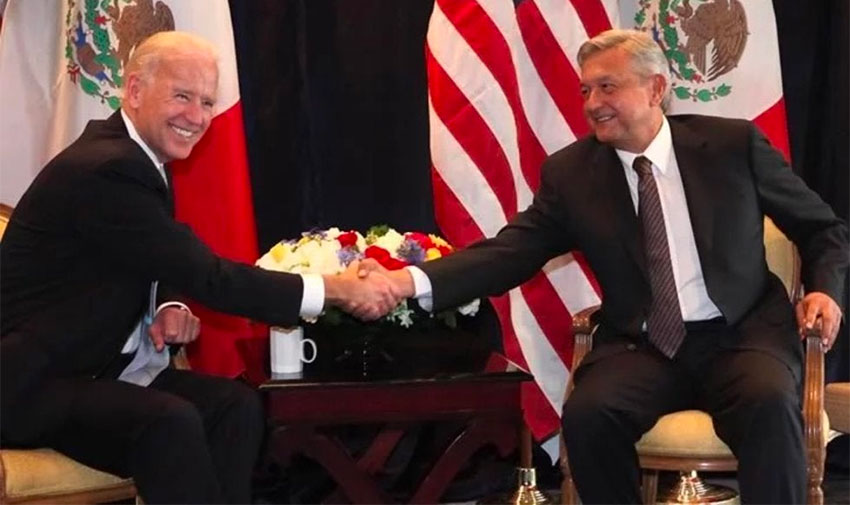
Biden and López Obrador met in Mexico City in 2012.

“There are no bad relationships, it’s just that I can’t congratulate one candidate or the other. I want to wait until the electoral process is finished,” he said.

In addition perhaps to not wanting to offend Trump while the U.S. president remains in office and takes legal action against alleged voting irregularities, López Obrador’s decision not to congratulate Biden appears related to his own experience in close, contested elections.

In remarks that were striking in their similarity to those made recently by Trump, the president said Saturday that the presidency was stolen from him at the 2006 election he lost narrowly to ex-president Felipe Calderón.

“They hadn’t finished counting the votes and some governments were already recognizing those who declared themselves winners,” López Obrador said.

Although AMLO – who also challenged the result of the 2012 election he lost to former president Enrique Peña Nieto – said his decision to not congratulate Biden didn’t amount to an endorsement of Trump, many of his critics charged that he had indeed sided with the U.S. president, who is deeply unpopular in Mexico.

It was widely expected that López Obrador would reach out to Biden given the importance of the relationship with the United States, which shares a more than 3,000-kilometer-long border with Mexico and is the country’s most important trading partner.

“This was a very serious mistake by López Obrador,” said Jorge G. Castañeda, a former foreign minister who served in the administration of ex-president Vicente Fox.

López Obrador should have followed the lead of other leaders who quickly congratulated Biden, he said, noting that leadership aspirants welcome congratulatory remarks from foreign leaders because it confers legitimacy on election results.

“The standard on these matters, and this is a long-standing issue in diplomacy, is pretty much this: you should do what everyone else does,” Castañeda said.

The former foreign minister, now a professor at New York University, charged that López Obrador is “scared to death of Trump” but wondered “what kind of retribution” he is afraid of.

“Trump is not going to close the border. Or bomb Ciudad Juárez. Or deport 2 million Mexicans. It’s not in the cards,” he said.

Pascal Beltrán del Río, editorial director of the newspaper Excélsior, charged that López Obrador effectively endorsed Trump’s repudiation of the election results by not congratulating Biden.

“The president of Mexico now owns Donald Trump’s hallucinatory observations about the presidential election,” he wrote on Twitter. “The relationship with Biden was already going to be difficult; now more so.”

United States Representative Joaquin Castro, a Texas democrat who heads up the Congressional Hispanic Caucus, said on Twitter that López Obrador’s failure to recognize Biden as president-elect was a  “a stunning diplomatic failure … at a time when the incoming Biden administration is looking to usher in a new era of friendship and cooperation with Mexico.”

Jesús “Chuy” Garcia, a U.S. representative for Illinois, tweeted at the president to tell him that “American voters have spoken and Joe Biden is our president elect.”

“He won fair and square,” he added before advising AMLO not to miss out on the timely opportunity to congratulate him.

Other observers were not as critical of López Obrador’s decision to withhold his congratulations.

“The crazy guy [Trump] could close the border, deport people or [do] something else that could cause a lot of damage to Mexico and to our compatriots,” said Genaro Lozano, a political analyst and columnist.

Héctor Diego Medina, a columnist and foreign affairs analyst, said that AMLO had made a “diplomatic error” but contended that it won’t be a costly one.

“Joe Biden is not a vengeful politician,” and therefore there won’t be any reprisal against Mexico once he takes office, he said. “Biden won’t create a fuss nor will he implement any sanction [against Mexico].”

The analyst said that he actually sees a warming of bilateral relations with Biden in the White House.

“The tone [toward Mexico from the U.S. president] will be better, the bilateral … [relationship] won’t be so coarse and there will be greater possibility of dialogue,” Medina said.

Foreign Minister Marcelo Ebrard said that he anticipates greater cooperation between Mexico and the United States if Biden’s election victory is confirmed.

He specifically cited economic matters as one area in which cooperation could improve but stressed that the relationship could benefit from a Biden presidency in a range of others.

Ebrard also said that the government will ask the United States to ramp up efforts to stop the flow of weapons into Mexico and the sale of drugs in the U.S.

The foreign ministers added that a meeting with an incoming Biden administration will be necessary in order to understand its vision for the relationship with Mexico. He ruled out any possibility that López Obrador’s decision not to immediately congratulate Biden will cause problems in the bilateral relationship.

Once the election result is confirmed, the Mexican government will dedicate itself to forging the “best possible relationship” with the new U.S. administration, Ebrard said.

Source: El Universal (sp), Milenio (sp), Infobae (sp), The Los Angeles Times (en) 

Golfer’s PGA win at Houston Open is first for Mexico in 42 years

0
Golfer Carlos Ortiz in Houston on Sunday.

After several close calls, Mexican golfer Carlos Ortiz came from behind to emerge as the victor at the Houston Open on Sunday. The win marked not only Ortiz’s first PGA tour victory but also the first PGA title to go to a native Mexican golfer in 42 years.

The 29-year-old Guadalajaran claimed the title with a two-shot victory, blowing past high-ranked golfers Dustin Johnson, Hideki Matsuyama, Jason Day, and Sam Burns, who started the tournament’s final day in the lead, one shot ahead of Ortiz.

In the end, Ortiz finished the tournament at Houston’s Memorial Park Golf Course 13 under par.

“I wasn’t really thinking about the other guys,” he told CNN. “I wasn’t worried. I knew if I played good I was going to be hard to beat.”

However, Ortiz was on the verge of tears at his win, accomplished with a more than 20-foot birdie putt.

“I’ve played great this week and it was really hard to hold the emotions all the way to the end,” he said of his tearful reaction. “But I’m really happy the way it played out and the way I played, too.”

The win places Ortiz into an elite group of only two other Mexican golfers to earn a PGA win — Victor Regalado, who won in 1978 at the Ed McMahon-Jaycees Quad Cities Open and in 1974 in the Pleasant Valley Classic, and Cesar Sanudo, who won the Azalea Open Invitational in 1970.

The win also qualifies Ortiz for an invitation to the prestigious 2021 Masters tournament at Augusta National Golf Course next April.

The Houston Open, which began Thursday, was the first PGA Tour event in the U.S. to have fans in attendance since March.

Sources: CNN (en)

Overflowing rivers create worst flooding in 50 years in Macuspana, Tabasco

0
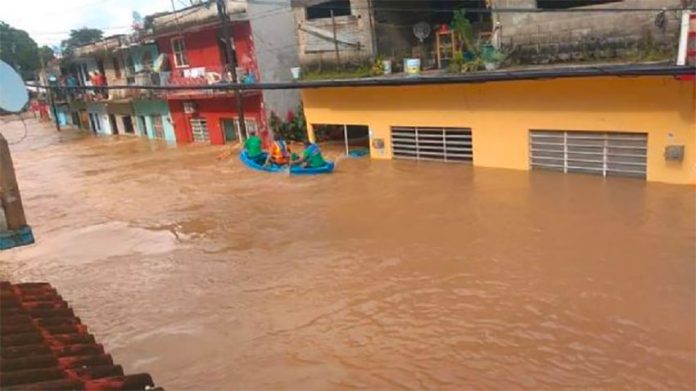
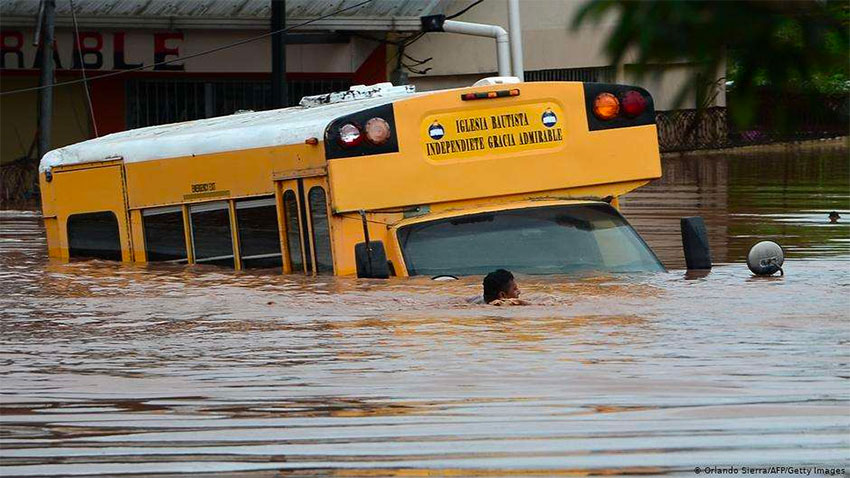
Boats have been the only means of transportation.

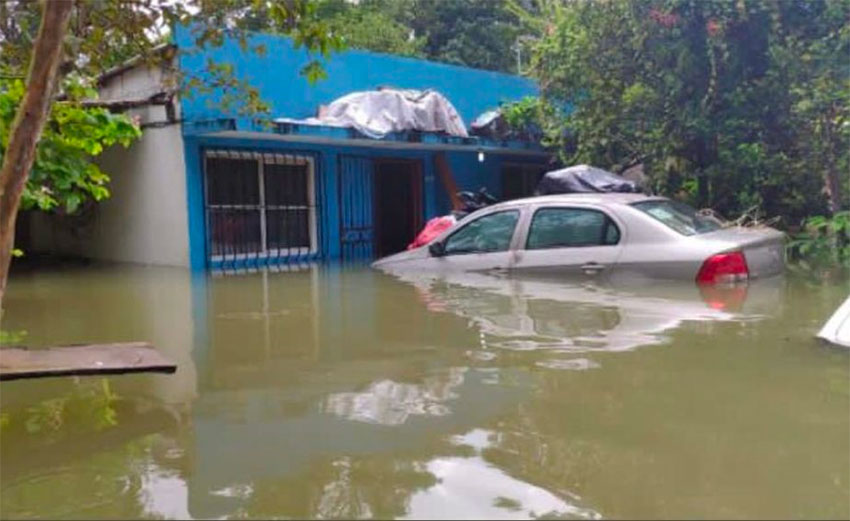
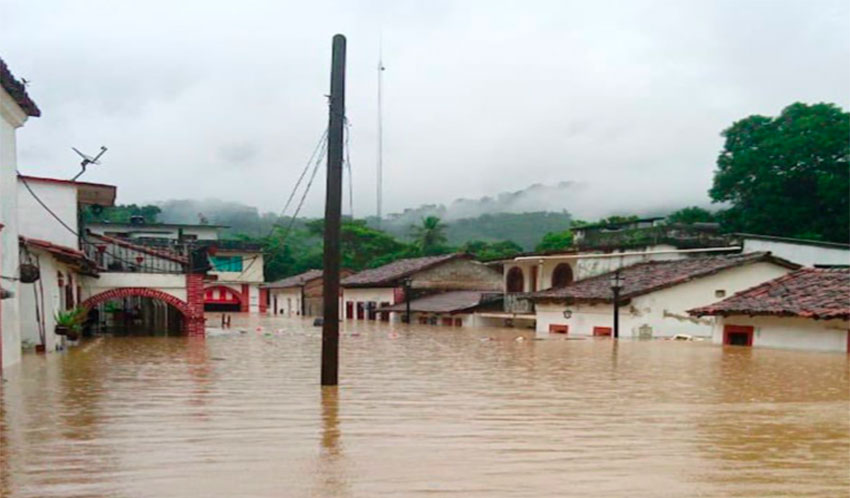
Flooding over the weekend was the worst in at least 50 years in the Tabasco municipality where President López Obrador was born, according to residents.

Several towns in Macuspana, located southeast of the state capital Villahermosa, suffered severe flooding due to heavy rains brought by two cold fronts and Tropical Storm Eta.

One of the worst affected was El Castaño, a community near Macuspana, the municipal seat.

The newspaper El Universal reported that residents sought refuge on their roofs as water from the overflowing Puxcatán and Tulijá rivers inundated the town.

Ángel Antonio, a local boatman who helped some residents evacuate their homes, said that floodwaters had claimed the lives of many people.

“There are a lot of dead people, [they] drowned. I saw them,” he told El Universal.

The official death toll in Tabasco from flooding stands at five but it appears likely that number will rise.

César Guadalupe Carrillo Sanchez, another resident of El Castaño, said Sunday that the town had been completely flooded for two days.

“It’s a situation that had never occurred in Macuspana,” he told El Universal while standing in waist-deep water.

“My neighbors and I are removing everything [from our homes], … We’re removing clothes and supplies, whatever we can.”

Carillo said that the only way to move about El Castaño was in a canoe or boat, adding that the roads into the community are cut off.

Macuspana under water.

“This had never happened. I’m 47 years old, I’ve been living here for 40 years and this had never happened,” he said.

Residents said that they haven’t received any support from state or federal authorities and that they are fearful of snakes and crocodiles lurking in the floodwaters. Despite that fear, some residents have fled their homes swimming, El Universal said.

In Tepetitán, López Obrador’s home town, water has inundated homes after flowing over the top of sandbag walls that were erected in vain.

Other Macuspana communities where flooding has been reported include Nicolás Bravo, Álvaro Obregón, Puxcatán, Luis Donaldo Colosio, Josefa Ortiz and San Joseito. Flooding has also affected Villahermosa, where the Grijalva River burst its banks.

The federal Civil Protection service said late Sunday that the government was providing humanitarian assistance to more than 177,000 people affected by heavy rains in Tabasco, Chiapas and Veracruz.  More than 141,000 of that number are in Tabasco.

The Civil Protection service also said that 58,877 homes have been damaged and that 220 roads and 20 bridges have been affected by flooding in the three states.

Civil Protection chief Laura Velázquez Alzúa said that 27 people had lost their lives due to the heavy rain – 22 in Chiapas and five in Tabasco. Several landslides have been reported in the former state.

She said that more than 8,000 people had sought refuge in 209 temporary shelters, 195 of which are in Tabasco.

Velázquez noted that rain is not forecast this week in areas currently affected by flooding. The forecast “allows us to take very important decisions to help people,” she said.

She said that thousands of civilian and military personnel from several government institutions are contributing to efforts to evacuate affected residents and deliver humanitarian aid.

López Obrador, who flew to Villahermosa on a military aircraft on Saturday, said that no one would be abandoned by the federal government.

He also said that the government will draw up a new plan to avoid future flooding in Tabasco. Rivers will be dredged and there will be greater control over the release of water from dams on the Grijalva River, López Obrador said.

The response to the flooding by Tabasco and federal authorities was criticized by federal Deputy Verónica Juárez Piña, who said that they acted too slowly.

The lawmaker, coordinator of the Democratic Revolution Party in the lower house of Congress, said the federal and state Morena party governments lacked foresight and coordination in their response.

Juárez also took aim at López Obrador for dissolving the disaster relief fund Fonden, one of 109 public trusts that were recently abolished.

Fonden, she said, ensured that funds for disaster relief were available and it was managed by officials with extensive experience in responding to natural disasters.

López Obrador and the ruling Morena party ignored the warnings about the adverse consequences that abolishing the fund would have, Juárez said.

Source: Milenio (sp), El Universal (sp) 

Guerrero announces stricter Covid measures ahead of Christmas holidays

0
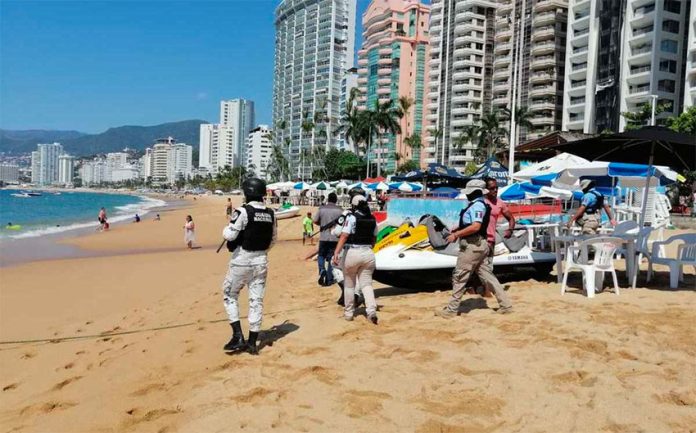
Officials patrol a beach in Acapulco.

Stricter coronavirus restrictions designed to avoid a spike in case numbers as the Christmas holiday season approaches take effect Monday in Guerrero.

Announcing 12 new measures to slow the spread of the virus, Governor Héctor Astudillo said that if there is a large new outbreak, the state won’t be able to receive tourists over the Christmas/New Year period.

That would be a big blow for the economy in Guerrero, whose Pacific coast beaches in destinations such as Acapulco and Zihuatanejo are popular with tourists during the end of year holiday season.

The new measures are:

  1. The use of face masks is mandatory in open-air and enclosed public spaces.
  2. Shopping centers, supermarkets and nonessential stores must close between 8:00 p.m. and 6:00 a.m.
  3. The sale of alcohol at convenience stores is banned after 8:00 p.m.
  4. Pharmacies, hospitals, health centers, gas stations and funeral homes may operate 24 hours.
  5. Citizens are prohibited from using their cars between 12:00 a.m. and 6:00 a.m.
  6. Bars in open-air spaces and on rooftops must close by 11:00 p.m.
  7. Bars in enclosed spaces, nightclubs/discos and casinos are not allowed to operate at all.
  8. Open bar events are prohibited.
  9. Restaurants must close between 11:00 p.m. and 6:00 a.m.
  10. Movie theaters must close by 11:00 p.m.
  11. Gyms must remain closed.
  12. Events such as weddings and 15th birthday parties are only permitted in open air spaces and must conclude by 11:00 p.m.
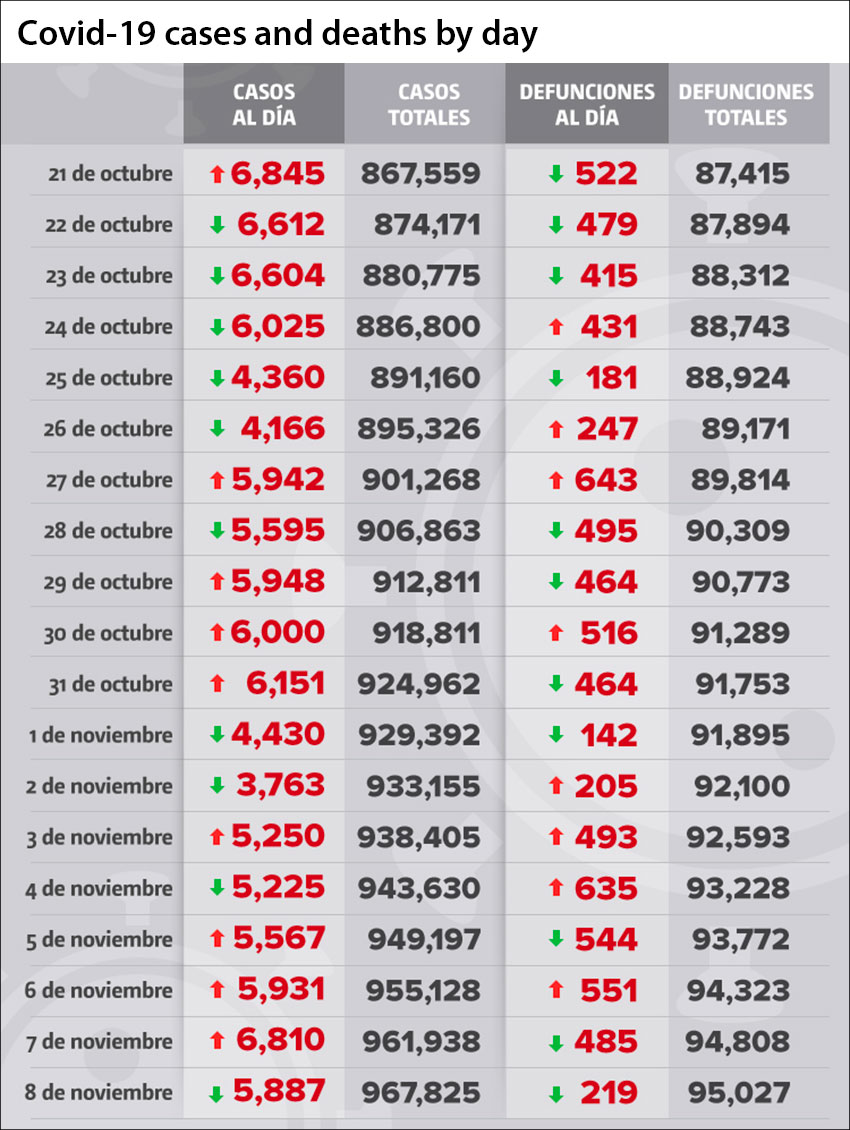
Coronavirus cases and deaths in Mexico as reported by day
Coronavirus cases and deaths in Mexico as reported by day. milenio

The restrictions will remain in effect for at least two weeks.

Astudillo said that a survey of residents in municipalities with high numbers of coronavirus cases found that more than seven in 10 people are in favor of stricter restrictions being implemented.

Non-compliance with the face mask measure will not immediately be punishable but Guerrero authorities are analyzing the possibility of establishing sanctions such as fines for people not wearing masks in public spaces. They are also considering the possibility of closing beaches.

To encourage compliance with health measures among visitors, officials with the state Tourism Ministry are carrying out an awareness campaign at bus stations and hotels. They are also distributing face masks and antibacterial gel to tourists in popular destinations including Acapulco.

At Playa Icacos, a popular beach in the resort city, members of the National Guard along with tourist police and municipal officials have been urging tourists to wear face masks and refrain from consuming alcoholic beverages, the newspaper Milenio reported.

According to federal data, Guerrero has recorded 22,598 confirmed coronavirus cases since the beginning of the pandemic, the 15th highest tally among Mexico’s 32 states. The federal Health Ministry estimates that there are currently 370 active cases in the southern state.

Guerrero’s official Covid-19 death toll is 2,219, the 15th highest total in the country.

Currently classified as “high” risk orange on the federal government’s coronavirus stoplight system, Guerrero is one of several states that have recently announced tighter restrictions to control the spread of the virus.

Among the others where stricter rules have been introduced are Jalisco, Chihuahua, Durango and Mexico City.

Mexico’s national coronavirus case tally increased to 967,825 on Sunday with 5,887 new cases reported, while the official Covid-19 death toll rose to 95,027 with 219 additional fatalities registered.

Health Ministry Director of Epidemiology José Luis Alomía said that Chihuahua, Durango, Aguascalientes, Mexico City, Coahuila, Querétaro and Zacatecas are all seeing a spike in new case numbers.

Mexico City, which easily leads the country for accumulated cases and Covid-19 deaths, currently has the largest active outbreak among the 32 states with an estimated 12,165 active cases.

On a per capita basis, Durango – one of two states currently painted red on the federal stoplight map – has the worst outbreak with 111.5 active cases per 100,000 residents.

Source: La Jornada (sp), Milenio (sp) 

Guerrero farmers face some obstacles if they’re to switch to legal crops

0
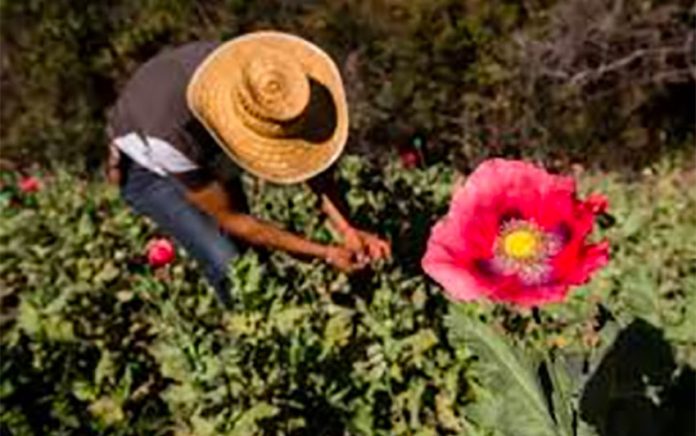
A poppy farmer in Guerrero.

Facing increased economic hardship, poppy-growing communities in southwest Mexico want to join a state program offering alternative projects, but this would only be a first step that cannot tackle all the complex issues campesinos are facing.

Hundreds of farmers spread across 19 communities in the Sierra poppy-growing region of Guerrero state allege that they were shut out of a government program — known as Sembrando Vida (Sowing Life) — by an official because they “had not pacified the region,” the newspaper La Jornada reported.

Launched by President Andrés Manuel López Obrador in early 2019, the government program arrived in Guerrero this year. It pays local community members 5,000 pesos (around US $240) per month to plant trees and cultivate legal harvests in an effort to move away from illicit crops. The goal is to improve living conditions for those in the countryside and stop environmental degradation.

However, the program has struggled to reach everyone in Guerrero’s Sierra. The farmers, who have banded together to form the Observatory for the Peace and Development of the Sierra (Observatorio por la Paz y el Desarrollo de la Sierra — OPDS), said officials have failed to even visit certain communities in the area, according to La Jornada.

“It is time for the government to support us; everything we have done is thanks to our efforts and from our own pockets, we have defended these forests without any support from the government,” farmer Norberto Verónica Jesús told the newspaper.

Farmers in Mexico’s poppy-growing region that stretches across the states of Chihuahua, Durango and Sinaloa, as well as Guerrero and Nayarit, have been struggling lately. Most recently, this has been driven by a sharp drop in the price of opium gum — the raw ingredient cultivated to produce heroin — as well as a complex set of criminal, social and political factors.

InSight Crime analysis

No single government program alone could adequately address the difficulties poppy farmers are facing in Guerrero.

Farmers there have grown poppies for decades, but Sembrando Vida encourages them to move towards alternative crops, such as avocado and coffee, which are also ideal for the high elevation and soil type of the Sierra. But there are other roadblocks, including the logistical problems posed by the remoteness of the area.

“You have this fertile land in the Sierra, but how are you going to transport these crops? There aren’t any roads. One of the advantages of cultivating poppy is that you can transport the opium gum in a backpack, which is much easier logistically than other, legal crops,” Irene Álvarez, an investigator with Noria Research in Mexico, told InSight Crime.

Guerrero also suffers from extreme violence and is highly marginalized both socially and geographically. What’s more, political powers — whether criminal leaders or elected officials, which at times are one and the same — have historically relied on violence to establish order and maintain power, according to Romain Le Cour, the president of Noria Research.

“You can have a legal framework for certain economic activities, but you also need infrastructure to enter the market and the political will to reform power dynamics and make them less violent,” Le Cour told InSight Crime. “As we have seen in neighboring Michoacán, the avocado and lime industries are perfectly legal and highly functional, but are regulated with violence like illegal markets are.”

Indeed, the booming avocado industry has led to criminal groups extorting exorbitant amounts from farmers in Michoacán. Alternative crops set up in Guerrero could very likely face a similar response.

The Sembrando Vida program is an important first step, according to Vania Pigeonutt, a Mexican journalist and the founder and editor of Amapola Periodismo, but does not provide the long-term focus Guerrero needs.

“Communities here have cultivated poppy and marijuana for decades,” she told InSight Crime. “There is no quick fix and any proposed solution must also analyze the roots of the complex structural factors at play.”

Reprinted from InSight Crime. Parker Asmann is a writer with InSight Crime, a foundation dedicated to the study of organized crime.

Investigation clears Foreign Affairs official of charging for personal travel

0
Deputy Foreign Affairs Minister Jesús Seade
Deputy Foreign Affairs Minister Jesús Seade was investigated for trips to Hong Kong.

Mexico’s chief North American trade negotiator has been cleared of allegations that he made improper use of travel allowances by flying to Hong Kong to visit family.

Deputy Foreign Affairs Minister Jesús Seade traveled to Hong Kong five times between 2018 and 2020, apparently to visit his wife and other family members who live there.

But Seade, who charged the government more than 865,000 pesos (about US $42,000) for his travel, claimed that the trips were work-related.

The newspaper El Universal revealed last month that the Public Administration Ministry (SFP) was investigating the deputy minister for embezzlement and abuse of office after he allegedly lied in order to obtain funding for his trips to the Asian city.

The Foreign Affairs Ministry (SRE) said in a statement Friday that the investigation had finished and that it found insufficient evidence to conclude that Seade had acted improperly.

It said that investigations “didn’t find sufficient evidence” to demonstrate that it was “probable ” that the official had committed an offense.

Seade posted a link to the SRE statement to his Twitter account but didn’t personally comment on the accusations he faced.

Seade led Mexico’s negotiating team in the latter stages of discussions with the United States and Canada aimed at reaching a new North American trade pact. The USMCA, as the agreement is known, took effect July 1.

The deputy minister was nominated as a candidate for director-general of the World Trade Organization but was eliminated from the race during a voting round in September.

Source: El Universal (sp) 

Monterrey doll artisans’ work bears a ‘neither here nor there’ perspective

0
Mayra René's art melds U.S., European and Mexican doll making traditions.

“We are neither from here nor there,” say Monterrey-based artisans Mayra René and Bertha García, but that is a boon for their art.

The northern part of Mexico is not known for art, or even handcrafts for that matter. Fine decorations and art have been the purview of central and southern parts of the country, where more complex civilizations developed.

There is still an expression in Mexico that Zacatecas “is where culture ends and carne asada begins.” Maybe someday soon the north will get the credit it is due.

That credit may finally come through the blending of influences from the Mexican south and the gringo north.

The intertwined stories of Mayra René and Bertha García provide a template for understanding how such a blending creates new images, avoiding both outright copying and kitsch. Both these artisans are from the northeast of Mexico, where the “not here, not there” vibe is quite strong.

Doll artisans Mayra René and Bertha García became fast friends in René's class and have been collaborators ever since.
Doll artisans Mayra René and Bertha García became fast friends in René’s class and have been collaborators ever since.

René is the better known of the two. She has worked for decades creating, teaching and promoting the making of art dolls. The basic concept comes from her experience living on the border in Reynosa, Tamaulipas.

René had access to books and the ability to travel north, learning from the likes of other artists like Paty Medaris Culea, Barbara Willis and Elinor Pace Bailey. Consequently, much of her work has a familiar feel to that of art doll makers and collectors north of the border.

Like her U.S. and European counterparts, René’s dolls tend to be mixed media, cloth along with papier-mache, Styrofoam and/or clay. The heads are the often the most important element, finely formed and painted. However, her work does not copy these contemporaries. There is a definite lack of the princesses, goblins, and other European fairy tale characters that often appear in works north of the border.

Her original designs include elements from family doll making, regional traditions and even the long-forgotten tradition of fine-cloth dolls made centuries ago in Puebla. She also pulls inspiration from Mexico’s visual arts. A favorite for René is the surrealist work of Remedios Varo, a Spanish painter exiled to Mexico in the 20th century.

In fact, René’s work has been a significant influence on doll makers in Mexico, from the northeast down into the state of Guanajuato, a result of classes she has taught and her first book, published in 2012, El Arte de las Muñecas en Tela. Historia y Métodos de Elaboración (The Art of Cloth Dolls. History and Techniques for Creating). This is how her collaboration with papier-mache (cartonería) artist Bertha Elisa García Espinosa began.

García’s entry into art and crafts came through her family. Her grandmother and aunts rolled newspaper strips and used paste to make gift baskets to sell. Her grandfather took the women’s techniques and used it to create an image of Christ. This caught García’s attention because she realized so much more could be done with what she had learned from the women in her family.

Bertha García is "the queen of papier mâché in northeastern Mexico," according to Mayra René, fellow artist and collaborator. They often do joint exhibitions.
Bertha García is “the queen of papier mache in northeastern Mexico,” according to Mayra René, fellow artist and collaborator. They often do joint exhibitions.

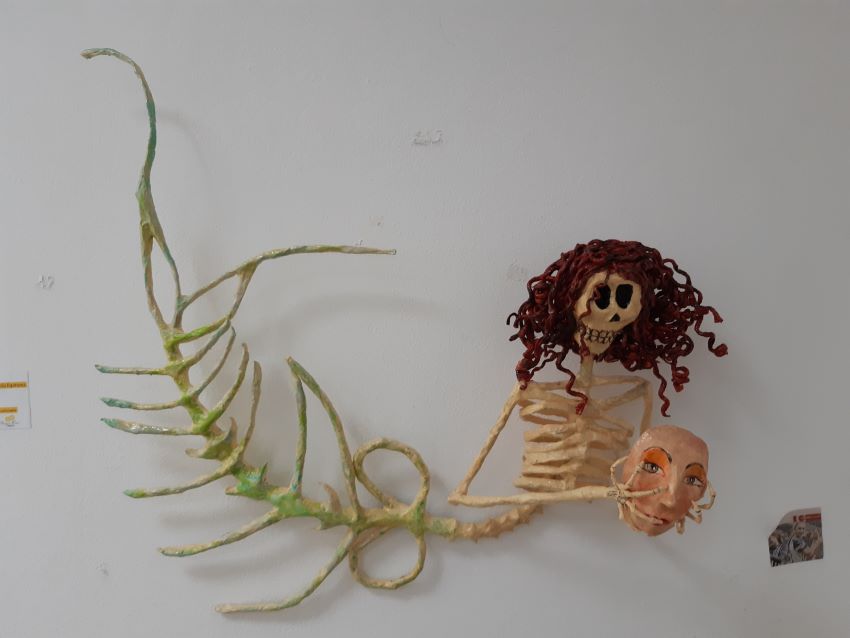
She began experimenting with making Catrinas, a skeletal image made popular in central Mexico. Still a psychology student at the time, she began selling the figures to her classmates. Classes in theatrical design, including puppet-making, introduced her to other papier-mache techniques.

A class in art dolls at René’s gallery in Monterrey not only introduced García to new design concepts but also to her most important collaborator and biggest fan. The two have since worked together on various projects and mutually support each other’s work through joint exhibitions, promoting both art dolls and Mexico’s cartonería traditions in northern Mexico.

René calls García the “queen of papier-mache in northeastern Mexico.”

Cartonería is not well-known in the north, but García has found success in making the teaching forms such as alebrijes (fantastical cartonería monsters invented in Mexico City in the 1930s by artist Pedro Linares), Catrinas and a type of doll called a Lupita.

Her most impressive work comes from the making of Catrinas and Lupitas, which is not a surprise given her long association with René.

Unlike alebrijes, the Catrinas and Lupitas have human (or human-like) faces — faces that lend themselves to the techniques used in art dolls to make them far more expressive. García’s Catrinas vary between the traditional and the innovative, but the dolls are always innovative in both face and body.

These two women’s creativity isn’t confined to their workplaces. The pandemic has affected them like everyone else. But rather than wait for government help, both have worked to develop online alternatives for both their sales and their classes. For García, this has meant expanding her business — not only teaching and selling to other parts of northern Mexico but also for and to clients in the United States and Spain.

Northern Mexico struggles with identity issues, with strong pressures coming from both south and north. But the work of René and García shows that this struggle is also a rich source of artistic inspiration. They have taken elements from both directions to make expressions of their own reality, without falling into the trap of simply tacking on stereotypical elements like long-toed boots onto their figures. Their work is far more subtle and meaningful than that.

René’s work can be seen at her Mayra René Gallery in Monterrey proper. García’s workshop, Galería 44 Creaciones, is located in her home in Apodaca, just outside the city.

Leigh Thelmadatter arrived in Mexico 17 years ago and fell in love with the land and the culture. She publishes a blog called Creative Hands of Mexico and her first book, Mexican Cartonería: Paper, Paste and Fiesta, was published last year. Her culture blog appears weekly on Mexico News Daily.

Heavy rains leave 21 dead in 3 states; thousands of homes damaged

0
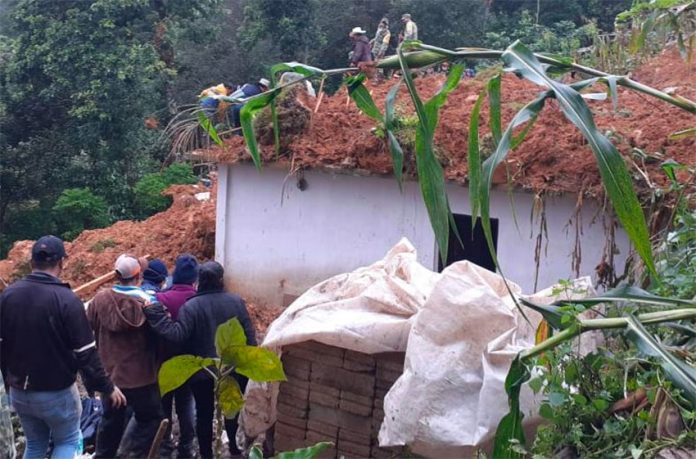
Mud covers a house after a slide in Chiapas.

At least 21 people have died in Mexico’s south and southeast due to heavy rain that triggered landslides and continued to cause flooding as of Saturday morning.

More than 100,000 people in Tabasco, Chiapas and Veracruz have been affected by the rains brought by two cold fronts and Tropical Storm Eta.

Nineteen of the reported deaths occurred in Chiapas, where at least 20 municipalities have received heavy rain. Among the deceased are 10 Tzotzil Mayan people who were killed in a landslide in the municipality of Chamula.

More than 2,000 homes have been damaged by landslides and heavy rain in the highlands region of the state.

Homes in more than 20 neighborhoods of San Cristóbal de las Casas have been damaged by flooding, according to municipal Civil Protection chief Pablo Reyes, and landslides have been reported in the municipalities of Yajalón, Tila and Chilón.

Floodwaters in southern Mexico.

The two other reported deaths occurred in Tabasco, where some 80,000 people have been adversely affected by the heavy rains. Both victims drowned in floodwaters.

At least 10 rivers have burst their banks in the Gulf coast state, causing widespread flooding. President López Obrador, a Tabasco native, called on people in the state to take shelter.

“Tabasco compatriots: the rivers are growing and it’s still raining. Keep yourself informed and … if you live in low areas, seek refuge in shelters or with family members who have homes in high areas,” he wrote in a Facebook post published Friday afternoon.

“Although furniture, homes and other assets might be affected, the main thing is life. Material things can be replaced and we will always help you.”

In a video message posted to social media on Saturday morning, López Obrador warned that water released from the overflowing Peñitas dam in Chiapas will make the flooding worse in Tabasco. He said he would travel today to Villahermosa, where flooding is severe, and convene an emergency meeting of the federal security cabinet in response to the situation.

The president noted that many of the most affected people in Tabasco are Chontal Mayans who live in low-lying coastal areas. He said Friday that corrupt past governments had allowed homes to be built in areas susceptible to flooding without constructing drainage infrastructure.

Las Choapas in southern Veracruz is one of the areas that has been hit hard by the heavy rains.

Tabasco Governor Adán Augusto López said Friday that the emergency in the state was at its “most critical point” but with the release of water from the Peñitas dam flooding could continue to worsen through Saturday.

The army, navy and Civil Protection services are helping vulnerable people evacuate their homes.

In neighboring Veracruz, at least 3,000 homes have been damaged by flooding and more than 10,000 people have been affected.

Communities in at least 12 municipalities in the state’s south and central regions have been cut off by landslides, the newspaper Milenio reported. Flooding is also widespread. Among the affected municipalities are Agua Dulce, Cosoleacaque, Las Choapas, Minatitlán and Uxpanapa.

The National Meteorological Service forecasts torrential rain in Tabasco, Chiapas and Quintana Roo due to Tropical Storm Eta, which was about 70 kilometers west-northwest of Grand Cayman at 9:00 a.m. CST.

Intense rain is also forecast for Campeche, Oaxaca, Yucatán and the south of Veracruz.

Source: Milenio (sp), Reforma (sp), Expansión Política (sp) 

Sonora, Sinaloa, Guanajuato backslide to high risk on coronavirus map

0
The stoplight map indicates the coronavirus risk level state by state.

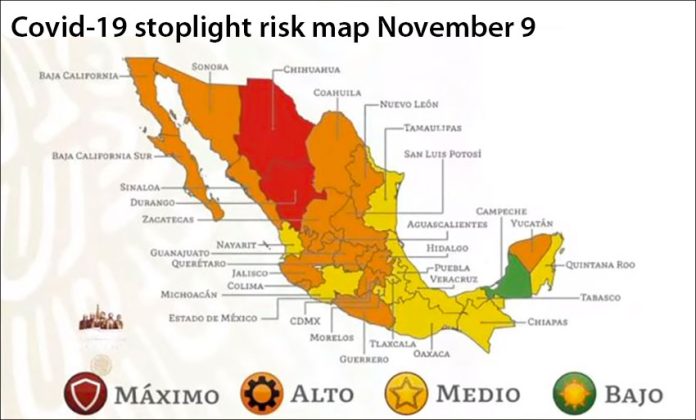
The risk of coronavirus infection has increased in Sonora, Sinaloa and Guanajuato and decreased in Nayarit, Michoacán and Quintana Roo, according to the federal Health Ministry’s latest stoplight system assessment.

The Health Ministry announced Friday that the risk level in the first three states will be raised to orange light “high” from yellow light “medium” on Monday while it will be lowered from orange to yellow in the other three.

Sonora, Sinaloa and Guanajuato will join 15 states that are already orange on the stoplight map and will remain at the same risk level for the next two weeks.

They are Aguascalientes, Baja California, Baja California Sur, Coahuila, Colima, Guerrero, Hidalgo, Jalisco, Mexico City, México state, Nuevo León, Querétaro, San Luis Potosí, Yucatán and Zacatecas.

Nayarit, Michoacán and Quintana Roo will join eight states that are already yellow. They are Chiapas, Morelos, Oaxaca, Puebla, Tabasco, Tamaulipas, Tlaxcala and Veracruz.

Coronavirus cases and deaths in Mexico as reported by day.
Coronavirus cases and deaths in Mexico as reported by day. milenio

There are two red light “maximum” risk states — Chihuahua, which switched to red two weeks ago, and Durango, which regressed to red this week.

Campeche remains the only green light “low” risk state in the country. The risk level in the Gulf coast state was reduced to green in late September and it has seen no changes since.

The Health Ministry uses 10 different indicators to determine the stoplight color allocated to each state including the Covid-19 effective reproduction rate (how many people each infected person infects), the weekly positivity rate (the percentage of Covid-19 tests that come back positive) and hospital occupancy levels.

It also recommends coronavirus restrictions for each risk level but several states ease and tighten rules according to their own criteria rather than that of the federal government.

The Jalisco government last week implemented tighter restrictions for a two-week period although the state’s stoplight system risk level had not changed, while Mexico City Mayor Claudia Sheinbaum announced slightly stricter rules on Friday even though the capital will remain orange next week.

New coronavirus case numbers have recently risen in Jalisco, prompting the government to introduce a curfew on commercial activities, while rising hospitalizations in Mexico City were the main reason behind the introduction of tighter rules there.

Nationwide new case numbers have also risen recently, increasing 26.5% in October compared to September. Last month was the second worst for coronavirus cases in Mexico since the start of the pandemic, with 181,746 new cases – an average of 5,863 per day.

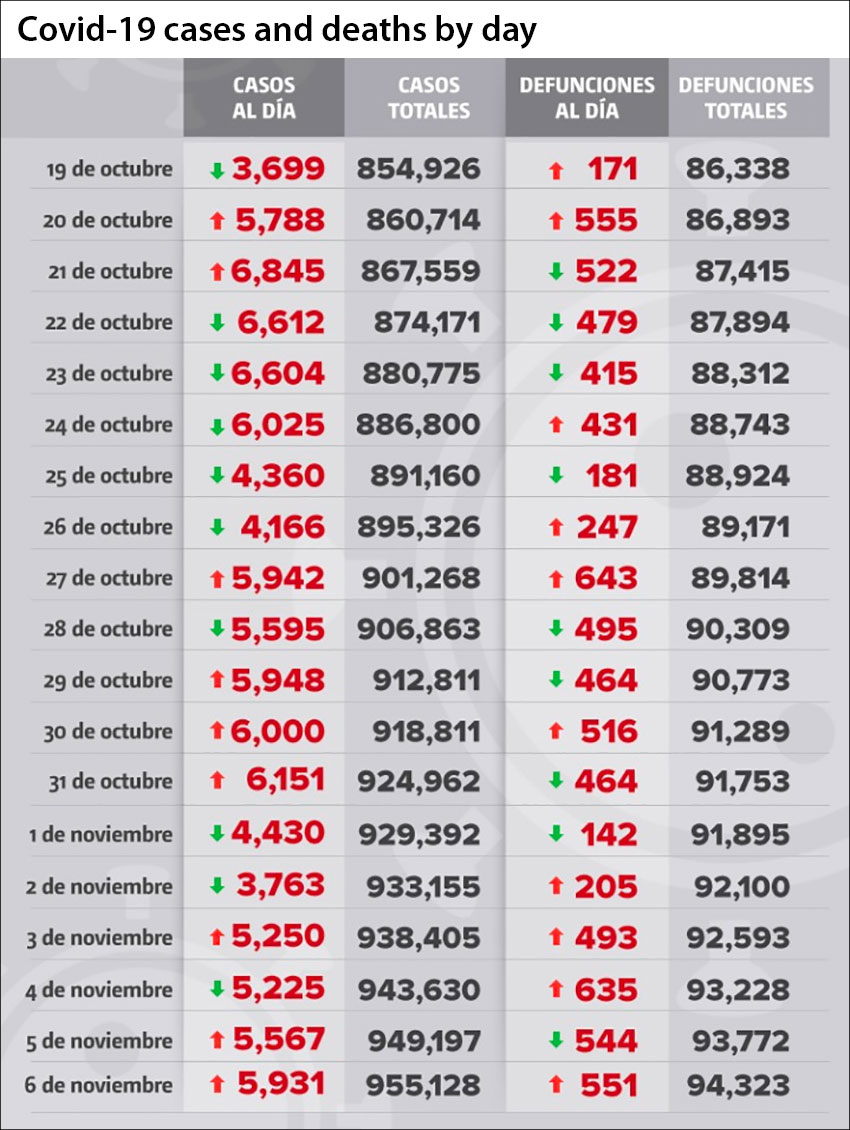
The Health Ministry reported 5,931 new cases on Friday, increasing the accumulated tally to 955,128, and 551 additional Covid-19 fatalities, lifting the official death toll to 94,323.

The ministry estimates that there are currently 48,250 active cases across the country.

Mexico ranks 10th in the world for accumulated cases and fourth for Covid-19 deaths after the United States, Brazil and India, according to data compiled by Johns Hopkins University.

Source: Reforma (sp), Milenio (sp) 

Black beaches and 2,000 turtles: just two of Cuyutlán’s many surprises

0
It's not ideal for sunbathing, but Cuyutlán's beach hosts manta rays and turtles.

So I received a text message during the last week in October: “Richard says Cuyutlán in Colima has the best black-sand beach he’s ever seen and an incredible surf. Want to go?”

Since Richard is a geologist, I figured this was one place I didn’t want to miss.

“I’m in!” I texted back.

I then tried to invite another friend — not a geologist — to join the expedition.

“Why would you want to go to Mexico’s worst beach?” he replied. “Count me out, but if you do go, don’t miss the local ecological center. They’re doing amazing things.”

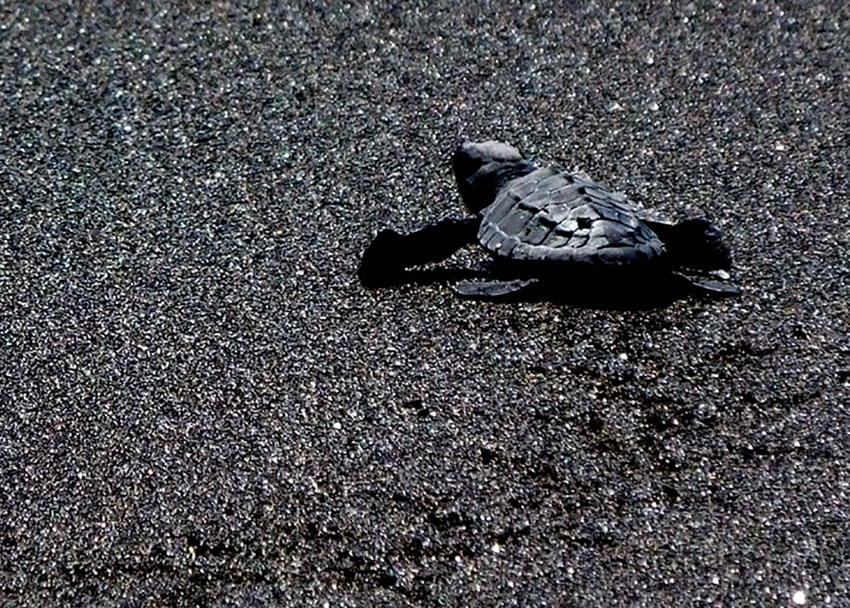
A newly released baby leatherback turtle races across the black sand toward the water in Cuyutlán.

This only piqued my curiosity, so off we drove to Cuyutlán, which lies 200 kilometers southwest of Guadalajara. Three hours later, we arrived, stepped out of the car and gasped.

“Holy cow!” exclaimed my friend Josh, “This town is a sauna!”

The temperature was 34 C with 82% humidity. It felt like we had walked right into the steamiest corner of a Turkish bath.

We wandered about the town, looking for a hotel, figuring that with a beach only a geologist could love, plenty of rooms would be available. Quite the opposite. Only one hotel had vacancies, and it was rather seedy.

Sad to say, the whole town doesn’t look too great, but I was told this is because the coast of Cuyutlán was affected by a powerful earthquake in 2003. Apparently, the town was devastated and simply never recovered. And, indeed, everywhere we looked, we could see the abandoned shells of once-grandiose hotels and spas.

Having secured somewhat smelly rooms in one of those hotels not quite ready for abandonment, we went to check out the beach.

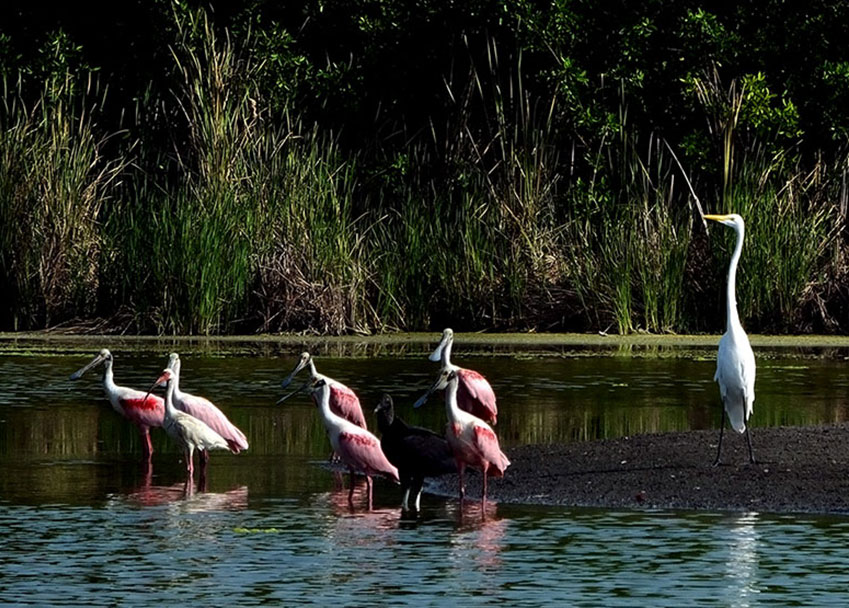
Roseate spoonbills and a great egret are just some of the waterbirds you can encounter wading in the Palo Verde Estuary.

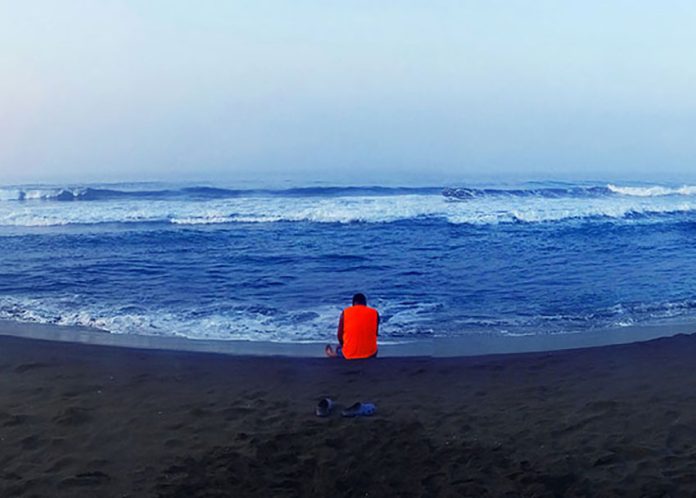
The sand was indeed as black as what you’d find inside a volcanic crater, probably consisting of small particles of basalt. The surf was so high, and the pounding waves so ferocious, that I did not see a single soul in the water the whole time I was there, neither by day nor by night. I had imagined we’d spot a surfer or two out there, actually enjoying those treacherous waves, but perhaps they were all discouraged by the big “Danger! Manta Rays!” signs prominently displayed up and down the beach.

Accepting the fact that we were not going swimming on this trip, we headed the following morning for the turtle sanctuary (tortugario) located just three kilometers southeast of Cuyutlán via an easily drivable road.

At the entrance to Centro Ecológico de Cuyutlán, we came upon the place’s director, Maricruz Rivera. She told us about the center and about El Tortugario, the name of the turtle sanctuary within the center.

[wpgmza id=”264″]

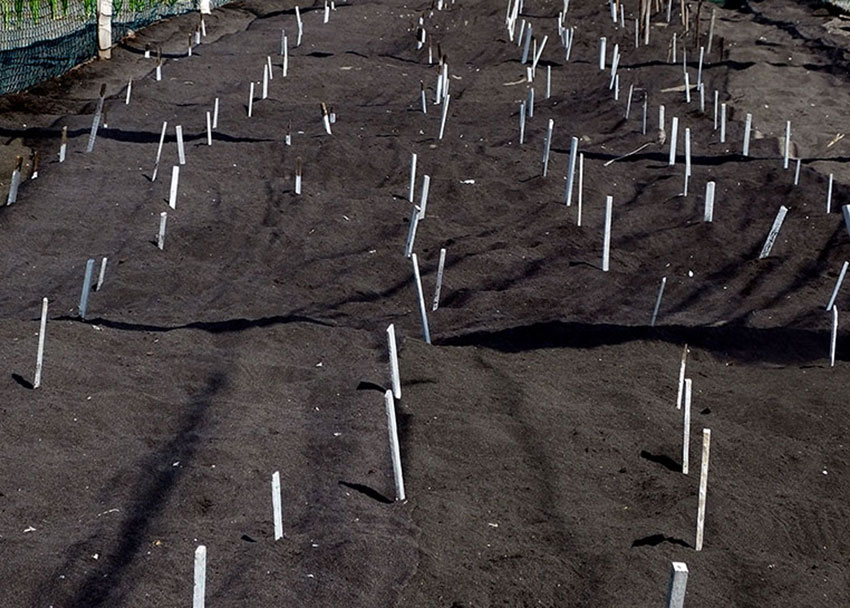
“This is a wildlife management site dedicated to education and research,” she told us. “We feel it’s important that people should not look at us as a tourist attraction. In reality, our center is involved in many wildlife conservation and protection projects. For example, we are responsible for protecting 30 kilometers of Pacific Coast beach. During the period when turtles come to lay their eggs, it’s our job to collect and transfer them to a place where they can incubate in complete safety. On average, 2,000 female turtles make their nests here every year, and this center has been assisting and protecting them for 26 years.”

Rivera told us that the workshops they give, both to students and to the general public, have opened the eyes of locals.

“Knowledge and understanding of these creatures have awakened love and respect for them. Everybody living around here is convinced they have to protect them.”

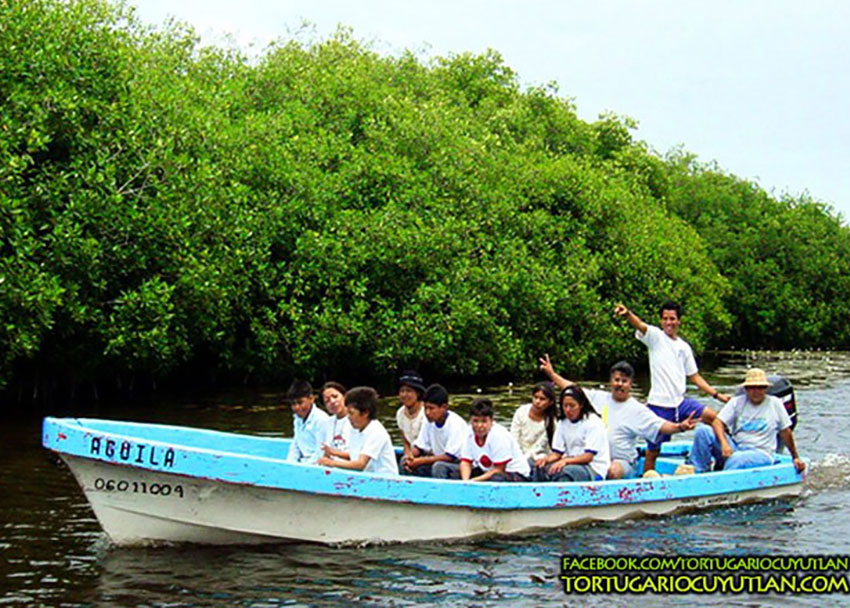
A panga (skiff) ride among the Palo Verde Estuary's mangroves.
A panga (skiff) ride among the Palo Verde Estuary’s mangroves.

The center has a staff of eight biologists to watch over their 30-kilometer stretch of beach. I was surprised to learn that these ecologists receive no outside funding of any kind and that the whole operation depends on the admission fee people pay to visit the place and to go on a boat ride into the estuary right next to the turtle sanctuary.

We immediately signed up for that boat ride.

A few minutes later, we found ourselves seated in a big panga (skiff), silently gliding through a tunnel in a dense forest of mangroves. Suddenly we emerged into the bright Palo Verde Estuary, a favorite place for local fishermen, according to our guide. He told us that the tide sometimes carries big ocean fish into the estuary and leaves them stranded there, where they are dead easy to catch.

The water in the estuary is only about 30 centimeters deep. For an hour, our boatman navigated by following two-meter deep channels that our eyes could not detect.

What our eyes could detect, however, were waterbirds of all kinds — egrets, cormorants, anhingas, great blue herons, ospreys, frigate birds, black-necked stilts, roseate spoonbills, and, of course, crocodiles, some of which were all of four meters long.

During our panga ride we learned that this estuary houses both white and red mangroves. The red ones turned out to be really curious, as their new roots come out of their highest branches and then grow straight downward until they finally reach the water and the thick layer of mud beneath it.

Turtle eggs are transferred from the El Tortugario sanctuary to this protected area for safe incubation. About 2,000 a year are laid on Cuyutlán's Pacific Coast beach.
Turtle eggs are transferred from the El Tortugario sanctuary to this protected area for safe incubation. About 2,000 a year are laid on Cuyutlán’s Pacific Coast beach.

After the boat ride, it was time for a turtle release, which typically takes place on Saturday afternoons. Because visitors to the sanctuary release the baby turtles, this event is very popular with kids.

Three kinds of sea turtles come to lay their eggs on the beaches of Colima: green turtles, olive ridley turtles and leatherbacks. It’s the leatherback sea turtle you’ll be releasing if you visit the Cuyutlán Tortugario. Amazingly, the tiny creature in the basket they give you is destined (if it survives) to grow into the largest species of turtle in the world.

The leatherback sea turtle is so called because it is covered with skin instead of a bony shell. The biggest verified specimen ever found measured over two meters in length and weighed 650 kilos.

At night, newly hatched sea turtles rely on light to find their way to the ocean. In a natural setting they would easily distinguish between the glow over the ocean and the dark silhouette of hills or jungle inland. Today, however, bright streetlamps and hotel lights do great damage to a multitude of species. Perhaps the worst example is how artificial lights along the sea coast lead baby turtles to their deaths.

At the sanctuary, the tiny turtles are released during daylight hours and, thanks to the careful procedures which the releasers must follow, all of them make it into the water, even though the strong surf may throw them back a few times.

Comments Maricruz Rivera, “I’m proud to say that since our founding, we have successfully released over 2 million turtles.”

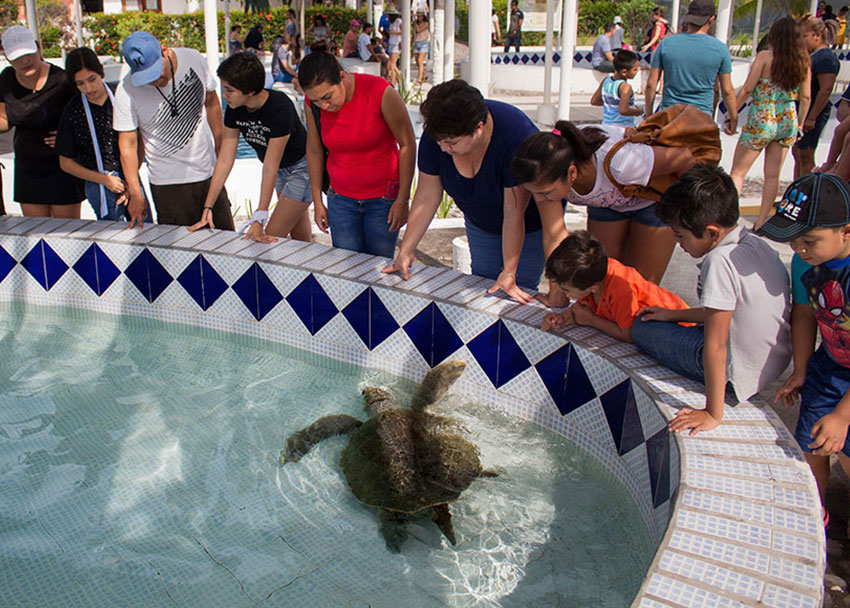
Visitors meet turtles at the Cuyutlán Ecological Center El Tortugario sanctuary.
Visitors meet turtles at the Cuyutlán Ecological Center’s El Tortugario sanctuary.

Following all the proper pandemic protocols, El Tortugario is open daily (except Wednesdays) from 9 a.m. to 5 p.m.

Before leaving Cuyutlán, we stopped to visit its unusual Salt Museum. Long before the Spaniards arrived in the new world, people were producing salt at Cuyutlán. In fact, they are still gathering and selling it to this day.

So there you have it. A non-geologist might detest Cuyutlán’s sizzlingly hot black beach, but there are things to do in this little town. People also tell me that the seafood is great. Just hold off your visit until winter, when it won’t feel like you’re in a sauna.

[soliloquy id="127821"]

The writer has lived near Guadalajara, Jalisco, for 31 years, and is the author of “A Guide to West Mexico’s Guachimontones and Surrounding Area” and co-author of “Outdoors in Western Mexico.” More of his writing can be found on his website.