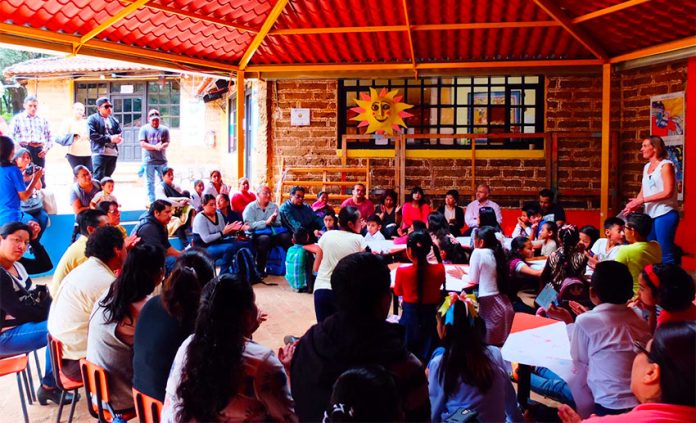
Students and parents begin a new cycle of activities in September 2019.
With only one state at the green level on Mexico’s coronavirus stoplight risk map, there appears to be no clear end in sight to Mexico’s approximately 33 million schoolchildren learning at home virtually via the internet, television, and radio.
However, a small education and vocational training program working with elementary school children in San Cristóbal de las Casas, Chiapas, has brought its students back together this fall for in-person classes, and staff say they see the impact of months of isolation on their students’ emotional well-being.
“They missed being together and working together, and shared with us that they had felt sad during the past months,” said Eleni Asimakopoulos, strategic director for Mundo de Talentos, a nonprofit program that offers children aged 10–13 in San Cristóbal a curriculum to prepare them academically and socioemotionally for higher education and fulfilling careers.
Founded in 2017, Mundo de Talentos educates children on a wide range of topics, including journalism, medicine, law, the arts, science, and entrepreneurship but also presentation, debate, collaboration, and conflict resolution skills. Since returning to hybrid classes in September, students meet on Saturdays with new safety protocols for the in-person classes and also take part in classes on WhatsApp video.
Before September, it had been using WhatsApp video exclusively since Mexico closed its schools in March.
The program is an offshoot of an academic enrichment and careers program for low-income students in the Netherlands, The IMC Weekendschool, founded in 1998. The San Cristóbal program is funded by donations from European and Mexican companies and maintains ties with the Dutch organization. Admission to the San Cristóbal program is free. The program expects to have its first class of graduates in April 2021.
Chiapas is a challenging environment for children to succeed in higher-level careers. According to Mexico’s statistics agency, Inegi, the state has the lowest percentage of school attendance for children 6–14 years old, with 7% not receiving any formal education. On average, residents over 15 have only about seven years of education, equivalent to little more than the first year of middle school. Statewide, more than 80,000 children aged 5–14 work.
In San Cristóbal, according to the children’s rights organization Melel Xojobal, 2,594 children citywide either work or accompany their families to work activities.
“Although the economic situation of families is a major cause of school dropout, another important reason why young people do not study or drop out of school is that they have not received any appropriate guidance on what future options and opportunities exist,” says Asimakopoulos. “We want to focus on supporting children from public schools in San Cristóbal to discover who they want to be.”
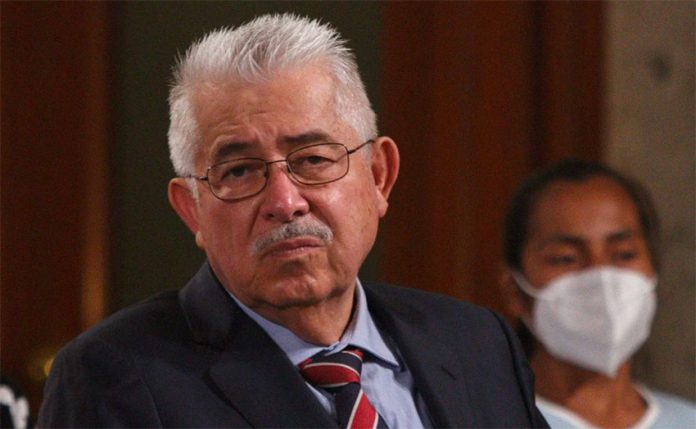
Alejandro Esquer signed contracts with bogus companies.
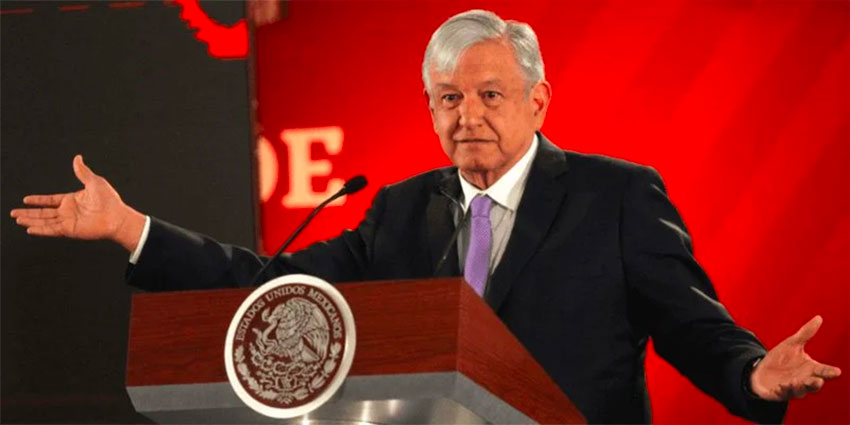
President López Obrador has lashed out at a major newspaper and an anti-corruption organization after they published an exposé detailing suspicious dealings by his personal secretary.
The newspaper El Universal and Mexicans Against Corruption and Impunity (MCCI) published the same report Monday that revealed that Alejandro Esquer Verdugo hired two front companies to provide logistics services and to put up political advertising at campaign events for López Obrador in Puebla for the 2018 presidential election campaign.
At the time Esquer was the finance secretary of the National Executive Committee of Morena, the party that was founded by López Obrador in 2014. He has worked for López Obrador on and off more than two decades.
The two firms Esquer contracted – Ligieri de México and ENEC Estrategia de Negocios y Comercio – were identified by the Federal Tax Administration this year as ghost, or bogus, companies.
The report published by El Universal and MCCI said the contracts signed by Esquer and the companies were available on Morena’s website until a few days ago.
ENEC was dissolved in October 2018, nine months after it signed contracts with Morena and three months after López Obrador won the presidential election. Ligieri de México was dissolved in February 2019.
The National Action Party, currently Mexico’s main opposition party, filed a complaint with the National Electoral Institute in July 2018 alleging that Morena exceeded permitted pre-campaign expenditure limits by paying Ligieri at least 398,000 pesos for each of 15 rallies for which it provided logistics services.
But Morena said that it only paid the company 36,450 pesos for each event at which it set up a stage, installed security barriers and provided a sound system among other services.
The El Universal/MCCI report said that poor people were listed as the owners of Ligieri and ENEC, presumably without their knowledge.
At his regular news conference on Monday, AMLO, as the president is known, said he had no knowledge of the matter but added that he had no problem with it being investigated. He then claimed that the report was part of a “smear campaign” against his government.
The owner of El Universal and Reforma – a newspaper that the president frequently derides as part of the prensa fifi, or elitist press – are “like moral or spiritual leaders of Frenaaa 1 and Frenaaa 2,” López Obrador said.
López Obrador said one of Mexico’s leading newspapers was ‘inspired by corruption.’
López Obrador said the “idol” of Reforma is Carlos Salinas, widely considered one of Mexico’s most corrupt presidents, and claimed that El Universal, which he described as a “dirty” publication, takes inspiration from all corrupt past presidents.
The broadsheet, which describes itself as “the great newspaper of Mexico,” has understood past presidents “very well,” burned incense for them, applauded them and obeyed them but “with us its conduct is not the same,” he said.
The president also took aim at MCCI, charging that it is funded by “powerful businessmen” who don’t pay taxes. He has previously claimed that it has received funding from foreign foundations to oppose the government’s Maya Train railroad project.
The group’s co-founder and former president is Claudio X. González, a businessman and outspoken critic of López Obrador.
AMLO said Monday that MCCI’s funding will be investigated. He claimed last year that the anti-graft group is carrying out a campaign of “sabotage” against his administration.
MCCI responded to the president in a statement, saying that it’s funded by donations that are properly reported to tax authorities.
“MCCI doesn’t operate in opacity,” it said, although it acknowledged that it doesn’t publicly divulge the identity of its donors. The group claimed that López Obrador’s questioning of its funding is designed to “intimidate those who support our work.”
“These actions are one more example of the repeated attempts by the federal government to silence critics, limit freedom of expression and promote polarization,” MCCI said.
MCCI also noted that Claudio X. González hasn’t been its president since July and now has no involvement in the organization.
The group also said that it has no “institutional relationship” with Sí Por México, which González co-founded, but added that “we respect its work.”
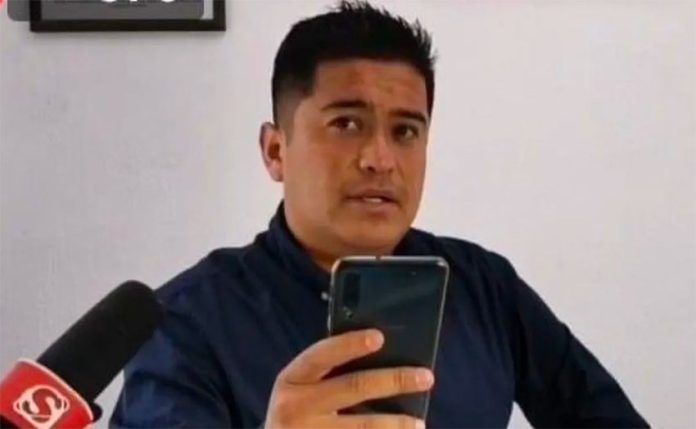
Israel Vázquez was a reporter with a newspaper in Salamanca.
A journalist who arrived before police at a crime scene in Salamanca was killed Monday by the armed men he encountered there.
Israel Vázquez Rangel, 31, a reporter with the digital newspaper El Salmantino, was shot and while attempting to cover the discovery of a body in the Villa Salamanca 400 neighborhood.
His vehicle bore the newspaper’s logo.
According to authorities, Vázquez was preparing to do a live broadcast from the scene when he was shot at least eight times.
When the National Guard arrived, they found him seriously wounded. He was taken by ambulance to a nearby hospital, where he died.
At the scene, the state Attorney General’s Office located several spent ammunition shells.
El Salamantino officials condemned the attack and demanded that local, state, and federal authorities find those responsible. The newspaper issued a statement saying that citizens in Salamanca needed to feel a sense of safety, as did “all the journalists who every day put their lives at risk to do this noble work.”
In a press release, the state Attorney General’s Office said that it had already assigned its specialized homicide unit to investigate the case.
Governor Diego Sinhue Rodríguez Vallejo and the Salamanca council both made statements condemning Vázquez’s killing and calling upon authorities to act swiftly.
“We expect a prompt resolution of the case by the attorney general,” Sinhue said Monday on his Twitter account.
Guanajuato has a state government body that is supposed to address threats and acts of violence against journalists, known as the State Council for Protection of the Human Rights of Activists and Journalists. Soon after the killing was made public, the council issued a statement saying that while it has addressed 30 reports of aggression by journalists in the state since 2018, the killing of a journalist in Guanajuato was unusual.
“We vow that these sorts of incidents will not happen again in Guanajuato. We call upon the authorities to go hand-in-hand with us to end this scourge, this lack of safety, that afflicts Guanajuato,” they said.
Water released from a dam in Chiapas after heavy rains in recent days continued to cause severe flooding in parts of Villahermosa, Tabasco.
The Grijalva River burst its banks in the Tabasco capital after large amounts of water were released from the Peñitas dam, located in a northwestern Chiapas municipality that borders the Gulf coast state.
Poor neighborhoods in the south of Villahermosa, where rain hasn’t fallen since Friday night, bore the brunt of the flooding on Monday.
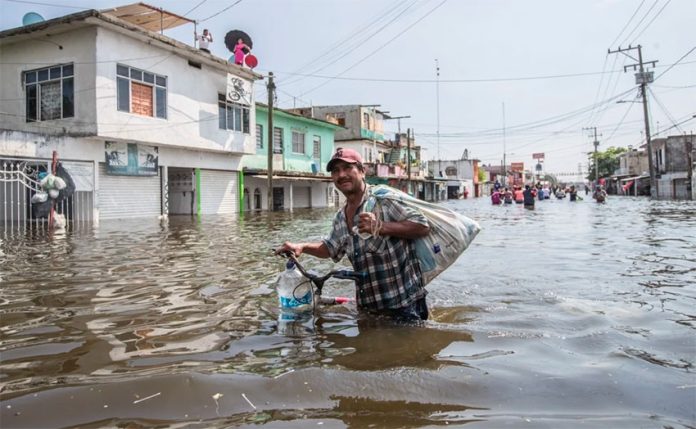
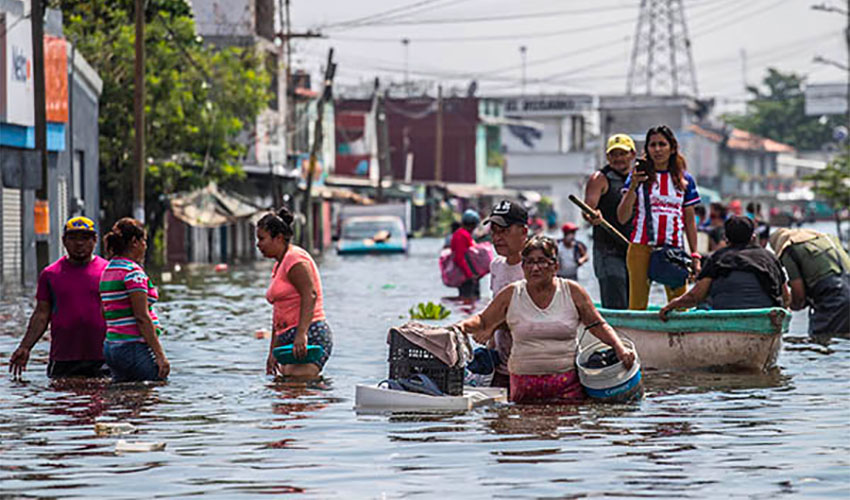
Many residents were forced to take shelter on the second floors or roofs of their homes, while others fled on boats with their pets and a few possessions. Some people waded through the floodwaters to reach safe – and dry – ground.
The Gaviotas Sur neighborhood, which is located near the Grijalva River, was especially hard hit. Many of those affected by the flooding blamed the Federal Electricity Commission (CFE) for the flooding, accusing the state-owned company of mismanaging the release of water from the Peñitas dam.
Tabasco Governor Adán Augusto López Hernández warned last week that the CFE would be responsible for any flooding caused by an increase in the release of water from the dam after it lobbied the National Committee of Large Dams to do so.
He said Saturday night that 1,300 cubic meters per second were being released from the dam and that the Grijalva had burst its banks near Villahermosa’s riverside promenade.
José Luis Arias, one of many Villahermosa residents affected by the flooding, told the newspaper Reforma that he had heard that water levels were continuing to rise due to the ongoing release of water from the dam, which was inundated with rain brought by two cold fronts and Tropical Storm Eta.
“It hasn’t rained much here but as they’re opening up the dam we’re having these floods,” he said.
Some residents complained that they haven’t received any assistance from authorities despite the dire situation, saying that the army is concentrating its efforts on stopping flooding in the center of Villahermosa.
“The president and the government don’t do anything for us,” said one man as he helped a woman sick with kidney problems navigate the dirty floodwaters.
A flooded street in the Tabasco capital.
“To save the center of Villahermosa, they [allowed us] to be flooded here,” said Diana Vázquez, a resident of Gaviotas Sur.
Indeed, Governor López said Monday that there was no risk of flooding in the downtown area of the state capital, explaining that water that inundated the nearby riverside promenade had been controlled.
The army, state authorities and civil society organizations sandbagged the promenade wall to prevent further flooding.
“Of course we have to be alert but at the moment the situation at the city promenade is controlled,” López said after inspecting their work.
Flooding has affected 10 of 17 municipalities in Tabasco in recent days, damaging about 60,000 homes and affecting more than 140,000 people.
Flooding in Macuspana, located southeast of Villahermosa, was the worst in at least 50 years, according to local residents.
Tabasco Civil Protection chief Jorge Mier said Monday that six people had drowned in floodwaters in the state including a 6-year-old boy.
Six police officers are under investigation after they opened fire at a protest in Cancún, Quintana Roo, on Monday, wounding at least two people.
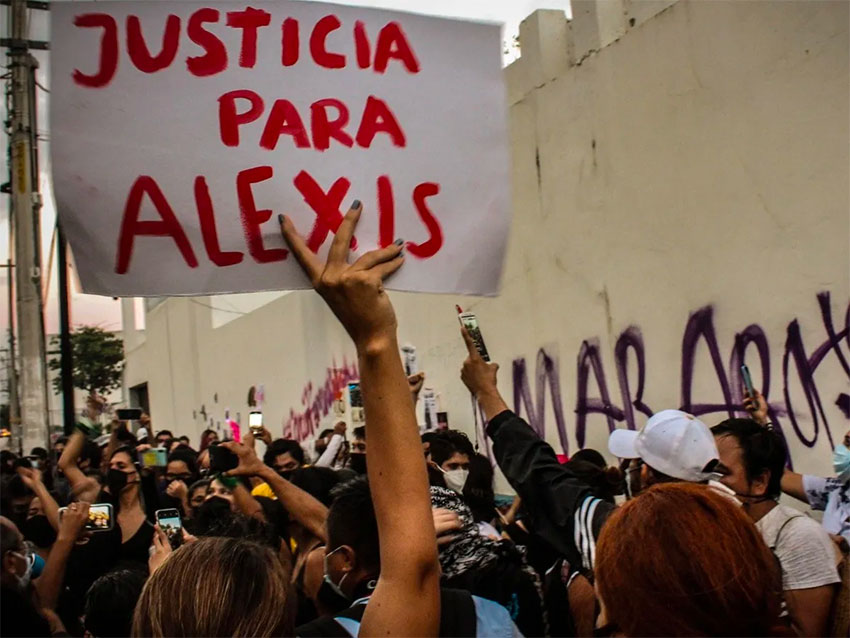
A group of approximately 500 people, mainly women, had gathered outside the municipal palace to protest the femicide of 20-year-old Blanca Alejandrina Lorenzana Alvarado, whose body was found Sunday, a day after she disappeared in Cancún.
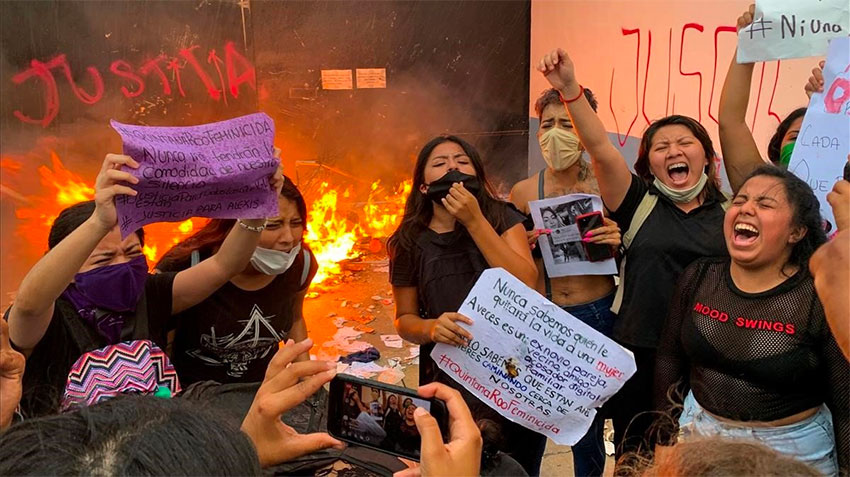
Some radical demonstrators were attempting to break into the municipal palace and setting fire to wooden boards that protected its facade when municipal police used tear gas and fired weapons into the air and at the ground to disperse them.
About 20 gunshots can be heard in video footage of the incident.
According to media reports, two journalists were wounded by gunshots, two others were allegedly beaten by police and some protesters were injured during the panicked rush to flee the gunfire.
Women in Cancún protest the weekend murder of Blanca Alejandrina Lorenzana.
There were preliminary reports that the police officers – members of a single-command Quintana Roo police force – used rubber bullets against the protesters but a women’s collective said that wasn’t the case.
“Don’t let the media and/or the government deceive you. It’s been circulating that they shot rubber bullets at our colleagues at the municipal palace. Several of them are wounded because the bullets weren’t rubber, they were real. There are several girls and women wounded,” the collective Furias Violetas said in a Facebook post.
The group also said that several protesters had been detained by police, including a young girl.
The mayor of Benito Juárez, the municipality where Cancún is located, said in an interview that she had been told that casings of real bullets were found at the scene but added that she hadn’t corroborated the information.
Mara Lezama rejected any suggestion that she ordered the aggression against the protesters, asserting that police in Cancún belong to the single-command force and receive their instructions from the state government.
“In no way did I order … repression of this nature,” she said.
In an interview with Milenio Television, Quintana Roo Police Chief Alberto Capella described the use of force against the protesters as stupid.
“It’s unacceptable, an enormous act of stupidity that violates the protocols of service and the use of force,” he said.
Capella, who was not in Quintana Roo when the incident occurred, said there was evidence that six police officers had panicked and fired their weapons because they believed the municipal palace was being set on fire and there were people inside.
However, the police chief said he couldn’t rule out the possibility that the actions of the police were motivated by their opposition to the enforcement of discipline measures in the single-command force. The use of force might have been an attempt to destabilize the police force and its security strategy, Capella said.
“I have a hypothesis that they did it with the intention of destabilizing the security efforts that are being made in the state,” he said.
The police that committed “this barbarity” could be “the same police who don’t agree with the discipline policy,” Capella said.
Protesters called for ‘Justice for Alexis’ in Cancún protest.
“We’re not just annoyed but extremely ashamed because it’s not possible to understand it [the aggression], let alone explain it,” he said.
The police chief said he didn’t know how he could explain to Quintana Roo Governor Carlos Joaquín why the offending police officers, “who shouldn’t have been armed,” were not being closely supervised, adding that his resignation was a possibility.
“Resignation always has to be on the table. We take complex decisions every day and an absence of supervision that resulted in such an unfortunate and regrettable situation [is unacceptable],” Capella said.
Governor Joaquín condemned the use of force and asserted that he didn’t order it.
“I condemn the acts of violence that occurred in Cancún tonight. I completely condemn the intimidation and aggression against the protesters. I gave precise instructions of NO aggression and NO weapons in the marches,” he wrote on Twitter.
“I will investigate the irresponsible person who gave different instructions to these and which have caused this complicated situation for Quintana Roo society. I will act firmly so that the law is applied against those who committed this aggression.”
The state Attorney General’s Office contradicted the women’s collective’s claim that protesters had been arrested, saying that no one was detained during or after protests in Cancún and other Quintana Roo cities.
The federal Interior Ministry demanded that state and municipal authorities conduct an investigation into the “repression and armed aggression” against the “feminist protest.”
“As the [department] responsible for the country’s domestic policy with respect to human rights and the defense of freedom of expression, the ministry will be attentive to the course of the case.”
President López Obrador condemned the violence at his morning news conference on Tuesday and called for “rapid justice.”
“An investigation has to be carried out, … the guilty have to be punished, it’s clear that force mustn’t be used. Weapons mustn’t be used, … this has to do with authoritarian attitudes,” he said.
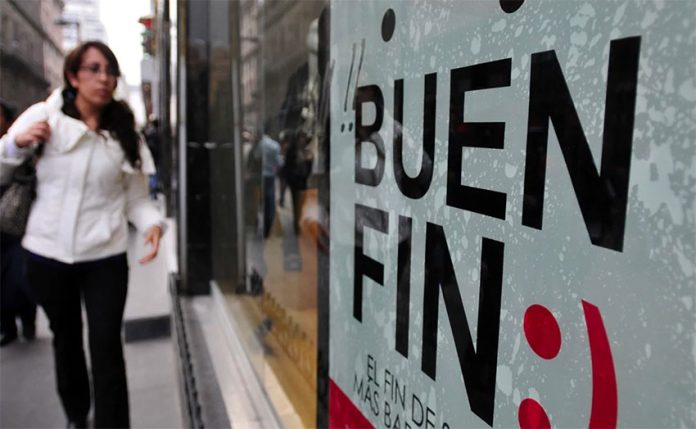
Sales at the shopping event Buen Fin — Mexico’s Black Friday — are expected to almost match those of 2019 despite the coronavirus pandemic and its impact on many people’s earnings.
The federal government and the private sector anticipate total sales of 117 billion pesos (US $5.75 billion), which would be just 3 billion pesos shy of last year’s total.
They are hopeful that the event, which started Monday and will run though November 20, will give a much-needed boost to the ailing economy.
A large part of this year’s discounted Buen Fin purchases are predicted to be made online but bricks and mortar stores across Mexico are gearing up for increased customer numbers during the 12-day event.
The fact that this year’s Buen Fin will run three times longer than last year’s is a major reason why sales are expected to come close to 2019 levels despite the coronavirus-induced economic downturn.
Participating retailers will be required to follow strict health measures, said Economy Minister Graciela Márquez and the Confederation of Chambers of Commerce, Services and Tourism (Concanaco).
Shoppers must wear face masks and will undergo temperature checks before being allowed to enter a store. They will be given antibacterial gel for their hands and will have to step on shoe sanitizing mats on their way into commercial establishments.
Stores must limit capacity to 30% of their normal levels and ensure that shoppers keep a “healthy distance” from each other.
Concanaco president José Manuel López Campos said that store managers have completed online courses in order to become au fait with the required health measures.
He said that business owners, employees and customers all have a responsibility to follow the rules and reduce the possibility of new coronavirus infections during the Buen Fin event.
While sales are expected to be strong, an academic at the Universidad del Valle de México said that many people will be unable to take advantage of the discounts and promotions on offer.
Myrna Guadalupe Martínez Lucio pointed out that many workers have had their salaries cut or hours reduced due to the pandemic while others lost their jobs and incomes completely.
Many people’s purchasing power has been reduced, she said. As a result they are unlikely to go shopping for nonessential items even though they might be able to obtain them at bargain prices.
The president of the Mexican Association of Travel Agencies was more optimistic, noting that consumers will be able to pay back some purchases interest-free over a period of 40 months while getting double or triple reward points from their banks.
“It’s an enormous opportunity,” said Eduardo Paniagua.
The 2020 Buen Fin is the 10th edition of the annual shopping event. Sales last year were three times higher than during the inaugural event in 2011 when shoppers spent 40 billion pesos.
If sales this year don’t exceed those of 2019 it will be the first time in the event’s history that revenue has declined from one year to the next.
Arroz con leche can be made quickly with leftover rice, but many swear using freshly cooked rice makes it come out much better.
In Mexico, arroz con leche is a longstanding traditional dessert, and there are as many ways to make it as there are grandmothers willing to share their recipe.
While it’s a simple enough dish, there are secrets to success that involve the ingredients, cooking methods and level of patience (ahem). Traditionally arroz con leche, or rice pudding, is made by slowly, slowly cooking rice in sweetened whole milk until the rice is soft and the milk has thickened. Cinnamon, vanilla and sometimes nutmeg can be added before serving.
Some people like an arroz con leche that’s more soupy; others prefer it firm. That’s just a matter of cooking time, the ratio of rice to milk and, to some degree, about the type of rice you’re using.
What’s the best kind of rice to use? Some say long-grain rice is best, some swear by short-grain for a creamier result. Some believe in arborio rice. Quien sabe? But don’t use “Minute Rice” or any kind of arroz precocido (precooked rice); it defeats the purpose of the rice starch cooking into the pudding.
Sugar is the time-honored sweetener, and for good reason: using granulated sugar or piloncillo (unrefined whole cane sugar) helps the milk caramelize as it cooks down, creating a complex depth of flavor.
Rice, milk, cinnamon, and sugar are the basics for making Mexican arroz con leche, but the delicious flavor variations are nearly endless.
But time-saving versions in some recipes use sweetened condensed milk instead of sugar, and/or use leftover or precooked rice rather than cooking it slowly in the milk. Can you do this? Sure. Will it taste the same? Well, I don’t think so, although I’ll still happily eat it at my favorite taco stand.
Rice pudding is a favorite all over the world, where it’s called by different names and baked, boiled and simmered in a variety of ways. Legend tells us a big bowl of kheer was the Buddha’s final meal before his enlightenment. In Chinese cuisine we find ba bao fan, made with eight kinds of fruits or nuts and eaten at the New Year. The Lebanese serve meghli to celebrate the birth of a child.
The Philippines’ tsamporado, a chocolate rice pudding, traces its history to early trade with Mexico; innovative Filipino cooks revised the Mexican champurrado by substituting sticky rice for masa.
If you’re going to make arroz con leche at home, I’ve included different versions of the traditional recipe. You be the judge, and see what you think.
If you’re a dairy-free person, other types of milk may work, albeit with slightly different final textures.
First, let’s start with a video of YouTuber Doña Angelita making her very traditional arroz con leche over a wood fire. The written recipe follows.
Arroz con Leche De Mi Rancho A Tu Cocina
Doña Angelita’sArroz con Leche
5 liters whole milk
½ kilo rice, washed
1 big cinnamon stick
5 small piloncillo cones
½ cup white sugar
1 cup raisins
Put 1 liter of the milk, plus the rice and the cinnamon stick in a large pot. Cook uncovered until rice is soft.
Add the remaining milk, piloncillo, sugar and raisins. Cook, stirring constantly to make sure it doesn’t burn or stick to the bottom, for about 30 minutes or until thickened.
Kind-of Classic Rice Pudding
¾ cup uncooked white rice
2 cups whole milk, divided
⅓ cup white sugar
¼ tsp. salt
1 egg, whisked
⅔ cup golden raisins
½ tsp. vanilla extract
Bring 1½ cups water to a boil in a saucepan; stir rice into boiling water. Reduce heat to low, cover, and simmer for 20 minutes. Set aside.
In a different pan, combine 1½ cups of the cooked rice, 1½ cups milk, the sugar and the salt. Cook over medium heat until thick and creamy, 20–30 minutes.
Stir in remaining ½ cup milk, the egg and the raisins. Cook 2 minutes more, stirring constantly. Remove from heat, stir in vanilla and let cool.
Old-Fashioned Arroz con Leche
1 cup uncooked rice
2 cinnamon sticks
¼ tsp. salt
2½ cups water
4 cups whole milk
1 cup sugar
In large pot over high heat, combine water, rice, cinnamon sticks and salt. Bring to a boil, cover and reduce heat to simmer. Cook 15 minutes.
Add milk, stir, cover and cook on low for another 15 minutes, stirring occasionally. Stir in sugar, cover and cook for 10 minutes, stirring occasionally.
Uncover, raise heat to medium and cook for 5 minutes until pudding thickens. Remove from heat and cool.
A bit of coconut milk in place of some of the milk in chocolate arroz con leche makes for an unexpected hint of the tropics.
Chocolate Rice Pudding
5 cups whole milk OR substitute 1 can unsweetened coconut milk for some of the milk
⅔ cup uncooked arborio or other short-grain rice
¾ cup sugar
1 vanilla bean, split lengthwise
1 Tbsp. unsweetened cocoa powder
1 cup semisweet chocolate chips
In a heavy medium saucepan, combine milk, rice and sugar. Scrape vanilla bean seeds into mixture. Bring milk to a boil, stirring occasionally.
Reduce heat to medium-low and simmer, stirring frequently, until rice is tender and mixture thickens, 35–40 minutes.
Remove from heat. Stir in cocoa powder. Add chocolate chips and stir until melted. Allow to cool 10 minutes, stirring occasionally. Spoon into serving bowls, cover and refrigerate.
Cajeta Arroz Con Leche
1 cup uncooked rice
3½ cups whole milk
½ cup sweetened condensed milk
¾ cup cajeta, divided
½ tsp ground cinnamon, plus more for garnishing
1 tsp. vanilla extract
In heavy-bottomed saucepan, cook rice as you normally would or use leftover rice. In separate pan, combine milk, sweetened condensed milk and ½ cup of cajeta. Bring to boil over medium-high heat. Stir into cooked rice.
Cook uncovered over low heat for 8–10 minutes, stirring frequently and scraping bottom to prevent sticking, until thick and creamy. Stir in cinnamon and vanilla. Spoon into serving bowls and refrigerate. Drizzle with cajeta before serving.
Janet Blaser has been a writer, editor and storyteller her entire life and feels fortunate to be able to write about great food, amazing places, fascinating people and unique events. Her first book, Why We Left: An Anthology of American Women Expats, is available on Amazon. Contact Janet or read her blog at whyweleftamerica.com.
The Michoacán town of Tlalpujahua refuses to let Covid-19 ruin its Christmas spirit: artisans here are preparing to go ahead with a 50-plus year tradition — the Tlalpujahua Ornament Fair, which begins December 13.
The fair, well-known throughout Mexico, will operate with some major restrictions: the usual capacity will be reduced by 50% and senior citizens and children will not be allowed to enter. There will be the usual temperature checks and distribution of hand sanitizer and social distancing rules will be in place.
In addition, to avoid overcrowded conditions, the 300 artisans expected to participate will only be allowed to set up shop on alternating days, meaning no more than 150 artisans will be on hand a time.
It’s a bit of a blow for the Magical Town that is known the “town of eternal Christmas.” But the more than 400 artisan workshops that make their living manufacturing blown-glass Christmas ornaments here are betting on visitors being willing to put up with the inconveniences to get a much-needed dose of the holiday spirit.
It’s a high-stakes bet: ornaments are big, big business here. Between year-round sales and the revenue generated in town from the annual event, Tlalpujahua artisans, directly and indirectly, represent about 60% of the town’s economy, or 180 million pesos annually. In some way or another, nearly all the town’s 27,000-plus inhabitants earn money from the industry — as craftsmen, factory workers, tourism providers, and suppliers and vendors.
[wpgmza id=”123″]
Christmas tree ornaments in Mexico go back probably to the late 1800s, when Queen Victoria made them a fad in Europe. Mexico already had Christmas trees, thanks to their introduction in the 1860s by Emperor Maximilian and his wife Carlota, who brought what is believed to be the first Christmas tree to Mexico from Europe and displayed it in Chapultepec Castle, likely using small candles, not ornaments.
However, even after the royal couple was ousted, wealthy families who copied their example kept the Christmas tree tradition alive and likely began importing ornaments as they became popular abroad.
The Christmas ornaments industry came to Tlalpujahua, located about three hours from Mexico City, in 1960. Resident Joaquín Muñoz and his wife María Elena Ruíz had learned the technique for glass-blowing Christmas ornaments while in the United States and brought the knowledge back to their town with them.
Muñoz went into the ornaments business and soon had 1,500 people working for him producing 15 million ornaments per season.
Over time, Muñoz’s workshop expanded, becoming an even larger source of local employment. The factory added a “Santa’s House” and, as of last year, a Bavarian-style Christmas village which, among other things, features craftspeople publicly making Christmas decorations and minstrels that dance and sing Christmas carols.
These days, the Muñoz workshop is run by the family’s 10 children, who say their parents trained many of Mexico’s renowned glass artisans, people like Javier Vidal Ramírez, 43, an expert in the technique who has spent the last 20 years working in the Muñoz workshop after learning the craft from Joaquín. He calls his work “the most beautiful job in the world,” and says that from boyhood he wanted to learn how to make ornaments, having grown up in Tlalpujahua, surrounded by the Muñoz workshop’s creations.
Joaquín’s son Alfredo Muñoz says he and his brothers attend international conventions each year to learn how to update their technology and innovate their designs. It’s a dedication to their craft that has paid off: Muñoz family ornaments have been on trees in the Sistine Chapel in Vatican City, and in the United States in the White House.
Two cartels have issued a threat to the governor of San Luis Potosí, warning that his government should cooperate because they plan to “seize the entire state.”
The Gulf Cartel and the Cartel de los Alemanes made the threat to Governor Juan Manuel Carreras in a video that has been widely shared on social media.
Surrounded by four armed and masked men, a suspected cartel member reads out a message to the Institutional Revolutionary Party governor.
“Governor Juan Manuel Carreras López, San Luis Potosí will burn in the last year of your six-year term.”
(The final year of Carrera’s term began in late September.)
“We recommend that you speak with your narco-government and tell your security chiefs that they can negotiate the state’s peace with us.”
The masked orator then told Carreras that if his government reaches a deal with the two allied cartels, current officials won’t have to go into hiding when they leave office next year.
“If you don’t help us, don’t get in our way because we’re coming with all the support of the Vaquero [the Cowboy] to seize the entire state. Stop screwing around. Yours sincerely, Cartel de los Alemanes and the Gulf Cartel,” he said.
The Vaquero is believed to be Evaristo Cruz, the suspected leader of the Gulf Cartel in Tamaulipas. He is wanted in both Mexico and the United States.
Earlier in the video, the orator announced that the Gulf Cartel and the Cartel de los Alemanes were now in the Huasteca region of San Luis Potosí “cleansing the towns” of undesirable elements so that “everything is in order.”
He told local residents to not be alarmed if they see cartel members “working” because they have no problems with them.
However, the speaker issued a threat to Huasteca region state police chief Samuel Ruiz Montealvo, telling him that he will pay with his life if he and his officers cause problems for the cartels.
“It’s better that you align [yourself with us]” or ask the San Luis Potosí security minister for a transfer, he said.
Just before he made that remark, one of the armed cartel thugs points the barrel of his gun directly at the camera.
The cartel mouthpiece also issued a threat to army Colonel Rolando Solano Rivera, telling him that if he continues sending “intelligence” people to the Altiplano region, “we’ll disappear” them.
“We’ve already located the assholes,” he said, adding that the cartels haven’t forgotten a clash with the army in the municipality of Charcas in late October in which one Gulf Cartel member was killed, two were arrested and weapons were seized.
The orator also told Solano that not all soldiers are “faithful to the homeland,” implying that some are in cahoots with cartels.
The video is the second in recent months from the two gangs. In August, a man who identified himself as cartel leader Alfredo Alemán issued threats to San Luis Potosí police director José Guadalupe Castillo Celestino and Security Minister Jaime Ernesto Pineda Arteaga.
The Gulf Cartel, one of Mexico’s oldest organized crime groups that remains active today, operates in at least 19 municipalities in San Luis Potosí, according to navy reports.
The Cartel de los Alemanes, an offshoot of the Zetas cartel, is a new criminal organization that announced its existence earlier this year.
US president-elect Biden favors the development of renewable energy but his Mexican counterpart is betting on fossil fuels.
As scientists and environmentalists — one mexicano, one estadounidense — we believe that the 46th United States president, Joseph Biden, will fulfill his campaign promises of placing environmental protection and climate change at the center of his administration’s agenda.
And we look forward to President Biden and Vice President Kamala Harris exercising a respectful cooperation and leadership with other nations — a leadership founded on true multilateralism. Tens of millions of Americans who gave them their vote expect nothing less, and the billions of people around the world cheering the election win will accept no less.
The U.S. and Mexico share a border of 3,000 kilometers, extending through some of the world’s most magnificent landscapes. From the banks of the Rio Grande, across the vibrant-with-life deserts of Sonora and Chihuahua bordering Texas and Arizona, to the Colorado River and Sea of Cortés, through breadbaskets of Arizona and California, to the Pacific Ocean — where the mighty gray whales have migrated for millennia between Alaska and Baja California to connect our two geographies.
And crossing the border through blue skies are millions of tiny, orange-and-black monarch butterflies weighing only half a gram but linking the hopes and aspirations of millions of U.S. and Mexican citizens through their annual migrations.
We are convinced that, despite past misgivings and sometimes mutual mistrust, for the most part the peoples of the two nations love and respect each other. Not only because we share landscapes and iconic species, but also because we depend on each other to culturally and economically thrive as neighbor nations.
It is in this context that we believe the next four years offer Presidents Biden and López Obrador an exceptional opportunity to boost an important binational alliance, one that helps tackle two of our most pressing environmental challenges: global warming and the loss of biodiversity. It is a unique moment in time for our nations to make history together.
For four years, Donald Trump led an unprecedented offensive to weaken scientific institutions and malign science and scientists. He degraded the Environmental Protection Agency and used it to undermine regulations on protected areas, wetlands, fisheries, and endangered species. His administration dismantled most public policies and institutional foundations needed to curb global warming and protect the environment and people, and he rolled back regulations for carbon dioxide emissions, toxic chemicals, food safety, and air and water pollution.
He even stopped payments to the Green Climate Fund – a UN program to assist developing countries in reducing carbon emissions.
But he might be most remembered as the builder of an infamous “wall” — a wall that offended all Mexicans and most estadounidenses, fragmented ancestral indigenous lands and some of the most mind-boggling landscapes on Earth; a wall that crippled hundreds of North America’s wild migratory species from the Pacific to the Gulf of Mexico.
But now comes the time for reconstruction, a time for healing and renewed partnership between our two countries. There are countless areas in which we can work together to improve our tightly linked societies and landscapes — such as immigration, trade, drug trafficking and gun smuggling, climate change, and biodiversity protection. As environmentalists, we herein focus on the last two.
The U.S. is the world’s second largest greenhouse gas emitter, while Mexico is the world’s 12th (and the largest in Latin America). Although fossil fuels still dominate the energy mix in the U.S., renewable energies are growing quickly. President Biden is expected to step up policies and efforts to fulfill his promise to invest nearly $2 trillion in infrastructure spending, focused mostly on renewable energy, as an opportunity to reestablish the U.S. as a global economic, environmental, and political leader. He wants to put the U.S. on an irreversible path to achieve net-zero carbon emissions by no later than 2050; an easily achievable goal that can also boost the economy.
Mexico’s López Obrador has favored fossil fuels over renewables.
On the other hand, President Lopez Obrador’s administration is betting on expanding Mexico’s fossil fuels capabilities, such as new oil refineries and boosting carbon production and use. This likely means the country would not fulfill its goal in the Paris Agreement to reduce emissions by 22% by 2030.
We believe there is ample room for the U.S. and Mexican governments to work in tandem for a renewed push in both the Paris Agreement and the Green Climate Fund, which are the most important current international agreements for tackling climate change. And there is also opportunity for President Biden to try to convince President López Obrador that the era of fossil fuels is rapidly coming to an end, and that renewable energies would not only reduce electricity prices to the people, but also create hundreds of thousands of new jobs across both countries.
Mexico and the U.S. are two of the world’s most biodiverse countries. They share a unique array of habitats and species, including 450 species listed under the Convention on the International Trade in Endangered Species (CITES) and over 100 species on the U.S. Endangered Species list. These species include many migratory mammals and birds, as well as native fish, amphibians, reptiles, and insects.
The U.S. national parks and Mexico’s protected areas system are both exemplars for the world. For decades, the two countries have invested billions to strengthen those protected areas, which have proven to be the best strategies yet to protect ecosystems, indigenous lands, and the associated environmental services on which the health and wellbeing of 335 million Americans and 130 million Mexicans depend.
This December, as the third year of President López Obrador’s administration begins, we hope he gives the environment the priority it deserves for the remaining four years of his mandate. And President Biden must join the other 196 countries in the world by signing on to the pivotal Convention on Biological Diversity and help protect planet Earth for this and future generations.
Presidents López Obrador and Biden — and all mexicanos and estadounideses — must seize the moment to work closely on those issues that bind us, not those that separate us. We cannot think of a better cause for our two nations to partner on than protecting our precious shared environment.
Omar Vidal, a scientist, was a university professor in Mexico, is a former senior officer at the UN Environment Program, and former director-general of the World Wildlife Fund–Mexico.
Richard C. Brusca is a research scientist at the University of Arizona, former executive director of the Arizona-Sonora Desert Museum, and author of over 200 research articles and 20 books.