Home Blog Page 1443

Protesters continue to occupy human rights office; director says she’s a victim too

0
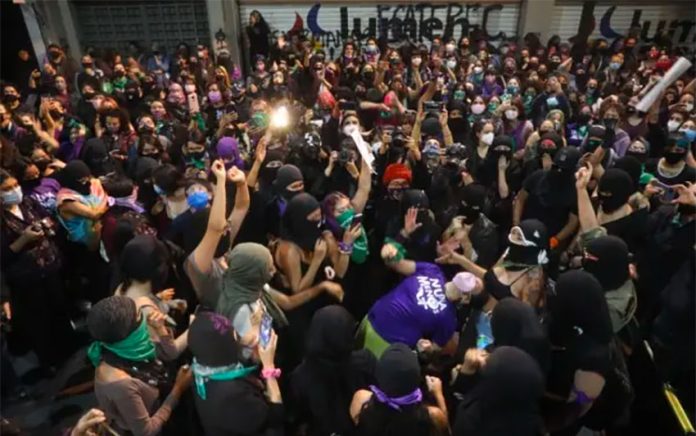
Monday's 'anti-grita' at Human Rights Commission headquarters.

Feminist activists who continue to occupy the Mexico City headquarters of the National Human Rights Commission (CNDH) after seizing the premises earlier this month held a boisterous event on Monday at which they burned a piñata of President López Obrador.

The so-called antigrita or anti-cry event was held outside the CNDH headquarters a day before Independence Day celebrations kick off with the commemorative Grito de Dolores (Cry of Dolores), a reenactment of the original shout for independence by Catholic priest Miguel Hidalgo in 1810.

“The country does not represent us,” women shouted late Monday night after denouncing gender violence and calling for justice with their anti-cry.

The event, which also featured live music, dancing and cultural activities, came 10 days after the CNDH headquarters in the historic center of Mexico City was taken over by a feminist collective and turned into a shelter for victims of gender-based violence.

According to the newspaper La Jornada, about 300 women attended Monday’s event, which began in the late afternoon and concluded after the antigrita at 11:00 p.m.

“We’re bad, we can be worse, … whoever doesn’t like it can get screwed,” the activists chanted.

Photographs published on social media and news websites showed a stocky piñata of López Obrador with a bulbous head being burned as hundreds of activists looked on and cheered. A painting of Miguel Hidalgo that was removed from the CNDH premises was also destroyed.

“This is a fucking painting, it’s not worth more than a life,” said Bertha Nava, whose son was one of 43 students who was abducted and presumably killed in Guerrero in September 2014. Nava claimed last week that the president appeared more concerned about damage to the painting than the cause for which the women were protesting.

Other family members of people who have disappeared in Guerrero were also in attendance at Monday’s event.

“We’re fed up, tired of the government and the authorities mocking our pain. My father disappeared two years ago, they don’t understand our pain,” a woman identified only as Flavia told the newspaper El Universal.

Prior to the event, the CNDH issued a statement that said that it has sought dialogue with the activists with a view to retaking possession of its premises.
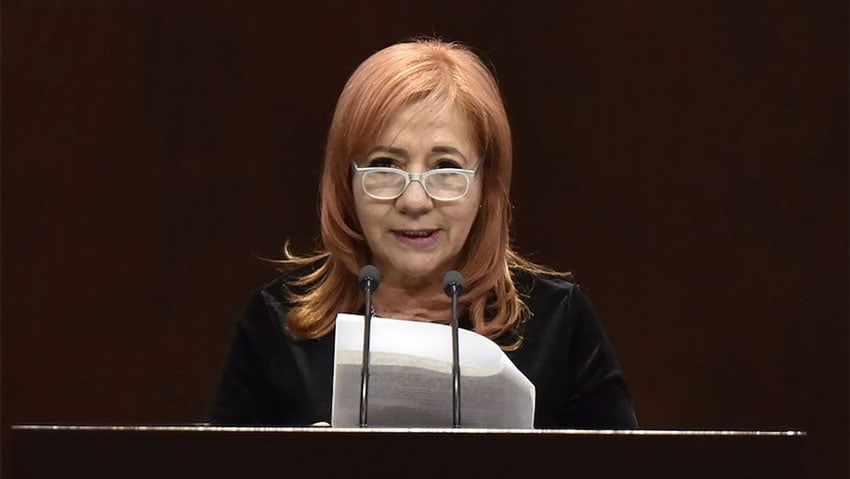
Rights commission chief Rosario Piedra.

The rights commission offered to issue a recommendation that the activists not be prosecuted for their actions and said it was prepared to allow them to use another building as a base to carry out their activities in defense of women’s rights and against gender violence.

Meanwhile, CNDH president Rosario Piedra said Monday that she was also a victim, explaining that she suffered human rights violations that were never resolved, referring to abuse against family members in the 1970s.

Piedra, who is currently facing calls for her to resign from feminist activists, some federal lawmakers and others, said the CNDH is facing “a formidable media campaign of smear and lies.”

Speaking during a virtual meeting with members of the Chamber of Deputies’ human rights committee, the rights chief said that the CNDH today is managed with “complete honesty and transparency.”

“They’ve tried to disseminate scandalous and slanderous … [information about the CNDH] but in the end the truth will come out and what will be left are the results,” Piedra said.

She rejected claims that she and other CNDH employees were served gourmet meals at the headquarters now occupied by the activists. Meat found at the premises that was denounced on social media as “cortes finos” or fine cuts was nothing of the sort, Piedra said.

“The menu was like that in any middle-class home: pasta soup, rice, beans, stews, agua fresca [water flavored with fruit], no gourmet food. [The meat] presented as ‘fine cuts’ was beefsteak, pork and beef shank. What I ate was exactly the same as what the cleaning and security staff ate,” she said.

Addressing criticism that she is too close to López Obrador and unduly influenced by him, Piedra responded:

“I exercise my powers fully as head of the commission, removed from pressure and influence other than those of the victims [of human rights violations]. I have done that and I will do that … with a multidisciplinary team in which each person fulfills his or her role and responsibility without overstepping the mark nor subjugating others to ensure teamwork that is efficient and empathetic with the victims. The autonomy of the commission is guaranteed.”

Piedra was appointed human rights chief last November amid claims that she would be a puppet of the federal government. Upon being sworn in she immediately courted more controversy by indicating that she was unaware that any journalists had been killed since López Obrador took office in December 2018 when in fact at least 13 had been murdered.

Source: El Universal (sp), La Jornada (sp) 

Billions of dollars in freight tied up by Chihuahua farmers’ water protest

0
Farmers have blocked tracks in Meoqui, Chihuahua.

Protests in Chihuahua over a 1944 water treaty with the United States are paralyzing sectors of the economy as farmers and ranchers angry over the deviation of water have blocked railway tracks in Meoqui since August 26, costing Mexican industry some US $10 billion.

The railway, which has been blocked by mounds of dirt and heavy equipment, is an essential thoroughfare between the United States and Mexico.  

Francisco Santini Ramos, president of the Chihuahua office of the national Business Coordinating Council (CCE), said that in the absence of an alternative that allows the transit of vital cargo, it is urgent that tracks be cleared

“It would be very difficult to change the shipments because that would mean using almost 20,000 trucks to move the merchandise and there are neither the conditions nor the infrastructure to make these changes,” he said. “The path is dialogue and unblocking the railway tracks.”

He said the situation has impacted the automotive, cement, food and beer industries in central Mexico that routinely ship their products north via rail through Ciudad Juárez, the second most important border crossing in the exchange of trade between the United States and Mexico. 

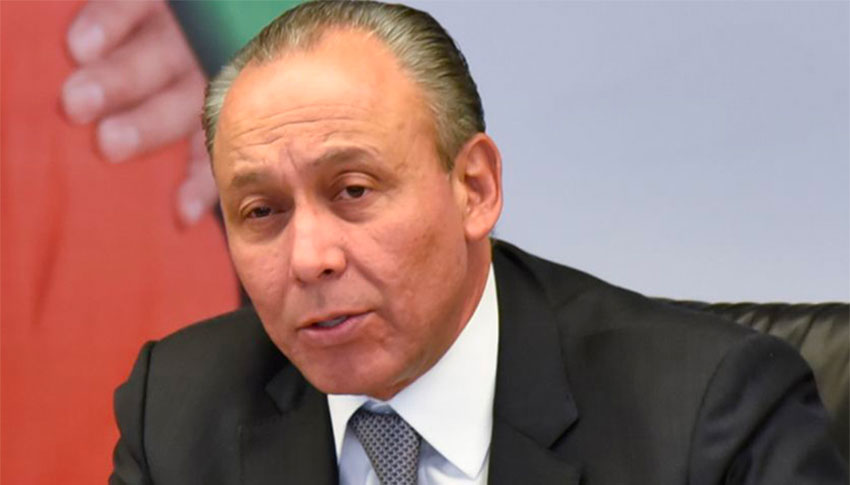
Former Chihuahua governor Reyes called the freezing of accounts 'political persecution.'
Former Chihuahua governor Reyes called the freezing of accounts ‘political persecution.’

Santini said the CCE has requested intervention by both the state and federal governments. Chihuahua Governor Javier Corral and Foreign Minister Marcelo Ebrard have been asked to resolve the water crisis and put an end to the blockade.

The Confederation of Industrial Chambers (Concamin) and the Mexican Railway Association (AMF) report that train shipments through Chihuahua are essential for national logistics due to the state’s strategic location and the importance of its agro-industrial sector for the country’s economy.

The conflict between farmers and the federal government exploded last week at the La Boquilla dam in San Francisco de Conchos and later claimed two victims. 

A man and a woman who were protesting at the dam last Tuesday when it was stormed by farmers wielding Molotov cocktails, sticks and rocks were found shot in their pickup truck in the nearby city of Delicias that night. 

The woman, Yessica Silva, died at the scene and her husband, Jaime Torres, was sent to the hospital in serious condition with gunshot wounds to the chest and neck. Witnesses say they were fired on by the National Guard.

President López Obrador asked the Attorney General’s Office to investigate the incidents at the dam which he says were instigated by his political opponents

The federal government took further action against protesters through the Financial Intelligence Unit (UIF) of the Ministry of Finance. It froze the accounts of three officials singled out for being behind the Boquilla dam protests, former Chihuahua governor José Reyes Baeza, Delicias Mayor Eliseo Compeán Fernández and Chihuahua Irrigation Association President Salvador Alcántar.

In addition, 44 bank accounts belonging to the municipality of Delicias were frozen, according to the mayor.

The UIF said it froze the accounts of ex-governor Reyes in connection with the suspected embezzlement of 129 million pesos while Reyes was head of the state workers health service, ISSSTE, during the administration of former president Enrique Peña Nieto.

It denied freezing the accounts of the municipality of Delicias.

Both Reyes and Mayor Compeán called the move political persecution.

Source: T21 (sp)

Tourists return to Tulum; hotels report higher occupancy

0
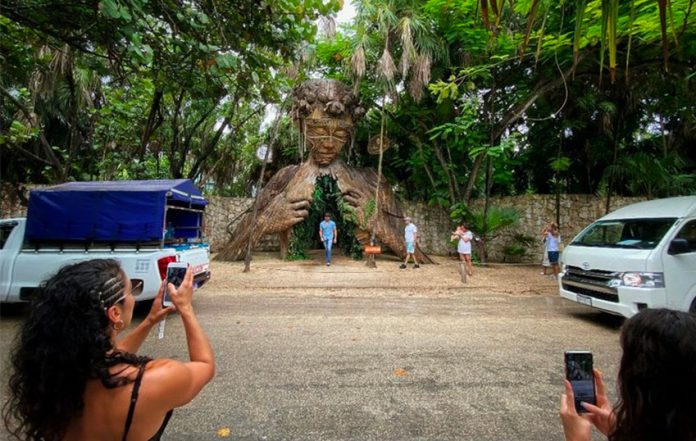
Tourists in Tulum. where hotels are seeing more guests.
Tourists in Tulum, where hotels are seeing more guests.

Hotel occupancy in Tulum, Quintana Roo, is currently at its highest level since the economic reopening, the resort town’s hotel association president said Sunday.

David Ortiz Mena said that 32% of rooms are currently occupied, noting that most visitors are staying in hotels and resorts located on or near the beach.

He said that some hotels remain closed and that those that have opened are operating at reduced capacity.

The Bahía Principe hotel, located about 25 kilometers north of the town of Tulum near Akumal, has only opened 750 rooms out of almost 4,000, Ortiz said.

The vast majority of hotels in the Tulum coastal zone – the town proper is located about five kilometers inland – have reopened and some have occupancy of close to 60%, he said.

“Only 4% of hotels in that area are still closed,” Ortiz said.

The hotel association chief said that he expects occupancy levels to increase further this month despite September normally being part of the low season. He also said that many tourists are choosing to stay longer than the average 3 1/2-day stay.

He said that Quintana Roo’s designation as a yellow-light state according to the federal government’s stoplight system to assess the risk of coronavirus infection is welcome news as it allows hotels and restaurants to increase their capacity. Ortiz highlighted that archaeological sites and beaches in Tulum are also now open at reduced capacity.

However, he noted that bars in the Caribbean coast municipality have not yet been allowed to reopen. As a result, Tulum has recently felt like the Tulum of old  – “a lot more rest and less partying,” Ortiz said.

While he agreed that bars shouldn’t yet reopen, the hotel association chief said that authorities should increase the limit on the number of people allowed to attend events such as weddings, which is currently set at 50.

Weddings in Tulum are big business but the current limit on guests is a deterrent, Ortiz said, adding that there are venues with the capacity to host larger numbers of people while ensuring that social distancing recommendations are observed.

While predicting that tourism will continue to increase, Ortiz said that Tulum’s market remains limited because flights from Europe to Cancún are still well below pre-pandemic levels. Canadians are also not currently traveling in the numbers tourism operators would like, he said.

Travelers who do make it to Tulum, as well as residents, are being encouraged to use a face mask as part of the Quintana Roo Tourism Promotion Council’s “Wear to Care” campaign.

“Despite [being allocated] a yellow light, it’s important that we keep working to send a safe image of our destination. We mustn’t relax the health measures,” Ortiz said.

Source: La Jornada (sp) 

Torture alleged at temporary youth shelter in Tijuana

0
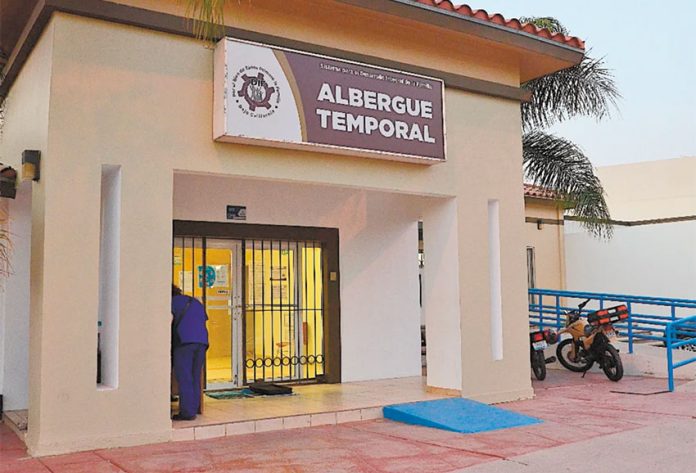
An investigation is under way into torture in children's shelters.

Dozens of children have been tortured at a temporary youth shelter in Tijuana, Baja California, according to one of the victims.

A 19-year-old man identified only as Javier told the newspaper El Universal that when he was 10 years old he was placed in solitary confinement at a shelter run by the DIF family services agency in the northern border city.

Javier said he was dragged into the so-called “meditation room” located behind the shelter itself by two employees and left there in the dark without access to water or a bathroom for more than a week.

Many other children suffered the same fate during the time they spent in the care of the state, he said.

“DIF did whatever they wanted to me,” Javier told El Universal at a Christian shelter where he now lives in San Quintín, a town about 300 kilometers south of Tijuana.

He said the first day he was held in the “meditation room” he demanded to know what had happened to his brother who was also staying at the shelter but whom he hadn’t seen for a week.

He found out that his brother had also been held in the “meditation room” as punishment for complaining about the quality of a meal he was given. Upon “release” he was transferred to another state-run facility.

Javier said that during his time in solitary confinement he was only given food sparingly.

“Sometimes they forget that you’re there and don’t give you anything to eat,” he said, adding that he had to relieve himself in the small, dark space. “I shouted that I wanted to go to the bathroom but they didn’t let me out,” Javier said.

“Once they took me out and said to me, ‘If I hadn’t seen you I wouldn’t have remembered that you were there.’ That was something that made me angry.”

One of the psychologists who worked at the shelter reportedly justified holding young children in solitary confinement, saying: “Sometimes it’s necessary because one doesn’t know what to do with them … [when] they behave badly.”

According to El Universal, an autistic boy revealed the location of the “meditation room” to the Baja California DIF director Blanca Fabela during a visit to the shelter last November. She was subsequently taken to the room and upon opening its metal door discovered that two adolescents were being held there.

It is unclear what action was immediately taken but in recent days, Baja California Minister of Integrity and Public Administration Vicenta Espinosa Martínez revealed that an investigation has been opened and that a criminal complaint against those responsible for the torture will be filed.

The State Human Rights Commission has also launched an investigation but no victims have yet been formally interviewed.

Some shelter staff members have been dismissed in connection with the alleged torture but none currently face criminal charges, El Universal said.

Javier, who left the shelter four years ago, says he now has ambitions to study law because as a lawyer he will be able to defend the rights of children facing the same situation he did.

The Tijuana youth shelter is not the only state-run home in Baja California where children are allegedly being mistreated.

According to a report published Sunday by the news website Noticias Ya, children at a temporary DIF shelter in Mexicali rioted last week against their mistreatment.

A children’s rights advocate told the news portal that the commotion occurred after several children had been held in isolation for varying lengths of time ranging from less than an hour to a few days.

The woman, whose identity wasn’t disclosed, said that DIF employees at the Mexicali shelter treat misbehaving children as if they were violent criminals. Even children with disabilities are held in solitary confinement at times, she said.

Ana Laura Galicia, a psychologist in Tijuana, said the children being abused come from violent homes where they were also mistreated. Locking them up on their own amounts to re-victimization and torture, she said.

The children’s rights activist said that solitary confinement has been used as a punishment at the shelter for at least 12 years.

Baja California authorities are also investigating the alleged mistreatment at the Mexicali facility and a complaint has been filed against employees who committed acts of torture against the children living there.

Source: El Universal (sp), Noticias Ya (sp) 

Bring on the blueberries! Mexico, after all, is one of world’s top producers

0
Try a blueberry balsamic glaze on chicken or turkey.

One doesn’t usually think of blueberries as a Mexican fruit. But in recent years Mexico has become one of the world’s foremost blueberry producers, rising steadily through the ranks and sitting comfortably in the top five.

The states of Jalisco, Michoacán, Sinaloa, Puebla, Baja California and Colima grow the most, with the majority slated for export. (Although we still get lots here during harvest time — like now.)

Blueberries — called mora azul, or technically arandano azul — are quite the trendy crop nowadays, and there’s a big profit to be made from them. Mexico and Chile (another big grower) are unique in that their climates allow for two and sometimes three crops a year.

The majority of Mexican blueberries are grown under giant poly-covers to protect the plants from too much sun and allow for careful attention to soil pH, watering and pest control.

Canadian readers may know that lowbush, or “wild” blueberries, are their country’s biggest fruit crop and that they lead the world in their production. Indeed, Oxford, Nova Scotia, is known as the Wild Blueberry Capital of Canada, and residents in some regions of Quebec are known as bleuets, or blueberries. These are a different variety than the “highbush blueberries” grown in the U.S. and Mexico.

blueberries
Mexico is among the top five producers.

Wherever they come from, though, we can all agree that blueberries taste great, are good for you and lend themselves to a wide variety of recipes. Pancakes, cobbler, pie, jam, muffins, cheesecake … the list of baked goods that blueberries work with goes on and on. I’ve included some unusual recipes here that use blueberries in atypical ways just to keep you on your toes.

Blueberry Lemonade

  • ½ cup sugar
  • 1 cup blueberries
  • ¾ cup freshly squeezed lemon juice
  • 5 cups water

First make blueberry simple syrup: combine sugar and 1 cup water in a medium saucepan over medium heat, stirring until sugar dissolves. Add blueberries and bring to a boil; reduce heat and simmer until blueberries break down, 3-4 minutes. Strain through a cheesecloth or fine-mesh sieve; cool. In a large pitcher, whisk syrup, lemon juice and water. Refrigerate until chilled. Serve over ice and garnish with blueberries.

Blueberry Ketchup

Great on any kind of burger!

  • 1 cup fresh or frozen blueberries
  • ¼ cup minced onion
  • ¼ cup granulated sugar
  • 2 Tbsp. apple cider vinegar
  • ¼ tsp. allspice

Combine blueberries, onion, sugar, vinegar and allspice in small saucepan over medium-high heat; bring to a boil. Reduce heat to medium; cook, stirring often, for 8-10 minutes or until thickened to syrupy consistency. Let cool completely.

Lettuce Wraps with Chicken, Blueberries & Almonds

  • ½ cup plain Greek or regular yogurt
  • ¼ cup fresh basil, chopped
  • ½ tsp. kosher salt
  • ¼ tsp. pepper
  • 3 cups cooked chicken, chopped
  • 1 cup blueberries
  • ½ cup celery, chopped
  • ¼ cup scallions, chopped
  • 8 lettuce leaves
  • 2 Tbsp. sliced almonds, toasted

Mix yogurt, basil, salt and pepper in a bowl. Add chicken, blueberries, celery and scallions; toss until evenly coated. Arrange lettuce leaves on serving platter and top with chicken mixture, dividing evenly. Garnish with almonds.

Blueberry Balsamic Glaze

Use to baste roast chicken or turkey, or as a sauce on fish like snapper or shark.

  • 2 cups blueberries (divided)
  • ½ cup minced dried figs
  • ½ cup balsamic vinegar
  • 1 Tbsp. maple syrup
  • 1½ Tbsp. Dijon mustard
  • Salt and pepper
  • Fresh rosemary sprigs

In small saucepan, simmer ½ cup of blueberries, figs and vinegar over low heat, stirring occasionally, until reduced by half. Add maple syrup, mustard, 1 tsp. of rosemary leaves and a pinch of salt and pepper. Use to baste meat during the last 30 minutes of cooking. Garnish with rosemary springs and a few blueberries.

Blueberry, Kale & Pineapple Smoothie

  • ¼ cup fresh mint leaves
  • 1¼ cups fresh pineapple chunks
  • 1½ cups fresh orange juice
  • 1 cup blueberries
  • 1 cup kale
  • 2 ice cubes

In a blender, mix mint, juice, blueberries, kale until smooth. Add pineapple and ice cubes and blend again.

Blueberry scones, with lemon and coconut.

Blueberry Lemon Coconut Scones

  • 2 cups flour, plus more for dusting
  • 1 tablespoon baking powder
  • 2 teaspoons sugar
  • 1 teaspoon kosher salt
  • ¼ cup refined coconut oil, solid but creamy
  • 1 cup fresh blueberries
  • 1 Tbsp. lemon zest
  • 1 cup unsweetened, full-fat coconut milk, shaken well before measuring
  • Turbinado sugar

Preheat oven to 400 F. Mix flour, baking powder, sugar, salt and coconut oil with a food processor, pulsing until mixture is a powdery meal. Transfer to medium bowl; add blueberries and zest. Stir in coconut milk to form a soft dough. Turn onto lightly floured surface and pat into a 7-inch round. Wrap in plastic and refrigerate 15 minutes. Cut chilled dough into six wedges. Sprinkle with turbinado sugar and arrange on parchment-lined pan. Bake until puffed and golden, about 25 minutes.

Janet Blaser has been a writer, editor and storyteller her entire life and feels fortunate to be able to write about great food, amazing places, fascinating people and unique events. Her first book, Why We Left: An Anthology of American Women Expats, is available on Amazon. Contact Janet or read her blog at whyweleftamerica.com.

Aggression against journalists up 45% this year, says freedom watchdog

0
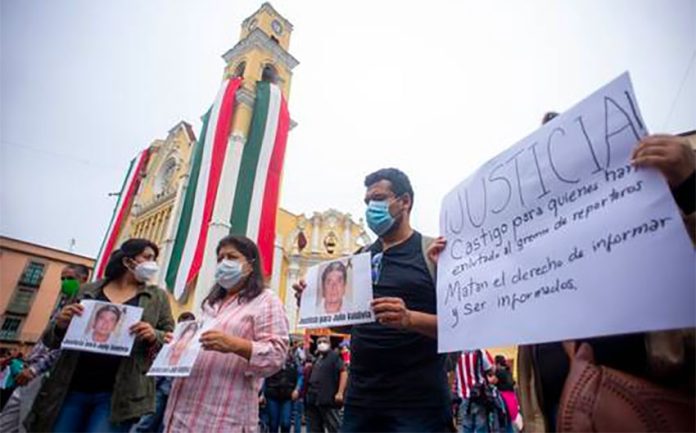
A protest by journalists in Veracruz last week over the killing of Julio Valdivia.

For Mexico’s journalists 2020 will likely be the worst year for violence against them in a decade, according to a freedom of speech watchdog organization.

Article 19, which reports on violence and intimidation against members of the press in Mexico and Central America, said the first half of 2020 was 45% worse for such acts than during the same period in 2019.

In the first half of 2019, Mexican journalists reported 280 acts of violence or aggression, and so far, between January and June 2020, that number has nearly doubled to 406, averaging out to an act of aggression or violence against a journalist occurring every 10.75 hours.

This puts Mexico on track to surpass the 2019 total by at least 66% and be most the violent year since the organization started recording such data. In 2019, Article 19 reported 609 acts of violence or aggression, which it says was the highest number reported in a decade.

Four journalists have been murdered this year and physical attacks on journalists are up 80% at 47.

However, the majority of aggressive acts toward journalists this year has come in the form of threats of various kinds, including death threats and threats of violence which, in all, have totaled 96, a 26% increase.

The organization also recorded 91 cases of other kinds of intimidation or harassment, up 40%. This includes smear campaigns, which the organization said have doubled in 2020 as a tactic to silence reporting.

The organization also reported 61 cases of censorship or other alterations of journalistic content, which they said doubled compared to last year.

The states with the most acts of aggression toward journalists reported this year are Mexico City, Puebla, Oaxaca, Veracruz, and Quintana Roo. Together, these states represented nearly half the total number of recorded incidents in the country.

Mexico City topped the list with more than double the reported incidents from last year — rising from 27 incidents last year to 64 this year. However, the biggest change was in Puebla: Although the state recorded fewer incidents than Mexico City — only 49 cases — it rose from 10th to second place on Article 19’s list.

The organization said among the factors behind the growing cases of aggression was intolerance among officials for public scrutiny. It also said there has been a multiplier effect in which the strategy of media attacks by President López Obrador has been repeated by state governors.

Mexico News Daily

Covid point man defends strategy, claims ‘sabotage’ by political and other groups

0

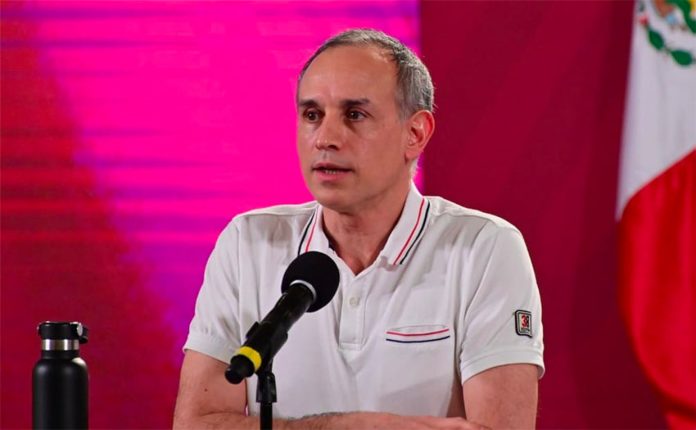
The federal government’s coronavirus czar has defended the response to the pandemic, asserting that the strategy implemented is the technically correct one despite Mexico having the fourth highest Covid-19 death toll in the world.

In an interview with the newspaper La Jornada, Deputy Health Minister Hugo López-Gatell stressed that the strategy adopted to slow the spread of the coronavirus is based on scientific and technical evidence.

Despite that, political, economic and social groups have “sabotaged” the government’s strategy, he claimed.

Although the government has been widely criticized for not testing enough, only recommending rather than enforcing a nationwide lockdown and not strongly advocating the use of face masks, the coronavirus point man said he didn’t regret any of the decisions he and other health officials took in response to the Covid-19 threat.

Mexico’s high death toll, which López-Gatell, President López Obrador and others have blamed on the high incidence of diet-related chronic diseases such as diabetes and obesity, is partially attributable to a shortage of intensive care physicians, the deputy minister said.

Asked what the lessons of the pandemic are, López-Gatell responded that there are many but added, “We know they are temporary because Covid-19 is a moving target.”

“In January it was thought that the virus would be similar to influenza and that’s not the way it has been. [One lesson is] the importance of acting based on scientific evidence and not out of political pressure nor the aspiration to please society,” he said.

López-Gatell acknowledged that some political and economic actors as well as certain media outlets have been critical of the government’s pandemic management, something he said he didn’t expect.

“I innocently thought that there would be human generosity but [certain people] have been sabotaging the efforts of government and society to control the pandemic,” he said.

Among the critics of the government’s response to the coronavirus crisis have been the governors of some states as well as six former federal health ministers.

In a document published last week, ex-health ministers who served in the administrations of former presidents Miguel de la Madrid, Vicente Fox, Felipe Calderón and Enrique Peña Nieto criticized the federal government for its pandemic response, especially its reluctance to test widely and its “anti-science resistance” to the use of face masks.

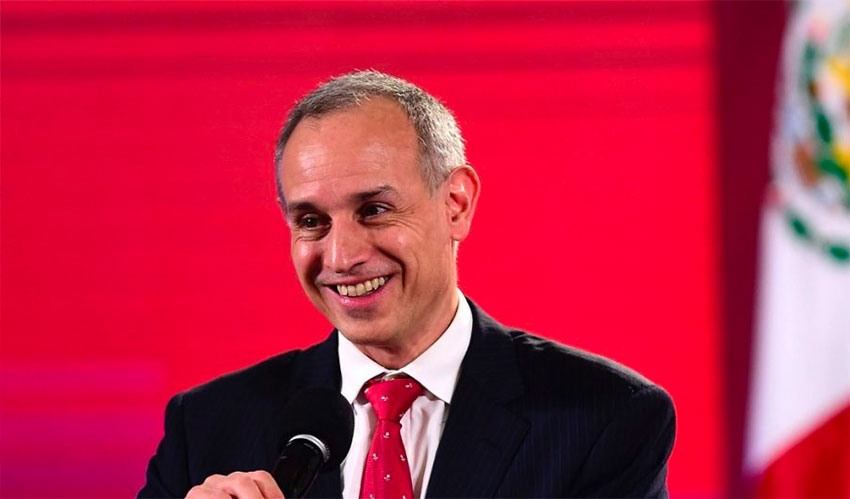
'I confess I was optimistic,' says López-Gatell of fatality projections that proved to be way off.
‘I confess I was optimistic,’ says López-Gatell of fatality projections that proved to be way off.

They called for a national testing campaign in order to obtain data that would give a better indication of how prevalent the coronavirus currently is and where it is spreading.

López-Gatell, who has previously described widespread testing as “useless, impracticable and very expensive,” once again responded to the former health ministers’ suggestions after saying sarcastically last week that their report was full of “magic formulas.”

“I expected a technical document with a scientific bibliography and evidence about testing,” he said.

“The reality is that there is nothing that clearly indicates the relation between the number of tests and the quality of infection control,” he added.

Asked whether Mexico has had enough testing kits to ensure that the sentinel surveillance system, in which coronavirus data is collected at 475 different health care facilities and extrapolated to provide an estimate for the total number of cases across the country, López-Gatell responded:

“We’ve never run out of tests. The sentinel surveillance [system] works.”

Despite that assertion, the federal Health Ministry hasn’t provided an estimate for the total number of coronavirus cases in Mexico for months. In the early days of the pandemic, López-Gatell said it was estimated that there were about eight undetected cases for each confirmed one.

If the same estimate applied today, around 6 million people in Mexico would have had Covid-19 since the start of the pandemic.

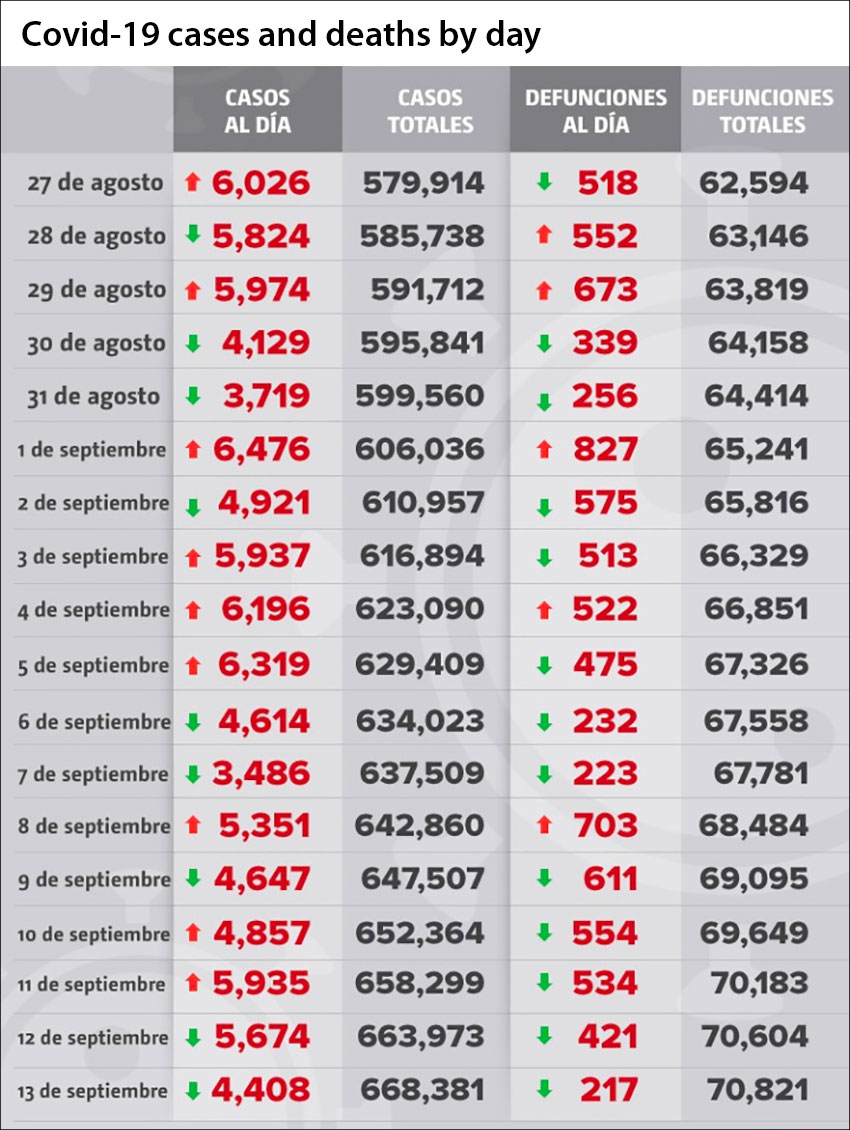
That figure is based on an accumulated case tally that increased to 668,381 on Sunday with 4,408 new confirmed cases reported.

The Health Ministry also reported 217 additional Covid-19 fatalities, lifting the death toll to 70,821.

As Mexico’s case tally is widely thought to show just a fraction of the real number of infections, the Covid-19 death toll is also believed to be significantly higher than official statistics show. The lack of testing is the main reason for undercounting both case numbers and deaths.

López-Gatell’s predictions about the number of deaths Covid-19 would cause have also been wildly inaccurate. When Mexico had recorded about 1,000 Covid-19 fatalities toward the end of April, the deputy minister predicted that the infectious disease would claim about 6,000 to 8,000 lives in Mexico.

Coronavirus cases and deaths reported by day
Coronavirus cases and deaths reported by day. milenio

In early June, when the death toll had just passed 12,000, he said that 30,000 to 35,000 fatalities were possible or 60,000 in a “catastrophic scenario,” a figure that was passed on August 22.

While the deputy health minister hasn’t offered any new predictions about how many people will die from Covid-19, the Institute for Health Metrics and Evaluation at the University of Washington is currently predicting more than 138,000 fatalities by the end of the year in the most likely scenario.

“I confess that I was optimistic,” López-Gatell told La Jornada after rejecting that it was a mistake to make the mathematical projections public.

“We said what would happen if and only if the lockdown was respected, nonessential businesses closed and state governments confirmed that was the case,” he said.

(A national social distancing initiative was in place from late March to the end of May before being replaced by state-by-state restrictions.)

“… Where the lockdown wasn’t respected, the prediction didn’t come true,” López-Gatell said.

Asked whether Mexico’s high number of deaths was related to patients arriving at hospitals only when they were gravely ill in addition to a lack of critical care specialists, López-Gatell said that the latter was the “reality we faced” and a factor in the elevated death toll, the fourth highest in the world behind the United States, Brazil and India.

“With regard to people arriving [at hospitals] in serious condition, that was at the start [of the pandemic]. We didn’t have enough beds and if we said ‘don’t wait,’ the hospitals would have been overwhelmed,” he said.

López-Gatell said that after hospital capacity was increased in April, health authorities began encouraging people to go to hospital as soon as they began feeling unwell, especially if they have, or suspect they have, diabetes or other chronic diseases.

With regard to Covid-19 vaccines, the coronavirus czar said that it is not acceptable for safety, quality and efficacy to be compromised in the haste to make them available.

Mexico, via the Carlos Slim Foundation, has struck a deal with the pharmaceutical company AstraZeneca to produce and distribute the Oxford University vaccine here should it pass phase three trials, while Russia last week announced an agreement with a Mexican pharmaceutical company to supply 32 million doses of its Sputnik V coronavirus vaccine.

López Obrador has pledged to make vaccines available for all Mexicans free of charge and offered to be the first person to be inoculated no matter where the vaccine comes from.

Source: La Jornada (sp) 

Franco’s film New Order goes on to win Silver Lion in Venice

0
Franco and his Silver Lion in Venice on Saturday.

Mexican film director Michel Franco took home the Silver Lion Grand Jury prize at the Venice International Film Festival Saturday for his film, Nuevo Orden (New Order).

“The lion is indeed heavy,” joked Franco after winning Saturday, adding that he’d be sending the award home to Mexico with a friend because he’s scheduled to serve as a juror in the San Sebastian International Film Festival, which starts Friday. “It’s going to need its own suitcase.”

Franco just missed winning the top prize, the Golden Lion, which U.S. film director Chloé Zhao won for her film Nomadland.

“The [jury members] told me that they were impressed with the film and that the vote was a close call,” Franco said.

Actor Cate Blanchett chaired the festival’s Grand Jury this year, which counted among its members actor Matt Dillon and director Joanna Hogg.

Franco also won the top prize from the festival’s Youth Jury on Friday.

Nuevo Orden, a dystopian thriller about class inequity, premiered at the festival. It will also compete in the upcoming Toronto International Film Festival later this month. The film opens with the lush wedding of an upper-class family taking place while an armed revolt of citizens is arising on the streets outside.

The prestigious win for Mexican cinema comes amid economic concerns this year for the nation’s film industry, which has been strongly supported by the government. In 2019, 49% of Mexico’s commercial films were supported at least in part by grants from government-run agencies and trusts like the Mexican Institute for Cinematography (Imcine), the Fund for the Production of Cinematographic Quality (Foprocine), which supports art films, and the Cinema Stimulus and Investment Fund (Fidecine), which supports commercial films.

But in April, President López Obrador announced an end to government-sponsored trusts, except for those written into federal law. Soon afterward, Foprocine, one such trust, and its budget was merged with Fidecine, one of the trusts written into Mexican law. Last week, Mario Delgado, coordinator for the majority Morena party in Mexico’s Chamber of Deputies, announced that Fidecine would also be reexamined, despite earlier promises that it would receive an increase in its budget.

In May, Imcine officials also announced that its 2021 budget for supporting film festivals across Mexico would likely be reduced by 40 million pesos and asked that applicants “reduce their economic expectations.”

The proposed federal budget, announced last week, cuts support for filmmaking by 60 million pesos, to 345 million.

Franco himself addressed budget cuts in an interview with the newspaper El Universal shortly after his win, indicating that the government should continue to support Mexican filmmaking.

“I am saying, in the most positive and clear manner possible, that it has gone well for [Mexico] in Venice, in Cannes,” Franco said. “There is no need to toss aside what has taken such a long time to build.”

Mexican filmmakers have been among the big winners at the festivals in recent years.

Source: El Universal (sp)

Cancún traffic cops investigated for operating extortion ring

0
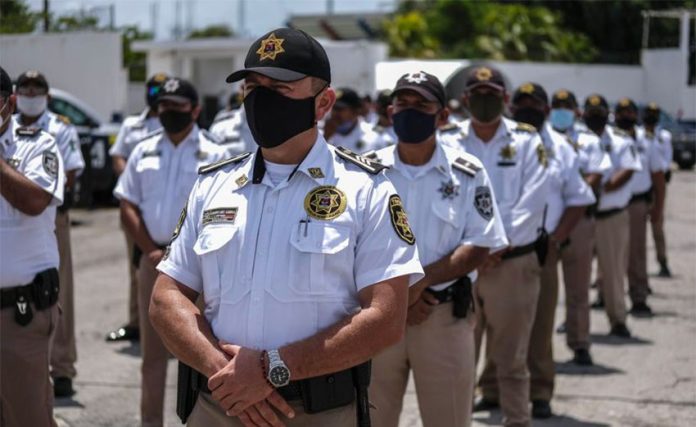
Police allegedly collect bribes from motorists to pay senior officers.

The Quintana Roo Security Ministry is investigating an extortion ring within Cancún traffic police that charges officers varying amounts depending on where they are stationed and the duties they are carrying out.

The officers in turn collect bribes from truck drivers and other motorists so that they can raise the cash needed to satisfy their superiors’ demands.

A report published Monday by the newspaper Reforma said that according to the Cancún officers, the extortion ring is made up of three former traffic police chiefs and the current one, Jorge García Cohuo.

It’s estimated that up to 2.8 million pesos (US $132,500) is collected per month via the scheme.

According to Reforma, officers say they have been charged weekly “fees” of up to 46,000 pesos (US $2,200) to work at sobriety checkpoints. The officers presumably meet the payments by collecting bribes from intoxicated drivers in exchange for letting them off formal charges.

Officers stationed in the hotel zone say that traffic police commanders ask them to pay 14,000 pesos a week while those patrolling the city’s downtown say they’ve been directed to make 9,000-peso payments. Motorcycle officers have been asked to turn over 30,000 pesos a week to their superiors.

Requested by Mayor Mara Lezama, the investigation into the extortion racket was launched as taxi drivers, truck drivers, transport companies and motorists in general were complaining that police extortion was on the rise.

The Quintana Roo Security Ministry has detected that the extortion scheme collects income from three different sources.

Officers with the traffic police “verification unit” collect illegal payments from truck drivers transporting goods such as fruit, vegetables, soft drinks and beer.

Officers collect some 1.2 million pesos a month in exchange for allowing the “free circulation” of freight trucks, according to the Security Ministry.

Traffic police patrolling Cancún in police cars, on motorcycles and on foot collect an average of 760,000 pesos a month via bribes paid by general motorists, according to official estimates.

Cancún Mayor Lezama.

Police commanders also benefit from illegal payments that motorists, transport companies and freight companies are asked to pay when applying for permits or seeking to retrieve impounded vehicles. Some 250,000 pesos per month is sourced from the “procedures and services” racket.

In addition, police commanders top up their regular salaries with payments they demand of tow truck operators and “coyotes,” people who carry out bureaucratic procedures at traffic police offices on behalf of others.

Although extortion has increased recently, the Security Ministry investigation has found that police bureaucracy-related corruption and the collection of “fees” by traffic police commanders has been a problem in Cancún since at least 1998.

The corruption has persisted despite the replacement of several traffic police chiefs and the election of new municipal governments in the Caribbean coast resort city.

Most recently, Jesús Ángel Salas Cruz, one of the former traffic police chiefs allegedly involved in the extortion ring, was replaced by García Cohuo at the end of last month.

At the same time, Cancún authorities launched an initiative known as the “Crusade for Honesty and Efficiency in the Traffic Police.”

The scheme distributed 90 body cameras to traffic police as part of efforts to combat corruption.

“We must make use of digital tools to combat corruption,” Mayor Lezama said at the time. “There are also honest police who thanks to the cameras will make themselves known.”

Source: Reforma (sp) 

Guanajuato firefighters travel north to help as forest fires rage in Oregon

0
The mayor and firefighters who are helping out in Oregon.

The mayor of Guanajuato and five city firefighters are lending a hand in Ashland, Oregon, where over 200 firefighting teams have been battling devastating forest fires.

The firefighters are mainly rescuing victims and providing medical attention to injured animals in the city, parts of which were ordered to evacuate last week. The firefighters also have forest fire training, said Mayor Alejandro Navarro Saldaña.

The five men have also been helping at Ashland-area shelters and assistance centers, including an impromptu community support center set up in a Mexican restaurant.

Wildfires across the state have already consumed more than 1 million acres of land and have forced tens of thousands of Oregonians out of their homes.

“It is apocalyptic,” said Senator Jeff Merkley Sunday on the ABC program This Week. “I drove 600 miles up and down the state, and I never escaped the smoke. We have thousands of people who have lost their homes. I could have never envisioned this.”

Drinking water and electricity are still only available intermittently in the Ashland area.

Guanajuato’s offer of assistance to Ashland was born from an already strong relationship between the two locales, which have been sister cities for 51 years.

“The inhabitants of Ashland and the inhabitants of Oregon would have surely done the same for us, and that’s why we are looking forward to it,” Navarro said in a Facebook post just before leaving Mexico. “Because in Guanajuato Capital, there is fiber, there is talent, and there is capacity.”

Sources: Punto Medio (sp), Revista Patrulla (sp)