Home Blog Page 1450

Families of the missing continue to protest against lack of action

0
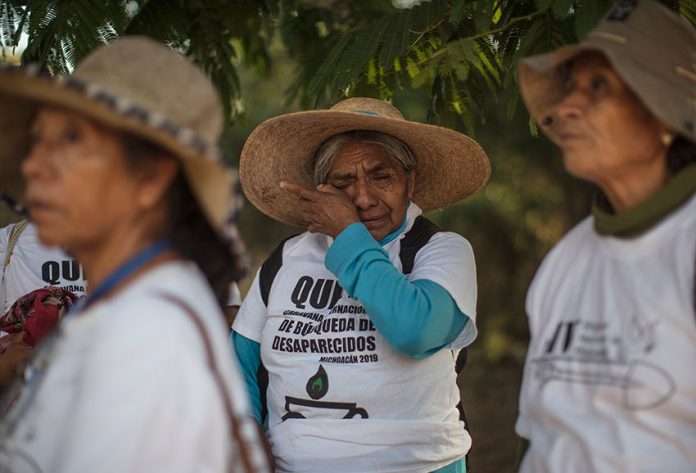
A participant wipes away tears during an international search caravan in Michoacán last year.
A participant wipes away tears during an international search caravan in Michoacán last year. Alan Ortega

Family members of Jalisco’s disappeared gather inside Guadalajara Cathedral. Some carry white roses. Others clutch photos of their missing loved ones. A priest solemnly reads the names of men, women and children who have gone missing in the state in recent years.

In the street outside, activists tie white ribbons to a fence, each one bearing the name of a missing person. They light candles and call for justice.  A women shouts into a megaphone:

“We are not two. We are not three. We are not four. We are not five. We are 10,000 people disappeared in the state of Jalisco. Wake up. Wake up, Jalisco …”

To mark International Day of the Disappeared on August 30, families of the missing in Jalisco and other states took part in protests and online campaigns to draw attention to the burgeoning human rights crisis.

They criticized the state’s failure to investigate the disappearances and to protect its citizens.

According to Karla Quintana Osuna, the head of the National Search Commission, there were 73,200 people missing in Mexico as of July.

Jalisco has the second-highest number of disappearances in the country – approximately 13% of cases nationally. Between June 1, 1995 and July 31, 2020, some 9,341 people disappeared without being found, according to the state’s Institute of Statistical and Geographical Information.

Miguel Ángel Chávez Cárdenas, a lawyer, is one of them.

His sister, Esperanza Chávez Cárdenas, is a member of Por Amor a Ellxs (For the Love of Them), one of many collectives formed of family members of the disappeared. She has been searching for her brother for six long years.

She told Mexico News Daily that the 54-year-old Chávez had disappeared without a trace on May 16, 2014.

On that day, the family had been celebrating the birthday of Chávez’s youngest son. They went to his sister’s house in Guadalajara to pick up a cake and a piñata to take to a restaurant. Chávez left the house before the others. But he never arrived at the party.
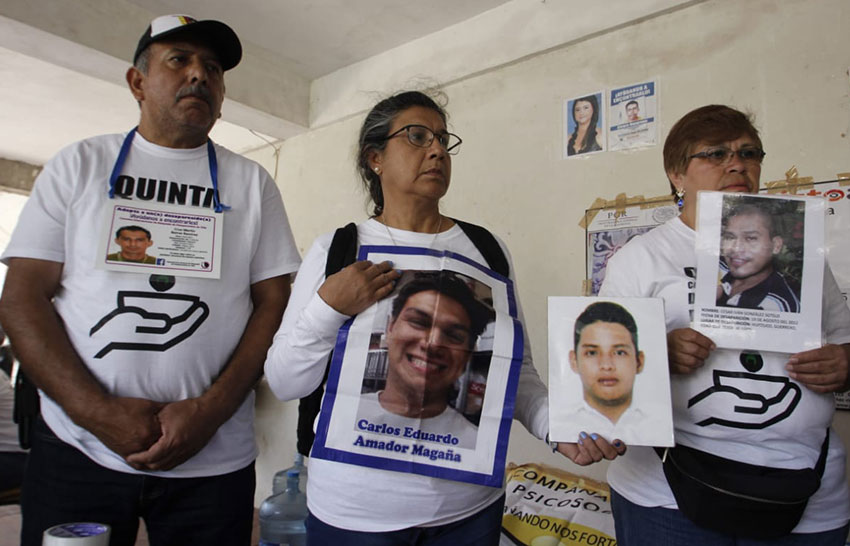
Families of the missing are left with memories and photos.
Families of the missing are left with memories and photos. Alan Ortega

“We left just behind him and we passed the place where [the police] think he disappeared. I passed there, but I didn’t see anything. It all happened so quickly. It’s been six years now and we don’t know anything about what happened to him because the prosecutor is not investigating,” said Esperanza Chávez.

She and other members of Por Amor a Ellxs are frustrated by and critical of what they call is the lack of action by Jalisco’s Special Prosecutor for Disappeared Persons. Created in 2017, the office was supposed to improve radically the investigation of disappearances.

But Chávez said that little has changed. “They are obstructing [the families]. They don’t want to give us copies [of evidence] and you can’t visit without an appointment. I feel they are treating the families very badly.”

She said that she herself had not been mistreated, but she gave many examples of families who had been victimized.

“The public prosecutor publicly announced that a women [who had gone missing] was a drug dealer. Can you believe this? It should have been kept private. I believe that other states are the same, like Guanajuato and many other places. They’re all bad, but we cannot allow [the authorities] to victimize us in this way.”

In another case, Chávez said a man who had been kidnapped from his home was later found alive but traumatized in a drug treatment center, even though he was not an addict. Despite evidence that he had been abducted, the police closed the case. The family was left without answers or legal recourse.

Nonetheless, Por Amor a Ellxs has some trust in Jalisco’s State Search Commission.

Such commissions have been set up in most of Mexico’s states following the creation of the 2017 general law of disappearances, which was drawn up after pressure from families of the disappeared.

Chávez said the commission had successfully initiated searches leading to the discovery of missing persons. And although it does not have the power to prosecute, the commission does coordinate with and provide evidence to the public prosecutor’s office.

However, Barbara Frey, director of the Human Rights Program at the University of Minnesota and an expert on human rights in Mexico, explained that state search commissions “vary in effectiveness, are under-resourced” and lack the expertise to investigate complex cases, which many of them are.

In Michoacán, families of missing persons have had negative experiences of the state’s new search commission, for example.

Laura Orozco Medina, a member of the collective Familiares Caminando por Justicia (Families Walking for Justice), said, “We have many criticisms. At this time, it is not clear what actions the commissioner is taking to address disappearances in the state.”
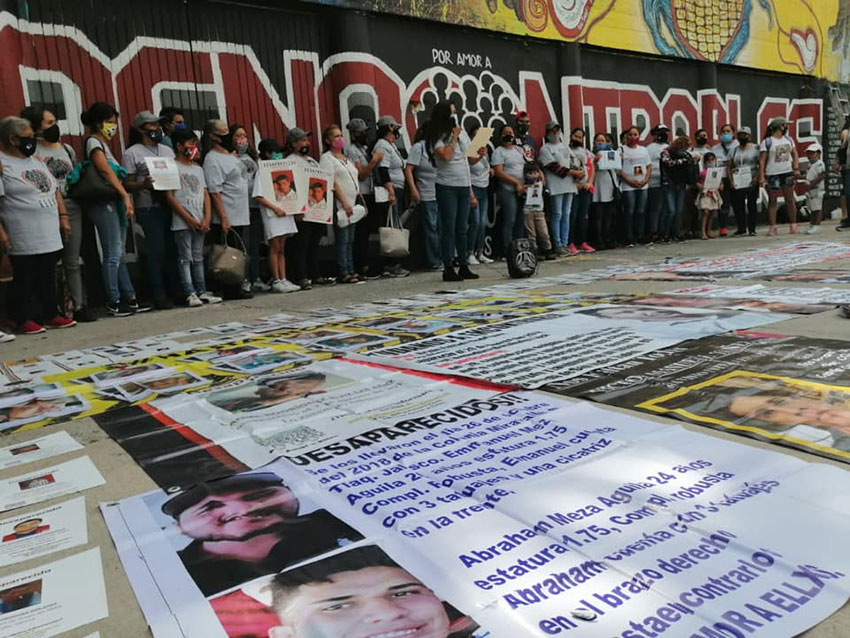
International Day of the Disappeared was celebrated August 30 in Guadalajara.
International Day of the Disappeared was celebrated August 30 in Guadalajara. Por Amor a Ellxs

Orozco is searching for her two brothers and her father.

Between 2008 and 2010, her brothers Leonel and Moisés and her father Leonel were allegedly forcibly disappeared by the now defunct Federal Investigations Agency (AFI) and members of the municipal police.

In addition, Orozco’s brother, José Iván, who had been falsely accused of a drug charge in 2007, was jailed for five years before being acquitted in 2012. Also a member of Familiares Caminando por Justicia, he was shot dead by two men in 2018.

The family, who lived in the small rural community of Nuevo Zirosto in western Michoacán, were targeted for extortion for their avocado orchards. Laura Orozco alleged that forced disappearances in Michoacán are being carried out by the state to create fear, occupy land and steal resources.

Describing life before they were targeted, she said: “We were a farming family and we dedicated ourselves to the cultivation and production of avocados. We were a very close, happy family. We were a normal family, like any other.”

Speaking about her own case and the experience of other members of Familiares Caminando por Justicia, Orozco said:Everything has changed for all the members of the group, not just for me. The life plans of each member has been broken.

“In addition, the psychosocial impact of these serious human rights violations has been harsh. It is not something that ever leaves you. It is something that continues to exist. Although you learn to live with it, this does not mean it is ever over.”

The lack of action on behalf on the authorities has meant that groups such as of Por Amor a Ellxs and Familiares Caminado por Justicia have had to lobby for adequate laws. Today their work includes organizing search caravans, participating in forums, and creating visibility for the victims of disappearances and their families through art, performances and protests. 

However, change is frustrated by high levels of impunity and the lack of political will.

“We have institutions, but there is still the same impunity. We have laws, but they are not applied.”

She added, “As long as the country is unwilling to investigate the cases, the chains of command, and the criminal and drug networks that are embedded in serious human rights violations, [Mexico] is not going to move forward.”

Mexico News Daily
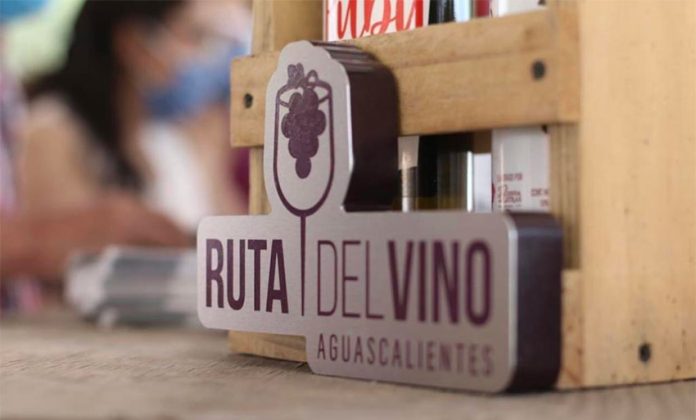
Aguascalientes bets on wine route for economic boost

0
aguascalientes wine tour
The tour event runs until September 13.

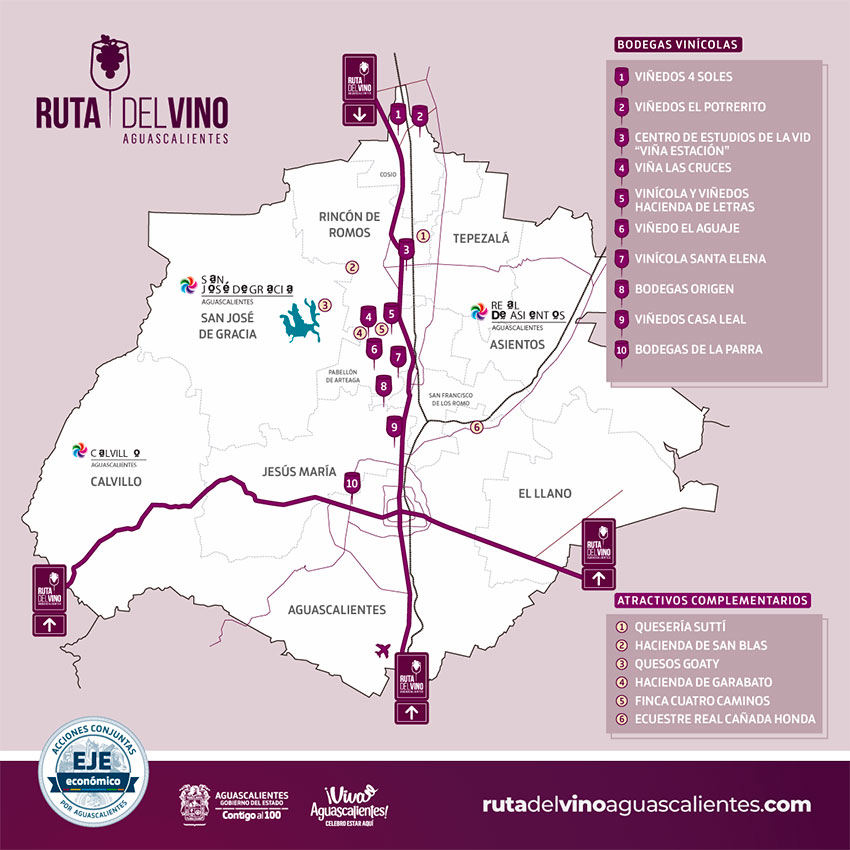
Attempting to reactivate the state’s tourism economic sector in the face of Covid-19, the Aguascalientes government has opened a new wine route to visitors.

The state is marking the route’s inauguration with a special 10-day event that started September 3, offering more than 300 activities to wine aficionados at 10 wineries and six other “complementary sites” around the state. The Ruta del Vino event ends next Sunday.

State Tourism Minister Humberto Montero said the tourism sector has been among the hardest hit by the coronavirus pandemic, which he says is clear from the wide range of businesses participating in the route and attempting to mitigate the economic effects.

However, Montero sees the new wine route as supporting much more than just the gastronomical producers directly involved, adding that hotels, restaurants, travel agencies, taxi drivers, and even musicians benefit, “an endless supply of service providers in the state that we are putting in motion.”

Montero projected that the event will garner 33 million pesos in revenues, attracting between 32,000 and 35,000 visitors.

The tour features 10 wineries and six complementary attractions.

More than a short-term solution, the route’s goal is threefold, not only revitalizing the economy but also recovering Aguascalientes’ tradition as a grape producer and diversifying its tourism offerings. While the current event ends Sunday, the route participants’ sites will continue to welcome visitors indefinitely and state officials plan to expand the route by the end of 2020 with seven more vineyards.

The additional vineyards are currently working on developing their sites to give tourists “a distinct experience,” Montero said.

The open-air nature of vineyards and the limited-capacity attendance that will be required at each site make this sort of tourist activity ideal, Montero said, adding that each site will have different capacity restrictions and that visitors will have to make a reservation through the wine route’s website to attend. 

Each participating site has been validated as a safe space by the state’s Guardia Sanitaria, a force of 50 medical professionals created earlier this year to monitor compliance with Covid-19 sanitary rules by businesses and other public spaces like daycare centers and open-air markets.

Source: Milenio (sp)

Electoral institute rejects Calderón’s new political party over ‘unidentified’ funding

0
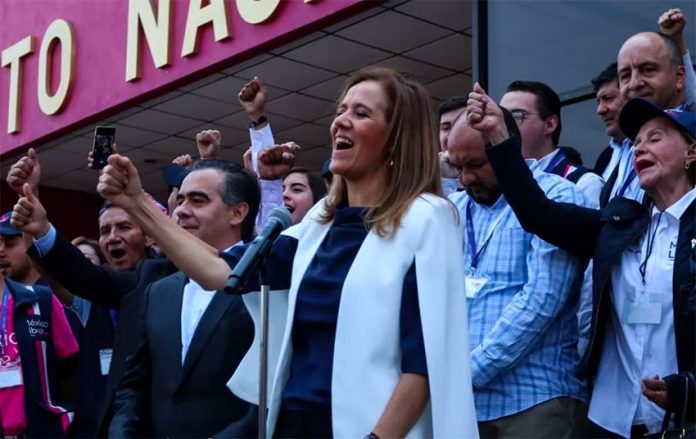
Zavala, center, was optimistic last week that party status would be granted to México Libre.

The National Electoral Institute (INE) has rejected an application to register a political movement created by former president Felipe Calderón and his wife Margarita Zavala as a political party due to questions over its funding.

Seven members of the INE general council voted against the registration of México Libre (Free Mexico) while four voted in favor.

The general council said that it rejected the application because more than 5% of México Libre’s funding came from “unidentified people.”

INE President Lorenzo Córdova said before Friday’s vote that the presence of “opaque money” among the would-be party’s resources was sufficient reason to reject its registration. He said later that there were questions about 8.2% of México Libre’s funding.

The decision to reject the movement’s application – effectively blocking it from contesting the 2021 midterm elections – can be challenged before the federal electoral tribunal, recourse México Libre said it would take immediately.

“Contrary to the law and without any foundation, the INE general council today rejected the registration of México Libre. … We will immediately challenge this absurd resolution,” the organization said on Twitter.

On the same social media platform, Calderón, president of Mexico from 2006 to 2012, rejected INE’s claim that some of the movement’s funding came from unidentified sources. The donations in question were made via the online payment platform Clip and the identity of the people who made them is known by the INE, he said.

“You’re lying, Lorenzo Córdova. Each and every one of our donors is perfectly identified. You know it, you hid it. It’s a day of shame for you, for INE and for the memory of Arnaldo, who would be ashamed of your decision,” Calderón wrote on Twitter.

Arnaldo is Córdova’s late father, who was an academic and served as a federal deputy in the 1980s.

Calderón said that México Libre had submitted all its donation receipts to the INE as well as documents that identified its donors.

The ex-president also said that the INE decision wouldn’t stop México Libre from pursuing its political ambitions.

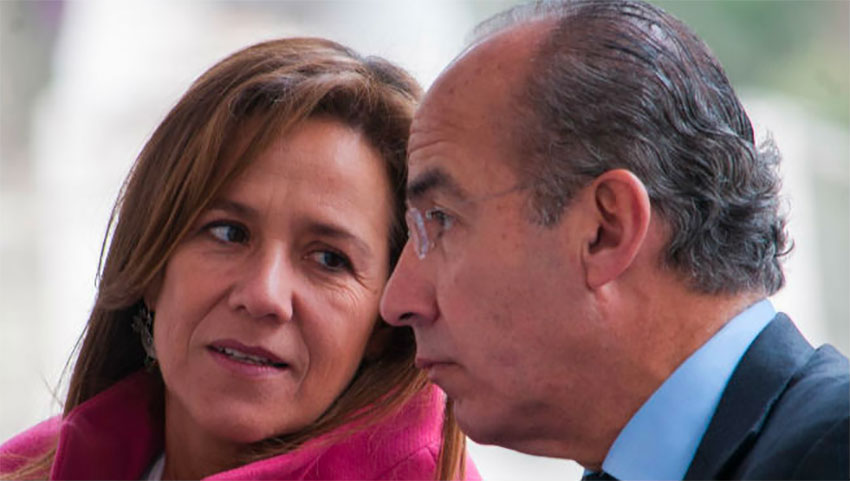
México Libre founders Zavala and Calderón.

The rejection of its application to be registered as a party came after the INE fined México Libre 2.3 million pesos (US $106,400) for irregularities related to donations it received. In handing down the fine, the institute said the movement had received more than 1 million pesos in funding from unidentified persons.

In a video message posted to social media, President López Obrador praised the decision to reject México Libre’s registration as a party, describing it as a “triumph of the people of Mexico.”

Speaking from his ranch in Palenque, Chiapas, the president said that Catholics and evangelicals who support his government would say that the decision against Calderón’s political movement is “divine justice” while non-believers would describe it as “earthly justice.”

“Skeptics” would say the INE decision was a “dirty trick” because the electoral tribunal will later overturn it, ensuring that México Libre is registered as a political party, López Obrador said.

“They surely hold that … if Felipe [Calderón] stole the presidency of the republic [López Obrador claims that he was the rightful winner of the 2006 election], how will he not able to register a political party if he’s used to succeeding without moral scruples of any kind,” he said.

But the president said he believed that “things have changed” in Mexico and the country is now living through “other times” and “new circumstances.”

López Obrador advised Calderón, with whom he has long had a testy relationship, to summon “friends” who helped him in the 2006 election, including powerful businessman and sections of the media, to “go out to the streets to peacefully protest” the INE decision.

The president himself protested alleged fraud at the 2006 election by convening massive street demonstrations in Mexico City.

Apparently speaking tongue in cheek, the president told Calderón that if he fails to find justice in Mexico, he has the option to take his case to “his friends” in the Organization of American States in Washington D.C.

López Obrador said that Calderón shouldn’t take his case to New York even though the United Nations is located there because that’s where his security minister Genaro García Luna is awaiting trial on charges he colluded with and accepted bribes from the Sinaloa Cartel.

The president asserted a month ago that Mexico was a narco state during Calderón’s administration given evidence that has emerged against García Luna.

In response to López Obrador’s video message, Zavala – who launched a bid for the presidency in 2018 but withdrew from the race 1 1/2 months before the election – highlighted that she leads México Libre, not her husband.

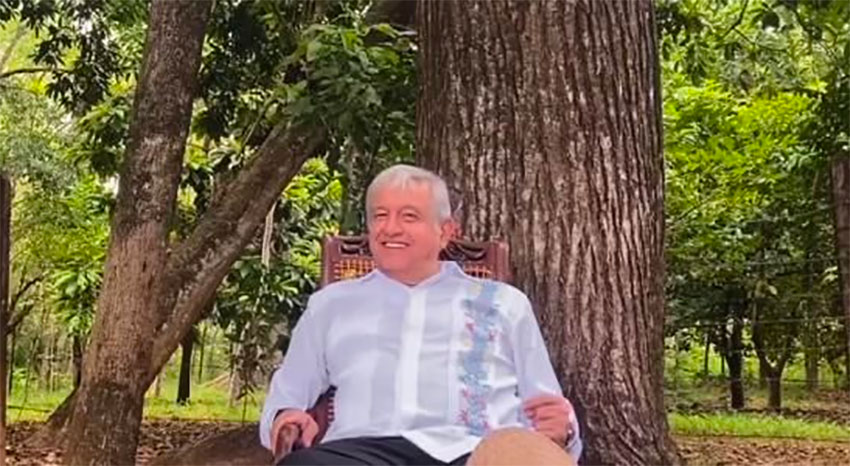
The president mocked Calderón in a video recorded at his ranch in Chiapas.

She said in a Twitter message that she was unsurprised that the president had referred to México Libre as Calderón’s party given his record of “detracting women.”

Zavala said the movement she leads is made up of more than 250,000 Mexicans who “must be respected” and claimed that López Obrador had confessed to pressuring the INE and is now threatening the Electoral Tribunal.

“With you [as president], democracy loses [and] Mexico loses,” she wrote.

In a subsequent video conference with México Libre supporters, the former first lady – who many people believe is planning to run for the presidency again in 2024 – said that donations to the would-be party were made with credit cards and via bank transfers to avoid “envelopes and bags.”

The remark was a reference to two videos that surfaced last month in which the president’s brother, Pío López Obrador, is seen receiving large amounts of cash in an envelope and paper bag.

The money, handed over in 2015 by a Chiapas government advisor who became Civil Protection chief in the López Obrador administration, was apparently donations for the now-ruling Morena party, which the president founded in 2014.

Zavala also claimed that there is an “operation” within the federal government to stop México Libre. For his part, Calderón has claimed that the political movement he co-founded with his wife will become the sole alternative to Morena.

Speaking at the movement’s national assembly in February, the ex-president asserted that México Libre will restore balance to Mexico’s political landscape and provide people with a “different option” at the ballot box.

México Libre will be the only party that “can save our beloved Mexico,” he claimed.

Source: El Universal (sp), Infobae (sp) 

Despite an uptick, Health Ministry sees 6-week downward trend in virus cases

0
Coronavirus case total rose to 634,023 on the weekend.

New coronavirus case numbers declined or remained stable for six consecutive weeks between mid-July and late August, Deputy Health Minister Hugo López-Gatell said Sunday.

He told the Health Ministry’s coronavirus press briefing that new case numbers have generally trended downwards since epidemiological week 30, which ran from July 19 to 25.

Between weeks 33 – August 9 to 15 – and 34, “there wasn’t a reduction but at least there wasn’t an increase,” he said.

López-Gatell noted Friday that the reduction in new case numbers had stalled between weeks 33 and 34 and attributed the “disconcerting” leveling off to the further reopening of the economy.

The deputy minister told reporters Sunday that data currently shows that new case numbers declined 15% between weeks 34 and 35, which concluded on August 29.

However, a decline of that size is unlikely to be maintained because the Health Ministry is still registering coronavirus data for the latter week.

“This number won’t remain 15%, it might be 14, 13 or 12; we can’t predict by how much it will reduced,” López-Gatell said, adding that final data might show that case numbers actually plateaued between weeks 34 and 35.

“But it’s important to have the expectation that [new case numbers] won’t rise,” he said.

López-Gatell also said that the positivity rate – the percentage of Covid-19 tests that come back positive – declined continuously in recent weeks.

The positivity rate reached 57% in epidemiological week 29 – July 12 to 18 – but by week 35 it had declined to 40%, he said.

Mexico’s positivity rate is still very high compared to most other countries because testing is mainly targeted at people with serious coronavirus-like symptoms.

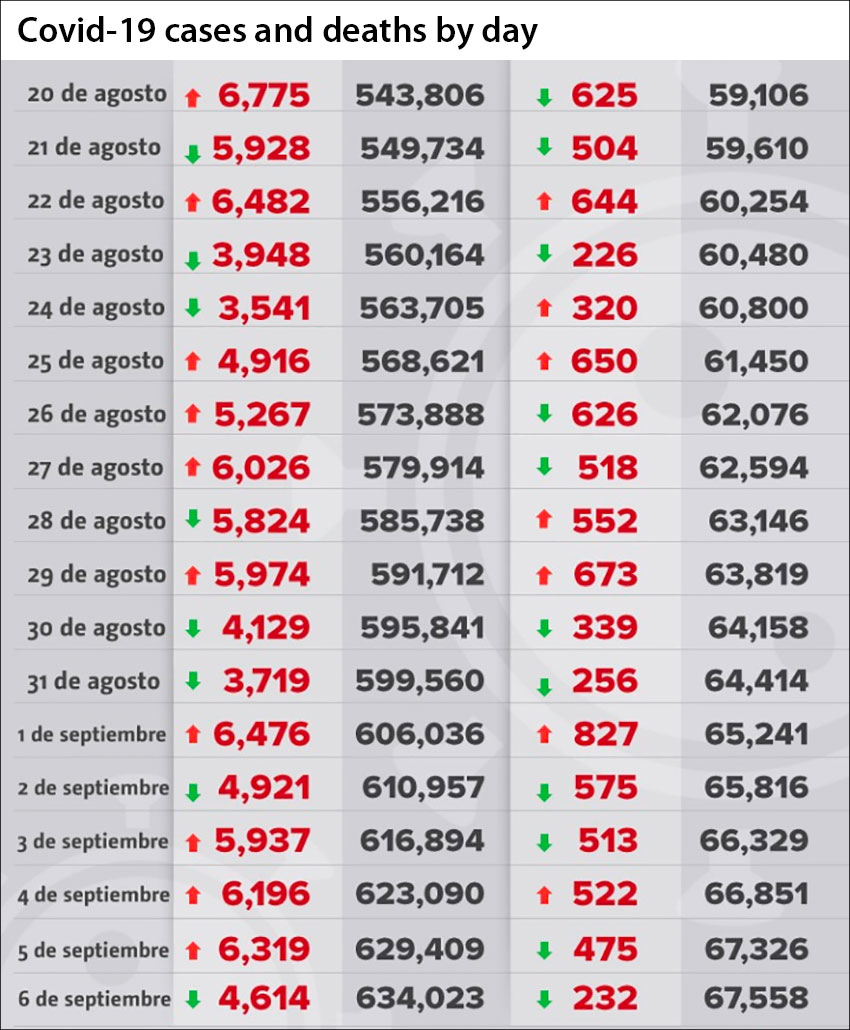
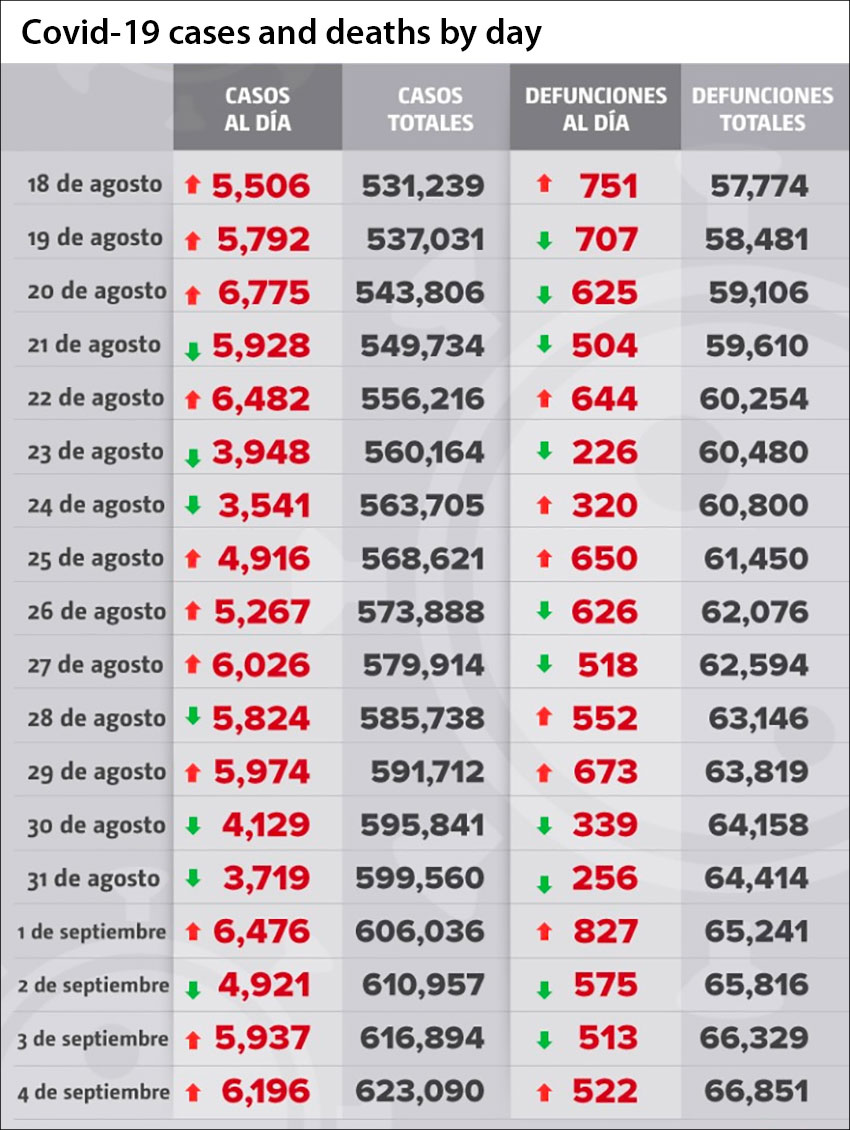
Coronavirus cases and deaths reported by day.
Coronavirus cases and deaths reported by day. milenio

López-Gatell warned that coronavirus case numbers could spike in October at the same time that the seasonal flu begins to circulate. Influenza and the coronavirus could coexist until March or April next year, he said.

Meanwhile, Mexico’s confirmed case tally increased to 634,023 after 4,614 new cases registered by the Health Ministry on Sunday and 6,319 on Saturday. Active case numbers are estimated to number 41,796.

The official Covid-19 death toll rose to 67,558 with 232 additional fatalities on Sunday and 475 on Saturday. However, various independent studies have concluded that the real death toll from the infectious disease is much higher.

That conclusion was supported by excess mortality data presented by the Health Ministry on Saturday that showed that there were 122,765 more deaths between March 15 – the first Covid-19 death was reported on March 18 – and August 1 than in the same period last year.

The real number of “excess” deaths is almost certainly much higher because the data presented was collected from only 24 of Mexico’s 32 states. Deaths in Chiapas, Durango, Guerrero, Michoacán, Nayarit, Oaxaca, Tabasco and Yucatán were not included in the data.

Ruy López Riadura, director of the National Center for Disease Prevention and Control Programs, said there were 330,050 deaths in the 24 states between March 15 and August 1, 59% more than the 207,285 fatalities reported in the same states in the same period of last year.

He said that excess mortality was 70% for men and 47% for women, and that the 45-65 age bracket saw the biggest increase in deaths.

“Excess mortality has not been seen in those aged under 20. [Deaths in that age bracket] are below what was expected,” López added.

He said that the highest number of excess deaths corresponded to epidemiological week 29, which ran from July 12 to 18. The number of deaths recorded that week was 102% higher than last year, López said.

The health official said that not all the 122,765 excess deaths can be attributed to Covid-19, although it’s likely that the majority were caused by the disease.

The figure – derived from only three-quarters of Mexico’s states – is 159% higher than the number of Covid-19 fatalities reported by August 1, when the official Covid-19 death toll was 47,472.

Source: Reforma (sp), El Universal (sp) 

National Guard seizes Michoacán gang’s homemade tank

0
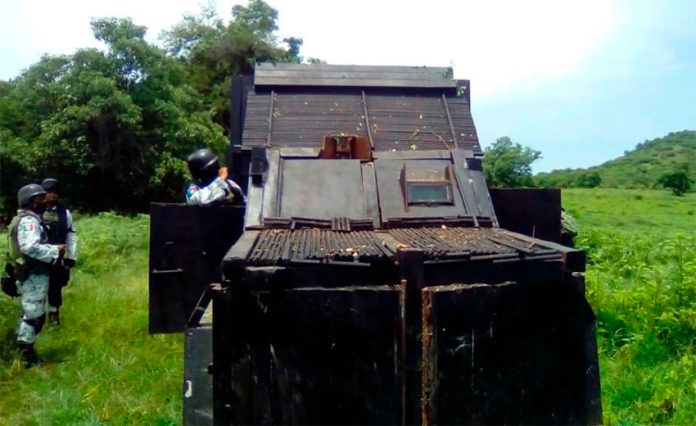
The latest narco tank discovered by Mexican authorities.

A genuine army tank may be hard to come by in Mexico, but cartels have got around that by producing their own, making improvised armored vehicles to give them the upper hand in battles with rival criminal gangs and the Mexican military. 

The National Guard unveiled one such vehicle in photos posted to Twitter on Friday. It was found during a routine patrol in San José de Chila, Michoacán. 

El Universal reports that the hulking black combat vehicle could belong to the Los Viagras cartel led by Nicolás Sierra Santana, alias “El Gordo,” which is known to operate in the state’s Tierra Caliente region.

Los Viagras are currently involved in a brutal turf war with the Jalisco New Generation Cartel, which released a video to social media showing its own convoy of armored vehicles in July. 

Homemade tanks, which are often mounted with high-caliber weapons and turrets, baptized with names such as “Monster,” “Rhinoceros,” “Batmobile” and even “Popemobile.” 

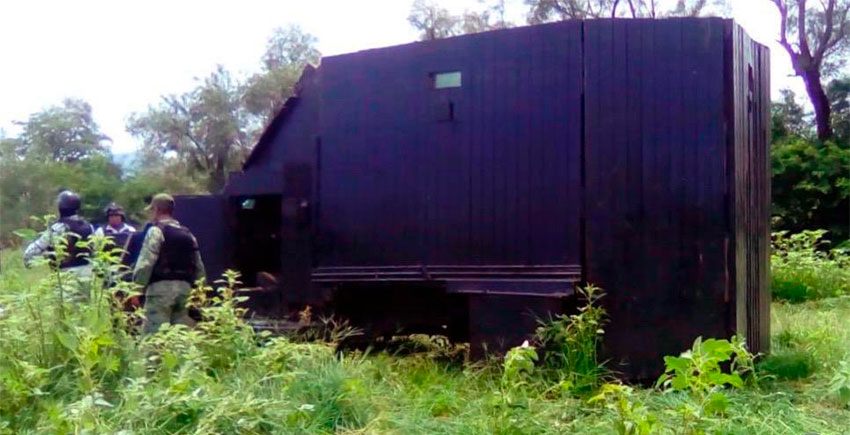
The vehicle is believed to have belonged to Las Viagras.
The vehicle is believed to have belonged to Los Viagras.

Over the past decade, cartels have even transformed trucks into narco tanks with Mad Max flare, affixing steel panels to the exterior that can be up to 25 millimeters thick. Some have had battering rams attached in order to plow through anything in their path, including police barricades.

One fortified vehicle found in Tamaulipas in 2011 was capable of speeds of up to 110 kilometers per hour and had space for 12 passengers with two openings for deploying rocket-propelled grenades and firing rifles. It was also modified to James Bond capabilities and could produce an oil slick or jettison nails onto the roadway to foil pursuit.

A narco tank factory containing eight vehicles that were being modified with anti-ballistic plates was discovered in Nuevo Laredo, Tamaulipas, in 2015. In this case, the armor was attached to the inside of the vehicles so as not to attract attention.

In late January, the Mexican military seized an armored dump truck in the same region of Michoacán as the most recent find. It was also suspected of having belonged to Los Viagras.

Source: Infobae (sp)

Hey, gordo, watch those M&Ms: law cracks down (again) on unhealthy snacks

0
m&ms
These guys will be illegal as of October 1 because labels will not allow the depiction of celebrities, athletes, mascots and other figures.

“Fat-shaming” is a 21st century generational word. In 2013, the United Nations, the world’s biggest NGO, crossed into the Health Maintenance Organization universe by fat-shaming the entire nation of Mexico.

Naming it the world’s fattest nation, knocking the United States off its No. 1 perch as the world’s fattest with a seismic thud, the UN ignited a national reaction from the Rio Grande to the Rio Suchiate, Mexico’s northern and southern borders, respectively.

Since 2013 the Mexican government, with a notable lack of success, has crusaded to change that image if not that reality.

The word “fat” is by nature subjective. Few would call Dutch painter Reubens’ models fat, most would prefer voluptuous. Although history is silent on the issue, it is unlikely that any of King Henry VIII’s surviving wives used the 16th century F-word in his presence.

Yet for most of the 20th century many newspapers’ comic pages carried a strip called simply Gordo, created by a Mexican American. Judging by its widespread use, gordo, or fatso, is still a common, almost affectionate nickname in Mexico, the government’s best efforts notwithstanding.

Say goodbye to Mamut, the character that appears on packages of the popular biscuits.

Those efforts included banning salt shakers on restaurant tables, a measure that lasted about 30 days and may have generated a never-caught-on Ranchero ballad called Where Have All the Salt Shakers Gone?

Undeterred, the government escalated the battle, slapping a special tax on soft drinks. “How’d that work out?” I asked Bruno (not a nickname), my local Walmart manager. “Great,” he said, “We sold out completely of soft drinks,” presumably thanks to canny Mexican shoppers racing to beat the tax.

The Mexican government has continued on the same course.

With effect October 1, the Mexican government has dropped the Big One, employing the Nuclear Option and turning America’s favorite M&Ms and Mexico’s favorite Mamuts (Mammoths) into collectors’ treasures, if not fossils.

Uncatchily-named NOM-051, legislation to fat-shame the packaged food industry and its customers, passed the Mexican Congress by a hefty —anything but a Weight Watchers — margin.

Accordingly, as of October 1 the packaging in which M&Ms and Mamuts are sold will be illegal. In a country where guns are generally illegal and selling stolen or smuggled gasoline is universally illegal, both iconic sweets feloniously use caricatures and mouth-watering words to lure Mexico’s Hansel and Gretels into a witch’s calorie cage.

How it will work out this time around is speculative. I foresee consumers stripping the shelves of their favorite packaged foods, cartels adding M&Ms and Mamuts to their product lines, and tourists from abroad being strip searched by zealous customs officials, but I hope the movement stops short of turning Mexico into the world’s thinnest nation: North Korea.

Carlisle Johnson is a frequent contributor to Mexico News Daily. He writes from his home in Guatemala.

87-year-old rescued from wooden cage in Guanajuato

0
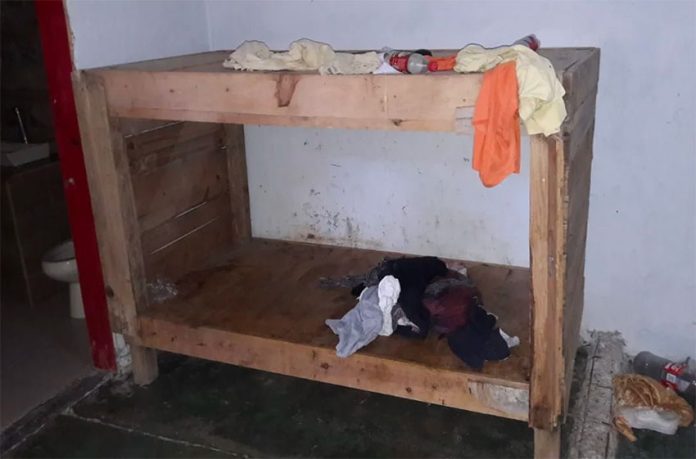
The partially dismantled wooden cage in which a man had been confined by his daughter.

Police freed an 87-year-old man in Celaya, Guanajuato, who was being kept in a wooden cage by his daughter.

The caged man, identified only as Bonifacio, was discovered when officers arrived at his 54-year-old daughter’s home in the Jacarandas neighborhood to execute a court-ordered seizure of personal property as payment of a debt she owed to the National Workers Housing Fund

While removing the property in question, officers heard cries for help and went to investigate. They discovered the man locked inside a wooden-planked box with a small hole at the top through which he had been fed.

The cage had to be dismantled in order to free the man, who was dirty, disheveled and appeared to be in poor health with a condition that affected both his legs. Bonifacio was unable to tell authorities how long he had been inside the box.

He was taken to a hospital for treatment while his daughter was taken into custody. 

According to Mexico’s National Human Rights Commission (CNDH), the country’s elderly population generally does not report abuse due to the family ties that exist with their aggressors, economic and physical dependence on their abuser, or the lack of access to law enforcement agencies.

A 2017 study estimated 12.6 million senior citizens in Mexico had experienced abuse and mistreatment. 

Source: El Universal (sp)

Mexico attracts people not only of this world, but from outer space too

0
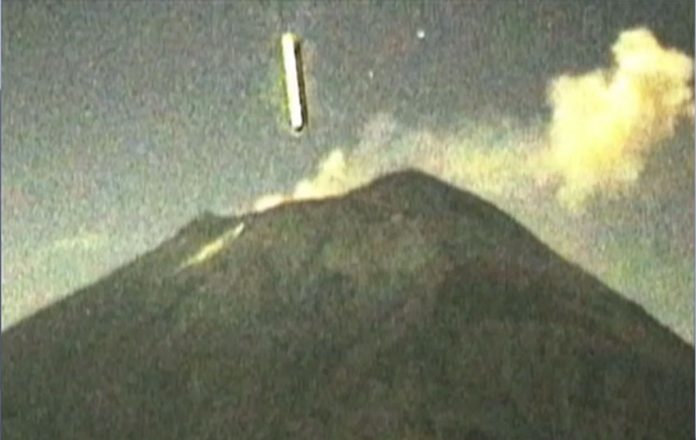
A UFO enters the crater of El Popo, the volcano in central Mexico.

So the Pentagon has admitted studying UFOs, and not a single person is shocked. I thought it would be fun to find out if our alien friends visit Mexico as well. Looks like they do!

In fact, Mexico ranks seventh in the world for the number of UFO sightings. One of Mexico’s ufologist pioneers was Pedro Ferriz, who even advised former president Gustavo Díaz Ordaz on the matter in the 1960s.

He has since been followed by others including UFO hunter Salvador Guerrero and journalist Laura Castellanos. By far, the best-known is Jaime Maussan, who has hosted a show on UFOs and the paranormal called Tercer Milenio (Third Millennium) since 2005.

There are reports of UFO sightings from all over Mexico, but some places seem to be more popular with aliens. One early incident is something that appears on a home video taken at Mexico City’s 1968 Olympic Games during the opening ceremony. Perhaps the best known are the sightings that occurred on July 11, 1991 during a total eclipse.

In both Mexico City and Puebla, one or more gray disk-shape objects were reported in the skies and were even filmed in both places. The event remains unexplained and launched a new generation of UFO enthusiasts.

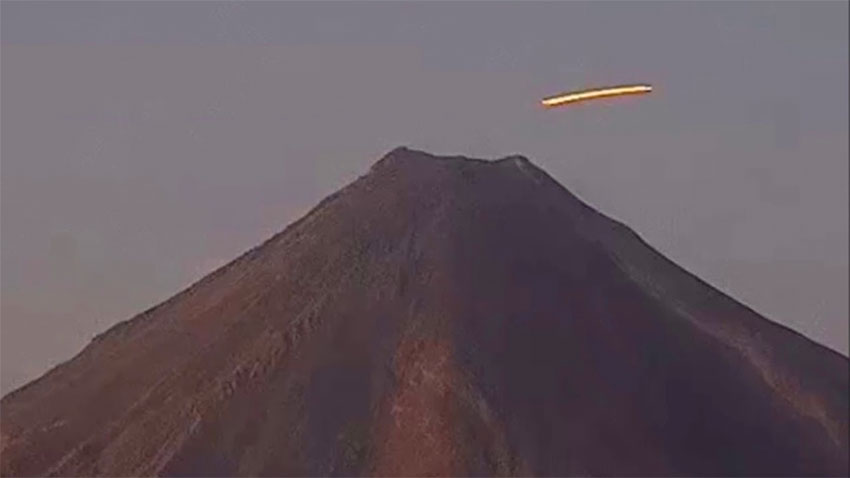
An object that looked like a flying saucer was captured over the Colima Volcano.

In 2017, the X Files filmed an episode in Mexico City, even bringing a “damaged gray flying saucer” into the main square of the capital. The capital has, by far, the most reports of UFOs. One area with many sightings is the San Mateo corridor, where planes coming in from the north approach the international airport.

Sightings here usually describe a light or spherical object that moves off to the side as a plane approaches and returns after it has passed. Even more reports come out of an area called the “Ruta OVNI” (UFO Route) that extends around the southern perimeter of the megalopolis.

The big magnet for the aliens seems to be the Popocatépetl volcano. Because of its height and location, sightings related to it have been reported from Puebla, Morelos, the state of México and Mexico City. The installation of 24/7 webcams to monitor the volcano’s activity has only served to heighten interest in strange lights, and movements are regularly seen around the crater, especially during eruptions.

Such images have made the news at various times, including those in which an object appears to pass through the eruption, come out from the crater, or dive into it. Even lenticular cloud formations around the crater lead to speculations about alien activity. Popocatépetl has drawn foreign ufologists such as Scott C. Waring, who believes that there is an alien base kilometers below the crater’s opening.

Like in Egypt and other places, there has been speculation that aliens had something to do with the advanced ancient civilizations of Mesoamerica. Some claim that there are artifacts that indicate extraterrestrial contact, and UFO sightings are still associated with pyramids. Chichén Itzá was featured in UFO specials produced by NatGeo, Discovery Channel and Fox.

In November 2017, Uruguayan Matias Ferreira and a film crew reported a sighting at Teotihuacán where they were working and claim to have caught something on film. Local residents in Tepoztlán, just south of Mexico City, regularly claim that strong blue and yellow lights can be seen flying around the small pyramid on a nearby crag.

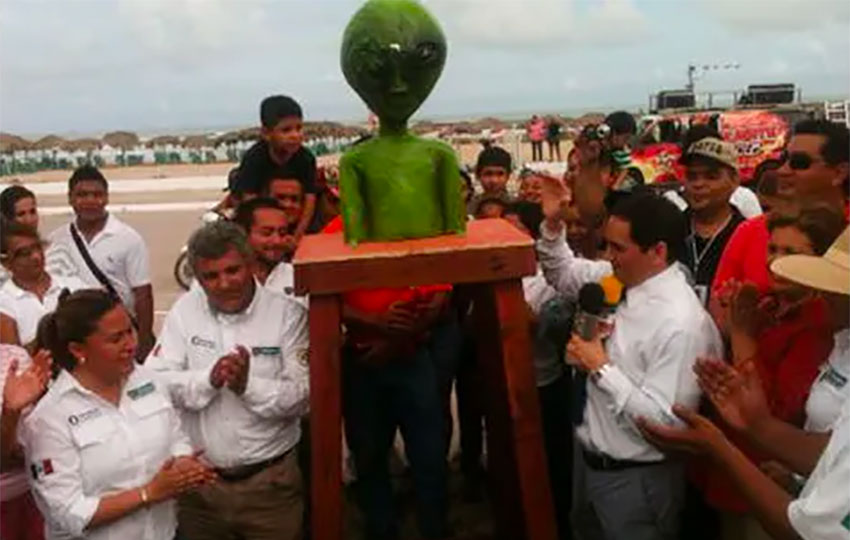
Authorities in Ciudad Madero, Tamaulipas, erected a statue of a martian at Miramar Beach in 2013.

Other sightings have occurred in Guerrero, in southwest Mexico. In 2019, a UFO was spotted over Acapulco, causing a local government official to quip that the tourist destination was “not only recognized nationally and globally, but also outside of the planet.”

But the best known incident occurred in the rural town of Mezcala. For three days starting on December 31, 2007, circular lights appeared in the sky over the Pie de Minas Mountain, with one person recording video of part of the event.

Sonora has had more than its share of reports in various parts of the state, including the capital of Hermosillo. One of these sightings was later proved to be a hoax when a helium balloon with LED lights was found in the area where the UFO “landed.”

Monterrey is noted for one particular sighting over the city’s iconic Cerro de la Silla mountain, filmed accidentally during the making of a commercial for Coca-Cola. No one saw it at the time, but review of the footage showed an elliptical object moving fast, in daylight hours.

Sightings in Durango date back at least to 1955 when two adolescents reported being stopped in their car by a light that then disappeared over the horizon.

Not to be outdone by Popocatépetl, residents of Ciudad Madero, Tamaulipas, also talk of an alien base. The “evidence” for its existence includes the fact that there have been no major hurricanes in the area since 1966. Supposedly, the aliens divert them northward to Texas. The stories prompted the erection of a statue of a “Martian” on Miramar Beach, where sightings are reported regularly, but the statue was stolen.

The interest in UFOs is not going way anytime soon in Mexico. There are various groups that watch the skies and document sightings and other evidence of extraterrestrial visits to the country. One of the most active groups is Vigilantes del Cielo (Sky Watchers), whose work can be seen on Facebook.

Leigh Thelmadatter arrived in Mexico 17 years ago and fell in love with the land and the culture. She publishes a blog called Creative Hands of Mexico and her first book, Mexican Cartonería: Paper, Paste and Fiesta, was published last year. Her culture blog appears weekly on Mexico News Daily.

Lawyers for ex-cartel boss ‘El Chapo’ Guzmán file appeal

0
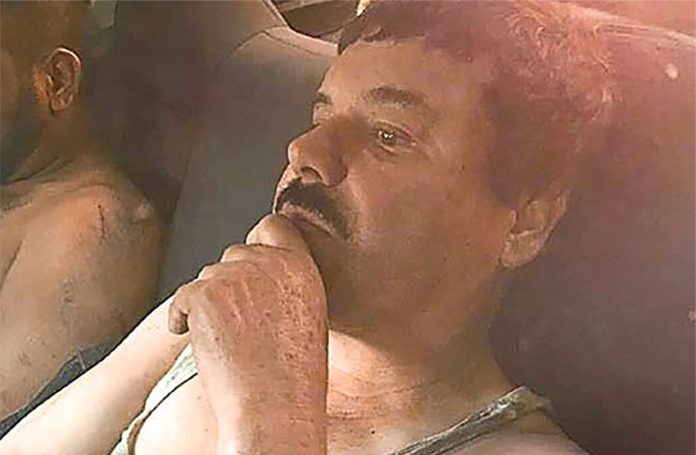
Guzmán after his arrest in 2016.

Lawyers for Joaquín “El Chapo” Guzmán have filed a second appeal to overturn his conviction and sentence of life plus 30 years handed down last year after he was found guilty of drug trafficking, money laundering, homicide, kidnapping and other charges. 

The 245-page appeal was filed with the New York Second Circuit Court of Appeals late Friday night. “Chapo Guzmán’s prosecution was marred by rampant excess and overreach, both governmental and judicial,” lead attorney Marc Fernich wrote in the motion. 

Last summer lawyers for the imprisoned Sinaloa Cartel leader filed an initial appeal the day after his sentence was handed down, arguing that a member of the jury told Vice News that several jurors regularly followed the case on social media during the trial in violation of the judge’s orders. 

The appeal was denied.

“This request is the textbook definition of a fishing expedition, rather than clear, strong, substantial and incontrovertible evidence that a specific, nonspeculative impropriety has occurred,'” the judge wrote at the time. 

Mariel Colón Miró, a 27-year-old attorney who is part of Guzmán’s legal team, hopes the latest motion will result in a new trial for the former cartel kingpin. “We are very optimistic that something positive will come out of this,” she told reporters, noting that the process could take from two to five years.

Guzmán, 63, is serving out his sentence in Florence, Colorado’s “Supermax” prison, the most secure penal institution in the country and known as the “Alcatraz of the Rockies.” 

The new appeal repeats the allegations of jury misconduct and also argues that because Guzmán was maintained in total isolation following his extradition to the United States in January 2017 he was prevented from collaborating with his lawyers on his defense before and during his trial.  

“These measures of total confinement, extreme torture even when his innocence had to be presumed (before his conviction) violated his fifth and sixth amendments,” Colón said.

The attorney, who joined the defense team right after passing the bar exam, says her last visit with her client was in March before visits to the prison was banned due to the coronavirus. She said solitary confinement has left him anxious and depressed. 

“He’s even more alone now after Covid-19,” Colón told CNN last month. “They completely canceled all visits, legal and social. He was allowed three hours a week of outdoor exercise but that has also been suspended in order to limit his contact with the guards, so of course this has been hard, or harder on him and it has affected Mr. Guzmán emotionally and psychologically in my opinion.”

Drug Enforcement Administration special agent Ray Donovan, who spent years investigating the former head of the Sinaloa Cartel, hds little sympathy for the drug lord, who he said was convicted on a “mountain” of evidence.

“Thousands of people died or were ordered killed because of the Sinaloa Cartel. So yeah, he doesn’t leave his cell. It is boring. It’s monotonous. It’s a daily routine. It is very sad but here’s the difference. He’s alive.”

Source: El Universal (sp), CNN (en)

Decline in new coronavirus case numbers has stalled, says López-Gatell

0
A casino is disinfected in Nuevo León, where they have been allowed to reopen.

The decline in new coronavirus cases in Mexico has stalled due to the further reopening of the economy, Deputy Health Minister Hugo López-Gatell said Friday.

Mexico City reported a record 1,367 new cases in a 24-hour period yesterday. 

“In weeks 33 and 34 [August 9-15 and 16-22] there was no decrease in the epidemic; this is certainly disconcerting because we all would like it to decrease until it disappears,” López-Gatell noted, conceding that for social and economic reasons “we cannot keep society permanently cloistered.” 

He also observed that some countries are seeing new case numbers spike at a rate that is higher than it was during the first outbreak, and a similar scenario could occur in Mexico.

“In European countries that began with the epidemic in the last two weeks of January or early February, there are very large outbreaks today,” he said. “This can happen at any time in a municipality, state, in the country or even worldwide,” he said.

Coronavirus cases and deaths reported by day
Coronavirus cases and deaths reported by day. milenio

The five states with the highest number of accumulated cases are Mexico City, the state of México, Guanajuato, Nuevo León and Veracruz, which together make up 41.5% of all cases registered in the country.

Mexico City, the state of México, Veracruz, Puebla, and Baja California continue to rank as the five states with the most deaths, 44.3% of the total.

Officials said Friday that the pandemic has hit Mexico so hard that one million new official death certificates are being printed and distributed after supplies in Baja California, the México state and Mexico City were nearly depleted

There were 6,196 new cases reported Friday, bringing the accumulated total to 623,090. Another 522 fatalities were reported, bringing that total to 66,851.

Source: Milenio (sp), El Financiero (sp)