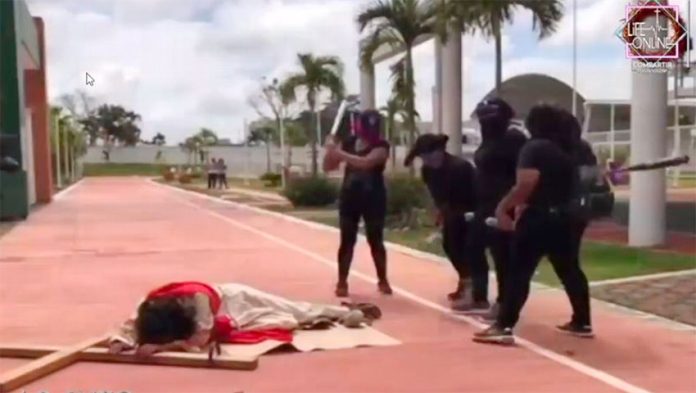
Jesus is down during a reenactment of the Stations of the Cross in Tabasco.
Students at a Catholic seminary in Tabasco chose to send a message to feminists with a change to the Easter event known as the Stations of the Cross: they gave Jesus a beating.
At the eighth station, where Jesus meets the women of Jerusalem, four hooded women, dressed in black and purple in the fashion of Mexico’s feminist protesters, used sticks to beat the actor who played Jesus.
The event was shared live on Facebook, with a narrator who questioned the tactics of the feminist movement. But the video was deleted several hours later after widespread criticism.
The speaker in the video recounted that “2021 years later, the Lord returns to find women very different than those he consoled, women trapped in an irrational collective, demanding rights by insulting and destroying everything in their path, fighting for feminism and respect for women when they do not even respect themselves. Violent women committing acts of vandalism, women who enter temples and profane the Eucharist, laughing at the Virgin Mary.”
The narrator went on to lament the demands for a right to abortion, stating, “From the moment of conception, every women is a mother and every aborted fetus is her child.”
The Diocese of Tabasco said the church respects the rights of all people and groups.
The video “does not represent the official position of the Catholic Church … The church is not against the people, it is against abortion,” according to spokesman Denis Ochoa.
André-Pierre Gignac, a French soccer player for Los Tigres, became a Mexican citizen and is beloved by fans for embracing his adopted nation.
In 1828, Alexander von Humboldt became Mexico’s first naturalized citizen. President Guadalupe Victoria issued a decree to recognize the German’s research work in the country.
Today, it is not necessary to get the president to naturalize you but still, a small percentage of permanent residents take this step. This is mostly due to Mexico’s immigration policies and the reasons why most people come to Mexico in the first place. According to the latest statistics on the Ministry of Foreign Relations (SRE) website, Mexico naturalized at least one person from 129 countries from all over the world from 2007 to the beginning of 2019. However, the total number was only 40,641, with the most being Colombians (5,726).
Not surprisingly, most of those naturalizations were of people from Latin America, in particular Cuba and parts of South America. Mexican law gives people from Spanish-speaking countries a slight advantage through a special category. In practice, however, it does not work the same for everyone in this category. Just about all of Europe is represented in SRE stats, but Spain is far in the lead, at three times over the country in second place, Italy. There is a long tradition of Spanish immigration to Mexico. One of the most recent waves was after the economic crisis of 2008 because it was easier for young Spanish professionals to find work here.
For non-Spanish-speaking people from the Americas, the United States leads with just over 2,000 naturalizations. But this is but a tiny fraction of the estimated 1 million U.S. citizens who live in Mexico, probably because many are retirees and because there is a strong aversion among Americans to modifying one’s citizenship or national identity. From Asia, most naturalizations are of people from China (1,528), followed by Korea (only 233). Numbers are surprisingly low considering the prominence of Chinese and Korean-owned businesses in parts of Mexico’s largest metropolitan areas.
Mexico’s immigration and naturalization laws reflect the country’s concerns about economy and identity. A simple example concerns foreign and naturalized football (soccer) players on professional and national teams. There was a strict limit on both from the 1950s to 2005. When the limit was dropped for naturalized citizens, teams began to help players get citizenship to free up spaces for other foreign-born players. This still causes controversy.
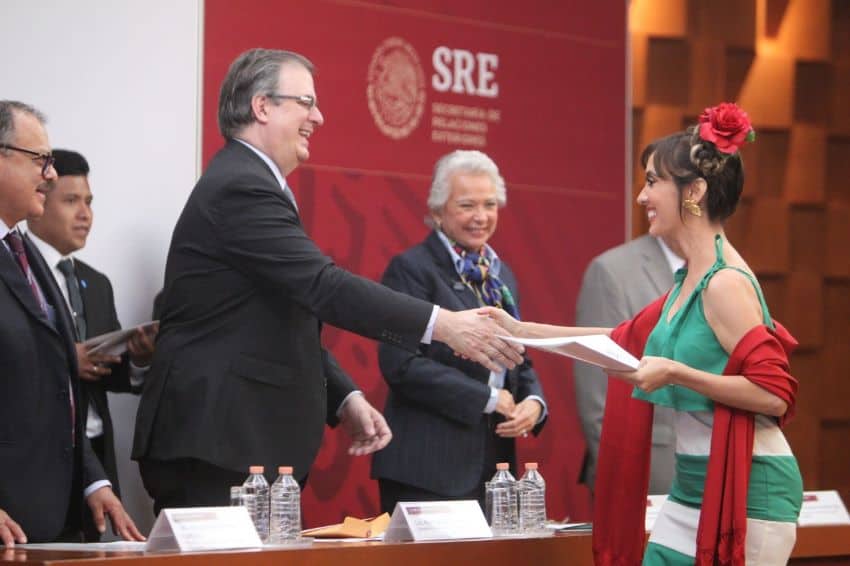
A woman receives her Mexican citizenship papers from Foreign Minister Marcelo Ebrard and Interior Minister Olga Sánchez Cordero in 2019.
Categories for allowing naturalization include family relationships (spouse, child or being a direct descendant of a Mexican), residency and recognition of contributions to Mexican society. The requirements include an exam on Mexican history and culture and a Spanish proficiency test. Requirements also change from time to time. One of the most recent changes came in 2019, allowing same-sex married partners of Mexicans to immigrate and naturalize equally.
The immigration advocacy group Sin Fronteras has been a longtime critic of Mexico’s requirements, which they claim discriminate, particularly against Central Americans. One issue, it says, is that the system has favored professionals and works against those from very poor countries. The group also claims that the Spanish-language requirement can work against those from indigenous communities in Central America.
Immigration and human rights lawyer Ela Janeth Valentín Jackson, whose family migrated from Honduras to Mexico, agrees with this assessment. She notes that the current large wave of immigration from Venezuela is not only because of that country’s dire situation but also because the migrating Venezuelans tend to be educated, which gives them an advantage even if they come with absolutely no economic resources.
The benefits of citizenship include political participation, a Mexican passport, the national voter ID card, the right to avoid most interactions with immigration and the ability to own property in Mexico’s restricted zones on the coasts and borders. Naturalized citizens often state that they feel that they are treated better by bureaucrats when they use the national voting card for identification.
The main reason that most permanent residents do not seek Mexican citizenship is that the benefits do not outweigh the effort to get it. One anonymous foreign resident puts it this way:
“The process is complicated, and permanent residency allows me to live here with my family, so there is no urgency.”
Mexico allows dual citizenship, and most other countries allow citizens to take a second national identity.
I can vouch for this. I have been eligible for eight years and only now am starting the process of applying for naturalization. The initial procrastination was due to the requirement of getting an apostilled copy of my New York State birth certificate (a nightmare). Now it is the studying for the test, which got harder in the last two years.
There can be other problems as well. For those considering naturalization, the requirement to “renounce” birth citizenship may be troubling. It does not mean that you must get your original country to negate your status with them. It means that you declare to the Mexican government that while in Mexico, you are a Mexican citizen and only a Mexican citizen. Most countries will not offer consulate protection while you are in Mexico. There are a few countries, such as Germany, the Netherlands and Japan, that can have further problems with dual citizenship, so it is best to check with your embassy prior to the process.
Naturalized Mexican citizenship is kind of a second-class version. Unlike birthright citizenship, naturalized citizens must maintain their status. Naturalized citizens are forbidden from taking on yet another naturalized citizenship from another country, accept certain titles from other countries and cannot live outside of Mexico for more than five consecutive years. Naturalized citizens can vote but can run only for certain political offices.
Most who get it do so because their spouse or children are Mexican citizens. This is particularly true for those who migrated from countries that are economically and politically stable. For those coming from less stable countries, Mexican citizenship can provide security. I should also note that several respondents I talked to from the U.S. and the United Kingdom indicated that recent sociopolitical developments in their countries are making them take a second look at becoming a Mexican national.
In an informal survey I conducted, Bob C. and others I communicated with state that they feel that they are treated better by bureaucrats when they use the national voting card for identification. Karen A. adds that it is “cool too — seeing the looks on faces when I show my ID!”
SRE has a website that explains the details of the requirements and the process — in Spanish — since one of the requirements of naturalization is proficiency in the language. The expat information website Mexperience recently published its 2021 update of the Mexico Immigration Guide, which does cover citizenship requirements.
• Special thanks to Ela Janeth Valentín Jackson for helping me verify and update the information on naturalization. She is located in Cuernavaca and can be reached at elahjaneth01@hotmail.com.
Leigh Thelmadatter arrived in Mexico 17 years ago and fell in love with the land and the culture. She publishes a blog called Creative Hands of Mexicoand her first book, Mexican Cartonería: Paper, Paste and Fiesta, was published last year. Her culture blog appears regularly on Mexico News Daily.
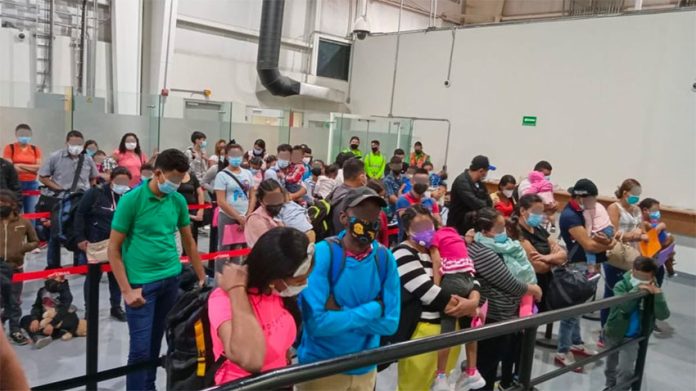
Migrants who were detained recently in Monterrey, Nuevo León.
Family service agencies (DIFs) have been overwhelmed by the recent surge of migrants under the age of 18, forcing authorities to send the youths to nonprofit shelters.
Between January 1 and March 21, the National Immigration Institute (INM) received 3,438 minors, both accompanied and unaccompanied by adults, while U.S. Customs and Border Protection reported the apprehension of 19,000 unaccompanied minors at the Mexico-U.S. border in March alone.
As a result, DIF offices have been overwhelmed by the young, mostly Central American migrants. In Veracruz, for example, the DIF in the capital city of Xalapa has lodging for only two to three migrant families.
“In Veracruz as well as Chiapas, the border states are saturated and turn-around has been delayed,” one DIF officer admitted in Veracruz. “It’s an incredible surge. Day after day, 30 to 50 families arrive, making for about 150 people [arriving daily].”
The officer said that families and unaccompanied minors are taken to nonprofit shelters based on instructions from the immigration institute, although the government does not have an agreement with those institutions.
One such shelter in Oluta, Veracruz, is overflowing.
“The shelter is full of children and families. The authorities bring them by the busload and then just leave. It’s a shame, same as in the U.S., but here it is 40 degrees. [Migrants are] poorly fed, poorly rested,” the administrator said.
In Nuevo León, the DIF has received more than 1,000 young migrants since January, up from 363 who were taken in during the entire year of 2020.
More than 171,000 migrants were apprehended by U.S. authorities at the Mexico-U.S. border in March, the highest monthly total in 15 years. One official predicted this week that more than a million migrants will arrive at the border this year, surpassing the 978,000 who arrived in 2019.
Nearly 20% of police suffer from a chronic health condition.
Municipal and state police are poorly trained and badly paid and half of the nation’s police officers suffer from work-related injuries or health conditions, according to data from the National Institute of Statistics and Geography (Inegi) and the nonprofit Causa en Común.
The lack of training and resources has come into the spotlight after the death of a Salvadoran migrant in Tulum, Quintana Roo, March 27. Two of the woman’s vertebrae were broken after a police officer held her down with a knee in the back.
A 2019 survey by Causa en Común showed that 19% of police had not received instruction on arrest and use of force and 29% had not received gender awareness training. Similarly, Inegi found in a 2017 national survey of police training standards that nearly 70% of police wanted to receive training on arrest tactics, detainee control and use of force.
Municipal police are the most lacking in pay and training. The 2017 survey found they have an average of 12 years of education. Nearly 25% have only elementary education, 63.5% have a high school diploma and 12.1% have attended college. The municipal force has a four to one ratio of men to women.
As for pay, a 2019 census found that just over 20% of municipal police officers earned 1,000 to 5,000 pesos a month (US $49 to $246) and 34.5% were paid 5,000 to 10,000 pesos ($246 to $492).
Nearly 20% of state and municipal officers have a chronic condition, with hypertension and diabetes being the most common, and 53% suffer from a work-related injury or health condition. The most common work-related health problems include weight gain or loss, anger, stress and cardiovascular conditions.
Daylight saving time for most areas of Mexico will begin Sunday at 2 a.m., when clocks will spring forward one hour. The change will apply to every state except Sonora and Quintana Roo, with the exception of the 33 northern border municipalities whose clocks changed last month.
Sonora will stay on Mexican Pacific Standard Time due to a 2016 agreement with the governor of Arizona, which created a commercial zone with shared time changes. Quintano Roo chose in 2015 to adopt Eastern Standard Time, the same as New York and Havana. The decision allows an extra hour of sunlight year-round for Quintana Roo’s many tourists.
Daylights saving time in Mexico lasts six months, ending October 31. The Trust for Electrical Energy Savings (FIDE) said the use of daylight saving time makes for better use of the available hours of sunlight, thereby saving energy during the times of highest demand.
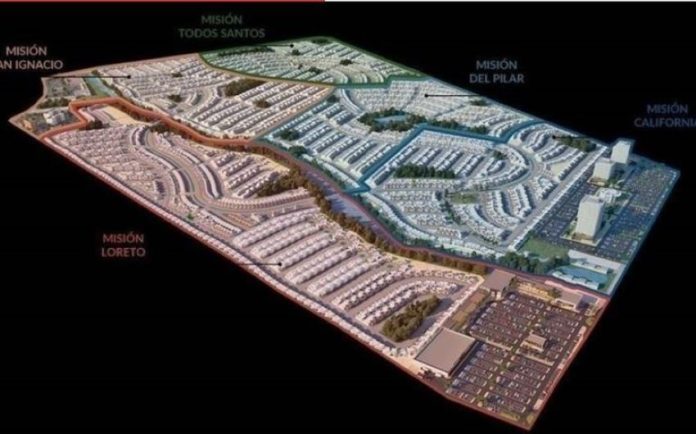
A scale model of the sprawling Misión Punta Norte project in La Paz.
A citizens group in La Paz, Baja California Sur, has launched a campaign against the construction of a 4,600-home development in the north of the city after the municipal council granted a change of land use that paves the way for the project to go ahead.
The organization Cómo Vamos La Paz, which claims that the Misión Punta Norte project will exacerbate water shortage problems in the city, launched an online petition on change.org against the development in order to pressure the local government to reconsider its decision.
The petition, which had been signed by more than 1,700 people as of 5:00 p.m. Friday, says the 203-hectare project is 6.5 times larger than the combined size of La Paz’s two largest malls.
It also states that the La Paz council doesn’t have the authority to approve a change of land use, as it did on Thursday last week.
The petition says there are two types of land use assigned to the property where the development is proposed, and neither is compatible with the project.
An architect’s rendering of part of the La Paz project.
“The city has serious water problems … with a deficit of 7.8 million cubic meters of water annually,” the petition says, adding that supplying water to 4,600 additional houses, two new shopping centers and other businesses will negatively impact supply to existing homes, including those in neighborhoods where there are already shortages.
The newspaper El Sudcaliforniano reported that the project could consume up to 2 million cubic meters of water per year.
Cómo Vamos La Paz also raised concerns about the pressure the new development will place on public services, including garbage collection and public transit.
The petition urges La Paz Mayor Rubén Gregorio Muñoz Álvarez and councilors to act in accordance with the law and reconsider the approval they granted in order to prevent a negative impact on “those of us who live in the city and future generations.”
Alma Lidia Cota Ojeda, a director of Cómo Vamos La Paz, said the organization is aware that legal action against the project might be necessary. She explained that the petition is designed to raise awareness about the development and its negative impacts.
“The objective of this initiative is to keep the issue on the public agenda,” she said.
The news website Peninsular Digital reported that one of the real estate companies involved in the project, Century 21, has links to Mayor Muñoz, who voted in favor of the development.
It also reported that his government placed three conditions on the change of land use granted: the developer of the project must build a desalination plant and a wastewater treatment plant, and the development must establish its own system for providing services such as garbage collection and street lighting.
Arturo Rubio Ruiz, a lawyer, questioned whether the council will maintain its commitment to those conditions and shared the citizens group’s view that the project is illegal.
He said 80% of the proposed construction site lies within an ecological reserve where construction is illegal. Rubio also agreed that the development will place significant additional pressure on La Paz’s limited water supply. He added that a desalination plant at the site would cause contamination and the plan to outsource the provision of public services is unviable.
“Are they serious? The majority of municipal services can’t be offloaded to private companies. Firefighting services, public security … garbage [collection], wastewater treatment plants … What did they smoke at that session?” he asked, referring to the council meeting at which the change of land use application was approved.
Every cloud has a silver living: that’s a modestly comforting expression to add a little good cheer to every difficult situation in practically every culture on Earth.
In Mexico the expression is “Es un mal viento que no sopla bien” (It’s an ill wind that blows no good). The pandemic, a struggling economy and the northbound crossing of the country by scores of impoverished refugees have added up to ample good cheer for a venerable profession in almost every town in Mexico.
Pawnbrokers.
Casas de empeño.
And you.
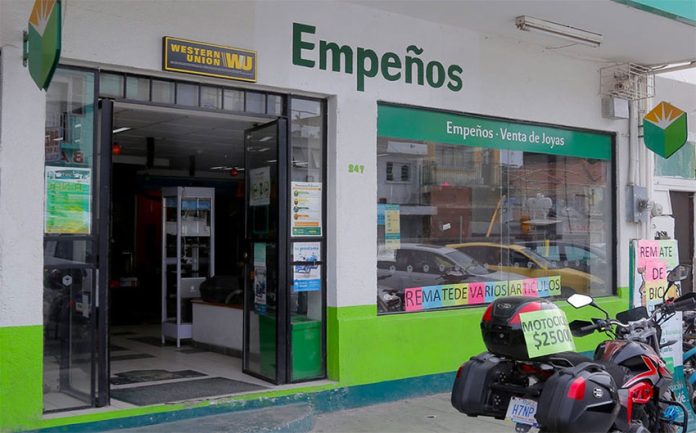
Every town in Mexico of a certain size has seen an explosion of pawnbrokers, usually clustered together, often in a single block. Have a look, next time you are at home or in an unfamiliar town. I’ve seen clusters from Matamoros on Mexico’s northern border to Comitán to the south. But don’t look for the three balls you may be familiar with elsewhere. Their origin is debatable, but not Mexican.
Medici? Norse gods? Las Vegas?
Although they’ve been given new breath by a popular TV show in the U.S., most of us, excepting inveterate and unlucky casino-goers, have probably never been in a pawnshop, but maybe now’s the time — on the buy side, not necessarily the pawn side.
Forget the pawn side, remember that Shakespeare’s Shylock is synonymous ( erroneously) with pawnbroker, but on the other side: I am writing this on a nifty 19″ monitor acquired just across the border in Comitán, at a pawnshop, at a fraction of comparable retail.
As times have advanced since Shakespeare’s day, pawnable items have keep pace. It’s no wonder that the swords, jewelry and mantles of the 16th century have given way to watches, cell phones, TVs, household appliances, computers and, in my case, a 19″ Taiwanese monitor.
So the next time you’ve out and about, remember the verb, empeñar. Get to know your local prestamista: maybe he’ll turn up some old musical instruments or furniture or some sports gear.
Carlisle Johnson writes from his home in Guatemala.
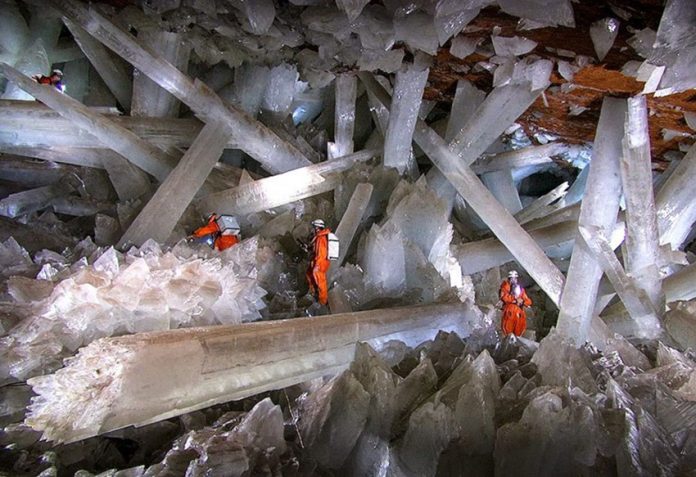
The Naica Crystal Cave, only ever accessible from a mine in Chihuahua but now completely submerged underwater, has bizarrely long, thick crystals.
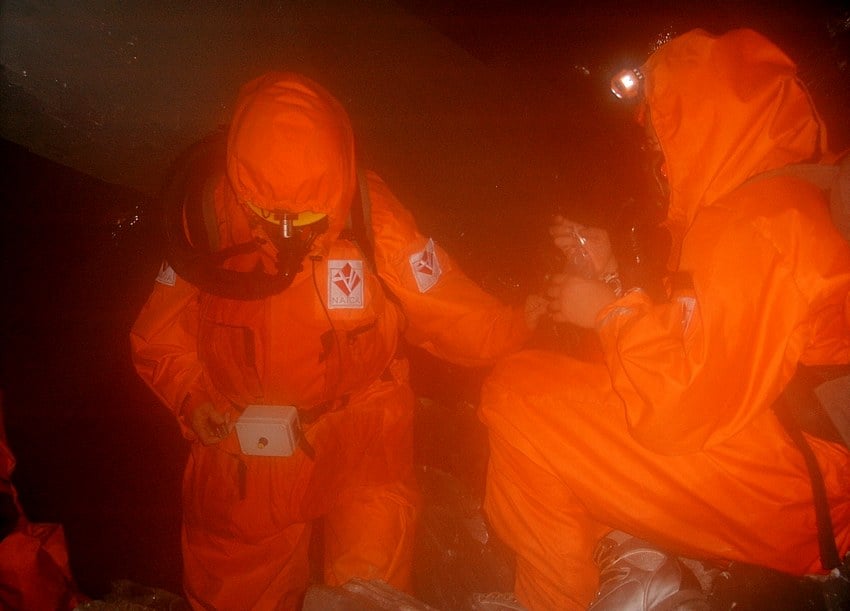
Its enormous crystals were up to 14 meters long and two meters thick, located inside a cave so hostile that no one could stand to be inside it for more than a few minutes: the whole world was stunned when the first pictures of the Naica Crystal Cave went viral.
As we celebrate the 20th anniversary of the cave’s discovery, it still leaves us gasping in astonishment.
This incredible cave is one of very few places that could be called — in the same breath — “the most beautiful place on earth” and “one step away from Hell.” It was only ever accessible from a tunnel in the Naica Mine, the largest lead, zinc and silver mine in Mexico, operated in Chihuahua by Industrias Peñoles, but today both that tunnel and the cave are entirely under water. But that may actually be to the natural phenomenon’s benefit.
Recently, I caught up with speleologist and historian Carlos Lazcano, the first scientist ever to set foot in the Naica Crystal Cave. Here is his recollection of that experience:
“Twenty years ago, several of my fellow students of geology happened to be working in mines in Chihuahua, and one day I went over there to hang out with them a bit. This is how I bumped into the foreman of the Naica mine.
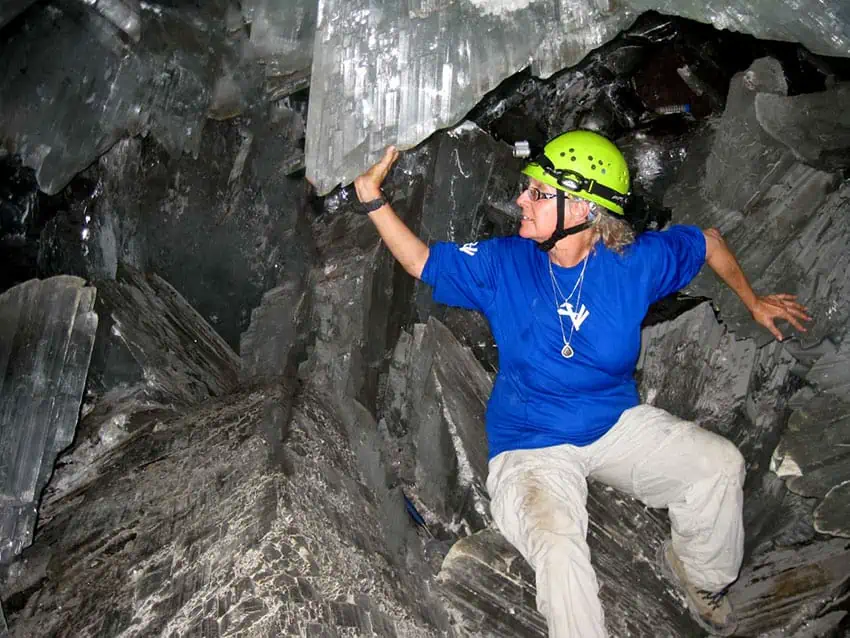
Penny Boston: “The crystals are amazingly sharp. I cut my hand on that one.” Michael N. Spilde
“As we were chatting, he mentioned that they had dug a new side tunnel with the idea of installing an air-conditioning unit there for the deepest levels of the system. In the process, he said, they had broken into a new cave: would I like to take a look at it?
“I told him I certainly would, and as soon as possible because I knew that the previous caves they had found in Naica contained large crystals. The most famous was La Cueva de las Espadas, the Cave of Swords, which had been discovered in 1910. Although the cave had been systematically trashed for 100 years, it still boasted crystals up to four meters in length, and it was so fascinating that I was really curious how it must have looked the first time they entered it.
Lazcano found his answer when he stepped into La Cueva de los Cristales.
“It was a surprise with capital letters! I was amazed not only at the size of the crystals but also at the aggressiveness of the environment surrounding them. The temperature was 50 degrees Centigrade (122 F) with 100% humidity.”
By chance, Lazcano got a visit from Claude Chabert, one of France’s most famous cavers.
“In April or May of 2000, we got full authorization to explore the cave, so the two of us were the first speleologists to try to study it. Both of us were excited by those bizarre giant crystals, but at the same time, we just couldn’t believe how hostile the cave was. We couldn’t stay in it for more than five minutes at a go! If we tried to make it to six minutes, we felt like we were dying!”
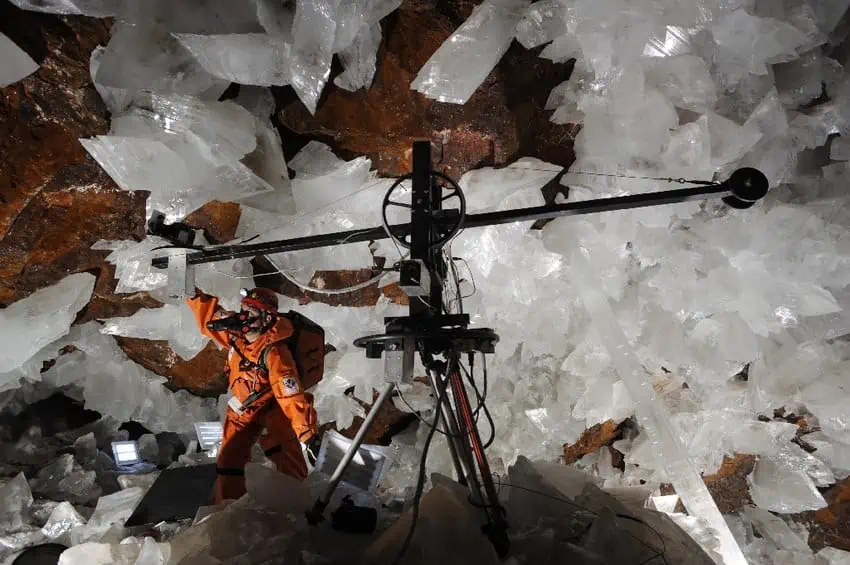
Due to the heat, Mexican filmmaker Gonzalo Infante’s robot camera had to shoot his documentary about the cave one frame at a time.
That’s when it occurred to him to contact his friends at Italy’s La Venta Association, which organizes scientific underground expeditions. He knew that they had explored volcanic caves there where the temperature was around 80 degrees Celsius (176 F), so he wrote to them and sent them pictures.
“I couldn’t believe how fast they showed up here … and that’s how Project Naica got started!”
The Naica Project, which consisted of 12 working trips to explore the cave and study everything in it, was organized by La Venta Exploring Team, which got its name from a 1990 speleo-archaeological project along Rio La Venta in Chiapas. Here, the team discovered and studied dozens of caves, most of them used by the Zoque Indians as long ago as B.C. 300. Since then, La Venta has carried out projects from Myanmar to Patagonia.
I have the privilege of knowing some of the scientists who participated in the Naica Project and asked them for their comments on working in this cave. One of those scientists is Professor Paolo Forti of the University of Bologna. Forti is coauthor of the book Cave Minerals of the World and past president of the International Union of Speleology. He is also one of the funniest men I’ve ever met and had us all in stitches when he showed up on an expedition to Saudi Arabia’s desert caves wearing a business suit.
“Don’ta worry,” he told us in his uniquely Fortian English. “In one minute I now transform myself into a real caver!” And from his pocket he pulled a most amazing paper boilersuit made of indestructible Tyvek.
“What was it like working in that cave?” I asked Forti.
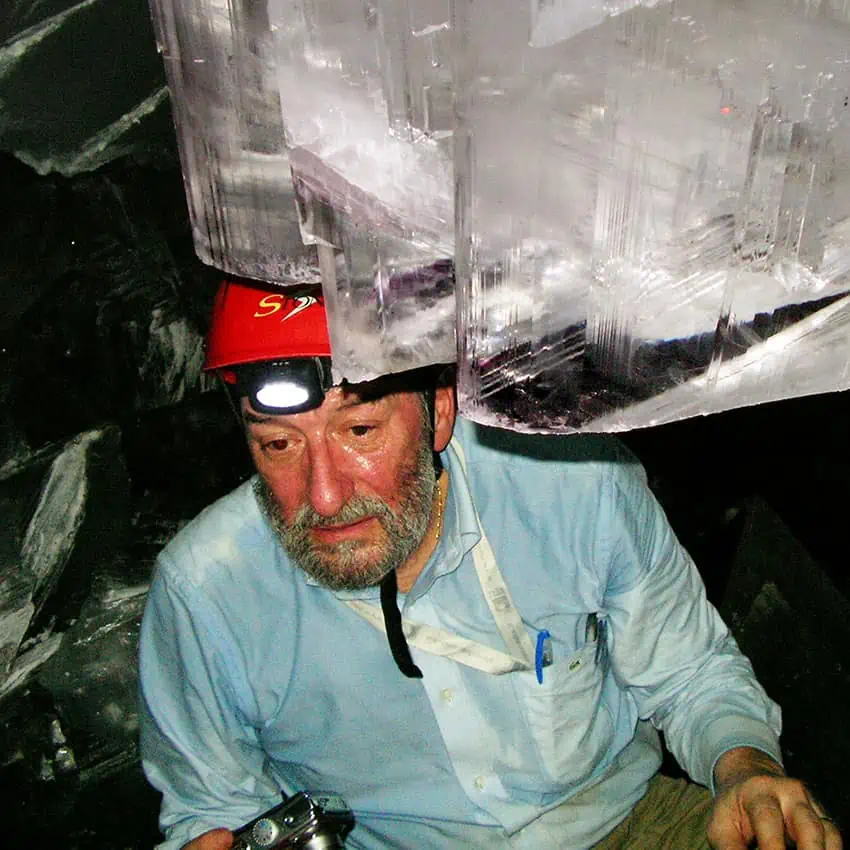
Mineralogist Paolo Forti inside the cave without a cooling suit.
“Never in the wildest dreams of my youth,” he said, “did I imagine seeing crystals such as these, così belli, così perfetti (so beautiful, so perfect). In theory, perfection doesn’t exist in this world, but the closest things to perfection on our planet are the crystals of Naica. So I must say that the Naica ‘adventure’ was probably the most exciting and scientifically productive activity of all my speleological life.”
The other Naica researcher I know is Dr. Penelope “Penny” Boston, famed among cave scientists for her studies of Cueva de la Villa Luz in Tabasco, which is the home of “snottites,” stalactite-shaped living colonies of bacteria which produce concentrated sulfuric acid.
Today she works with NASA and is a leader in designing techniques for the exploration of lava tubes on Mars.
“How did you find the Crystal Cave?” I asked her.
“Hahaha … hot!” she replied. “It was like being in a sauna for a long time while climbing around with difficult footing and trying to do delicate scientific operations all at the same time. It was extremely challenging.”
I knew she went into Naica looking for signs of life hidden inside the crystals. “Did you find something?” I asked her.
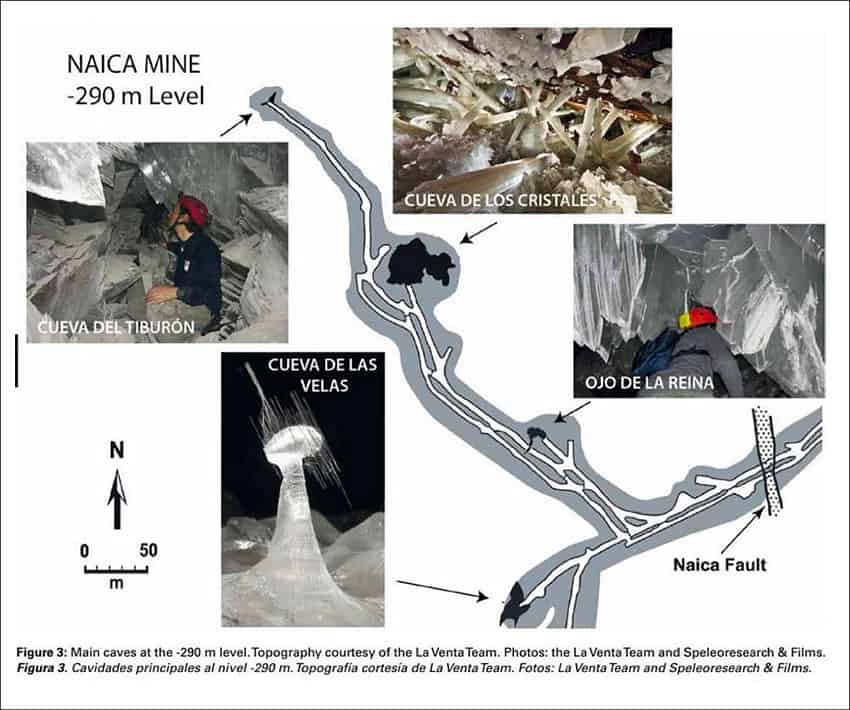
Map of the main crystal caves at the -290 meter level.
“Yes,” replied Boston. “We grew a number of interesting microbial cultures taken from fluid in the inclusions we extracted from the giant crystals. We also studied organisms that we took from the amazing red material on the walls. That material appears to be clay and iron oxides ‘glued’ together by a mesh of microbial filaments.”
In 2017, Boston announced that the cultures she and her colleagues had grown from the dormant microbes inside the crystals were genetically distinct from anything known on Earth. She also suggested that those microbes must have been trapped inside the crystals for somewhere between 10,000 and 50,000 years.
When I asked her if she had any other comments about her
extraordinary experience, Boston’s eyes went dreamy.
“The beauty of the environment was completely entrancing. It was a precious gift to be able to experience that amazing place and to help promote the scientific understanding of how this system came to exist and [of] the wonderful micro-organisms that are living in this extreme environment,” she said. “The first time I entered … tears came to my eyes and I put my arms around some of the giant crystals and felt that I was actually a part of the cave system. That day, when I got out, I wrote a poem about it.”
At the height of Project La Venta — Mexican cinematographer Gonzalo Infante decided to make a documentary inside Naica in order to allow the world to see what could surely be called “The Eighth Wonder.”
Researcher Penny Boston says of the cave’s heat, “Everything instantly fogs up, including your glasses and your camera lens.” Tom Kieft
Every video camera tested by Infante failed, and they finally resorted to using a robot-mounted Nikon still camera to literally shoot the movie one frame at a time. “To get 10 seconds of movie, the robot had to shoot stills for six hours,” said Infante. “Many times, we just left the thing on, and it would run all night long.”
A few years ago, the Naica miners broke into an aquifer. Try as they might, they were unable to stop the flow of water. As a result, that part of the mine —and the cave — are now flooded.
But nothing could be better for those giant cave formations, which were already beginning to deteriorate once they were immersed in air instead of water. Today they are protected and who knows — someday in the future, mankind may again gaze, for a few brief moments, upon the world’s largest natural crystals.
To commemorate the 20th anniversary of Naica’s discovery by the scientific community, Naica the Crystal Caves, a 255-page English-language coffee table book with spectacular photos, will be published this year by La Venta Association.
The writer has lived near Guadalajara, Jalisco, for 31 years and is the author of A Guide to West Mexico’s Guachimontones and Surrounding Area and co-author of Outdoors in Western Mexico. More of his writing can be found on his website.
María Eugenia Campos accused the state governor of political persecution.
A judge has ordered a candidate for governor in Chihuahua to stand trial on charges she accepted bribes while she was a state lawmaker.
María Eugenia Campos, National Action Party (PAN) candidate for governor, and two other former lawmakers, Rodrigo de la Rosa and María Ávila Serna, allegedly received millions of pesos in illicit payments during the 2010-2016 Chihuahua government led by former governor César Duarte, who was arrested in the United States on corruption charges last July.
Judge Samuel Uriel Mendoza Rodríguez determined that there was sufficient evidence for the case to go to trial.
The Chihuahua government said Thursday night that the judge had accepted prosecutors’ accusations that resources were illegally diverted from the state Finance Ministry to the three ex-lawmakers. The allegedly illegal payments were made as part of a corruption scheme known as “secret payroll” in which Duarte was supposedly involved.
The Chihuahua government asserted that Campos, who left her position as mayor of Chihuahua to contest the June 6 election, received 9 million pesos (US $443,000 at today’s exchange rate) from César Duarte, who is fighting extradition to Mexico.
Some of that money allegedly went to César Jáuregui Moreno, another former PAN lawmaker.
The government claimed that de la Rosa, a former Institutional Revolutionary Party lawmaker in Chihuahua, received 2.5 million pesos and 3.8 million pesos went to Ávila, who represented the Ecological Green Party in the federal Congress.
A fund of 1 billion pesos (US $49.2 million) was used to make illicit payments in the “secret payroll” scheme, according to Chihuahua authorities.
The three lawmakers were not remanded in custody but the judge ruled that they cannot leave the country. Mendoza granted prosecutors a six-month period to conduct further investigations before the case proceeds to trial.
Campos accused current Chihuahua Governor Javier Corral, a fellow panista – as members, supporters and representatives of the PAN are known – of leading a campaign of political persecution against her. She also accused Chihuahua government general secretary Luis Fernando Mesta Soulé of conspiring against her.
Their aim, Campos said, is to “hand over the state to the Morena,” an accusation that is surprising because Corral has been a staunch critic of the ruling party founded by President López Obrador.
But the governor and Campos have had a testy relationship and the former has not supported the latter’s candidacy.
Campos said she would not suspend her campaign despite the accusations she faces, pointing out that she hasn’t been convicted of any crime.
“I want to make it very clear that this … [decision] is not a sentence and doesn’t affect my political rights to vote and be voted for,” she said on Twitter.
PAN national president Marko Cortés and former president Vicente Fox are among a range of political figures who have expressed their support for Campos, who is widely known as Maru.
“Maru will overcome!! The forces of evil will not prevail!!” Fox said on Twitter.
Two CJNG vehicles abandoned in Zamora, Michoacán, after a shootout in May 2019.
Eight decapitated bodies have been found in the Michoacán municipality of Aguililla, the state Attorney General’s Office announced Thursday. The killings are believed to be the result of confrontations between the Jalisco New Generation Cartel (CJNG) and the Cárteles Unidos, which are in the midst of a territorial dispute.
The eight men’s bodies were found after authorities received a report of possible crimes in the town of La Enramada. Upon investigation, forensic services found the mutilated bodies, which also bore gunshot wounds.
“The bodies were taken by medical forensic services for legal autopsy and continued investigation,” said the state attorney general.
In 2020, more than 50% of intentional homicides were associated with six criminal groups, including the CJNG. Last year Michoacán registered 50.4 intentional homicides per 100,000 residents, nearly double the national average.