Home Blog Page 1479

Covid reproduction number uncontrolled in 15 states, allowing virus to spread

0
Efforts to limit crowds in Mexico City have been unsuccessful since businesses began reopening two weeks ago.

Mitigation measures failed to keep the basic reproduction number for coronavirus below 1 in 15 states between the end of May and the end of June, a situation that allowed local epidemics to grow.

Data presented by health officials at Monday night’s coronavirus press briefing showed that the reproduction number (the number of people each infected person infects) was above 1 between May 28 and June 26 in Baja California Sur, Coahuila, Colima, Durango, Guanajuato, Hidalgo, Nayarit, Nuevo León, Quintana Roo, San Luis Potosí, Tamaulipas, Tlaxcala, Veracruz, Yucatán and Zacatecas.

Deputy Health Minister Hugo López-Gatell noted that in states where there is a reproduction number of 1, or R1, the size of the local coronavirus epidemic will remain unchanged.

“The epidemic will continue, it won’t end but it won’t increase either,” he said.

If the reproduction number is above 1, the size of the epidemic will grow and if it is below 1 it will decrease, López-Gatell said.

Active coronavirus case numbers in the past month show a steady increase.
Active coronavirus case numbers in the past month show a steady increase. mexico news daily

The deputy minister stressed that a reproduction number below 1 is needed in order to “begin to control the epidemic,” adding that the purpose of presenting the data for each of Mexico’s 32 states was not to scold state governments for their management of the coronavirus crisis nor apportion blame to them.

“What we’re presenting here is not a reprimand in any way, … it’s a technical reality. Achieving control [of the pandemic] is a huge challenge for society and for governments,” López-Gatell said.

He also said that it’s likely that Covid-19 will remain a threat for two or three years.

“We’re talking about two or three years in which [the virus] will return again and again in small, medium-sized or large outbreaks. It’s important to be aware that prevention doesn’t just depend on general instructions from the government nor on a prohibition on occupying public spaces or carrying out activities,” López-Gatell said.

It is “very advisable” that people make changes to their everyday lives in order to mitigate the risk of contracting coronavirus, he added.

Across Mexico, the number of people confirmed to have been infected since the beginning of the pandemic exceeded 300,000 on Monday.

Covid-19 death figures as of Monday.
Covid-19 death figures as of Monday. milenio

Health officials made no mention of the accumulated case tally nor the Covid-19 death toll at last night’s press conference but data published on the federal government’s coronavirus website showed that the number of confirmed cases in Mexico had risen to 304,435 with 4,685 additional cases registered.

An additional 485 Covid-19 fatalities were also registered, lifting Mexico’s death toll to 35,491.

Of the confirmed cases, 28,843 are considered active, meaning that many people tested positive after developing coronavirus symptoms in the past 14 days.

The number of active cases has increased by 28.8% over the past month, peaking at more than 30,000 last Saturday before declining slightly on both Sunday and Monday.

There are also 76,824 suspected coronavirus cases across the country, meaning that the results of that number of tests are not yet known.

Mexico City continues to lead the country for accumulated and active coronavirus cases even though the reproduction number in the capital dropped below 1 in June. It has recorded 58,114 confirmed cases since the beginning of the pandemic, of which 4,195 are currently active.

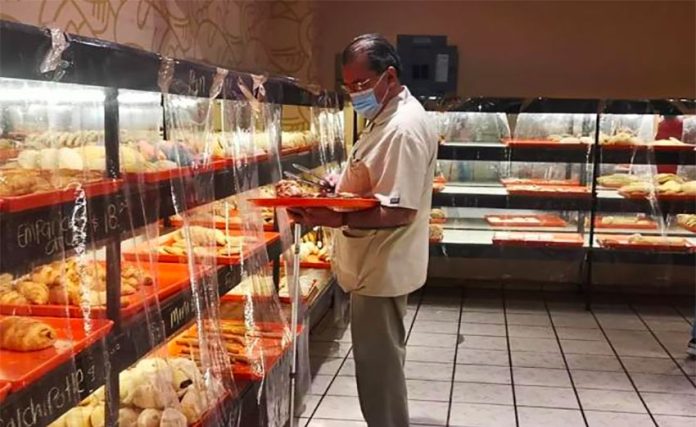
Most of those present observed coronavirus health protocols when President López Obrador ate at a Mexico City restaurant on Monday.

The capital also has the highest Covid-19 death toll in the country, with 7,722 confirmed fatalities as of Monday.

Source: El Universal (sp) 

Here are some recipes that make zucchini look more enticing

0
Squash and prosciutto, grilled and served with mint sauce.

It seems I’ve always had a love/hate relationship with zucchini. Not hate, really — more of a pronounced ambivalence coupled with the feeling that I’m often forced to choose between it and broccoli as the only ways to get some green into my system. Así es.

As another of my quarantine-in-the-kitchen activities, I’m trying to change that mindset. My research has turned up some very interesting and amusing info about this humble FRUIT. Yes, although treated and cooked like a vegetable, botanically speaking zucchini is a fruit. (Who knew?!) It’s the ovary of the flower, and although both male and female plants produce flowers, only the female flowers go on to produce fruit.

Squashes were first documented in Mesoamerica (the area from Central Mexico south through Guatamala, Honduras, Nicaragua and Costa Rica); and the predecessor to modern-day zucchini was called ayokonetl in Náhuatl. It made its way to Europe in the 16th century, where it took several hundred years to develop into the zucchini we know today.

The Italians enthusiastically adopted the tender green squash, calling it zucchino (masculine) or zucchina (feminine), derived from zucca, the word for squash or pumpkin. “Zucchini” is the masculine plural, used in many countries, and courgette and marrow are used in France, Quebec, the U.K., South Africa and throughout Asia and New Zealand.

Whatever name you use, choose the smallest, youngest, freshest zucchini you can find, as then the flesh is firm and the seeds have not developed as much. It’s those seeds that make the squash watery, bitter or fibrous. And you want them to be firm, not rubbery.

This zucchini pizza crust is tasty enough to eat on its own.

Some chefs say another way to combat the bland mushiness so often associated with zucchini is to cook them fast, at high heat, in whatever recipe you’re using. That traps in the juiciness and allows their natural buttery flavor to remain. Some also recommend salting the sliced squash before cooking — like you’d do with cucumbers — to draw out some of the water and “firm up the flesh.”

Here’s how: slice zucchini however the recipe calls for. Place in a colander or bowl and sprinkle generously with salt. Let sit for at least an hour. Blot the slices with paper towels to remove the excess salt and moisture, and then continue with your recipe.

Zucchini Crust Pizza

This crust is so good you’ll be tempted to just eat it as is!

  • Olive oil and flour for the pan
  • 2 cups packed grated zucchini (about 2 chubby 7-inchers)
  • 2 eggs, beaten
  • 1/3 cup flour
  • ½ cup grated mozzarella
  • ½ cup grated parmesan
  • Optional: dried basil or marjoram
  • 2 Tbsp. olive oil
  • Toppings: tomato sauce, cheese and standard pizza toppings

Preheat oven to 400 F. Oil a 10″ pie pan and coat lightly with flour. Combine zucchini, eggs, flour, mozzarella, parmesan, herbs and 1 Tbsp. oil in a bowl and mix together thoroughly. Spread mixture in prepared pan and bake 35-40 minutes or until golden brown. Halfway through baking, remove from oven, brush with remaining 1 Tbsp. oil. Return to oven. Remove crust from oven; let cool for 10 minutes before using a spatula to loosen it from the pan. Add pizza toppings and bake again for 10 minutes until heated through and cheese melts.

Grilled Squash Ribbons & Prosciutto with Mint Dressing

  • 1 tsp. finely grated lime zest
  • ¼ cup fresh lime juice
  • ¼ cup chopped mint
  • 2 garlic cloves, very finely chopped
  • ¼ cup extra-virgin olive oil, plus more for brushing
  • Salt & freshly ground pepper
  • 2 medium zucchini
  • 2 medium yellow squash
  • 6 oz. thinly sliced prosciutto

Light grill or preheat a grill pan. In a small bowl, combine zest and juice with mint, garlic and the ¼ cup of olive oil. Season with salt and pepper; set aside. Using a mandoline or wide peeler, slice squash very thin lengthwise. Thread zucchini, yellow squash and prosciutto onto four pairs of 12-inch skewers, folding slices back and forth. Lightly brush vegetables and prosciutto with olive oil and season generously with salt and pepper. Grill over high heat until the squash ribbons are lightly charred, about 1½ minutes per side. Serve with mint dressing.

Zucchini Tomatillo Bisque

A smooth, satisfying soup with a bit of heat.

  • 2 Tbsp. olive oil
  • 2 Tbsp. butter
  • 2 cloves garlic, minced
  • 2 medium onions, chopped
  • 6 medium zucchini, chopped or coarsely grated
  • 1-2 medium dried colorado or ancho chiles, seeded and chopped
  • 1 jalapeño, seeded and chopped
  • 6 tomatillos, husked and chopped
  • 6 cups vegetable or chicken stock
  • 5 corn tortillas
  • 1-2 Tbsp. fresh lime juice
  • 1/3 cup cilantro leaves, chopped
  • Salt and pepper

In large saucepan, heat oil and butter, add garlic and onions and sauté until softened. Add zucchini, chiles and tomatillos, stirring until heated through. Add stock, bring to boil, then cover and simmer 20 minutes. Tear tortillas into pieces and add to soup; stir in lime juice and cilantro. In a blender or food processor, purée soup in batches until smooth. Return to pan and heat through. Add salt and pepper to taste. Serve topped with sour cream, crumbled tortilla chips and cilantro. – “More Recipes From A Kitchen Garden,” by Renee Shepherd

Combine zucchini with pine nuts to make this pound cake.

Zucchini & Pine Nut Pound Cake

  • 10 Tbsp. butter
  • 3 small zucchini
  • 1 lemon
  • 4 eggs
  • 1¼ cup sugar
  • 1 tsp. vanilla
  • 2 cups flour
  • 1 tsp. salt
  • 1½ tsp. baking powder
  • 2/3 cup pine nuts

Melt butter over low heat. Without salting, grate zucchini coarsely and set aside. Preheat oven to 425. Zest the lemon and juice; set aside. Blend eggs, melted butter, sugar and vanilla in a food processor, then add zest and lemon juice. In a bowl, mix flour, salt and baking powder, then add this in batches to the mixture in the food processor. Beat till smooth, return to bowl and add grated zucchini and pine nuts. Grease and flour a loaf pan and pour in batter. Smooth the top, bake for 10 minutes, then lower temperature to 350 and bake for another hour. –Roger Verge’s “Vegetables in the French Style”

Janet Blaser has been a writer, editor and storyteller her entire life and feels fortunate to be able to write about great food, amazing places, fascinating people and unique events. Her first book, Why We Left: An Anthology of American Women Expats, is available on Amazon. Contact Janet or read her blog at whyweleftamerica.com.

Missing persons total reaches 73,000, up 11,500 since January

0
One of many marches for the missing held over the years.

There are 73,201 missing persons in Mexico, according to a federal government report presented on Monday.

The figure – a record high – is 11,564 higher than the number of missing persons reported in January by the the National Search Commission (CNB).

Presented by Interior Minister Olga Sánchez and Deputy Interior Minister Alejandro Encinas, the new CNB report says that 97.9% of the more than 73,000 people currently missing disappeared after 2006, the year in which former president Felipe Calderón launched the so-called war on drugs.

The remaining 2.1% of missing people disappeared in the years between 1964 and 2006.

Since the former year, a total of 177,844 people have been reported as missing, of whom 104,643, or 58.8%, were located. A total of 98,242 missing persons, 93.9%, were found alive, while 6,401 of those located, 6.1%, were dead.

Encinas said that 63,523 people have been reported as missing since the current federal government took office at the end of 2018. Of that number, 35,652 people have been located, he said.

That means that 27,871 people who were reported missing in the past 1 1/2 years are still unaccounted for.

The states with the highest number of missing person reports during the federal government are, in order, México state, Jalisco, Tamaulipas, Veracruz and Sinaloa.

Encinas said that 1,146 hidden graves containing 1,682 bodies have been exhumed in the 19 months the administration led by President López Obrador has been in power. Just over 42% of the exhumed bodies – 712 – have been fully identified, he said.

The deputy minister has previously described all of Mexico as an “enormous hidden grave.”

Almost 60% of the hidden graves found between December 2018 and June 2020 were located in just five states — Veracruz, Sinaloa, Colima, Guerrero and Sonora. Crime gangs have a strong presence in all five.

While the federal government and state authorities have faced criticism for not doing enough to locate Mexico’s many missing persons, the former appears to be making progress in arguably the most prominent abduction case in recent years.

The government announced last week that the remains of one of 43 teaching students kidnapped in Guerrero in 2014 had been identified by forensic scientists at the University of Innsbruck in Austria.

Source: La Jornada (sp), Milenio (sp) 

Cancún airport reopens Terminal 2 for domestic flights

0
cancun airport
International flights easily outnumbered domestic ones.

Citing the fact that Quintana Roo has been allocated an orange coronavirus risk rating and is allowed to open 172 kinds of public activities, Cancún International Airport authorities have announced the reopening of Terminal 2 on Tuesday.

“With the reactivation of hotels at 30% occupancy, in accordance with [Mexico’s Covid-19] stoplight rating of orange for Quintana Roo, and after a deep analysis of the probability of airlines renewing flights …we’ve decided to reopen operations in Terminal 2 at midnight on July 14 for domestic flights by Viva Aerobus and Volaris …” said airport spokesman Eduardo Rivadeneyra.

Since April, when airline activity at the airport dropped by more than 80%, the airport has been operating with only Terminal 4 open, a newer international terminal.

In the past six months, the number of international travelers has decreased more than 50% compared to the first six months of 2019, when 8.9 million international travelers used the airport, compared to 4.2 million during the same period in 2020, according to Aeropuertos del Sureste, which manages nine airports in Mexico, including Cancún’s. Overall, Mexico experienced a 90.4-percent decrease in total domestic and international air travel in June, in comparison to figures for June 2019, according to the organization.

The airport will require both incoming and outgoing travelers to submit to the Mexican Health Ministry’s required screening traveler questionnaire for Covid-19 risk factors, and to body temperature checks, Rivadeneyra said. The airport will also provide access to medical personnel who can assess persons displaying risk factors and direct them to clinics for further investigation and treatment.

According to Viva Aerobus’s website, it is currently offering 15 flights in and out of Cancún between Mexican cities only. Volaris Airlines is offering flights in and out of Cancún, but only between Mexican destinations. 

U.S.-based airlines such as Spirit and Delta have been increasing the number of flights in and out of Cancún since June and are currently flying between Cancún and U.S. destinations. Delta Airlines added seven weekly flights at the beginning of July. Spirit is offering daily flights to and from Cancún from some U.S. cities.

Source: El Economista (sp)

34 areas in Mexico City designated red on virus risk stoplight map

0

The Mexico City government announced on Sunday that 34 neighborhoods and towns in the capital will be given special attention in order to reduce their high number of active coronavirus cases.

High-risk “orange light” coronavirus restrictions will remain in place in most of Mexico City this week but the 34 areas where 20% of the capital’s active coronavirus cases are located will be painted maximum risk red on the “stoplight” map as of Wednesday.

The Covid-19 hotspots are located across 13 of Mexico City’s 16 boroughs. They are:

  • The colonias (neighborhoods) of Olivar del Conde Section 1, Olivar del Conde Section 2 and San Bartolo Ameyalco in the western borough of Álvaro Obregón.
  • Aldana in the northern borough of Azcapotzalco.
  • Ajusco, Pedregal de Santo Domingo, Pedregal de Santa Úrsula and Adolfo Ruiz Cortines in the southern borough of Coyoacán.
  • Doctores and Guerrero in the central borough of Cuauhtémoc.
  • Nuevo Atzacoalco in the northern borough of Gustavo A. Madero.
  • Lomas de San Lorenzo in the eastern borough of Iztapalapa.
  • Cuauhtémoc, San Bernabé Ocotepec, Barros Sierra, La Malinche, El Tanque and Las Cruces in the southwestern borough of Magdalena Contreras.
  • Anáhuac and Tlaxpana in the northwestern borough of Miguel Hidalgo.
  • The pueblos (towns) of San Salvador Cuauhtenco, San Pablo Oztotepec and San Antonio Tecómitl in the largely rural southeastern borough of Milpa Alta.
  • San Francisco Tlaltenco in the southeastern borough of Tláhuac.
  • San Miguel Topilejo, El Capulín and San Pedro Martir in the southern borough of Tlalpan.
  • The neighborhood of 20 de Noviembre in the eastern borough of Venustiano Carranza.
  •  The pueblos of San José Zacatepec, San Gregorio Atlapulco, Santa María Nativitas, Santa Cruz Acalpixca, Santiago Tepalcatlalpan and San Lucas Xochimanca in the southern borough of Xochimilco.

The three boroughs with no identified hotspots are Benito Juárez, Cuajimpalpa and Iztacalco.

The Mexico City government said there will be an “intervention” in the 34 “red light” areas aimed at reducing economic and everyday activities, providing support that allows people to stay at home and ensuring that citizens have access to health care.

City officials will go house to house in the identified colonias and pueblos to provide medical advice, carry out health checks and perform Covid-19 tests, while health “kiosks” will be set up in the maximum risk areas for the same purposes.

The government will also carry out information campaigns, including by loudspeaker, that seek to educate residents about coronavirus prevention measures and encourage them to stay at home.

Families with a member who has tested positive for Covid-19 will be provided with food, medical and financial aid and doctors will offer medical advice to patients in home quarantine.

Street markets will be prohibited in the “red light” areas, with stallholders to be offered financial assistance, and authorities will carry out a deep clean of public spaces.

The identified hot spots will keep their designation for at least 15 days, and new entries and omissions to the “red light” list will be announced on Sundays.

Mexico City has recorded 57,674 confirmed coronavirus cases since the start of the pandemic, according to official data, of which 4,477 cases are considered active.

The capital has also recorded 7,657 confirmed Covid-19 deaths although the real number of fatalities is widely believed to be much higher.

Source: El Universal (sp) 

Mexico City journalist Jo Tuckman loses fight against cancer

0
Tuckman was highly respected among foreign and Mexican journalists.

When British journalist Jo Tuckman was diagnosed with cancer last year, friends told her to leave Mexico and go back to England for medical care, but the longtime Guardian writer refused, saying Mexico was her home, according to friend Marion Lloyd.

“She absolutely loved Mexico,” Lloyd told The Guardian after Tuckman’s death last Thursday.

Tuckman, 53, who had been undergoing cancer treatments since her diagnosis, died in the Mexico City home where she conducted one of her last interviews for The Guardian — that of exiled Bolivian president Evo Morales.

The newspaper’s international editor, Martin Hodgson, said in an obituary published on Friday that Tuckman had a deep understanding of her adoptive country “but never lost her capacity to be surprised, outraged, and enchanted by it.” 

Well respected not only by her foreign correspondent colleagues but also by Mexican journalists, Tuckman covered some of Mexico’s most iconic news stories for The Guardian and also served as Latin American bureau chief for Vice News. Born in 1967 in London, she studied social anthropology at the University of Edinburgh and first worked in Guatemala and Spain, for the Associated Press, before coming to Mexico in 2000, just as Mexico was holding its first truly democratic elections in 70 years. 

Democracy Interrupted, Jo Tuckman's book about Mexico's transition from one-party rule.
Democracy Interrupted, Jo Tuckman’s book about Mexico’s transition from one-party rule.

Among the many topics she covered in her 30-year career were the Zapatista rebels, Mexico’s drug wars, deadly attacks on journalists, and stories of Central American and African migrants trying to migrate to the U.S. In 2012, she wrote a piece that appeared to confirm longstanding accusations of biased media coverage of the country’s politicians.

Her book, Democracy Interrupted, which chronicled the country’s shift from decades of one-party rule to true democracy, is considered a must-read by many foreign correspondents in Mexico.

Mexican journalist Jenaro Villamil, a journalist who has worked for El Financiero, Proceso, and La Jornada, called her book “one of the best sociological texts about Mexico’s failed democratic transitions.”

On Twitter Thursday, Mexico City-based New York Times journalist Ioan Grillo said of Tuckman, “When I started here in 2001, she was a guiding light, and her body of work for The Guardian is a document of Mexico in these turbulent decades.” 

Though best known for her political coverage of Mexico and Latin America, Tuckman also wrote passionate, in-depth stories about social issues and the daily life of average people here, according to a tribute to Tuckman published online Friday by the Coalition for Women in Journalism.

Some of her most memorable nonpolitical stories were about patients crossing the Atlantic looking for cancer treatments in Tijuana to stories and about LGBTI persons in Central and South America, it said.

“Jo was a wonderful colleague and was a great support to fellow journalists,” coalition founder Kiran Nazish said. “When I arrived in Mexico in 2016, she shared a great deal of knowledge with me. To share one’s expertise of a region one had spent their life understanding is very generous for a reporter. Jo was a sharp and realistic journalist, and it’s a heartbreak to know she had to go so soon.”

Tuckman is survived by her father, sister, and two children.

Sources: The Guardian (en)

Guerrero one step away from reverting to maximum-risk red on virus map

0
Zihuatanejo's temporary Covid-19 hospital.

Guerrero is on the verge of regressing to the “red light” maximum risk level on the federal government’s coronavirus “stoplight” map, Governor Héctor Astudillo said Sunday.

“We’re on the limit between the orange light and the red. … If infections keep increasing, the possibility that we’ll go from orange to red is very high,” he said.

The governor’s remarks came just six days after Guerrero transitioned to an “orange light” on the Health Ministry’s “stoplight” map, used to indicate the risk of coronavirus infection in each of Mexico’s 32 states and to determine which restrictions can be eased.

Coronavirus case numbers spiked as restrictions were lifted in the southern state last week, although most new infections likely stemmed from exposure while “red light” rules remained in force.

Health Minister Carlos de la Peña said that 1,389 new cases were added to Guerrero’s tally last week, a 63% increase compared to the 854 registered the previous week. More than 200 new cases were reported on four separate days last week, something that hadn’t occurred since the beginning of the pandemic.

De la Peña noted that case numbers in the Pacific coast resort cities of Acapulco and Zihuatanejo spiked considerably between July 1 and 10 – the tourism sector was allowed to reopen on July 2 – compared to the first 10 days of June.

In the former city, Guerrero’s coronavirus epicenter, 1,112 new cases were reported in the first 10 days of July, a 94% increase compared to the same period of June when 572 cases were registered.

The spike was even more alarming in Zihuatanejo, a municipality that includes the city of the same name as well as the nearby tourist destination of Ixtapa.

Just eight cases were reported in Zihuatanejo between June 1 and 10 whereas in the same period this month, 97 new infections – an increase in excess of 1,100% – were registered.

The coronavirus wards of the IMSS and the Bernardo Sepúlveda hospitals in the Pacific coast city have been full since Thursday, the newspaper El Universal reported, a situation that caused the Zihuatanejo Red Cross to suspend the transfer of patients suspected to have Covid-19.

“This pandemic exceeded hospital capacity. We apologize for not being able to provide you with [the ambulance transfer] service. … For now the situation is not in our hands,” said local Red Cross chief Gerarda González Montalva.

Some of the pressure may be relieved with the opening Saturday of a temporary, 25-bed Covid-19 hospital donated by the United States government through Ambassador Christopher Landau. The hospital arrived in containers June 26 but its opening was delayed five days by a shortage of supplies, reported the news agency Quadratín.

Elsewhere in Guerrero the situation as a whole is markedly better, according to federal data presented at the Health Ministry’s coronavirus press briefing on Sunday night.

Only 36% of general care hospital beds set aside for coronavirus patients are currently occupied while 44% of those with ventilators are in use.

Guerrero has recorded 7,471 confirmed coronavirus cases since the start of the pandemic, the 14th highest tally among Mexico’s 32 states, and 1,069 Covid-19 fatalities, the nation’s ninth highest death toll.

The federal government has not yet published a new coronavirus “stoplight” map for this week, allegedly due to problems with the data reported by state governments, but is expected to do so on Monday.

If Guerrero moves back into the “red light” maximum risk category, it will not be the first state to be relegated since the “stoplight” system took effect at the start of June.

On the most recent map – and the one that remains in force – five states that were previously orange are marked red.

Source: El Universal (sp), Quadratín (sp)

Elephant seal makes itself at home on San Pancho Beach, Nayarit

0
Meet Pancho, an elephant seal that has spent the last week on a Nayarit beach.
Meet Panchito, an elephant seal that has spent the last week on a Nayarit beach.

An elephant seal peacefully stranded on a beach in Nayarit for the past week has been enchanting visitors and locals and raising questions by environmental officials about its extraordinary appearance so far from home.

It is not yet certain what subspecies of elephant seal it is that suddenly appeared on the shores of San Pancho Beach on July 5. No one has got close enough to the animal — named “Panchito” by delighted locals — to take a blood sample and risk being bitten, nor have experts been willing to risk its health by moving it.

However, whichever subspecies Panchito is, sea elephants are cold water animals, and its closest natural habitat to Nayarit would be the northern part of the Baja peninsula.

Authorities have cordoned off Panchito’s location to protect the animal, and marine experts continue to observe without further interference for now. They estimate it weighs between 200 and 300 kilos.

The seal has been seen entering the ocean multiple times and then returning to the beach, and environmental officials say that, at the moment, Panchito appears to be in good health and merely resting.

“It could be that he returns to the sea and leaves [for good], or his state of health could take a turn for the worse, and that’s when we would intervene,” said Roberto Moncada, a marine biologist at the Bahía de Banderas Technological Institute.

Despite the hands-off approach, Panchito has been a popular attraction since arriving, making a splash on social media.

Elephant seals, are carnivorous mammals and there are two types — northern and southern. Northern elephant seals, scientifically known as Mirounga angustirostris, normally live in an area stretching from the Gulf of Alaska to the northern Baja peninsula.

However, southern elephant seals, or Mirounga leonina, come from much farther away in the southern Atlantic, off the coast of Argentina. Some colonies of southern elephant seals exist as far south as Tasmania and New Zealand.

While elephant seals are known to take long journeys in search of food, if Panchito turns out to be a southern elephant seal, a journey this far from home would be extremely unusual.

“If it is indeed [a southern one], this animal is far, far away from its habitat,” said Moncada. “Its arriving here would be a record.”

The elephant seal Pancho on the beach in San Francisco, Nayarit.
The elephant seal Panchito on the beach in San Francisco, Nayarit.

Sources: El País (sp)

Coronavirus erases 1 million formal jobs in first half of year

0
Number of employees registered with the health service since December 2017
Number of employees registered with the health service since December 2017. el financiero

More than 1.1 million formal sector workers lost their jobs between March and June due to the coronavirus pandemic and associated restrictions.

Mexico shed a total of 1,113,677 formal sector jobs during the four-month period, according to the Mexican Social Security Institute (IMSS).

Considering the growth in employment recorded in January and February, net job losses in the first half of the year totaled 921,583.

IMSS reported on Sunday that 83,311 formal sector workers lost their jobs in June, the first month of the so-called “new normal” in which coronavirus restrictions applied on a state by state rather than national basis.

While it doesn’t make for happy reading, the result is an improvement compared to March, April and May during which formal sector job losses totaled 1,030,366.

Since Covid-19 was first detected in Mexico at the end of February, almost 184,000 formal sector workers in Mexico City lost their jobs, a figure that accounts for about one-sixth of all job losses in the country over the past four months.

Quintana Roo, whose economy is heavily dependent on tourism, shed just over 113,000 jobs in the same period, while more than 80,000 people lost their jobs in both Nuevo León and Jalisco, home to the large cities of Monterrey and Guadalajara.

As a result of the heavy job losses, the number of people employed in the formal sector is 4.3% lower than a year ago. The annual decline is the largest since IMSS began keeping comparable records in 1997.

Compared to the end of June 2019, the number of people employed in the construction, business service and mining sectors has declined by 11.6%, 8.1% and 6.5%, respectively.

Quintana Roo suffered the worst year-over-year decline in employment numbers as expressed in percentage terms. The number of people working in the formal sector in the Caribbean coast state at the end of June was 22.9% below the level at the end of the same month last year.

With an 11.7% drop in formal sector employment, Baja California Sur, which also depends on tourism for a significant percentage of its GDP, recorded the second largest decline over the past 12 months, while Guerrero saw a 7.2% fall to rank third.

Accumulated job losses by state from March until June, in thousands of positions.
Accumulated job losses by state from March until June, in thousands of positions. el financiero

However, IMSS data shows that more people were employed in some sectors and states at the end of June than a year earlier.

Jobs in the agricultural, social services and electricity sectors increased by 3.5%, 2.3% and 0.1% respectively, while formal sector employment was up by 1.4% at the end of June in Tabasco and 0.1% in each of Michoacán and Baja California.

The total number of formal sector jobs lost over the past four months is more or less in line with a forecast by President López Obrador, who said July 1 that he expected the coronavirus crisis to cost Mexico 1 million positions.

The president claimed that job losses had “bottomed out” and predicted that an employment recovery would commence in July.

However, experts who spoke with the newspaper El Financiero warned that more jobs could be lost and that an employment recovery, when it comes, will be slow.

“It’s still too soon to know if we’ve already bottomed out,” said Carlos López Jones, chief economist at economic forecasting company Tendencias Económicas y Financieras.

He said it is likely that a lot of businesses will close in the second half of the year because their sales are still low despite their recent reopening. As a result, more job losses can be expected in coming months.

“Recovering the level of formal employment we had before the pandemic could take the rest of [López Obrador’s] six-year term,” López Jones said.

Jesuswaldo Martínez, a researcher at the Senate’s Belisario Domínguez Institute, said that while it’s “desirable” to think that job losses have “bottomed out,” the reality remains that the coronavirus pandemic is not under control, and that situation will hinder economic recovery.

“What [the lack of control] generates is a higher degree of uncertainty,” Marínez said, adding that while the virus continues to spread unabated, “it’s likely that economic activity won’t recover and there won’t be investment or jobs.”

Carlos Ramírez of the consultancy firm Integralia also said that he feared it will take years to recover the more than 1 million jobs that have been lost.

Mexico’s economy is forecast to suffer a deep recession in 2020 as a result of the coronavirus pandemic and the measures put in place to slow its spread.

The International Monetary Fund predicted in late June that Mexico’s GDP will shrink 10.5% this year, a bigger contraction than that forecast for every other country in Latin America.

Source: El Financiero (sp) 

Back in business: expat entrepreneurs reopen with increased precautions

0
Staff at Tippy Toes in Mazatlán
Staff at Tippy Toes in Mazatlán, where a consultant was hired to ensure it complied with 30 pages of new regulations.

In Mexico City, Bridget Rutherford watched with alarm as the coronavirus spread from China to Europe and beyond.

A native Australian, she and her Mexican-born husband opened the first of 14 hair removal salons in 2011; now Wax Revolution has 130 employees and thousands of customers spread throughout Mexico City, Querétaro and Puebla.

“I knew this was going to come to Mexico,” she said. “I started preparing in January.”

In mid-March Mexico City closed down. The couple negotiated discounted rents and continued to pay staff to “sit at home,” although some kept working, setting up pre-paid future appointments. “Everyone was hurting,” said Rutherford.

Official estimates say half a million formal businesses in Mexico could close in the next six months, with unknown numbers of casual workers and small family-run businesses affected. Without any kind of unemployment benefits — neither the federal nor local governments in Mexico provide this — what will these people do?

“There’s no safety net for them,” said Deborah Rodriguez, who started a GoFundMe campaign to pay her staff at Tippy Toes Salon in Mazatlán during what she calls “an unimaginable worst-case scenario.” Regular customers bought gift certificates or donated, as well as “random people from around the world,” she said.

But taking care of employees was just one piece of the unfolding crisis for business owners. Even as the Mexican president downplayed the pandemic and claimed the country was “morally protected,” they tried to prepare for an eventual re-opening. And now, after almost four months of no income, for many that time has come — albeit with a tangled web of new regulations and protocols that vary by city, state and type of business.

Rutherford found Australia’s protocols online, adjusted them for her business and then translated them into “10 Mandamientos de Higiene” (“10 health commandments”), which are part of the new training all her employees received. Rodriguez made changes in her salon, using recommendations from the U.S. Professional Beauty Industry, including reupholstering seating with wipeable vinyl and installing plexiglass barriers. She also had her employees certified in Covid-19 training by salons provider Barbicide.

“Your health, my health and my staff’s health is the most important thing right now, and I want people to feel they can come to Tippy Toes with confidence,” said Rodriguez in Mazatlán. “If it can’t be washed, dipped or sprayed with Barbicide, or be disinfected with extreme heat, then we consider it a single-use item and will throw it away. That’s our guarantee of cleanliness.”

Rodriguez even hired a consultant to make sure she was in compliance with the 30 pages of regulations that arrived by email before the city reopened on July 1. Precautions begin with a sanitation mat at the door filled with disinfectant to clean shoes; temperatures are checked, everyone must wear a face mask; hand sanitizer is mandatory. Rodriguez uses a disinfectant mister to clean rooms between clients; Rutherford, whose staff is 99% registered nurses, said they’d already been using many of these standards before the pandemic hit.

“A lot of Covid precautions are medical standards we’re taught — wiping everything down with medical grade disinfectant, always using clean sheets, thorough hand-washing — so all that, I was already doing,” said Mexico City acupuncturist Megan Maclaggan. Now she wears a mask and a shield, takes patients’ temperatures, and changes not just her mask but her clothes between each patient.

Don Pedro’s Restaurant in Sayulita is operating at 50% capacity, but it's in the minority.
Don Pedro’s Restaurant in Sayulita is operating at 50% capacity, but it’s in the minority.

“The only way we can get back to normal is if there is no spread of the disease,” said Rutherford. All staff received extensive training during the shutdown, not just about the salon’s new protocols, but about what also had to be done in their personal lives. For example, if anyone has contact with a Covid-positive person, they’re given two weeks off with pay.

“I want that Covid disappears from our planet! The only way to do it is to limit contagion,” Rutherford explained. “If everyone does all these things, it is possible to limit the transmission. Then we can all go back to life as we know it. It’s not about the individual, it’s about all of us.”

Despite government reports claiming the situation is improving, Mexico has the fourth highest death toll of any country, with more than 40,000 new cases last week, and nearly 300,000 confirmed cases as of Sunday. Government health officials repeatedly warn that the numbers may actually be higher, and some states are considering shutting down again. Yet Mexico has opened for tourism and is promoting heavily.

In Sayulita, where tour buses arrive daily and disgorge hundreds of passengers for “a day at the beach,” restaurant owner Damian Porter said he’s trying to “hold the line” in terms of health protocols, using the state’s mandates as well as his own guidelines.

Unlike Puerto Vallarta in neighboring Jalisco, beaches in Nayarit are still officially closed – although there’s little or no enforcement and vendors and tourists crowd the sand. Businesses are supposed to allow only certain percentages of capacity, yet again nothing is being enforced and most bars, shops and restaurants are packed.

“It’s hard to enforce — I get it,” said Porter, whose Don Pedro’s Restaurant & Bar is one of Sayulita’s oldest and most popular restaurants. After furloughing 60 employees with pay for three months and starting a take-out/delivery service, reopening is a mixed bag. He’s had to close the restaurant’s beach entrance and take away tables on the sand, even while others continue to operate fully.

“Unfortunately, everyone’s chasing the dollar. Hopefully people understand our position, and that we’re doing the best we can for our staff.”

Don Pedro’s has put in place all the familiar measures: social distancing for tables, masks for all, automated disinfectant dispensers, sanitizer mats. They’re operating at 50% capacity, and tables are disinfected between customers. Staff and customers get their temperatures taken and any employee with signs of sickness is not allowed to work.

Yet all these precautions are for naught if people don’t comply by wearing masks and following social distancing guidelines. Tourists, visiting somewhere for a long weekend, are often unwilling to “spoil” their vacation by following basic protocols. And in Mexico and around the world, younger people especially don’t seem worried about catching — or spreading — the coronavirus.

“My obligation is to take care of my staff,” said Porter. “A lot of them live in multi-generational households. I try to explain to them that this is what happened in Italy and Spain.”

In Mexico City, Rutherford said they’ve had the occasional client who’s a “Covid-denier,” but they’re not allowed in the salon if they don’t wear a mask.

“They prefer to have the service than not,” she said. “And if they post on social media, that’s just fine. It won’t hurt us — quite the contrary! Our clients are happy about our measures, and they feel safe about coming back.”

Despite all these concerns, businesses all over Mexico are opening and people are eager to return to shopping, eating out or getting their hair cut.

“There’s a moment of ‘normal’ for people when they come in to the salon,” said Rodriguez. “They get a pedicure or a haircut, and they feel good. For just a moment they’re not in the Covid world.”

Mexico News Daily