Home Blog Page 1483

AMLOve is not unconditional; for this writer, the honeymoon is over

0
Ramos and López Obrador face off at a morning press conference last year.

If I could submit a column composed almost entirely of emoticons, I’d quote both President López Obrador and President Trump complaining about their mistreatment and victimhood by the media, then fill the rest of the page with that one emoticon of a lady who’s just slapped her forehead in disbelief and dismay.

Back in early 2019, shortly after AMLO was elected, Jorge Ramos wrote a piece for the New York Times criticizing him heavily regarding his very public negative attitude toward the press. He’d attended one of the morning meetings and felt the president had been unfair in his responses to him and generally dismissive of the problem of violence against journalists in general.

I watched their interaction on YouTube later, and actually did feel that Ramos had been unnecessarily aggressive while AMLO seemed to treat him with patience and respect: it reminded me of a teacher dealing with a child having a tantrum, and I had not been impressed at all with Ramos’ attitude. 

I even thought, “Well if this is how the media treats him, why wouldn’t he sometimes lose his patience?” I imagined too that he was probably a bit sensitive after likely having (I truly believe) the 2006 election stolen from him. Who wouldn’t be defensive after an experience like that?

Since then — I even wrote a letter to the editor of the New York Times complaining about Ramos’ abrasive and aggressive demeanor, arguing that he was actively trying to provoke the president and it didn’t work, so what did that say about him, eh? Very mature, I know — I’ve been reminded of how wrong I was many times over to the point that I now follow nearly every one of my opinions with the phrase, “But, you know … I’ve been wrong before!”

AMLO’s attitude toward the media has only become more threatening as time has passed. In a country designated the most dangerous in the world for journalists, one would think he’d pause to reflect on the weight of his words.

Someone with even a little power who can’t take criticism is dangerous, but someone with all the power that can’t take it is an absolute terror. Why, just look at my own president! AMLO’s similarities to Trump have been eerily, terrifyingly coming into focus from the beginning. I denied them at first, but eventually it was something I couldn’t ignore: while their ideologies are in many ways on opposite ends of the spectrum, they both have tendencies to govern through sheer force of will and an attitude of “I know everything better than everyone so everyone else shut up.” (With AMLO it’s “I have different data;” with Trump its … well, so many things.)

I can at least say for AMLO that he knows how to string together coherent sentences.

I wanted AMLO to win. I would have voted for him enthusiastically all three times if I could have. I loved him, but my love, unlike that of many of both his and Trump’s supporters, is not unconditional.

And boy, is this honeymoon ever over.

The trouble now seems to be that even though he’s finally Mexico’s chief executive, he still sees himself as a victim of a mean and corrupt media (as does my own president). But here’s the thing: if you’re the most powerful person in your country, and in Trump’s case, in the world, you don’t get to behave like a victim, because you simply are not one.

Criticizing elected officials is both a right and a duty. They are, after all, servants. Our servants. The fact that AMLO doesn’t tolerate it and lashes out like a child — like Trump — is worrisome indeed.

Claiming journalists “are paid millions” to criticize him, AMLO said: Now Im looking for a way to have them contribute because attacking me is a lucrative business. How much are they paid to attack me? They benefit from that so they should contribute something.”

Whoa. Well, I don’t know how much those bozos get paid, but I have yet to see my own bank account balloon with trash-talking money. Am I missing out on a gigantic salary for my valuable, highly sought after service of criticizing the president? (What’s up, Tony? Where are my millions?)

The next thing he said sent a chill through my bones: If its 500,000 pesos, they should contribute 50,000 to a good cause and with that, they keep their permission, their license, to continue attacking me.”

I’m sorry, what? Is he really suggesting that if they don’t pay money, they could have permission taken away from them to keep reporting? What does that even mean? Should I have been issued a “permission-to-criticize-the-president” card at some point? (Tony, that makes two things I need explained to me, pronto!)

Seriously, though, I think he may have gone off the deep end. And I’m really, really sad about it.

Though several people have asked and worried about my status as a writer who sometimes writes vaguely about politics, it’s hard for me to take that worry to heart: I’m a small, minuscule, tiny fish in a very big ocean. First off, I’m not really a journalist, I’m just an opinion writer and occasional blogger.

And second, writing these articles only in English means my audience is fairly small, mostly consisting of fellow norteamericanos. Still, though. Maybe light just a small candle for me if you think of it later, just in case.

I still don’t love Jorge Ramos. But on AMLO, he was right. Mea culpa, Jorge.

Sarah DeVries writes from her home in Xalapa, Veracruz. Tony, her editor, wonders how the honeymoon lasted so long.

Pushups winner looks forward to rowing competition at Tokyo 2021

0
Ramírez, left, and fellow rowing competitors.

Mexico City traffic cop Pablo Ramírez Lemus found his 15 minutes of fame in a story and video that went viral last week after he beat a fitness instructor who challenged him to a pushups contest.

But the 28-year-old officer has much bigger dreams that could put him on a worldwide stage if he achieves his goal of competing in the 2021 Paralympic Games in Tokyo.

Ramírez was in a motorcycle accident in 2012 which pinned him between two cars. The young man was in a coma for days and underwent some 28 surgeries over the span of four months before doctors finally told him they would need to amputate his leg in order to save his life.

The amputation sent him into a depression, but he pulled through with the support of his family. “There was a time when I did feel sad when I looked at myself and said ‘Oh, I’m missing a leg,’ but I learned something. My family told me to accept myself, to believe in myself and everything will be normal, and yes, it was.”

Ramírez was fitted with an artificial leg to help him walk, but the rehabilitation process was slow and arduous. 

Ramírez shows off a rowing medal.

“I had to start from scratch. It is not like I just put on the prosthesis and walk as before, it is very different. Your balance is totally different. I wanted to take a step and I fell,” he says. “It is as if you were learning to walk again.”

A love of sports that began in childhood continued, and as he recovered he started working out again and acts as a fitness coach to other officers on his squad. 

Four years after his accident he met Mexico’s national rowing coach and found his new passion. Ramírez was drawn to the thrill of competition the sport offers, and the feeling of moving under your own power. He began training intensely to develop his endurance and strength with an eye to competing internationally and the Paralympic Games in his crosshairs. 

“Now I dream of Tokyo,” he says.

Source: Milenio (sp), Esto (sp)

Ethical hackers predict more attacks coming against government sites

0
The Condusef website after it was hacked by Anonymous.The Condusef website after it was hacked by Anonymous.The Condusef website after it was hacked by Anonymous.
The Condusef website after it was hacked by Anonymous.

After targeting the central bank and a government agency this week, the hackers collective Anonymous México is predicted to carry out more cyberattacks in the coming days.

Ethical hackers – people who hack into a computer network to evaluate its security rather than with malicious or criminal intent – who spoke with the newspaper El Financiero said that Anonymous México has a list of federal government and private company websites that it plans to attack.

They said one of the purposes of the attacks is to expose the weakness of IT security in Mexico.

Among the websites and/or computer systems Anonymous intends to attack, according to the ethical hackers, are those of the Finance Ministry and the main government portal (www.gob.mx).

They also said the hacking group plans to disrupt President López Obrador’s morning press conference (exactly how is unclear) and carry out attacks on the websites of the BBVA bank and Soriana supermarket chain, among other companies.

The warning comes after Anonymous claimed responsibility for cyberattacks on the websites of the financial consumer protection agency Condusef and the Bank of México, also known as Banxico.

Anonymous left a message on the Condusef site on Monday that was directed to AMLO, as the president is commonly known, and warned of an impending attack on the central bank portal.

“AMLO, we’re sick of it. Condusef doesn’t respond to us about what you and your lackeys do. This is the first of many … citizens’ complaints. Our [next] target will be Banxico and we will leak [information about] the large quantities [of money] you triangulate among your minions!! … In your morning press conference, we’ll hit you with everything!!” said the group’s message.

Condusef chief Óscar Rosado Jiménez confirmed the cyberattack but said that none of the agency’s information was compromised.

A day later, the Bank of México said that its website was targeted by hackers at about 1:00 p.m. Tuesday. The bank said in a statement that the hacking attempt caused problems on the site for approximately 30 minutes.

The statement said that the “protection mechanisms and protocols established by the Bank of México for these kinds of circumstances prevented impacts on its financial market processes and payment systems.”

It also said that the central bank’s information and that of other financial institutions was not compromised.

Anonymous México, an offshoot of the international activist/hactivist collective Anonymous, also claimed responsibility for an attack last month on the website of the national anti-discrimination council Conapred.

Source: El Financiero (sp), El Economista (sp) 

San Miguel de Allende hotel named No. 2 in world by Travel + Leisure

0
The Hotel Amparo, No. 2 in the world.

A tiny boutique hotel in San Miguel de Allende, Guanajuato, has been named the second-best in the world in Travel + Leisure magazine’s annual survey. 

Hotel Amparo, a five-room hotel in the center of the colonial city took the No. 2 spot in the 25th annual World’s Best Awards, and was also named the top city hotel in Mexico. 

The hotel, which opened in a 300-year-old former mayor’s mansion in 2019, makes its first appearance on the prestigious list with a ranking of 99.23 out of 100. 

The survey, which concluded in March, asked readers to rank hotels on the quality of their rooms and facilities, location, service, food and value.

“We are honored to make our World’s Best Awards debut as the Top City Hotel in Mexico,” said Mariana Barran de Goodall, co-owner of Hotel Amparo. “My husband and I sought to create a hotel experience unique for San Miguel, which was no small task given the city is already one of the most special places on Earth with several great hotels … so we are thrilled our guests and the magazine’s readers appreciate our vision. We pride ourselves in providing unparalleled customer service, and owe a great deal of gratitude to our dedicated team members, who work tirelessly to provide an authentic and memorable experience for our guests each and every day.”

Amlparo, which is the owners’ first venture in the hotel industry, also features an upscale coffee lounge and rooftop bar and restaurant. 

The hotel’s interior was designed by Texan Aaron Rambo to highlight the building’s Spanish-style architecture and is accented by a collection of mid-century furniture. 

Rates for the hotel start at US $235 and include a continental breakfast. 

Six other Mexican hotels made the World’s Best list. Cala de Mar Resort and Spa in Ixtapa, Guerrero, came in at No. 38, and the Rosewood Mayakoba in Playa del Carmen, Quintana Roo, was named 56th. The Waldorf Astoria Los Cabos Pedregal in Baja California Sur made No. 72, followed by Mexico City’s Saint Regis at 73. The Pueblo Bonito Emerald Bay Resort and Spa in Mazatlán, Sinaloa, came in at No. 94 and Viceroy Los Cabos, Baja California Sur, was 95th on the list.

Source: Travel + Leisure (en), Condé Nast Traveler (en)

As virus spreads, Jalisco governor threatens economic shutdown

0
Governor Alfaro warns of total lockdown.

Jalisco Governor Enrique Alfaro has warned that he will shut down the state economy if coronavirus cases and hospital admissions continue to increase.

In a video message uploaded to social media on Tuesday, Alfaro said his government has implemented an “emergency button” system and that if he presses it, all economic activity in Jalisco will be required to come to an immediate halt.

The governor said he will be forced to act if people fail to understand the risk of “breaking lockdown” and if Covid-19 case numbers and hospital admissions continue to trend upwards as has occurred in recent days.

If people flood the streets of Jalisco, the lives of hundreds of residents will be placed at risk and there will be a “necessity to immediately stop all activities in the state by means of the emergency button,” Alfaro said.

He explained that activation of the button depends on two factors: hospital occupancy levels and the weekly per capita incidence of new coronavirus infections.

“If the first indicator reaches 50% or the second reaches 400 per million inhabitants, we will have to stop [economic activities] again. It’s as clear as that. Today the first indicator is at 26% and the second is at 290,” Alfaro said.

He said that the economic shutdown would be stricter than that imposed while the entire country faced uniform social distancing restrictions in April and May.

“It would mean closing all industry, commerce and services. Only health and security services, and those related to the supply of food, would be maintained,” Alfaro said.

“In this period of total lockdown, restaurants wouldn’t be able to operate, not even for home delivery. There wouldn’t be public transit except for … health and security personnel. Street markets, banks, churches, the government, plazas and shopping streets wouldn’t be able to operate,” he said.

“Only markets and supermarkets would be able to open during the week, exclusively for the sale of food.”

Jalisco has recorded 8,090 confirmed Covid-19 cases since the beginning of the pandemic, the 10th highest tally among Mexico’s 32 states, and 889 deaths. A third of the confirmed cases were detected in Guadalajara, Jalisco’s capital and largest city.

As of Tuesday, 1,110 of the state’s confirmed cases were considered active, meaning that number of people tested positive after developing coronavirus symptoms in the past 14 days.

Jalisco is one of 17 states that were allocated an “orange light” Friday on the federal government’s color-coded “stoplight” map, used to indicate the risk of coronavirus infection, but the state government is following its own economic reactivation plan.

Alfaro said he will present a new risk assessment instrument next week that will define when businesses that have not yet been allowed to reopen – among which are bars, cinemas and casinos – will be permitted to resume activities and the conditions  under which they will be required to operate.

However, the reopening of such businesses, and the continued operation of those that have already resumed activities, will be contingent on case numbers and hospital admissions remaining below the “emergency button” levels set out by the governor.

Source: El Economista (sp) 

Statues don coronavirus face masks in México state capital

0
Face masks are a common sight in Toluca.

In order to emphasize the importance of wearing face masks to prevent the spread of the coronavirus, city officials in Toluca, México state, placed masks on 44 statues and monuments on Tuesday.

The move comes after the local council approved a new law that takes effect this week requiring the mandatory use of masks in public as the city eases some coronavirus restrictions. The state remains in the red on the federal government’s coronavirus “stoplight” map, meaning that it continues to be at maximum risk.

People not wearing masks in businesses, public transportation and on city streets could face fines ranging from 865 to 2,607 pesos (US $38 to $115) and 12 to 23 hours in jail.

“The initiative seeks to raise awareness among the population about the importance of using masks and to motivate people to protect themselves from the virus because according to health institutions, their use increases the effectiveness in preventing infections by up to 80%,” the city government said in a statement.

Mayor Juan Rodolfo Sánchez Gómez argued that masks are a tool that can reduce the risk of viral transmission, and should be worn not only during the maximum, high and intermediate-risk stages of the pandemic but as a permanent measure when out in public, calling it a new habit that residents should integrate into their daily lives. 

Venturing out in public without a mask is punishable with a fine or jail time.

Enforcement of the new mandatory mask law will start with a warning, with fines imposed on the second occurrence and jail time upon the third. Names of offenders will be recorded in a database.

This “intense and unprecedented” campaign to safeguard Toluca residents comes as the city has seen a recent surge in the number of cases, officials say, reiterating that prevention is the most important tool in battling the spread of the coronavirus and frequent hand washing and social distancing must also continue. 

As of Tuesday, the state had registered 39,108 confirmed cases of the coronavirus and 4,894 deaths.

Source: El Financiero (sp), El Universal (sp), Milenio (sp)

Coronavirus case numbers up 6,258 to 268,000

0
Healthy distances are difficult to maintain while taking group selfies.

The federal Health Ministry reported 6,258 new coronavirus cases on Tuesday, increasing Mexico’s accumulated tally to 268,008, while 895 additional Covid-19 fatalities lifted the official death toll to 32,014.

Director of Epidemiology José Luis Alomía told a press conference that 26,557 cases are considered active, an increase of 752 compared to Monday.

There are also 77,703 suspected cases across the country, 4,668 more than the number reported on Monday.

Mexico City leads the country for confirmed and active coronavirus cases, with 53,423 of the former and 3,951 of the latter.

México state, which includes many municipalities that are part of the greater metropolitan area of the capital, ranks second in both categories, with 39,108 confirmed cases and 2,420 active ones.

The daily tally of coronavirus cases and deaths
The daily tally of coronavirus cases and deaths. Deaths are numbers reported and not necessarily those that occurred each day. milenio

Tabasco, Puebla and Veracruz rank third, fourth and fifth, respectively, for accumulated cases, while Guanajuato, Nuevo León and Veracruz fill the same positions for active cases.

Mexico City also has the highest Covid-19 death toll in the country, with 7,191 confirmed fatalities as of Tuesday.

With 4,894 confirmed Covid-19 fatalities, México state ranks second for deaths followed by Baja California, where 2,138 people are confirmed to have lost their lives to the disease.

Five other states have death tolls in excess of 1,000. They are Veracruz, Puebla, Sinaloa, Tabasco and Guerrero, which passed the four-figure mark on Tuesday.

In addition to the more than 32,000 confirmed Covid-19 fatalities, 2,253 deaths are suspected of having been caused by the disease.

Based on confirmed cases and deaths, Mexico’s fatality rate is currently 11.9 per 100 cases, 159% higher than the global rate of 4.6.

Alomía said that 16,462 of 29,711 general care beds set aside for coronavirus patients are currently available, while 6,216 of 9,956 beds with ventilators are vacant.

Tabasco and Nayarit are the only states in the country where more than 70% of general care hospital beds are currently in use, while Baja California and Nuevo León have the highest occupancy rates for beds with ventilators – 63% and 55%, respectively.

Fifteen of Mexico’s 32 states currently face “red light” maximum risk coronavirus restrictions while “orange light” high risk rules apply in the other 17.

Source: El Universal (sp), Milenio (sp) 

López Obrador journeys north to toast trade deal with Trump

0
Two populists from opposite sides of the political spectrum.

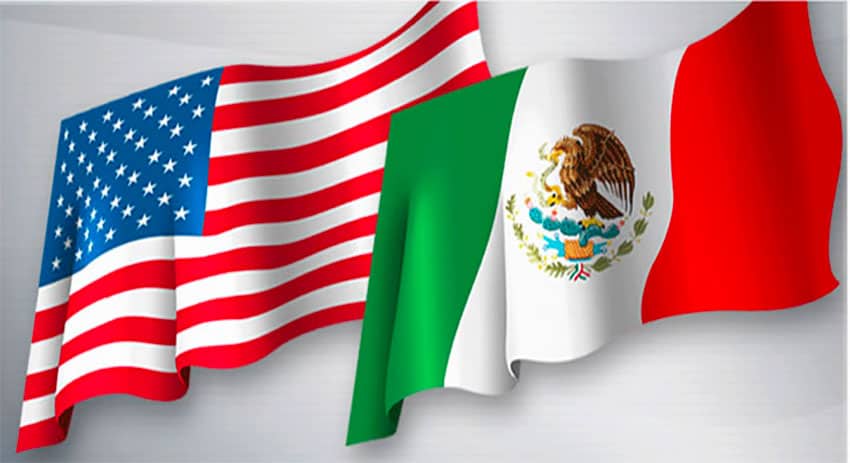
Andrés Manuel López Obrador makes his first international trip as Mexico’s president to visit Donald Trump on Wednesday, where the two populist leaders will toast the launch of the USMCA trade treaty despite mounting woes at home.

Since taking office 20 months ago, López Obrador has made not upsetting Trump a priority despite the U.S. president’s provocations. But critics fear he is wading into a political minefield just four months before the U.S. election — and with no plans to meet Trump’s Democratic challenger, Joe Biden.

López Obrador had initially expected to celebrate the July 1 start of the trade deal with the U.S and Canada — which replaced the quarter century-old NAFTA — via videoconference, because of the pandemic.

But on a visit to a border patrol station in Arizona last month, Trump said a visit was imminent. So Mexico’s president shelved his dislike of foreign travel to arrange a trip that — owing to his insistence on flying commercial — involved a layover and required him to take a Covid-19 test and wear a face mask, something he has refused to do despite rising numbers of cases at home.

The about-face reinforced a view in Mexico that despite their intertwined economies, López Obrador, who was critical of the U.S. president’s “authoritarian attitude” toward Mexicans and migrants in his 2017 book Hey Trump, invariably defers to his northern neighbour.

The decision by Justin Trudeau, Canada’s prime minister, to stay home — citing longstanding commitments — heightened those concerns.

Some fear that López Obrador will become a pawn in the re-election campaign of a president who professes friendship but has preached hostility to Mexicans and migrants and has made high-profile visits in recent weeks to his border wall.

“I think it’s a trap,” said Verónica Ortiz, head of Comexi, a foreign affairs think tank. Although Trump has hailed his counterpart as a “really great guy” and López Obrador has defended the U.S. president, “I don’t think people in Mexico see respect — they see continual aggression,” she added.

Both leaders — populists from opposite sides of the political spectrum — may find the meeting a convenient distraction from domestic troubles as they battle the Covid-19 pandemic.

López Obrador’s domestic approval ratings have dropped 20 points since early in his presidency, and he has been criticized for business-unfriendly policies including the cancellation of a partly-built U.S. brewery.

“He gets to say with USMCA that Mexico is open for business when everything else he is doing shows that Mexico is not,” said Duncan Wood, head of the Mexico Institute at the Wilson Center. “It’s a photo-op so he can say ‘I’ve handled Trump,’ which isn’t true.”

Trump has also seen his approval ratings drop as he comes under fire for his handling of the pandemic and its economic fallout. He continues to lose ground in polls to Biden.

The Congressional Hispanic Caucus attacked the trip in a letter to Trump as “nothing more than an attempt to distract from the coronavirus crisis” as well as “a blatant attempt to politicize the important U.S.-Mexican relationship along partisan lines.”

Some fear that despite López Obrador’s policy of non-intervention in other nation’s affairs, his failure to meet Biden or senior Democrats could make it look like he was taking sides.

“USMCA was only ratified because of Democrat support,” said Jason Marczak, head of the Atlantic Council’s Adrienne Arsht Latin America Center. “The U.S.-Mexico relationship is far more than just an AMLO-Trump deal.”

Mexican officials denied any bias. “The reason this trip is limited to meeting the president is precisely because Mexico does not want to intervene in an internal U.S. [electoral] process … It’s a government-to-government, president-to-president meeting between two countries which in 2019 were each other’s biggest trading partners,” said foreign ministry spokesman Daniel Millán.

Nevertheless, Trump has usually prevailed. Within a month of taking office, López Obrador accepted Washington’s demands for migrants to await U.S. asylum hearings in Mexico.

The U.S. president then threatened tariffs on Mexican exports unless it clamped down on rising numbers of Central American migrants. López Obrador acquiesced, deploying his National Guard police force en masse.

There is also the spectre of Trump’s visit to Mexico during the 2016 campaign, which left then-president Enrique Peña Nieto humiliated after failing to challenge insults against Mexicans and plans for a border wall.

López Obrador maintained “it is better to have good relations than to fight.” As well as controversial issues including drugs and weapons trafficking, he said the two men may also discuss their shared love of baseball.

Mexico’s president was to kick off his trip on Wednesday with a visit to the Lincoln memorial. After paying his respects to his favourite U.S. president, he was to visit a statue in the U.S. capital of his political hero, 19th-century Mexican president Benito Juárez.

He meets Trump on Wednesday afternoon. The trip will end with a White House dinner attended by top Mexican business leaders, including Carlos Slim, Mexico’s richest man and a prominent investor in the president’s infrastructure projects.

Others include Ricardo Salinas, a media, banking and retail mogul and one of his closest business advisers, as well as Bernardo Gómez, co-president of Televisa, Mexico’s top television station, who hosted Trump’s son-in-law and adviser, Jared Kushner, for a dinner at his home in Mexico City last year.

© 2020 The Financial Times Ltd. All rights reserved. Please do not copy and paste FT articles and redistribute by email or post to the web.

Veracruz hospital gives grieving widow the wrong body

0
Andrade with a photo of her late husband, whose body was mistaken for that of another virus victim.

A grieving widow in Veracruz claims that hospital staff tried to give her the wrong body after her husband passed away from Covid-19.

Dulce María Andrade’s husband, 42-year-old Ángel Lucas Rueda, was admitted to the Mexican Social Security Institute (IMSS) hospital in Coatzacoalcos on June 29 with respiratory symptoms and died just before noon on July 4.

Several hours later, another male patient also passed away. Relatives of both families were notified, but Andrade was unable to claim her husband’s body over the weekend. 

“He passed away on Saturday morning, and so I asked the funeral home if they could pick him up, but they told me that it would be until Monday because they don’t work on the weekend,” Andrade says. 

When she went on Monday to identify and claim his body from the morgue, the corpse they presented her with was not that of her husband. 

Andrade says hospital staff tried to convince her that people look different after they have died, but the body they said was her husband was much older, and Andrade wasn’t buying it.

She asked the hospital if she could go from room to room looking for him, clinging to the hope that he might still be alive, but the hospital refused.  

It wasn’t until the following day, Tuesday, that hospital officials were able to provide her with an explanation. IMSS staff said that when relatives of the other patient who died on Saturday arrived to claim the deceased, they were given the wrong body in a case of “erroneous identification,” and it was subsequently cremated. 

Hospital officials told the widow that they would retrieve her husband’s ashes and turn them over to her once the appropriate paperwork was completed. 

The hospital apologized to Andrade and stated that “the IMSS authorities in Veracruz are carrying out mediation work with the families involved in order to complete successfully the exchange of the funeral remains.”

Andrade says she plans to file a complaint against the hospital for negligence.

Source: Milenio (sp), Animal Político (sp), Presencia (sp)

Remains of a third Ayotzinapa student found; no sign of fire damage

0
Family members of the missing students outside the National Palace in Mexico City.

Almost six years after 43 teaching students disappeared in Iguala, Guerrero, the federal government announced on Tuesday that the remains of one of them had been identified.

Omar Gómez Trejo, the special prosecutor in charge of the reexamination of the disappearance and presumed murder of the Ayotzinapa rural teachers college students, said that forensic scientists at the University of Innsbruck in Austria had identified a bone fragment found in a ravine in Cocula, Guerrero, as the remains of Christian Alfonso Rodríguez Telumbre.

Gómez noted that the bone fragment was not found in the Cocula municipal dump or the nearby San Juan River and therefore the “historical truth” – the former government’s official version of events of what happened to the students on September 26, 2014 – “is over.”

The former government claimed that the students were intercepted by corrupt municipal police in Iguala after they commandeered a bus to travel to a protest in Mexico City. According to the “historical truth,” the police handed the students over to a local crime gang, the Guerreros Unidos, whose members killed them, burned their bodies in the Cocula dump and scattered their ashes in the nearby San Juan River.

However, the current federal government rejected its predecessor’s version of events and launched a new investigation shortly after President López Obrador took office in December 2018. Many people suspect that the army played a role in the students’ disappearance.

Gómez said that forensic experts from Argentina had confirmed the findings of the scientists in Innsbruck, adding that more remains will be sent to Austria for analysis.

A report by the Argentine Forensic Anthropology Team (EAAF), which has collaborated with Mexican authorities on the investigation into the Aytotzinapa case, said the bone fragment identified as the remains of Rodríguez had no signs of exposure to fire, debunking the “historical truth” proffered by former attorney general Jesús Murillo Karam in January 2015.

Seen by the newspaper Milenio, the EAAF report said the identified bone fragment came from the student’s foot. Given the bone’s preserved state, the forensic scientists in Innsbruck were able to obtain DNA from it that allowed them to identify the student.

After comparing the DNA with genetic samples provided by Rodríguez’s three sisters and parents, the scientists concluded that there was “very strong evidence” that the bone fragment was the student’s remains.

An analysis conducted by the EAAF found that there was a probability in excess of 99.9% that the bone fragment corresponded to Rodríguez.

The bone fragment and other human remains were found by federal authorities in November last year. All told, more than 100 bone fragments were found in a ravine located about a kilometer from the Cocula dump, Milenio reported.

Ayotzinapa student Christian Rodríguez was one of 43 students who disappeared in 2014.

The remains of six bodies – three that were found in the ravine and three found on a property near Iguala – were sent to Austria in March.

At least five bone fragments sent away for analysis showed no signs of fire damage, Milenio said.

Rodríguez, who was 21 at the time of his disappearance, is the third of the 43 students to be identified through DNA analysis of discovered remains.

The other two were Alexander Mora Venancio and Jhosivani Guerrero de la Cruz. However, Guerreo’s family refused to accept the accept the scientists’ findings.

Deputy Interior Minister for Human Rights Alejandro Encinas said Tuesday that the veracity of the identification of Guerrero was under investigation.

The positive identification of Rodríguez is the first major breakthrough for the federal government, which has conducted searches for the students’ remains in hundreds of locations across several municipalities in Guerrero.

One theory is that the students were separated after their abduction and killed in different locations.

Encinas said President López Obrador will meet with the families of the victims on Friday and share details with them about the progress of the investigation. He said the family of Rodríguez was told about his identification two days before the news was publicly announced.

Attorney General Alejandro Gertz Manero said last week that authorities had established a new theory about what happened to the 43 students after their abduction in September 2014.

“We already know what happened, we know who ordered it, who covered it up … and [why] they did what they did,” he said.

Gertz also said that prosecutors had requested 46 warrants for the arrest of municipal officials in Guerrero in connection with the students’ disappearance.

The authorities have already obtained arrest warrants against former Attorney General’s Office officials, including the ex-head of the Criminal Investigation Agency, Tomás Zerón, who is believed to have fled Mexico.

Zerón is wanted on charges of torturing people detained in connection with the case, forced disappearance, evidence tampering and altering a crime scene.

The presumed leader of the Guerreros Unidos, the gang that allegedly killed the students, was arrested in late June after almost six years on the run.

José Angel Casarrubias Salgado, also known as “El Mochomo,” was released from prison last week after his mother allegedly paid  multi-million-peso bribes to the presiding judge’s staff. However, he was immediately rearrested and remains behind bars.

The Ayotzinapa case is the biggest stain on the record of former president Enrique Peña Nieto, whose administration was plagued by scandals.

The disappearance of the students triggered some of the biggest protests seen in Mexico in recent years, with demonstrators calling for the resignation of Peña Nieto. But the ex-president survived the uprising and went on to complete his six-year term in 2018 before vanishing from public life.

Source: Milenio (sp)