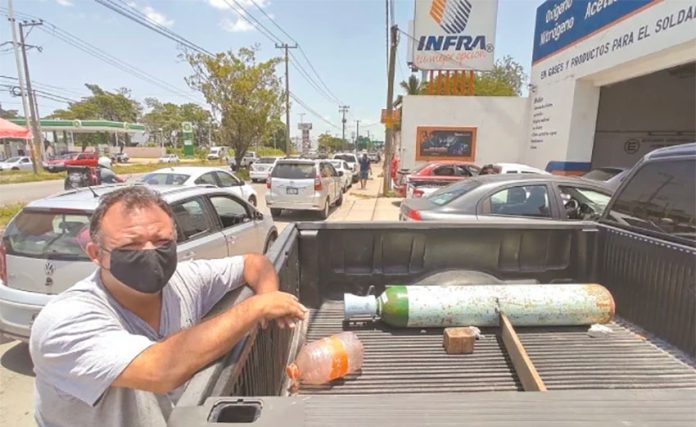
Demand for oxygen has increased along with the coronavirus.
Medical oxygen is proving scarce in Tabasco, presenting a daunting challenge for family and friends of coronavirus patients who need breathing assistance while being cared for at home.
Refilling an oxygen tank, if you can find one and know where to go for more, can cost upwards of 1,000 pesos (US $44).
José Alberto Carrera traveled 50 kilometers from Macuspana to Villahermosa to fill an oxygen tank for a friend, El Universal reports. After standing in line for two hours, his request was declined as he did not have the necessary paperwork documenting proof of residency, and he was forced to go home empty-handed.
Among the 20 people queued up was Alejandro, who had been waiting since dawn to refill an oxygen tank for a sick relative. The cost of doing so was overwhelming, but he said his family member was improving.
Tabasco residents have also taken to social media to look for oxygen, hoping to network through Facebook. Tanks purchased online can cost between 3,800 and 8,500 pesos (US $169 to $377).
All three oxygen companies in Tabasco have sold out of tanks, and now they are only available for rental. Rogue suppliers offer oxygen to sick customers but at double or triple the normal retail price.
Tabascos Health Minister Silvia Roldán Fernández said that many people who are infected with the coronavirus prefer to be treated with oxygen at home over being hospitalized, a method of treatment she does not recommend. “You are at greater risk, and yes you might be more comfortable,” she said, “but life is life. There are many young people who have decided to do that and who have died in their homes.”
The head of Tabasco’s Office of Consumer Protection (Odeco), Pedro Aldecoa Calzada, says that the state is monitoring companies who sell, rent and refill oxygen tanks.
“We do routine inspections and have sanctioned more than 40 companies for consumer abuse, but people need to have a culture of reporting in order for us to investigate those cases and verify claims,” he says.
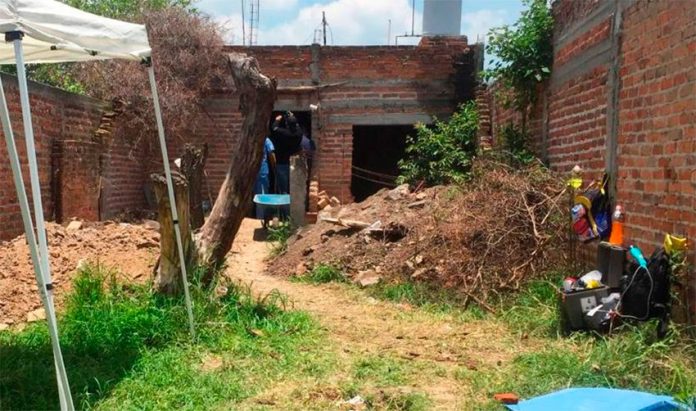
The Jalisco Attorney General’s Office reported yesterday that 23 bodies and four bags of remains were discovered on July 13 in a clandestine grave in the municipality of El Salto, just blocks from the police station and 33 kilometers southeast of Guadalajara.
The corpses were buried on a farm in the El Pedregal neighborhood. To date, only three bodies have been identified.
The case is being investigated in collaboration with Jalisco’s missing persons unit.
In the past 18 months, 428 bodies have been discovered in hidden graves across the state, with 215 found between January and May of this year alone.
The majority of victims were found near Zapopan, Tlajomulco and Tlaquepaque.
Missing persons activist groups, including Jalisco’s Families United for the Disappeared, were invited by the police to assist in the discovery of the El Salto mass grave. The group stated that the 23 bodies were unearthed intact, which would help in identifying them.
In Jalisco, 9,413 people have been reported missing, according to the state’s database.
Since 1964, 73,249 people have gone missing in Mexico, and bodies have been discovered in 3,978 clandestine graves, the Ministry of the Interior (Segob) reported last week. That number has increased by 11,564 since January, the National Search Commission (CNB) reports.
Jalisco ranks fifth in Mexico for homicides, with a murder rate of 37.7 per 100,000 inhabitants.
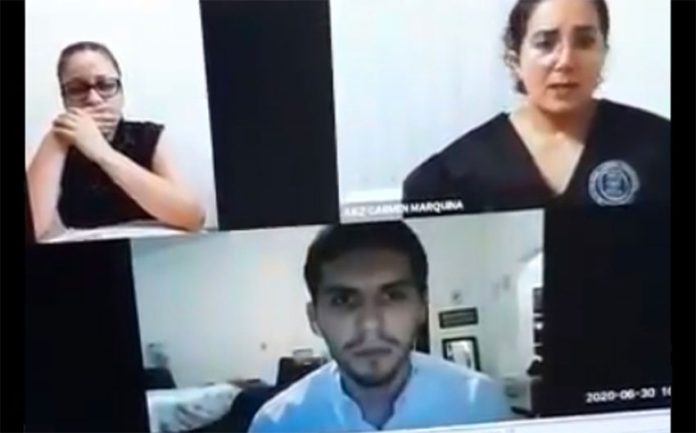
The hapless lawyer, center, and the upset judge, top right, in a screenshot of the hearing held via Zoom.
Virtual meetings via Zoom or other platforms have become de rigueur in the era of the coronavirus pandemic, but social distancing need not come at the cost of social decorum as a lawyer who attended a virtual meeting in his underwear found out.
The attorney logged in to a Zoom hearing with a judge and all was fine until he stood up and his computer’s camera revealed that he was clad in a button-down shirt and boxers, despite an attempt on his part to cover the lens.
The visibly upset judge called him out.
“Counselor, you are not wearing pants [and] you are in court,” admonished the judge.
“I am wearing pants, your honor,” replied the young lawyer, unconvincingly.
A video of the scantily clad lawyer’s hearing has gone viral on social media, garnering more than 228,000 views.
Judge María del Carmen Cruz Marquina of Tamaulipas later said that it was the first time a lawyer had appeared before her without pants, but stated that court proceedings were not affected by the attorney’s wardrobe choice.
“I must tell you that the lawyer is a very serious and professional person. I believe it was an accident,” the judge said. “These are the circumstances of the new normal to which we are all adapting.”
A video showing heavily-armed Jalisco New Generation Cartel (CJNG) members alongside a long convoy of armored vehicles is under analysis to determine whether it is authentic, Security Minister Alfonso Durazo said Friday.
An approximately two-minute-long video posted online on Friday shows some 75 masked gunmen dressed in military fatigues and wielding high-caliber weapons.
Filmed on a dirt road in a rural location, the frightening footage also shows about 20 armored vehicles – some of have been modified to include gun turrets – emblazoned with the CJNG initials and “special forces” or “elite group.”
As a camera films the lengthy procession of vehicles, gunmen shout “pura gente del señor Mencho,” or “only Mencho’s people,” among other remarks.
El Mencho is Nemesio Oseguera Cervantes, the fugitive leader of the CJNG and Mexico’s most wanted drug lord.
I was wondering when we would see another public act of communication by the CJNG, two weeks after the attack on Harfuch
This one, taken yesterday in the Jalisco Sierra as I’m told, is more than clear in its message toward the fed gov: You come after us, and we will strike back. pic.twitter.com/Xnii4z5P8S
When and where the video was filmed is unclear but some social media users claimed that the gunmen were in Tomatlán, a coastal municipality south of Puerto Vallarta.
Following the release of the footage, Security Minister Durazo said on Twitter that the “propaganda video attributed to a criminal group” is being analyzed in order to confirm its authenticity and determine when it was filmed.
“Regardless of that, we declare that there is not any criminal group with the capacity to successfully challenge federal security forces,” he said in a second tweet, adding that the video only added credence to that assertion.
Nevertheless, Falko Ernst, senior Mexico analyst for the International Crisis Group, says the video sends a clear message to the federal government: “You come after us, and we will strike back.”
Release of the video comes after a visit to Jalisco by President López Obrador.
Ernst said on Twitter that the release of the video doesn’t necessarily change the nature of the relationship between the CJNG and the government, writing that “rather than a declaration of war … it’s primarily geared at guarding the status quo at a crucial time” when federal authorities have to define their “future posture” toward the powerful criminal group.
“It’s an episode in a much wider sequence of negotiation of power … Displays of violence in this context aren’t new. The degree of the production is.”
Gabriel Guerra, a political analyst and columnist for the El Universal newspaper, described the video as “truly worrying.”
“While its authenticity has to be established, it speaks of an armed capacity comparable to or greater than that of many guerrilla groups. Everyone will see different things; what I see is an enemy of the Mexican state and all of us,” he wrote on Twitter.
Security analyst Alejandro Hope told El Universal that the video “speaks of the state’s territorial control problem.”
“They [the CJNG] move about in large convoys announcing who they are because they don’t fear the authorities,” he said.
Hope noted that it’s not the first time that military-style vehicles with gun turrets and large numbers of sicarios, or hitmen, have appeared in cartel videos whose main purpose is to show off their significant firepower to both rival criminal organizations and the government.
Indeed, some videos have shown as many as 60 armored vehicles and between 100 and 150 sicarios, he said.
The CJNG is “not the biggest criminal group we’ve seen,” Hope said, adding that the Zetas – a cartel founded by former army commandos – used to be “more intimidating.”
However, the analyst said that the latest CJNG video – it has released many – is testament to the cartel’s immense firepower and manpower, and shows that it has militarized. Militarization of criminal groups, however, is not a new phenomenon in Mexico, Hope said, adding that emblazoning a cartel’s name on its vehicles is not new either.
Citing its ongoing turf war with the Santa Rosa de Lima Cartel in Guanajuato and the attack on García, the Mexico City police chief, Hope said the CJNG has shown in recent months that it is prepared to increase its aggression against both rival criminal groups and authorities.
The release of the video is part of the cartel’s “escalation of confrontation” approach, he said.
After the attempt on García’s life – which didn’t result in the police chief’s death but killed two of his security detail and a bystander – Hope said the government has an obligation to respond to such a “brutal” attack and charged that it should allocate “extraordinary resources” to “deal with the unprecedented security matter.”
But López Obrador says his administration will continue with its non-confrontational security strategy, which aims to bring peace and tranquility to Mexico by addressing the root causes of violence, namely poverty and lack of opportunity.
Ports are 'enclaves of corruption,' says President López Obrador.
The military will assume control of Mexico’s customs offices and ports, President López Obrador announced Friday as efforts to eliminate corruption continue at ports of entry.
“Land and maritime customs (offices) are going to be in the charge of the army and the navy to ensure safety and avoid the introduction of drugs,” López Obrador said Friday at a press briefing in Manzanillo, Colima, Mexico’s busiest port. “Ports and customs have long been enclaves of corruption,” the president stated.
The move is just another step in the president’s reliance on the military to keep the peace. In addition, López Obrador has charged the military with building a new airport in Santa Lucia to serve Mexico City, as well as the construction of social welfare agency bank branches.
Mexico’s head of customs, Horacio Duarte, said the military will work in coordination with agents under his charge in order to prevent illegal drugs, guns and cash from entering the country and to enforce the payment of duties on taxable goods at the country’s 49 borders and 116 maritime ports.
Duarte said that annual customs revenue amounts to some 900 billion pesos, around US $40 billion.
López Obrador’s order comes despite the fact that Mexico’s Congress had frozen an initiative that would assign control of the country’s ports to the navy. It also violates legal statutes dictating that customs officials be civilians, Duarte said.
The military’s presence at borders has done little to staunch corruption at ports of entry, where corruption is rampant. Reforma reports that criminal organizations were able to bring a variety of illegal goods into Tamaulipas in 2017 by paying a US $300 fee to customs agents. Larger illicit shipments were allowed to pass after gangsters paid a bribe of some US $2,000.
Customs officials need to be on the alert for contraband in any form, Duarte said, including imports to the country that are deliberately undervalued to minimize tariffs.
As the coronavirus pandemic continues to grow, authorities in 24 states have made wearing a face mask mandatory in all public spaces.
Residents of Aguascalientes, Campeche, Coahuila, Chihuahua, Mexico City and Durango have been required to wear a mask outside their homes since April.
Authorities in Hidalgo, Jalisco, México state, Michoacán, Morelos, Nuevo León, Oaxaca, Puebla, Quintana Roo, Tabasco, Tamaulipas, Yucatán and Zacatecas have also mandated the obligatory use of masks in public spaces since April.
Guerrero Governor Héctor Astudillo followed suit on June 15, ordering citizens to wear masks in both public and private places, and four more states mandated the compulsory use of masks this month.
The State Committee for Health Safety in Guanajuato said on July 2 that residents must wear masks in all open and closed public spaces across the state’s 46 municipalities, while the Sonora government decreed their mandatory use on July 5.
The governors of Colima and San Luis Potosí this week joined a pact with their counterparts in nine other states that decrees the mandatory use of masks in all public spaces.
Authorities in three states – Nayarit, Querétaro, Veracruz – have ordered residents to wear masks on public transit but their use is not obligatory in other public spaces.
Meanwhile, authorities in Baja California, Baja California Sur, Chiapas, Sinaloa and Tlaxcala have not issued any orders to wear a mask.
Despite mandating the use of masks in public, Mexico’s coronavirus pandemic continues to grow, with more than 100,000 new cases reported so far this month.
The federal Health Ministry reported 7,257 new coronavirus cases on Friday – the second highest single-day tally since the start of the pandemic – increasing the total number of confirmed cases to 331,298.
Just under 9% of the confirmed cases – 29,363 – are considered active while there are also 85,877 suspected cases across the country, meaning that the results of that number of Covid-19 tests are not yet known.
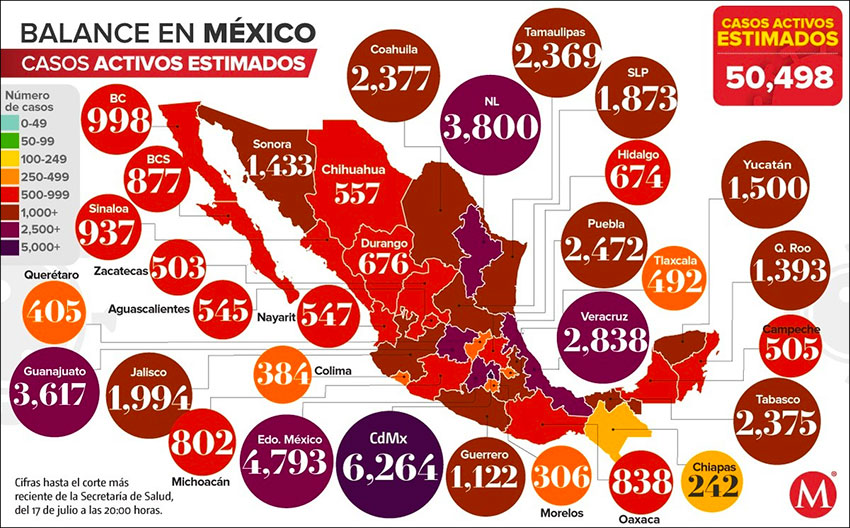
Active coronavirus cases as of Friday. milenio
Based on past positivity rates, the Health Ministry estimates that Mexico’s accumulated case tally is 372,099 and that active cases total 50,498.
The Health Ministry also reported 736 additional Covid-19 fatalities on Friday, lifting Mexico’s death toll to 38,310.
National data presented at Friday night’s coronavirus press briefing showed that 46% of general care hospital beds set aside for coronavirus patients are currently occupied while 38% of those with ventilators are in use.
Tabasco has the lowest availability of general care beds, with 85% already in use, while Nuevo León has the highest occupancy rate for beds with ventilators, at 66%.
In Chiapas, where Friday night’s press conference was held, new coronavirus infections have been on the wane for four consecutive weeks, said Deputy Health Minister Hugo López-Gatell.
“At this time, none of the municipalities are trending upwards [in case numbers],” he said.
The southern state has recorded 5,379 confirmed cases since the beginning of the pandemic but just 242 are currently active. Chiapas has also recorded 806 Covid-19 deaths.
The Health Ministry published an updated coronavirus “stoplight” map – used to indicate the risk of infection in each of Mexico’s 32 states – on Friday, which had no changes from a draft version presented to governors on Thursday.
Nine states will switch from “orange light” high risk to “red light” maximum risk on Monday, joining nine states that are already red.
The 18 “red light” states as of July 20 will be Baja California Sur, Coahuila, Nuevo León, Tamaulipas, Zacatecas, San Luis Potosí, Jalisco, Nayarit, Colima, Querétaro, Guanajuato, Hidalgo, Puebla, Tabasco, Veracruz, Yucatán, Quintana Roo and Oaxaca.
The 14 “orange light” states will be Baja California, Sonora, Sinaloa, Chihuahua, Durango, Aguascalientes, Michoacán, Guerrero, México state, Mexico City, Morelos, Tlaxcala, Chiapas and Campeche.
López-Gatell ruled out any possibility that students will return to classes in August, adding “it could be in September” but stressing that no decision has yet been made.
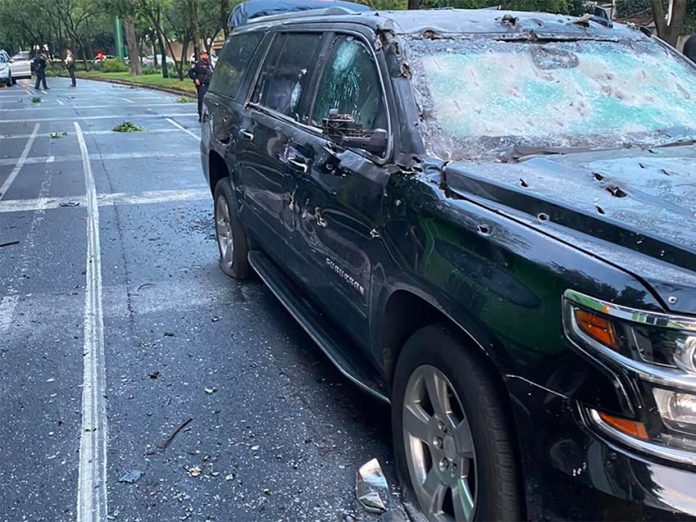
The vehicle in which the Mexico City police chief was traveling when he was attacked.
“Hugs, not bullets?” scoffed Antonio Rivera, a businessman in the central Mexican town of Irapuato, referring to President López Obrador’s strategy for ending more than a decade of increasing violence. “This is a war zone.”
As head of the local branch of business confederation Coparmex, Rivera has witnessed how intensifying drug cartel wars has turned his home state of Guanajuato — one of the country’s top car production centers — into the murder capital of Mexico.
Even López Obrador last month said violence in Guanajuato was “out of control” — and that was before heavily armed men burst into a drug rehabilitation centre for young people in broad daylight in Irapuato on July 1 and gunned down 28.
The president insists his government has “halted the historic upward trend” in homicides nationwide, thanks to the creation of the National Guard, a militarized police force, and the close tabs his administration keeps on the situation through daily 6 a.m. security cabinet meetings. But the number of murders rose 3% to a record 34,608 in the first year of his administration and this year hit 14,631 by May.
On a tour of Guanajuato and two other violence-stricken states, Jalisco and Colima, last week, López Obrador was heckled by residents who believe things are getting worse.
A poll by El Financiero newspaper at the start of July found 63% of respondents disapproved of his handling of security. Only 23% reckoned he was doing a good job.
“I don’t think the security strategy makes any sense at all,” said Juan Pablo Hernández, a businessman in Guadalajara, home to one of Mexico’s most aggressive gangs, the Jalisco New Generation Cartel (CJNG). “I don’t see a clear strategy yet.”
López Obrador intended his more peaceful approach to contrast with President Felipe Calderón’s doomed 2006-12 “war on drugs,” which sent violence skyrocketing, and the record of his immediate predecessor Enrique Peña Nieto, who failed to contain the mounting murder rate in his 2012-18 term.
Last year, police botched the capture of Ovidio Guzmán, one of “El Chapo’s” sons, during an operation in the cartel stronghold of Culiacán, when the traffickers flooded the city with gunmen. López Obrador ordered Guzmán’s release, saying he wanted to avoid bloodshed.
Rivera described López Obrador’s strategy as “the least successful” in recent years. In Guanajuato, the CJNG, a big international drug trafficking organization that is believed to control as much as two-thirds of the U.S. market, has been battling the local Santa Rosa de Lima cartel for territorial control.
The result was 1,903 murders in the state between January and June — 13% of the national total. “We feel defenceless,” said Rivera.
Despite the “hugs, not bullets” rhetoric — designed to focus less on fighting cartels than giving young people education grants and apprenticeships to stop them falling into crime — López Obrador “immediately created the National Guard as a military institution … and cancelled all crime prevention programs,” said Catalina Pérez Correa, a security expert at Mexico’s CIDE university.
“There is no different strategy — that’s a false premise,” she said. “It didn’t work before, why should it work now?”
The violence has escalated into areas previously off-limits to major cartels, such as the CJNG’s dawn ambush on Mexico City’s police chief last month. More than two dozen hitmen poured out of a truck after blocking the road in one of the capital’s wealthiest neighbourhoods and raked Omar García Harfuch’s armoured SUV with bullets. Harfuch survived. but two bodyguards and a bystander were killed.
Two weeks before the attack, the cartel targeted Uriel Villegas, a federal judge who heard organized crime cases, including one involving a son of the CJNG’s fugitive leader Nemesio Oseguera. Cartel members stormed his home in Colima state and executed him and his wife.
“Brazen attacks by the CJNG against public officials … underscored the organization’s heightened sense of impunity in directly confronting the Mexican state,” Empra, a consultancy, said in its June security report.
A decade ago, the border city of Ciudad Juárez was Mexico’s murder capital. “It felt so far away then. But we’re now going through what they did — it’s endless,” said Raúl Calvillo, head of the Irapuato ¿Cómo vamos? Citizen’s Observatory, which tracks local crime trends.
For businesses, extortion is also a serious problem. “A young man will come in, offer to protect you as if he were Robin Hood, in exchange for you letting him sell drugs on the premises,” said Rafael — not his real name — who runs restaurants in 22 of Mexico’s 32 states. “They’re violent. You can’t negotiate with them … I’ve had to accept.”
Rivera predicted that the Covid-19 crisis, which has pushed millions out of work, would boost violent crime.
Pérez Correa was also downbeat. “We’re losing [this war],” she said. “There is no sign of things getting better.”
Should BCS shut down again, hotels and restaurants would have to close once more, as well as nonessential businesses.
Governor Carlos Mendoza Davis has repeatedly warned that the state could go back under lockdown if the increase in cases did not stop.
Meanwhile, in Mulegé city hall has been shut down for 10 working days as the municipal government has sent workers home to quarantine due to the coronavirus. The confinement will take the place of their regular summer vacation, BCS Noticias reports.
With the rainy season on its way, Civil Protection in BCS is readying a series of hurricane shelters to be used during summer storms for people with the coronavirus.
“There will be a new model of care for temporary shelters in the framework of the coronavirus pandemic for the hurricane season; they will be school classrooms that have all the infrastructure and medical structure to combat Covid-19,” said Carlos Godínez, who added that the new shelters will “establish health safety protocols, especially to guarantee healthy distances and avoid infections during the time that families remain protected.”
Cabo San Lucas delegate Óscar Leggs Castro told BCS Noticias earlier this week that authorities should consider reopening bars because they employ more than 11,000 people in the city. Leggs argued that there are crowds of people everywhere and that since tourism has returned visitors need someplace to go.
As of Thursday, BCS had 2,709 confirmed cases of the coronavirus and had seen 110 deaths.
Water crisis in Loreto
A citizens group met with politicians this week to demand that they intervene in Loreto’s water shortage, which they say affects thousands of families, some of whom have been without water for nearly a week.
The shortage also affects water purification companies, who have had to put limits on the number of bottles being sold to each consumer because they have run out of water to purify.
The citizens said neither Loreto Mayor Arely Arce Peralta nor the municipal council has shown any interest in resolving the situation.
The Pueblo Mágico, or Magical Town, has been having difficulties fixing the pumping system that brings water to Loreto through the San Juan Londo aqueduct and officials have been trucking water in for residents, El Sudcaliforniano reported.
Sports in the time of coronavirus
The BCS state chess championships, which offer cash prizes, will be held online, the head of sports in the state, Jose Avila, announced on Wednesday. “Given the situation that currently prevails due to the coronavirus pandemic, it is a good strategy to promote online tournaments so that chess players from municipalities compete and prepare for future face-to-face tournaments at the national level.”
And while an online strategy may work for chess, it does not translate to fishing tournaments. Whereas the Bisbee’s East Cape Offshore fishing tournament is scheduled to go forward as planned on August 4, a tournament planned for Loreto in August has been canceled.
The state sportsfishing tournament, Copa Calisureños 2020, which drew a crowd of 1,800 people last year, will be rescheduled for 2021.
The Baja 1000 off-road race which normally takes place in November may also have to be postponed or canceled, BCS Noticias reports. The race, in which vehicles navigate most of the length of the peninsula, has been run every year since its founding in 1967 and is considered one of the most prestigious off-road races in the world.
And the national baseball championships, scheduled for October in La Paz, may also have to be canceled as sporting events are only permitted when the state is at the green level, indicating a low risk for transmission of the coronavirus.
Gyms in Baja California have, in theory, been allowed to reopen provided they have ample space outside and operate by appointment only. So far, Diario El Independiente reports that only one gym, Cabo Iron in Cabo San Lucas, has met the government’s requirements.
Free vasectomies are back
Free, no-scalpel vasectomies, a program that was put on pause at the beginning of the coronavirus pandemic, are back as of Friday, BCS Noticias announced. The coordinator of the state’s family planning program says that the surgeries will be performed by appointment only to avoid crowding.
Video captures the moment a car flew off a cliff and landed in the sea in San José del Cabo.
Things that fell
On Wednesday morning, a 500-kilo cow fell into a three-meter-deep cistern in La Paz and was unable to extricate itself, BCS Noticias reports. The fire department was called and after about an hour managed to hoist the cow out using a crane.
Also on Wednesday morning, public security cameras captured the moment when a white sedan careened through the barricade of a closed scenic overlook point by the highway in San José del Cabo and went straight off the cliff into the sea below.
The video, which is making the rounds on social media shows the car drive off the cliff then pans to the wreckage in the waves below. Amazingly the driver, a 20-year-old man who was wearing his seatbelt, was not seriously hurt.
The Texcoco archaeological site that was damaged this week.
An ancient aqueduct at an archaeological site in Texcoco, México state, was damaged this week, triggering an investigation by municipal authorities.
Using heavy equipment, farmers from the town of Santa Catarina del Monte damaged part of the Caño Quebrado aqueduct at the site commonly known as Los Baños de Nezahualcóyotl (The Baths of Nezahualcóyotl).
According to a report by the news website La Silla Rota, the farmers wanted to build a new road between their town and agricultural land and were using a bulldozer when they inadvertently damaged the aqueduct, part of a complex hydraulic system.
The farmers hadn’t applied for a permit to build a road on the site formally known as Tetzcotzinco, and almost certainly wouldn’t have been granted authorization if they had.
The Texcoco government has launched an investigation into the events that led to the damage of the aqueduct, which was built while Nezahualcóyotl – known as the poet king – was the ruler of the city-state of Texcoco in the 15th century.
The local authorities said they have also filed a complaint with the National Institute of Anthropology and History (INAH).
Luis Antonio Huitrón Santoyo, INAH’s México state delegate, and his technical team traveled to the archaeological site on Thursday to assess the damage. They were accompanied by the Texcoco government’s cultural, legal and police chiefs, who are part of a team in charge of the investigation.
Mayor Sandra Falcón Venegas said that local authorities will collaborate with INAH to repair the damage.
The Tetzcotzinco archaeological zone was once home to elaborate gardens established by Nezahualcóyotl, a philosopher, warrior, architect and poet who ruled Texcoco from 1429 to 1472.
The pre-Hispanic ruler, a military and political ally of the Mexica or Aztec people, used the site as a retreat and meditation place as well as a center for astronomical observation, according to INAH. Religious and socio-political rituals and celebrations also took place at the site, located about 40 kilometers northeast of Mexico City.
The Baños de Nezahualcóyotl site, which includes several stone structures and baths, is considered one of the most important archaeological zones in México state.
A plover chick just hours after hatching. Filiberto González
To call someone a cabeza de chorlito in Spanish is equivalent to calling that person a birdbrain in English. But how did the poor little chorlito (plover) end up with a reputation for not being the sharpest needle on the cactus? Recently I found out.
I had been invited to the shores of Atotonilco Lagoon — a Ramsar (protected) wetland located alongside the town of Villa Corona, located 40 kilometers southwest of Guadalajara — by a group of volunteers who were trying to remedy a problem that the snowy plover, Charadrius nivosus or chorlito nevado in Spanish, is hopelessly stuck with.
At the lagoon, nature photographer Ernesto Sánchez explained the situation to me: “Unlike other birds that hide their nests in tall grass or trees, the plover, which is on the list of endangered species, lays its eggs on a flat spot on the beach, out in the open and its nest consists of nothing more than a slight depression in the sand or mud. For a chorlito, even an animal footprint will do as a nest.
“So, here on the shores of the Atotonilco Lagoon, those eggs are left not only to the mercy of predators like crows and possums, but are also in danger of being accidentally crushed by human heels, cows’ hooves or the wheels of cars being driven aimlessly up and down the beach.”
“¡Cabezas de chorlito!” I couldn’t help exclaiming. “Why do these birds lay their eggs out in the open?” I asked the leader of the project, biologist Said Felix, whom I found bending over a cluster of three little eggs, with a caliper in one hand and a clipboard in the other.
Banded chorlito chick.
“Believe it or not,” he told me, “the reason is that plovers have to perform a little ritual for choosing a nesting site, and it can only be done on soft sand or mud, in a flat, open spot. Here the male uses his feet to dig three slight depressions.
“The female then inspects each spot for quality, chooses whichever she considers the best and then drops little pebbles — or pieces of colored glass, if she can find them — all around the winning depression, and that is where she lays her eggs, whether or not we think it’s logical.”
Felix went on to tell me that female plovers aren’t really all that dumb. It seems, in fact, that they are rather promiscuous and might have three different “husbands,” all of whom may end up sitting on the eggs and caring for the chicks, while their communal “wife” goes off to do something else.
After measuring and numbering each egg, Felix placed it in a small bowl full of water. “If it falls to bottom,” he explained, “it means it was recently laid, whereas if it floats high in the water, it will hatch very soon. In the latter case, if you put the egg to your ear, you may hear the chick inside already pecking at the shell.”
Snowy plover eggs need about 25 days to hatch, and for all that time are threatened by myriad dangers. Although plovers are pretty feisty and will pull on the tail feathers of an enemy bird, there’s not much they can do if a big animal comes along, except to run away from the nest and hope the intruder will follow them.
Plovers tend to run or even fly from the nest when feeling threatened or disturbed and use imaginative distraction displays, especially when approached by mammalian predators.
A plover executes its distraction strategy. Said Felix
The chicks, fortunately, pop out of the egg ready to deal with the less than desirable situation their parents have put them in. “Within minutes after hatching,” Felix said, “a baby plover — which is born covered in down — is capable of running far away at high speed.”
A newly-hatched plover takes off running at speed. Said Felix
All the people working to understand and protect the snowy plovers of Lake Atotonilco are volunteers who spend many of their weekends at this task. They call their organization Eco Kaban and they receive some financial assistance from Terra Peninsular and Tracy Aviary. They also collaborate with the Max Planck Institute of Ornithology in Seewiesen, Germany, to collect blood samples to determine genetic populations in the Americas.
So just what is the weekend like for an Eco Kaban volunteer?
“They have a bird blind,” Canadian geologist and birder Chris Lloyd told me after visiting the lagoon a few days ago. “It’s a real Mexican-style bird blind: a converted taco stand, the portable kind with wheels, and it’s covered completely with cloth, right down to the ground. So they wheel it in place and check out the area through a spotting scope. They watch the birds flying around and if they keep coming back to the same spot, they say: ‘There’s got to be a nest there.’ So they line up that spot with something off in the distance and go stick a little flag next to it, so they can find it again.
“Next they put a kind of chicken-wire lobster trap over the nest. When the adult plover tries to get to its eggs, it follows a sort of funnel down to the end, goes through and then can’t find its way out. That’s when Said rushes over to grab it before it escapes.
[soliloquy id="117474"]
“He brings the bird back inside the blind, which houses a little lab, measures the bird’s wing span, takes a blood sample and bands it. A Mexican colleague studying at the Max Planck Institute will later take all the blood samples to Germany for genetic analysis and eventually there will be a paper on the differences between plover populations on the coast and inland.”
The bird bands are very important:
“For the last three years we have been putting four brightly colored rings or bands on each bird,” Said Felix told me. “These can easily be seen with binoculars, and the color combination identifies the bird as one nesting on Lake Atotonilco.
“This has been a great help for understanding the migratory habits of these birds which disappear every year in October only to pop back up in February. And now we have an even bigger help thanks to the German Research Foundation and the University of California, which has given us several tiny transmitters.
“Very recently our colleagues in Sinaloa were able to put one of these on a plover and it showed us the bird’s movement from the coast of Sinaloa to sites as far as 200 kilometers away, over a period of five months. As a result of all this, we are just beginning to see the migration route of the snowy plovers, so we can help protect them in the winter.”
Eco Kaban is a Guadalajara-based NGO of biologists and ecologists working to preserve the environment “for this generation and for future generations.” In addition to studying snowy plovers at the Atotonilco Lagoon, Eco Kaban helps organize the Christmas Bird Count in the Guadalajara area. This Audubon Society event has been ongoing for 115 years and counts 65 million birds each year.
Eco Kaban’s third project involves tagging birds in Guadalajara’s Huentitán Canyon in cooperation with MoSI, the bird-banding program of the Institute for Bird Populations, a nonprofit corporation founded in the United States in 1989 to study the causes of bird population declines.
The writer has lived near Guadalajara, Jalisco, for more than 30 years and is the author of A Guide to West Mexico’s Guachimontones and Surrounding Area and co-author of Outdoors in Western Mexico. More of his writing can be found on his website.