Home Blog Page 1495

Recovering lost miners’ bodies estimated to take 4 years, cost 1.75bn pesos

0
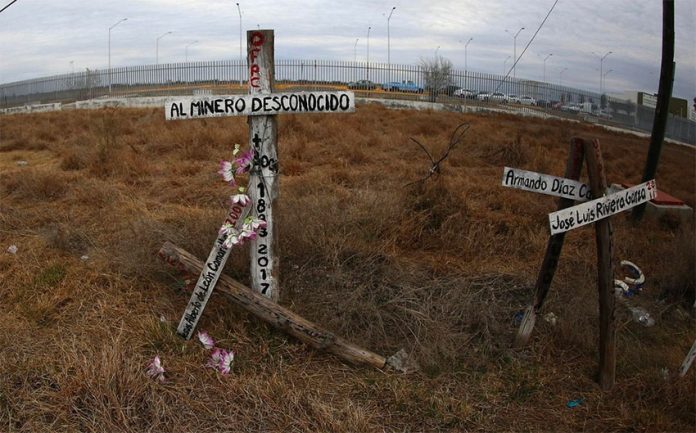
A memorial to the 63 missing miners.

Recovering the remains of 63 of 65 miners who died in a methane explosion at a Coahuila coal mine 14 years ago could take as long as four years and will cost around 1.75 billion pesos (US $77.7 million), says a spokeswoman for the victims’ families.

Cristina Auerbach told the newspaper Milenio that authorities are in the final stage of preparations to commence the project to recover the bodies of 63 miners who died at the Pasta de Conchos mine on February 19, 2006.

The explosion trapped the miners underground and only two bodies were ever recovered.

For years, relatives of the victims pleaded for efforts to be made to retrieve the other bodies but the mine owner, Grupo México, insisted that conditions were too dangerous to do so. However, President López Obrador announced on May 1 – International Workers’ Day – last year that he had ordered a recovery operation.

Labor Minister Luisa María Alcalde said in February that an expert group was planning to build a new tunnel into the mine to recover the bodies. She predicted that work on the tunnel would start in October.

However, Auerbach said it could be 2024 by the time the deceased miners’ remains are brought above ground. She said it was regrettable that some people have been critical of the cost associated with retrieving the miners’ remains, explaining that their families have been waiting for years for justice and to bury their loved ones with dignity.

“They need to put themselves in the place of the victims. … I believe that there is no project or cost that cannot be paid in exchange for justice. … It’s about recovering the remains but also about recovering the truth,” Auerbach said.

Auerbach also took aim at Morena party Senator and National Union of Mine and Metal Workers chief Napoleón Gómez Urrutia, who has called for the cost and duration of the recovery mission to be reduced.

Cost-cutting and time-saving measures were what caused the miners’ deaths, she asserted. The remains of the miners belong to their families, she added, explaining that they need to know who was responsible for the disaster and what will be done to prevent a similar occurrence in the future.

The National Human Rights Commission conducted an investigation at the site following the accident and determined that government officials had allowed the mine to operate under unsafe conditions.

Almost one year after the accident, the widows of the miners won an injunction that gave them access to internal Grupo México documents, which revealed it had been operating the Pasta de Conchos mine under less than optimal safety conditions since at least the year 2000.

However, no government officials or company representatives have been held legally responsible for the deaths of the 65 miners.

Grupo México is the country’s biggest mining company and the third biggest copper producer in the world. Its CEO is Germán Larrea Mota-Velasco, Mexico’s second richest person.

Source: Milenio (sp) 
Company designs inflatable protective suit for paramedics

0
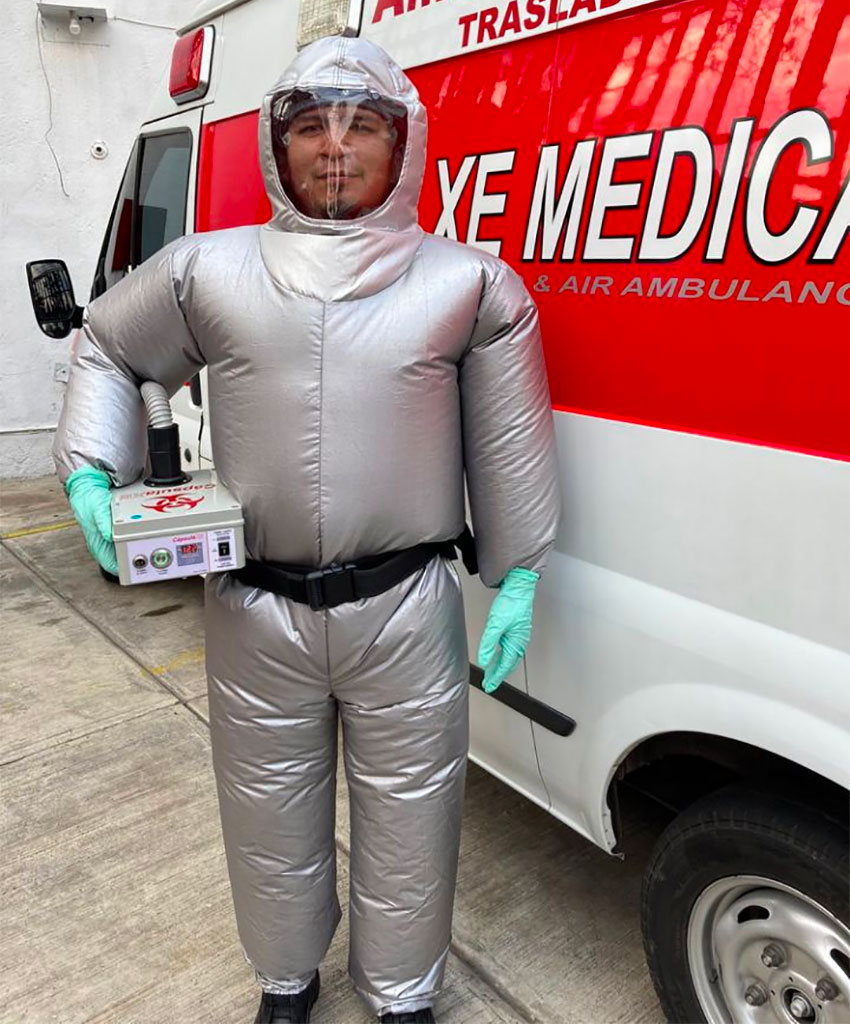
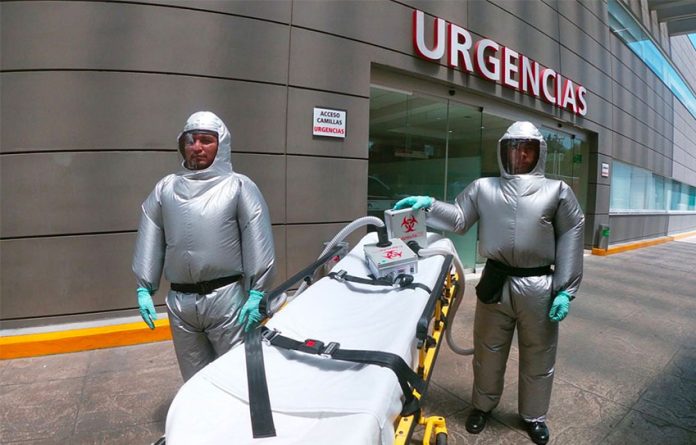
XE Médica's new protective suit.

A Mexican company has invented an inflatable suit to protect medical personnel from the coronavirus. 

“What we wanted was for it to be completely hermetic. That was the first detail that interested us. And simultaneously we solved other problems that included, first, the heat and temperature in the summer sun, “says Fernando Avilés, director of  XE Médica, which created the suits. 

The silver suit includes a device that provides fresh air to the interior and a sensor that regulates air pressure. “Temperature is very important because people think better when they feel relaxed and cool,” said Avilés.

The battery that runs the system lasts eight hours, although the suit can also be plugged into an electrical outlet. Even if the suit tears, it won’t deflate and can continue to function until the problem is resolved. The suit does not require the use of a mouthpiece and the clear plastic face shield does not fog up. 

A medical equipment company that has been in operation in Mexico City for 20 years, XE Médica has also designed a 35,000-peso (around US $1,500) capsule to transport coronavirus patients. It hermetically isolates the patient from paramedics and uses HEPA filters to prevent the spread of infectious diseases. 

The suit runs off a battery that lasts eight hours.

The company is made up of former paramedics and provides ambulance service in the city’s capital as well as specially engineered products for health personnel.

The inflatable suits will be made available to the public, XE Médica says, but it is unclear what they will cost.

Source: Yahoo Finanzas (sp), La Silla Rota (sp) 

Another week at the orange alert level for Mexico City

0
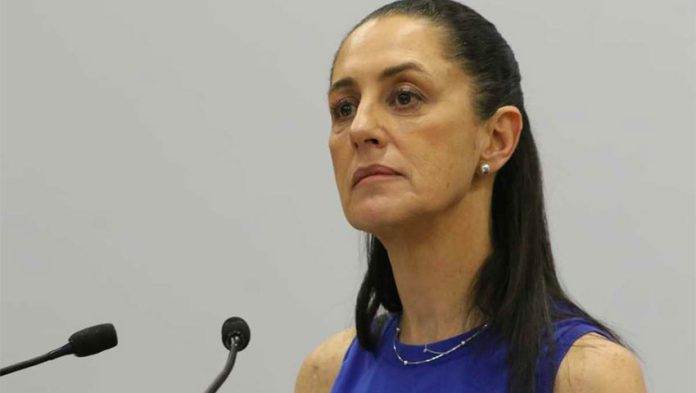
Mayor Sheinbaum said she will donate her Christmas bonus to help pay doctors' salaries.

Mexico City will continue at the orange level of the federal government’s coronavirus “stoplight” map next week, meaning that risk for the spread of the pandemic is still high.

Mayor Claudia Sheinbaum reported a slight reduction in hospitalization after 60 beds were freed in the last two days. “The reduction continues, although the speed of reduction had a decrease; in the previous week more beds were vacated,” Sheinbaum stated, adding that the nation’s capital has 60,474 confirmed cases of Covid-19. The most affected municipalities are Iztapalapa with 10,105 cases, Gustavo A. Madero with 7,565, and Tlalpan with 4,751.

As of Monday wholesalers in the city’s historic center will be permitted to operate between 6 a.m. and noon, and other businesses from 11 a.m. to 6 p.m., she announced, with businesses alternating days based on whether their street address is an odd or even number.  

Eduardo Clark, Director of Mexico City’s Office of Technology and Intelligence, said that if the downward trend in hospitalization continues, religious services could again be permitted as soon as July 26. Services would be limited to 30 minutes, and churches would only operate at 30% capacity with sanitary protocols firmly in place. Libraries may also be allowed to reopen, he said. 

Mayor Sheinbaum also announced she will be donating her Christmas bonus, which is equivalent to two months’ pay, to help fight the spread of the coronavirus by using the money to pay the salaries of doctors. 

The donation is in addition to the two months of salary she donated to the coronavirus effort in April, she said, a measure replicated by other government officials which led to the raising of nearly 50 million pesos, around US $2.2 million. 

Source: Reforma (sp), Excélsior (sp), Milenio (sp)

Next week’s proposed virus stoplight map shows 9 states reverting to red

0
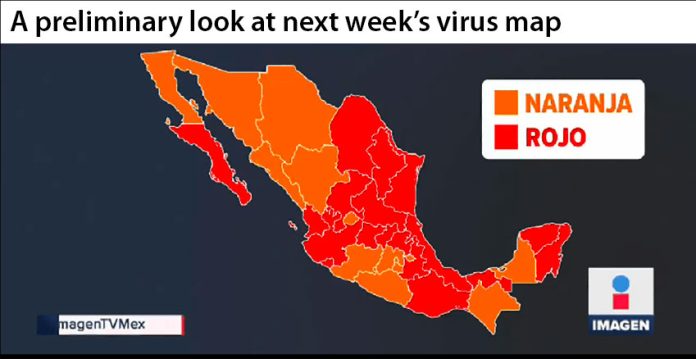
A draft version of next week's stoplight map.
A draft version of next week's stoplight map. The final version will be released Friday evening.

Nine states will switch from “orange light” high risk to “red light” maximum risk on the federal government’s new coronavirus “stoplight” map to be presented Friday night if no changes are made to a draft version shown to governors on Thursday.

Baja California Sur, Hidalgo, Jalisco, Oaxaca, Querétaro, Quintana Roo, San Luis Potosí, Yucatán and Zacatecas are slated to revert to red, the newspaper Reforma reported.

Deputy Health Minister Hugo López-Gatell said this week that the “stoplight” map would continue to be updated on a weekly basis – even though it wasn’t revised last week – but several governors told Reforma that the stoplight colors allocated to each state, and the accompanying recommended restrictions to slow the spread of the coronavirus, will now apply for two weeks.

According to the proposed map, Coahuila, Colima, Guanajuato, Nayarit, Nuevo León, Puebla, Tabasco, Tamaulipas and Veracruz will retain their current status as “red light” states.

Six other states currently painted red are slated to switch to orange. They are Baja California, Chiapas, México state, Sinaloa, Sonora and Tlaxcala.

If their risk rating is downgraded, they will join Aguascalientes, Campeche, Chihuahua, Mexico City, Durango, Guerrero, Michoacán and Morelos as “orange light” states. The draft map shown to governors by federal health authorities proposed that those states keep their current high-risk rating.

If the proposed map becomes the official one, there will be 18 “red light” states, an increase of three compared to the map currently in force, and 14 “orange light” ones.

The government considers four factors when determining the risk level and corresponding stoplight color for each state: case number trends (whether new infections are increasing, decreasing or stable), hospital admission trends for coronavirus patients, hospital occupancy levels and positivity rates (the percentage of people tested who are confirmed to have Covid-19).

Among the governors who said that the updated map will apply for two weeks were Omar Fayad of Hidalgo and José Rosas Aispuro of Durango.

“There is already an agreement [that] the stoplight [map] will be made public every 15 days,” Fayad said before adding that a state’s stoplight color could still be updated on a weekly basis in certain circumstances.

Rosas also said that federal and state authorities agreed that the stoplight map would be published every two weeks, “with the understanding that if a state needs to modify it before, it will be able to.”

As of Thursday, Mexico had recorded more than 320,000 confirmed coronavirus cases and 37,574 deaths.

Source: Reforma (sp) 

Jo Tuckman embodied the social responsibility of a foreign journalist

0
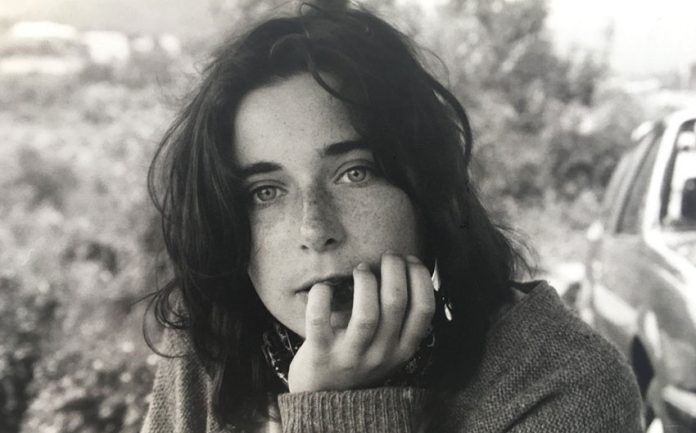
jo tuckman
Tuckman’s approach was always centered around her fascination with stories and the people behind them.

Last week saw the unfortunate death of Jo Tuckman, a journalist and Latin America correspondent for the U.K.’s Guardian newspaper, widely celebrated as a passionate and tenacious reporter whose writing signified a deep-seated love of Mexico.

Tuckman embodied a style of journalism that had been falling out of fashion over the past 20 years, one that is distinctly anthropological and that explores complex truth through personal stories. She leaves a posthumous legacy that provokes our ever-growing, reporting-by-number news conglomerates and that inspires a fresh belief in sensitive and immersive journalism.

Arriving in Mexico in 2000, Tuckman found herself reporting on some of the most politically tumultuous years of its existence, documenting the transition to democracy following 70 years of single-party rule. Those first years in the country went on to define her career as she continued to dissect complex political and social issues for a U.K. audience.

Some of Tuckman’s most notable contributions include stories about cartel violence, the expanding war on drugs, the persecution of fellow journalists, and the human rights abuses of indigenous peoples.

Jo Tuckman’s extraordinary ability as a reporter, however, was not limited to her bravery in confronting power, or even facing off criminals known for their violence toward journalists, but instead for the nuanced approach she adopted in her coverage. Tuckman’s approach was always centered around her fascination with stories and the people behind them, an inclination that many attribute to her background and education in complex social anthropology. The charm of her stories was always found in, and expanded out of, human interest, allowing her to find ways to engage readers in Mexico’s social and political happenings.

There was a recurring sensitivity throughout Tuckman’s work that allowed her to transition seamlessly from reporting on ruthless drug lords and untold violence to the unfortunate passing of Gabriel García Márquez, one of Latin America’s best loved authors, and his world-bending narratives of magical realism.

She could one day be confronting political corruption and embezzlement and the next, be exploring a recently discovered mammoth trap as evidence of prehistoric hunting methods. Genre-hopping journalism of this kind can be mind-numbingly jarring, inhibiting the sensitivity required to dissect and understand effectively the story at hand, but Tuckman constantly seemed to be energized by the diversity and irregularity of her work.

This energy that Tuckman brought to her reporting sets the standard for what foreign journalism in Mexico and Latin America should be, her expansive portfolio woven throughout with lessons about the complex responsibilities involved with the profession. At its core, Tuckman’s career in Mexico exemplifies the importance of connection to one’s country of reporting and a genuine love for its people.

Jon Bonfiglio, Latin America correspondent for TalkRadio, claims that “her coverage of abuses toward vulnerable Mexicans was angry, loud, always passionate. She wasn’t just reporting on Mexican society, she was a part of Mexican society.”

It was this intense relationship that gave her the profound motive and ability to help a foreign and disconnected readership interact with the Mexican struggle.

Far too often, foreign journalists deployed to areas experiencing complicated, and often destructive, political and social problems lack the incentive and understanding to portray the inhabitants with the nuance that their situation deserves. These are often country-hopping, career journalists that score points “back home” by standing in front of impoverished inhabitants, reporting on, and looking down at, corruption in democratic infancy, and generally helping the Anglo-Saxon reader feel a little happier about his situation.

Meaningful foreign correspondence never emerges from this hastily concocted formula, in fact, for real reportage that accurately distills truth across cultural boundaries. Foreign correspondence must become local correspondence. This is the legacy that Jo Tuckman leaves, a journalism that is invested, loved, nurtured. Tuckman never belittled Mexico because there were always stakes, risk, an understanding that to portray inaccurately the people of Mexico would fundamentally undermine her wide-eyed wonder and admiration of the place that had become her home.

Even when Tuckman fell ill and was told to return to the U.K. for medical care, her induction from foreign journalist to Mexican citizen led her to respond “no, this is my home.” She was accepted by Mexico and, importantly, had accepted Mexico herself; this is the cornerstone of avoiding reckless parachute journalism.

Perhaps, in one of her final stories, an interview with former Bolivian president Evo Morales who was embarking on his exile in the Mexican capital, she would have remembered her own first days in the country, and realized how far she had come.

Jack Gooderidge writes from Campeche.

Authorities seize 25,000 sea turtle eggs in Oaxaca

0
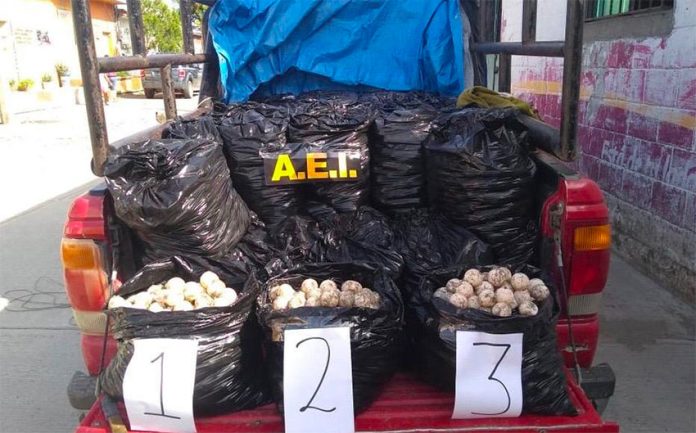
The truck and its cargo of eggs seized this week in Oaxaca.
The truck and its cargo of eggs seized this week in the Isthmus of Tehuantepec.

State police and the Oaxaca Attorney General’s Office have seized 25,000 sea turtle eggs in the Isthmus of Tehuantepec.

Attorney General Rubén Vasconcelos reported that a man was arrested with the eggs after blowing through a checkpoint on the Salina Cruz-La Ventosa highway on Wednesday afternoon.

The turtle eggs were stored in 50 black plastic garbage bags which were hidden under tarps in the back of a pickup truck.

The man tried to drive past the checkpoint without stopping, and when a chase ensued he abandoned the vehicle by the side of the road and attempted to flee into the brush where he was caught by authorities. 

Initial reports indicate that the turtle eggs were to be transported to Mexico City and sold to a buyer who authorities say is already being tracked. 

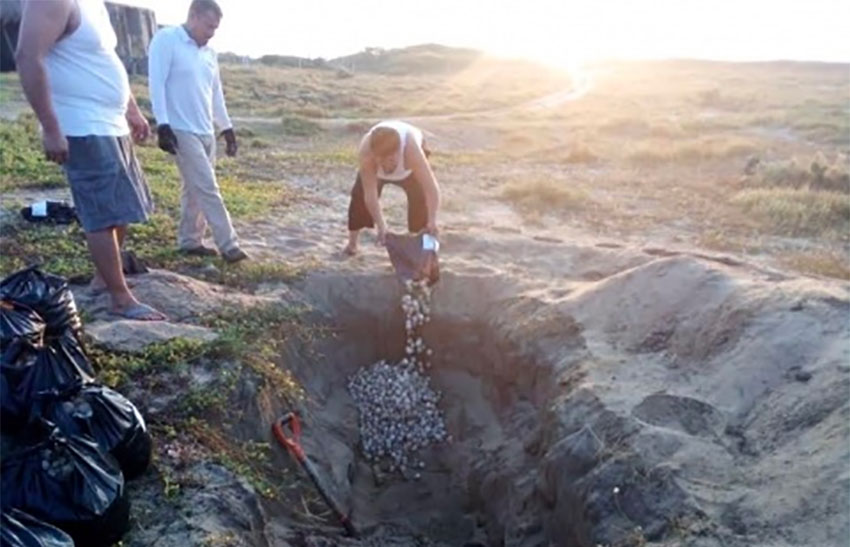
Turtle eggs are reburied on a Oaxaca beach.

Sea turtles and their eggs are endangered and heavily protected under Mexican law, and the trafficker could face a hefty fine of 300,000 pesos or around US $13,327 and up to nine years in prison for illegally collecting the eggs. 

Although the sale of turtle eggs has been banned since 1990, in some places it still occurs, especially in the area where the man was arrested, on Oaxaca’s Pacific coast. 

In Juchitán de Zaragoza, residents continue selling and eating turtle eggs and the government turns a blind eye as long as the commerce stays local.

The area is home to six of the world’s seven sea turtle species that come ashore to lay their eggs, most notably the olive ridley sea turtle which can grow to up to 70 kilos. The beaches at La Escobilla, Barra de la Cruz and Morro Ayuta are some of the world’s most important nesting sites for many species.

Turtle protection activists in the region say that the theft of turtle eggs has actually increased during the coronavirus pandemic. 

Sergio Ordaz, who runs a turtle protection program in Colotepec, Oaxaca, where nests are corralled off and monitored, says “the looting of turtle eggs has increased. The killings have returned; they take the turtles from the nesting pen.”

Profepa announced on July 1 that 2.28 million turtles had arrived on Oaxaca beaches during the 2019-2020 season.

Source: Milenio (sp), Excélsior (sp), El Universal (sp)

CORRECTION: The earlier version of this story said Profepa had monitored the laying of 2.28 million turtle eggs. In fact, that was the number of turtles that arrived during the season.

CDMX plans massive coronavirus testing; goal is 3,500 per day

0

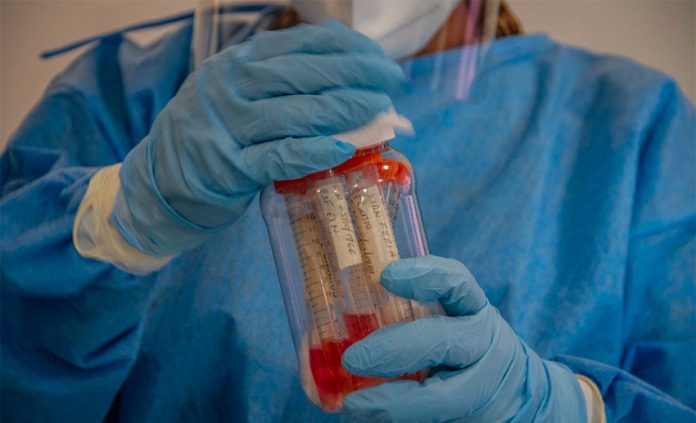
Covid-19 testing is set to ramp up considerably in Mexico City, the country’s coronavirus epicenter.

The city government has signed collaboration agreements with the national institutes of Medical Science and Nutrition, Respiratory Diseases and Genomic Medicine that will allow a total of 3,500 tests to be performed and processed every day.

As a result of the agreements, waiting times for test results will be reduced from seven days to just three.

Eduardo Clark, a director at the government’s Digital Agency for Public Innovation, told the newspaper El Universal that at the start of the coronavirus pandemic, the Mexico City Health Ministry was performing between 800 and 1,000 tests per day.

However, testing rates declined to about 650 people per day at the beginning of April, he said.

Under the new agreements, the government will pay for the testing kits while the national health institutes will pay the costs of carrying them out, Clark said.

The Institute of Epidemiological Diagnosis and Reference and a Mexico City government-run laboratory will also continue to perform and process coronavirus tests, he said.

The city has recorded more than 60,000 confirmed coronavirus cases since the start of the pandemic but low testing rates mean the real number of people who have been infected is almost certainly much higher.

The capital has also recorded more than 8,000 Covid-19 fatalities, according to official data.

“Orange light” high risk coronavirus restrictions currently apply in Mexico City but authorities have designated 34 areas of the capital as “red light” zones due to their high number of cases.

Source: El Universal (sp) 

Government passes the hat; civil servants asked to donate part of salary

0
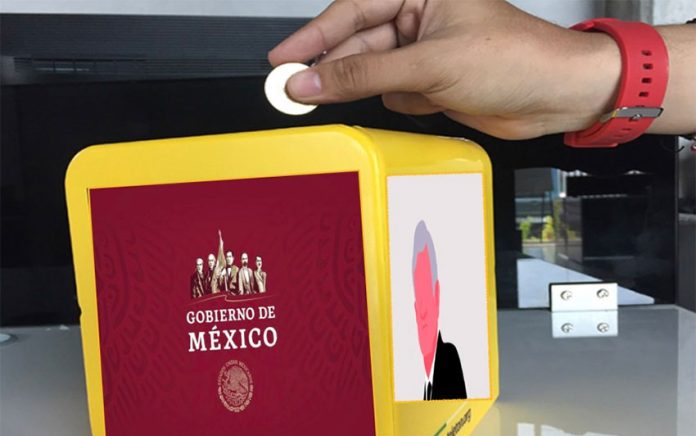
Donations welcome.
Donations welcome.

The federal government is passing the hat among senior civil servants and officials to collect funds to help cover the costs of responding to the coronavirus crisis.

As of Thursday, high-ranking officials are being encouraged to donate part of their salary back to the government in line with President López Obrador’s austerity push.

A Finance Ministry letter seen by the newspaper El Financiero says the “voluntary contributions” to public coffers that officials are being encouraged to make would comply with a presidential decree on austerity issued on April 23.

“In a voluntary way, the salaries of high-ranking public officials will be reduced by up to 25%,” the decree said, adding that larger contributions should be made by those who earn more.

López Obrador, who earns a net monthly salary of 111,990 pesos (just under US $5,000), should donate one-quarter of his wage to the government, according to the decree.

Therefore, to set the example he wants other officials to follow, the president will have to forsake some 28,000 pesos for the good of the country, whose economy is in dire straits as a result of the pandemic and the associated restrictions.

Cabinet ministers should donate 23% of their salaries, according to the decree, while deputy ministers and other officials of a similar rank should relinquish 21% of their take-home pay.

Lower ranking officials down to the level of deputy department director are being encouraged to return between 5% and 19% of their salary to the government depending on the position they hold.

If officials decide that they are able to give part of their wages back to their employer, they can make an online transfer or alternatively make the payment at a bank with cash in hand.

López Obrador has made cutting costs a central aim of his administration, and frequently quips that “there can’t be a rich government with poor people.”

In April the president decreed that senior public servants would not be paid their annual, year-end bonus, but the government had to backtrack and opt for a voluntary contribution after experts in constitutional and labor law pronounced that the decree was illegal.

Among other cost-saving measures the president has adopted are flying commercial rather than in the presidential jet – which he put up for sale, living in the National Palace rather than the official presidential residence and largely foregoing personal security.

López Obrador has also refused to increase public debt to support the economy amid the coronavirus crisis, a stance that has put him at loggerheads with many business leaders.

Source: El Financiero (sp), Reforma (sp) 

Baja California lawmakers reject same-sex marriage

0
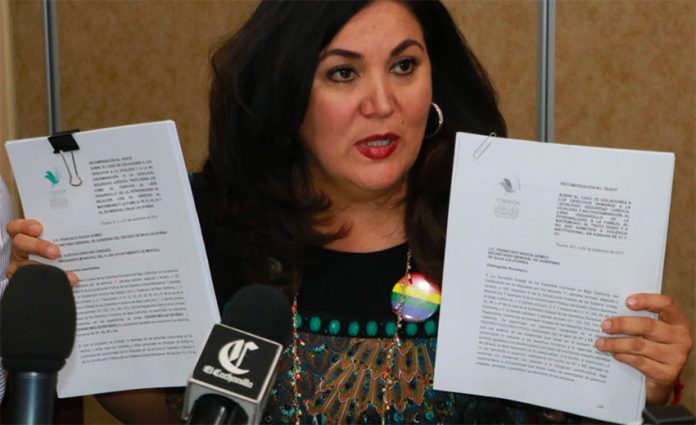
Deputy Miriam Cano, who proposed the bill, said threats were made against her.

Lawmakers in Baja California have rejected a bill to change the state’s constitution and allow the recognition of same-sex marriage. 

The initiative, presented by the Morena party, failed to get the two-thirds majority required to change the wording of the constitution, which currently defines marriage as between a man and a woman. 

Of the 25 votes cast, only 15 were in favor, with three against and seven abstentions. 

Those who abstained said they needed to explore the issue in more depth. 

“This is very sad. This is a sad day for our state’s history,” Deputy Montserrat Caballero said after the vote.

“People pay us to take a vote. To vote yes or no. Not to worry about our seats and abstain from voting,” she said.

The bill caused a confrontation between the state’s LGBT+ advocacy community and pro-life groups who waited outside Congress in Mexicali to see if the 2010 constitutional amendment which defined marriage exclusively as the union between a man and a woman would be overturned. 

The proposed law will be returned to the governance commission at a later date for further discussion. Last year a similar proposal was tabled after outrage from conservative groups. 

Same-sex marriage has been legal in Mexico since 2015, after a Supreme Court ruling that enabled couples to get an injunction in federal court against state laws prohibiting their union. 

However, the process can be lengthy and first requires couples to file for a marriage license and be rejected before suing in federal court. 

LGBT+ advocates say the process is unfair because it forces same-sex couples to spend significantly more time and money navigating the legal process to get married than heterosexual couples face.

Several states in Mexico have already legalized same-sex marriage.

Opponents such as conservative religious organizations like the National Front for the Family gathered some 27,000 signatures opposing the failed bill. They claimed it would damage families, which are formed with the goal of procreation. 

“As parents, we appreciate that the legislators have listened to us since the legalization of marriage equality was just going to be the beginning of actions that seem unfair to us for our children, like transgender bathrooms in schools,” said Marcela Vaquera, a spokeswoman for the National Front for the Family.

The bill was introduced by Ensenada legislator Miriam Cano, who expressed disappointment that the measure failed. 

Cano said she put the bill forward at the request of the community and upon recommendations by the National Human Rights Commission.  Cano reports her support for same-sex rights has led to threats of violence and death. “They wish my children would die and be crushed, burned and dismembered,” she said. 

Same-sex marriage advocates vowed that the fight for equality would continue.

Source: La Jornada (sp), San Diego Union Tribune (en)

Photographer captures comet Neowise from Cancún

0
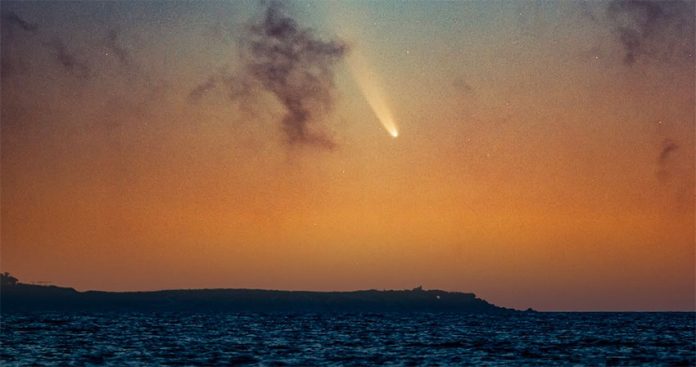
The comet Neowise over Isla Mujeres on Tuesday.
The comet Neowise over Isla Mujeres on Tuesday. roberto fernández

A Mexican photographer took a photograph of the comet Neowise that has been shared on social media by the United States National Aeronautics and Space Administration (NASA).

Roberto Fernández rose before dawn for five days in a row trying to capture the comet’s image, which he finally did on Tuesday, photographing the celestial body over Isla Mujeres in Quintana Roo. 

“Happy, happy, happy today,” Fernández wrote on his Twitter account after learning that NASA had shared his photo. “The image was captured in Cancún and you can see the southern tip of Isla Mujeres. If you look carefully, you can see the temple of the goddess Ixchel.”

The comet is visible to the naked eye in dark skies with little or no light pollution, but binoculars are needed to see the tail, NASA said.

Comet Neowise passed through Mercury’s orbit just over a week ago. Its proximity to the sun caused dust and gas to burn on its surface and created a long tail of debris.

NASA’s Neowise Infrared Space Telescope discovered the comet in March, but it will be visible throughout the Northern Hemisphere until mid-August when it will again head toward the outer zone of the solar system.

It will be about 7,000 years before the comet returns, “so I wouldn’t suggest waiting until the next time it happens,” said Joe Masiero, deputy principal investigator at NASA’s jet propulsion laboratory in Pasadena, California.

The comet will be closest to Earth on July 23 when it will be 103 million kilometers away. It is visible in the northeastern part of the sky in predawn hours, and in the northwest just under Ursa Major about 45 minutes after sunset. 

“What you want to do is go out right around the time that the first stars start to show up. You’re not going to be able to see it before that,” Masiero said. “It’s probably about as bright as some of the stars in the Big Dipper.”

Neowise was discovered on March 27, 2020, and was named for the telescope through which it was first viewed. It is the brightest comet visible from earth since Hale-Bopp in 1997.

The comet has been photographed in the United States, France, Croatia, Switzerland, Canada and twice in Mexico, in Zacatecas and Cancún.

Source: Infobae (sp), Sin Embargo (sp), Space (en)