Bioluminescent plankton was observed in the waves on an Acapulco beach for the first time in over 60 years on Monday night after the Covid-19 pandemic has kept people out of the water for nearly a month.
Photos and videos of waves shot through with streaks of neon blue on Puerto Marqués beach the night before went viral on social media early Tuesday morning. Some excited residents even took the opportunity to splash around in the unusually glowing waters.
Although the phenomenon may seem rare, biologist Enrique Ayala Duval said that the phytoplankton that cause it are actually more prevalent than their fear of human activity may have people believe.
“Marine bacteria are the most abundant of the bioluminescent organisms,” he said, adding that they can live independently or symbiotically on the surfaces, in the cavities or digestive tracts of other marine animals.
Some residents of Acapulco were lucky enough to see a whale surface in the main bay on the very first day of quarantine, and Monday night’s event was another example of the natural world’s propensity to retake the spaces humans have left empty during the Covid-19 pandemic.
Some who tweeted about the phytoplankton lamented the influence that human activity has on the natural world.
“The bad part is that human beings will always be there to ruin everything,” said one Twitter user who posted a video of someone riding a flyboard in the luminescent waves.
The absence of people on the beach in Oaxaca brought out crocodiles earlier this month. The reptiles usually spend their days hidden away in the waters of the lagoon at La Ventanilla, but were spotted roaming the beach.
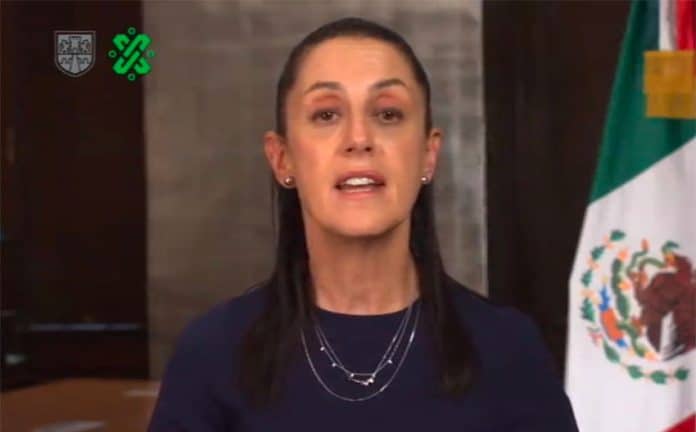
Mayor Sheinbaum announces Covid-19 phase three measures.
With Mexico entering into phase three of the coronavirus pandemic, and with Mexico City being a hot spot for contagion, Mayor Claudia Sheinbaum announced new measures to help flatten the curve in a video circulated on social media Tuesday night.
Beginning Thursday, around 20% of Mexico City’s 195 Metro, bus and light rail stations will close.By closing some of the least busy stations, the mayor hopes to ease crowding at busier stations by increasing the frequency of trains and buses.
The city’s Metro system serves around 1.7 billion passengers a year and is the ninth-largest urban transportation system in the world. On a normal day, that translates to around 5 million riders, although stay-at-home measures due to the coronavirus have already reduced that number to around 890,000 per day.
Other new measures in the capital include implementing the “Hoy No Circula” — “no-drive day” — program for all residents, although taxi drivers, truckers, people with disabilities and medical and health care workers will be exempt.
Metro stations and other public spaces are slated for increased sanitary measures, and nonessential businesses that remain open will be sanctioned, the mayor announced.
Sheinbaum promised that her government would not implement a curfew, nor fine people who venture out of their homes. She instead appealed to citizens’ sense of responsibility and applauded “those who have stayed at home, those who respect social distancing and those who wear masks on public transit. This has been very important, but in phase three we need to redouble our efforts. We are going to beat the pandemic, but we all have to participate,” she said.
Mexico is now in the most critical phase of the coronavirus pandemic but lacks at least 10,000 ventilators to respond to it adequately, according to an academic at Mexico City’s Metropolitan Autonomous University (UAM).
The federal government declared the commencement of phase three of the pandemic on Tuesday, acknowledging that the number of Covid-19 cases and patients requiring hospitalization is likely to increase rapidly in the coming weeks.
President López Obrador said Sunday that public hospitals will have a total of 13,000 ventilators available for the treatment of coronavirus patients, highlighting that China and the United States have agreed to sell Mexico almost 2,500 of the machines.
However, as things stand, the country only has 5,200 ventilators, says Joaquín Azpiroz Leehan, a biomedical engineering professor at UAM. “At least another 10,000 are needed,” he told the newspaper Milenio.
“According to data from the Health Ministry,” Azpiroz added, Mexico has one ventilator per 22,813 residents whereas Canada has one for every 12,000 people and has “already declared a crisis.”
Ventilators are a key piece of equipment in the treatment of Covid-19 patients.
“That shows the level of scarcity in our country,” he said.
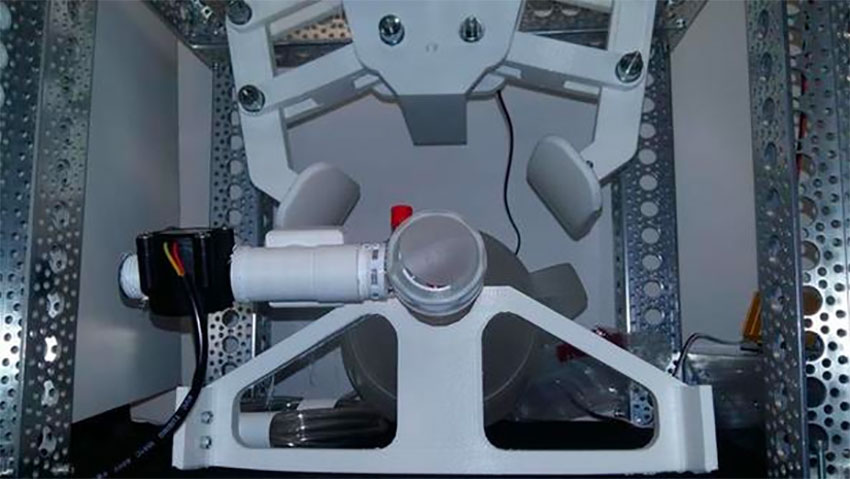
While the government waits for ventilators deliveries from China and the United States that are expected to commence this week, universities and private companies are moving ahead with their own plans to manufacture the vital medical machines.
Researchers at UAM and the National Autonomous University are currently collaborating on the design of a ventilator and expect to have the first 1,000 made by June or July, Milenio reported. The researchers are seeking agreements with companies including Ford and Mabe to manufacture at least 10,000 units.
Thirty-five private companies have already committed to contributing to a project that intends to manufacture 15,000 ventilators to treat coronavirus patients, Enoch Castellanos, president of the National Chamber for Industrial Transformation, said earlier this month, while the National Council of Science and Technology has indicated that it has the capacity to produce up to 500 ventilators per week.
However, as the new coronavirus spreads rapidly in many parts of the country and with hospital admissions expected to increase sharply in May, everyone involved in the manufacture and acquisition of ventilators will be racing against the clock.
It remains to be seen whether Mexico will ultimately have enough of the machines to treat critically-ill Covid-19 patients – as López Obrador has promised – or whether it will face the same shortages as other countries that have had large outbreaks of the disease.
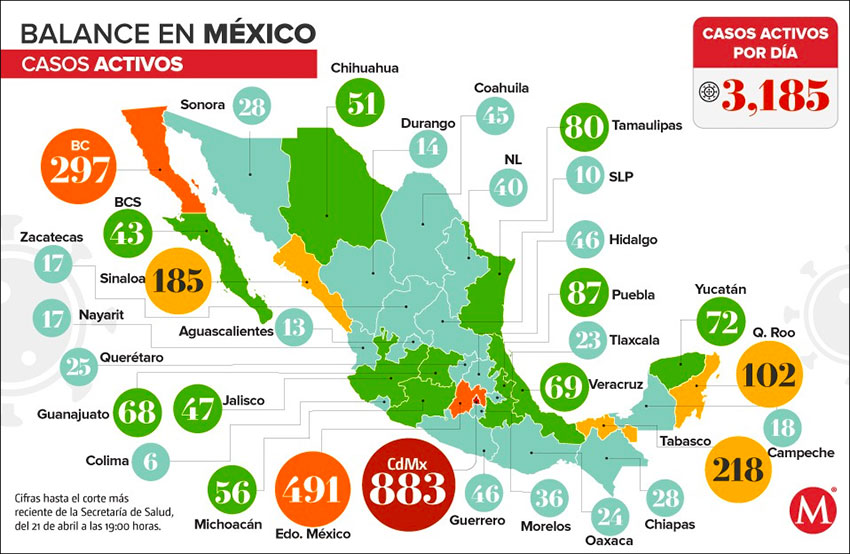
Map of active coronavirus cases. In such cases victims show symptoms and are still considered contagious.
The government’s General Health Council has already published a guide, suggesting that younger Covid-19 patients who need critical care should be prioritized over seniors when medical resources such as ventilators are limited.
Some hospitals in Mexico, including public facilities in Mexico City and Tijuana, are already being stretched to the limit as the number of people requiring medical treatment for Covid-19 continues to increase.
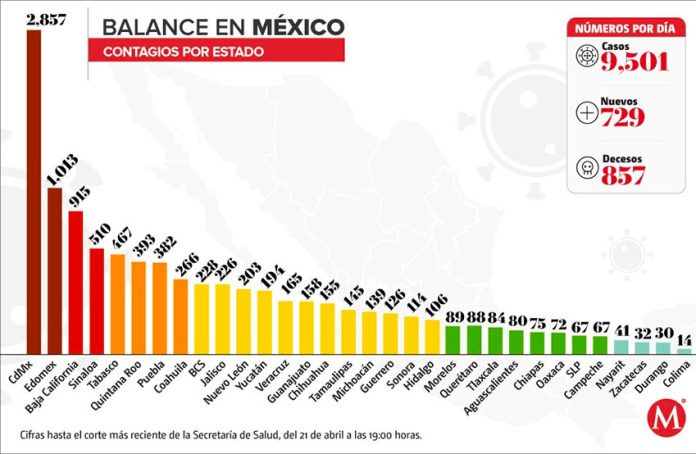
Health Ministry Director of Epidemiology José Luis Alomía reported on Tuesday that the death toll from the disease had increased to 857 from 712 on Monday. The 145 new fatalities represent the biggest single-day increase in the death toll since the first Covid-19 patient died on March 18.
Alomía also said that the number of confirmed coronavirus cases had increased by 729 to 9,501. Just under 3,200 cases are currently considered to be active, he said. There are also more than 8,000 suspected cases of the disease across the country.
Just over 37% of people confirmed to have Covid-19 have required hospitalization, a figure that has increased sharply since the end of March when only about 10% of those infected had needed hospital care. More than two-thirds of those who have died after contracting Covid-19 have been men.
Mexico City continues to be the worst-affected entity in the country with 2,857 confirmed cases and 224 deaths. México state ranks second for cases with just over 1,000 while Baja California is second for deaths with 100.
Every state in the country has recorded at least two coronavirus fatalities with more than 50 deaths reported in each of México state, Tabasco, Puebla and Sinaloa.
At the municipal level, Tijuana has recorded the highest number of deaths with 66 followed by Gustavo A. Madero in Mexico City and Culiacán, Sinaloa, where 44 and 36 people, respectively, have lost their lives to the disease, which has now infected almost 2.6 million people around the world and killed just under 180,000, according to official counts.
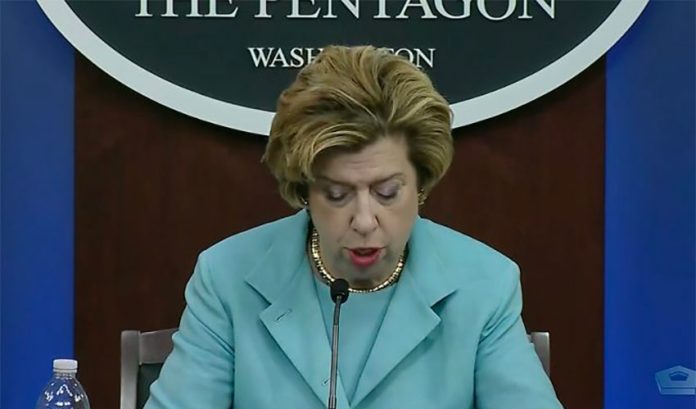
Ellen Lord: the companies are important for US airframe production.
The United States government is urging Mexico to allow the reopening of certain factories that were closed due to the coronavirus pandemic.
The supply chain for defense manufacturers in the United States, especially those in the aircraft sector, has been disrupted because the Mexican government didn’t classify factories in the aerospace and defense sectors as essential when it declared a health emergency at the end of March.
Ellen Lord, U.S. Undersecretary of Defense for Acquisition and Sustainment, told reporters at the Pentagon on Monday that she had discussed the problem with U.S. ambassador to Mexico, Christopher Landau.
She also said that she was planning to write Foreign Affairs Minister Marcelo Ebrard to ask that he “help reopen international suppliers” in Mexico.
“These companies are especially important for our U.S. airframe production,” Lord said. “Mexico right now is somewhat problematical for us but we’re working through our embassy.”
Among the companies that have factories in Mexico and supply aerospace products to the United States are General Electric, Honeywell, Lockheed Martin and Eurocopter.
Aerospace exports from Mexico have increased exponentially over the last 15 years from US $1.3 billion in 2004 to $9.6 billion in 2019, according to the Mexican Federation of Aerospace Industries (FEMIA).
Luis Lizcano, the federation’s general director, told the website Defense News that Mexico is in the top 10 overseas suppliers to the U.S. aerospace and defense sector. A broad range of products including avionics, landing gear and fuselages are manufactured here, he said.
Lizcano said that FEMIA is arguing publicly that the government should classify Mexico’s aerospace and defense sector as essential to bring it into line with the same industries in the United States and Canada.
“What we’re asking is that we standardize in this sector because we’re going to break with supply chains … for commercial and defense aircraft,” he said.
For his part, Ambassador Landau said in a Twitter post on Tuesday that he is doing all he can “to save” the decades-old supply chains between Mexico, the United States and Canada.
“It’s possible and essential to look after the health of workers without destroying those chains. The economic integration of North America requires coordination,” he wrote.
His post triggered a critical response from some Twitter users, prompting Landau to defend it in a series of additional tweets.
“Human life must be protected without destroying the economy. That’s the conversation we need [to have]. There is risk everywhere but we don’t all stay at home out of fear that we’re going to crash our cars. Economic destruction also threatens health,” Landau said in one tweet.
“Of course health comes first but I think that it’s shortsighted to suggest the economic effects don’t matter,” he wrote.
“We have to protect [people’s] health without destroying the economy. It’s not impossible. … I’m here to look for win-win solutions. On both sides of the border, investment = employment = prosperity.”
Among the Twitter users who criticized the ambassador’s suggestion that factory workers should return to their jobs amid the coronavirus pandemic was the novelist and journalist Francisco Goldman.
“Ambassador MAGA [Make America Great Again], shame on you,” he tweeted to Landau.
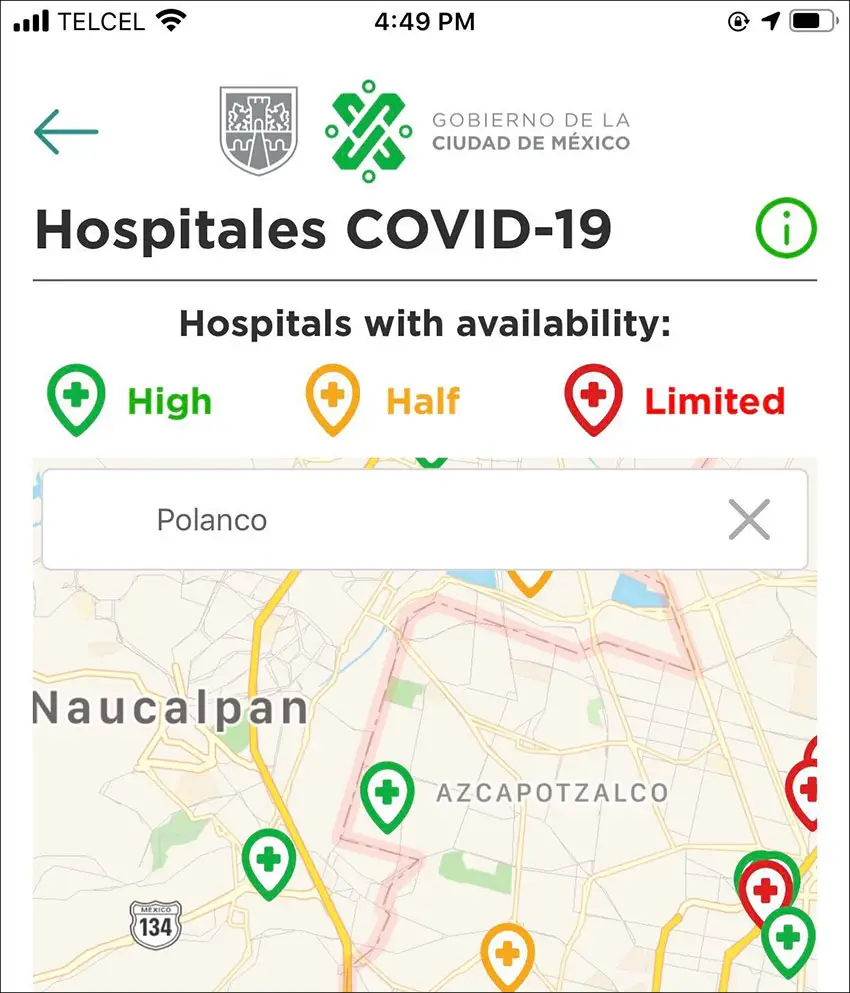
As the country braces itself for the worst of the Covid-19 outbreak in the coming weeks, the Mexico City government has added a section to its app that informs users of hospital locations and real-time conditions.
By keeping citizens informed of hospital activity, authorities in the capital and México state hope to avoid panic and hospital saturation.
The App CDMX is available for both Apple and Android phones. Those who already have it downloaded should update it to make sure that the new hospital feature is working properly.
In the Hospitals section, users can get access to the GPS location of the hospital treating Covid-19 patients nearest to them, as well as its current availability, listed as either high, medium or low.
But the app isn’t the only place for citizens to find hospital information. The interactive map can also be found on the city’s website.
The city has also set up a text messaging system to provide support to those who fear they may be infected. By texting “covid19” to the toll-free number 51515, possible victims can receive a questionnaire to evaluate their case and see if they need further attention for the disease.
The questionnaire can also be downloaded here — and is available in English, as well — or requested via a direct message to the city’s Facebook account.
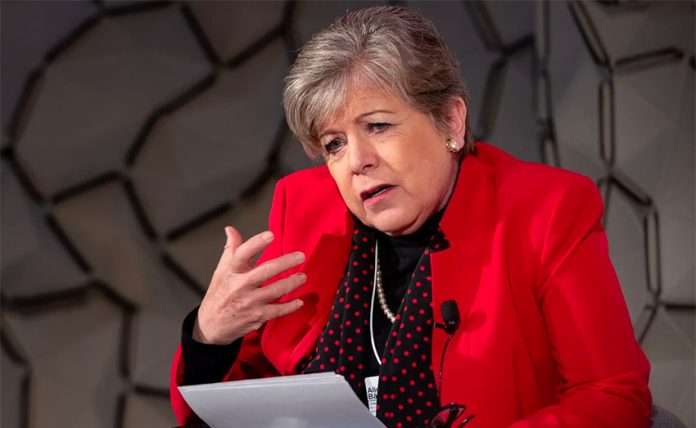
ECLAC's Bárcena: a sharp increase in unemployment is forecast.
The United Nations Economic Commission for Latin America and the Caribbean (ECLAC) and the financial institution Citibanamex have both downgraded their forecasts for the Mexican economy this year as the coronavirus pandemic worsens.
ECLAC executive secretary Alicia Bárcena said on Tuesday that the commission is predicting that GDP will shrink by 6.5% in Mexico this year. The commission forecast on April 3 that the contraction would be between 3.8% and 6%.
ECLAC is predicting that the coronavirus pandemic will cause GDP across Latin America and the Caribbean to fall by 5.3%, which would be the biggest recession the region has ever suffered.
In 1914, the first year of World War I, GDP declined by 4.9% while in 1930, the first full year of the Great Depression, the region’s economy contracted by 5%.
“A sharp increase in unemployment is forecast, with negative effects on poverty and inequality,” Bárcena said.
ECLAC said in a press release that Mexico will suffer the impact of a deceleration in the United States’ economy in 2020 and be hit by the decline in oil prices.
Meanwhile, Citibanamax is now predicting that the Mexican economy will shrink by 9% this year. Its previous forecast was a 5.1% contraction.
The bank said that without fiscal support from the government, the economy could contract by as much as 10.5% as a result of the coronavirus pandemic and the measures put in place to limit the spread of the disease. However, Citibanamex predicted that the severity of the recession will force the government to change its attitude on the provision of fiscal support.
In addition to its bleak growth outlook, Citibanamex estimated that exports will decline 18% this year, personal consumption will fall 11.5% and investment will drop 19.7%.
It also predicted that the economic contraction will push down inflation to a year-end rate of 3% from 3.4% at the end of 2019.
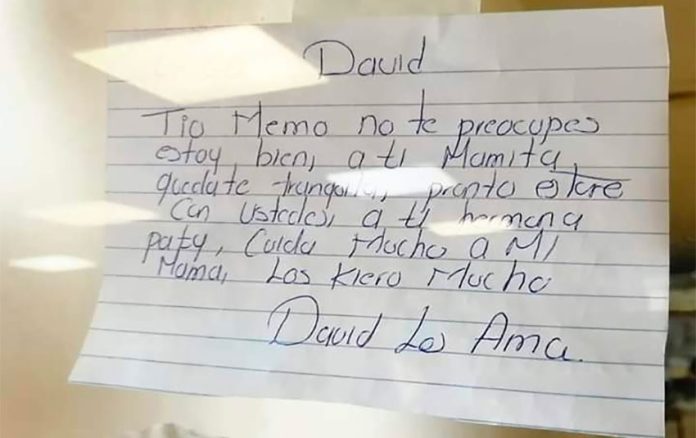
A note from David to his family outside the hospital where he is a Covid-19 patient.
Coronavirus patients at a government hospital in Mexico City are finding ways to communicate with their loved ones despite being in isolation, the newspaper Milenio reports.
Their messages, ranging from the practical to the sentimental, are transcribed by doctors and nurses on a piece of paper and then taped to windows of the hospital’s first floor. There, social workers take photos of the messages and share them with the patients’ families, many of which wait outside the hospital each day, hoping for information or the possibility of a visit.
One patient, Maribel, reminded relatives to feed the dog, pay credit card and utility bills and put gas in the car. She also told her family she loves them and regrets not being able to say goodbye because everything happened so fast.
Francisco López was admitted to the hospital 10 days ago with atypical pneumonia. His son, Jorge, does not know if he has been diagnosed with the coronavirus, but through messages, they are told he is stable. “I only know that he is alive because of the message the nurse gave me,” Jorge says.
In the message, Francisco tells his children he loves them, and not to worry because he has “been through worse.”
“We answered the message, on a little paper note that goes inside a plastic bag,” Jorge said. “We told him that we are here, that we miss him. We also sent him a bottle of water.”
María García also communicates with her husband Julián through daily messages and sends care packages containing soap, towels, sandals and shampoo. She includes notes telling him she loves him and that he will be able to come home soon.
But still, she’s anxious and wants to see him, arriving at the hospital every afternoon hoping one of the police officers guarding the door will let her in. It hasn’t happened. “They don’t want us to risk getting sick, too,” she concedes.
Currently, Mexico is in phase three of the pandemic, with 8,261 cases of the coronavirus and 686 deaths.
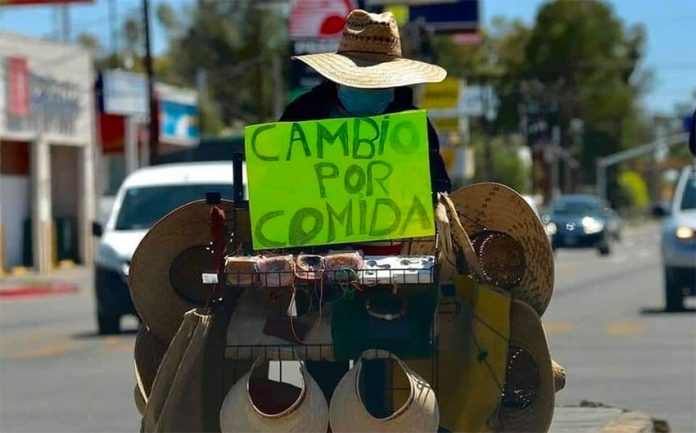
'Exchange for food,' reads street vendor Margarita's sign in Los Cabos.
Without tourists to sustain the normally thriving informal economy in Baja California Sur, street vendors in Los Cabos have resorted to bartering directly for food in order to survive.
Such vendors commonly earn just enough for them and their families to get by day to day and do not have the option to wait out the Covid-19 pandemic in home isolation.
“I need food in order to feed my children, that’s why I’m exchanging my hats for food,” said Margarita, a street vendor originally from Tlaxiaco, Oaxaca. She supports her family by selling woven sunhats from Oaxaca, Guerrero and Puebla.
But sales dropped to zero after the coronavirus pandemic similarly tanked the local tourist economy.
Having had little success bartering her hats, Margarita said that she, her husband and their four children are currently getting by thanks to the charity of people who want to help.
“Really, I’m not gonna wear the hat, but out of solidarity I exchanged a few stewed dishes for two of her hats. It’s preferable to her having to turn to crime,” said a woman who traded with Margarita.
The immediate future does not look bright for Margarita or anyone else in the state who depends on visitors to make a living. State Tourism Minister Luis Humberto Araiza López said he expects the pandemic to cost the region tens of billions of pesos in revenue.
“… we’re expecting a 10-point loss in the tourism gross domestic product at the national level, in Baja California Sur this will mean a drop of 20 billion pesos (US $819 million),” he said, adding that the loss at the national level is expected to total around US $10 billion.
The vendors in Los Cabos aren’t the only ones in the country who have had to adapt to the caprice of the Covid-19 pandemic. Street merchants from Acapulco to Cuernavaca to Mazatlán have been changing out their normal products for face masks in order to meet demand and be able to get by.
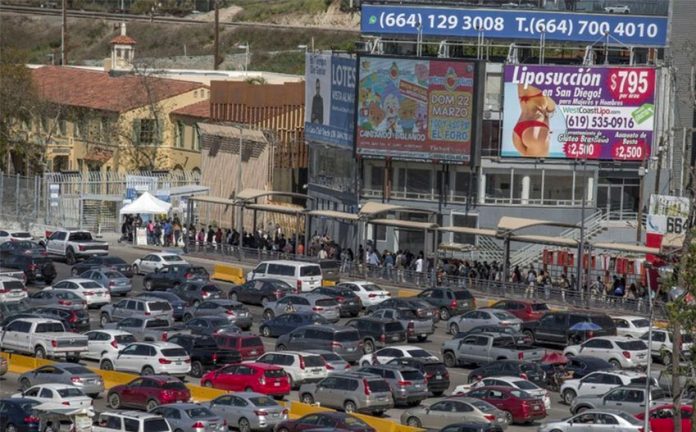
Baja California has requested that the federal government install health screening checkpoints at the state’s international border crossings in order to detect possible cases of Covid-19 coming into Mexico.
State Congress president Luis Moreno asked federal Foreign Affairs Minister Marcelo Ebrard to install screening checkpoints on the border to locate and isolate people “who continue to import the virus to Baja California border towns.”
State Health Minister Alonso Pérez Rico said that the virus was brought to the state by people entering from its neighbor to the north.
“We have detected cases [imported] from the United States of people who cross the border into Baja California after testing positive for Covid-19 in order to be treated in the state’s health centers, because they don’t have health insurance in their country or because of the high cost of treatment in California,” said Pérez.
Baja California authorities said the decision by the federal Health Ministry not to set up border control mechanisms in recent weeks has allowed many patients to enter the state, despite U.S. restrictions on Mexicans entering the country during the pandemic.
The pandemic has significantly decreased transborder traffic, where some media reports have cited crossings as much as 70-90% lower than normal. But considering that the Tijuana-San Ysidro crossing is the world’s busiest, there are still many opportunities for the virus to cross into Baja California.
Pérez and other officials fear that the situation could cause a resurgence of the outbreak in the state, which currently occupies third place in the number of confirmed cases in the country.
Baja California authorities closed the state’s beaches in late March to prevent the spread of the virus, but the lack of controls at the border appears to have fueled the outbreak, especially in Tijuana.
The Guerrero family that was prevented from returning to their home.
With more than 220 communities across 10 states in Mexico closing their borders to outsiders due to fear of the coronavirus, even some returning residents are being turned away.
Such was the case for a woman in Guerrero who traveled from her hometown of Marquelia to seek medical treatment for her infant daughter in Mexico City and was not allowed to return home.
Lizeth Ariana Camacho and her husband and three children left the town of about 12,000 in March because their 3-month-old daughter needed heart surgery in the nation’s capital, where rates of infection are more than four times higher than the national average.
The family was stopped at a coronavirus checkpoint upon trying to return to the town, where Ariana says they were treated like “dogs,” and asked to self-quarantine elsewhere for 14 days before they would be allowed to go home.
Ariana says she tried to reason with town officials, saying the hospital would have never released her baby daughter to the family if they were infected, but the townspeople weren’t budging on their decision.
They first took refuge in a school then, with all three kids and suitcases in tow, Camacho said via Facebook posts, the family was made to walk for more than an hour along the beach under the hot sun to reach a family member’s home which was under construction and had no electricity or clean water. Later, a woman who runs a hostel let them stay in one of her rooms and gave them food.
The president of Guerrero’s Human Rights Commission, Ramón Navarrete Magdaleno, said that his organization would be looking into the situation as a possible violation of the family’s human rights.
Guerrero currently has 129 positive cases of the coronavirus and 14 people have died.